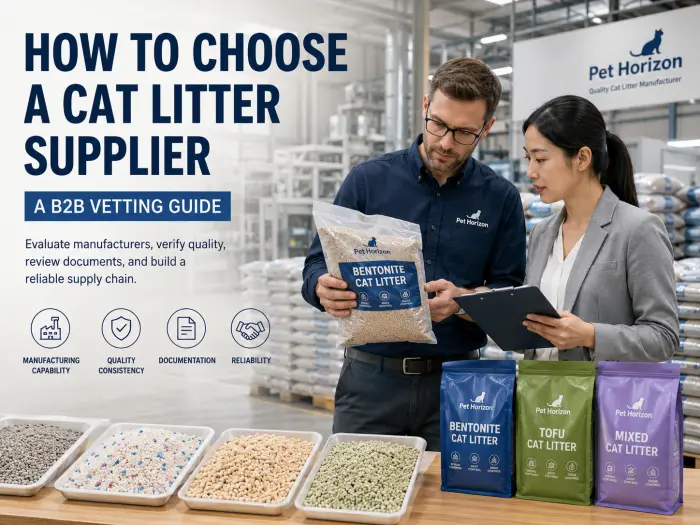


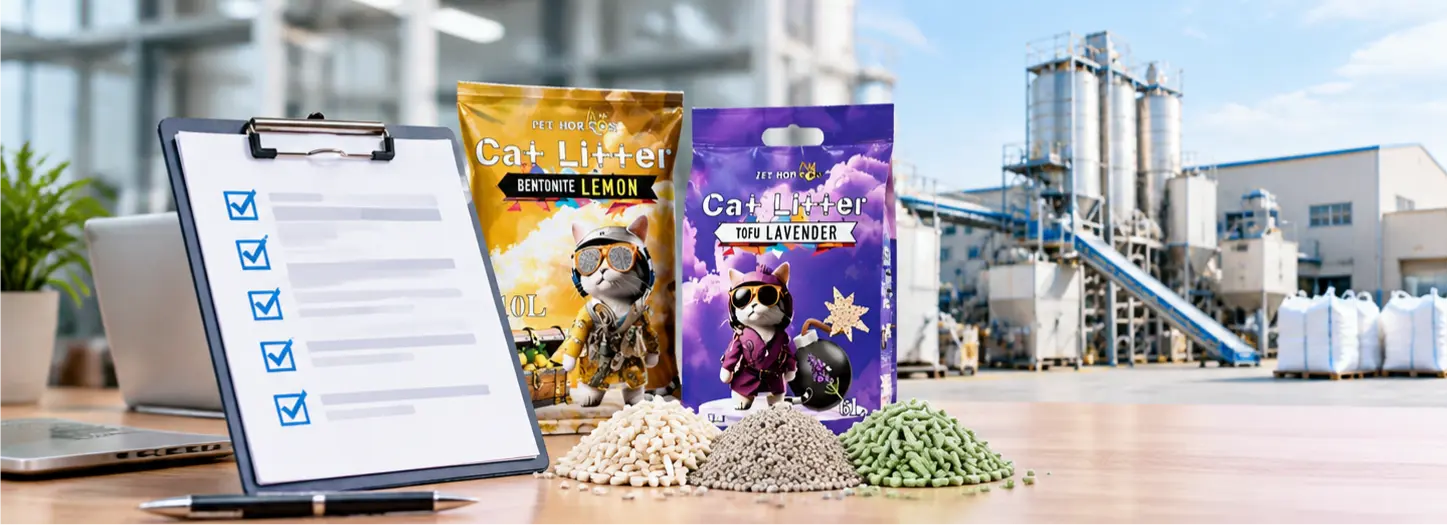
A cat litter factory audit is a structured verification process used by importers to evaluate a cat litter manufacturer before placing bulk orders. It reviews the supplier’s legal status, production capability, quality control system, export experience, and compliance documents. For buyers sourcing from China, where many global cat litter supply chains are concentrated, a supplier verification checklist helps reduce risks such as inconsistent quality, production delays, hidden subcontracting, and export compliance issues. This guide provides a practical audit framework for evaluating cat litter factories before starting an OEM, private label, or wholesale partnership.
Quick Answer: A cat litter factory audit verifies three things before ordering: whether the supplier is a legitimate manufacturer, whether its production and quality systems can meet your specifications, and whether required export documents are available. A complete audit combines document verification, factory inspection, product testing, and supplier capability review.
Why Importers Audit a Cat Litter Factory
An audit is not paperwork for its own sake. It protects an order against four common failures: inconsistent quality between samples and bulk shipments, undisclosed subcontracting, capacity shortfalls at peak season, and compliance gaps that block customs or retail acceptance. A cat litter factory audit turns a sales conversation into verifiable evidence about what a supplier can actually deliver.
Pre-Audit Document Checklist
Before any visit, request the documents below. They are easy to request and can reveal major supplier risks before production begins.
| Document | Why it matters |
|---|---|
| Business and export license | Confirms the supplier’s legal business status and export capability, and helps verify whether you are working with a manufacturer or trading partner |
| Social compliance or factory audit report (for example BSCI or SMETA/Sedex) | Shows labour and workplace standards have been assessed by a recognised scheme |
| Product test reports | Covers clumping, moisture, dust or fines, and any market-required safety screening |
| Safety data sheet (SDS/MSDS) | Required for silica or additive-containing litters and for freight classification |
| Quality system certificate (such as ISO) | Indicates documented process control; verify the certificate number and issuing body |
| Shipment references | Past export records and customer references let you confirm real delivery experience |
| Product specification sheet | Confirms particle size, moisture, absorption, dust level, packaging requirements, and agreed product standards |
| OEM or private label capability information | Confirms whether the supplier can support custom formulas, packaging, labeling, and production requirements |
Ask for the certificate number and the issuing body for every quality or compliance certificate, then verify it against the issuer’s database rather than accepting a PDF at face value.

On-Site Factory Audit Checklist
If you can visit, walk the following areas and record what you see:
- Raw material intake and storage: are clay, tofu residue, wood materials, additives, and other inputs identified, stored properly, and traceable to production batches?
- Production line: mixing, granulation or forming, drying, screening, and dust collection
- In-house quality control lab and the test methods used for routine checks
- Bagging and warehouse: packaging integrity, lot marking, and storage conditions
- Workplace and dust control: ventilation and protective measures reflect worker-safety discipline, which also correlates with process control

Factory Capability Verification Checklist
Beyond documents and the production floor, confirm the supplier can deliver at your required scale. Review monthly production capacity, key production equipment, backup production capability, minimum order quantity (MOQ), standard lead time, raw material supply stability, and peak-season capacity before committing to a large order.
Third-Party Audit and Certification Schemes
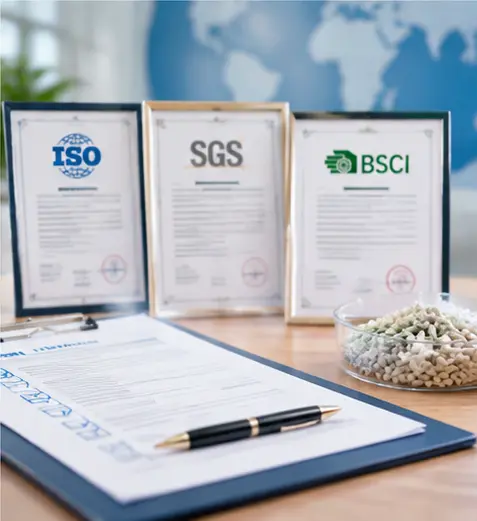
Many importers require social compliance assessments from recognised schemes such as BSCI or SMETA/Sedex, while product testing or inspection may be carried out by independent testing and inspection organizations such as SGS. The purpose is verification: confirm that reports are current, traceable, and issued for the correct legal entity. For broader import compliance context, the U.S. International Trade Administration publishes guidance importers can use to structure due diligence.
Product and Quality Verification
Auditing the factory is not enough; importers must verify that the actual cat litter product matches the approved specification. Depending on the litter type, define acceptance criteria for key parameters such as clumping performance, moisture content, absorption, dust level, particle size distribution, odor-control performance, and packaging requirements. For tofu, bentonite, pine, or other specialty litters, testing methods and acceptance limits should be agreed before mass production to ensure samples and bulk shipments remain consistent. A documented dust-free clumping cat litter shows what method-based acceptance looks like in practice.
Compliance Split: Supplier Versus Importer
A frequent source of disputes is assuming one party owns all compliance. Clarify the split in writing:
| Supplier responsibility | Importer responsibility |
|---|---|
| Legal manufacturing and export license | Destination-market product registration and any import permits |
| Product safety and accurate commercial documents | Destination-market labeling, language, and environmental or performance claims such as biodegradable, flushable, natural, or dust-free |
| Provide product information, packing details, and export documents to support HS classification | Tariffs, landed cost, and ISPM-15 compliance if wood packaging is used |
Note that tariff treatment depends on HS classification, which is composition-dependent for cat litter, and a low duty rate is not the same as a low landed cost once freight and handling are included. If wood pallets or crates are used, confirm ISPM-15 marking; most cat litter ships in bags on standard pallets, but verify if wood packaging appears in your supply chain.
Red Flags During Supplier Verification
- Unable to show a business license or a physical factory
- Vague or unverifiable certificates with no issuer or number
- Reluctance to share documents or grant a visit or video walkthrough
- No batch records or QC test logs
- A price far below market without a clear reason
- Pressure to abandon documented specifications
Remote Audit When You Cannot Visit
A remote cat litter factory audit is a practical option when international travel is difficult. Importers can request a live video walkthrough of raw material storage, production lines, QC areas, packaging operations, and warehouses. Combining video inspection, document review, third-party inspection, and independent product testing provides stronger verification than relying on supplier information alone.
Working With a Verified Manufacturer
Auditing is the gateway to a stable supply relationship. Once a supplier passes your cat litter factory audit, an OEM cat litter partnership can move from verification to repeatable production. Choosing a reliable cat litter manufacturer with stable quality systems is essential for long-term wholesale supply.
Conclusion
A cat litter factory audit is not a one-time formality but an ongoing verification discipline. Use the document checklist and an on-site or remote inspection to confirm capability and compliance, separate the supplier’s export duties from your import obligations, and verify every certificate before you commit. Importers who audit consistently import with fewer surprises and fewer costly disputes.
Frequently Asked Questions
It is a structured verification of a cat litter manufacturer covering legal status, production capability, quality control, and compliance documents, done before or during a sourcing relationship to reduce supply risk.
Request the business and export license, any social-compliance or factory audit report, product test reports, a safety data sheet where relevant, quality-system certificates, and shipment references, then verify each certificate against its issuer.
Yes. A remote audit uses a live video walkthrough, shared documents, a local third-party inspector, and independent laboratory sample testing, combining methods when an on-site visit is not possible.
Common schemes buyers request include BSCI or SMETA/Sedex for social compliance and bodies such as SGS for product verification, plus quality-system certificates; the key is verifying each certificate is current and issued to that legal entity.
Red flags include no verifiable license or factory, unverifiable certificates, refusal to share documents or allow inspection, absence of batch or QC records, and a price far below market without explanation.
Responsibilities split: the supplier handles legal manufacturing, export licensing, and product safety for export, while the importer handles destination registration, labeling law, tariffs, and any wood-packaging requirements such as ISPM-15.
Ask for the certificate number and issuing body, then check it against the issuer’s own verification database or request the original document, rather than relying on a supplied PDF.
A safety data sheet is typically required for silica or additive-containing litters and for freight classification; confirm the specific requirement with your freight forwarder and destination market.
The timeline depends on the audit depth, but importers should complete document verification, factory capability review, product testing, and specification confirmation before mass production. A proper supplier audit helps prevent quality disputes after shipment.
To verify a cat litter factory in China, review business registration information, export experience, production facilities, quality-control records, product specifications, and third-party inspection reports. A factory video audit or on-site visit can further confirm production capability.