

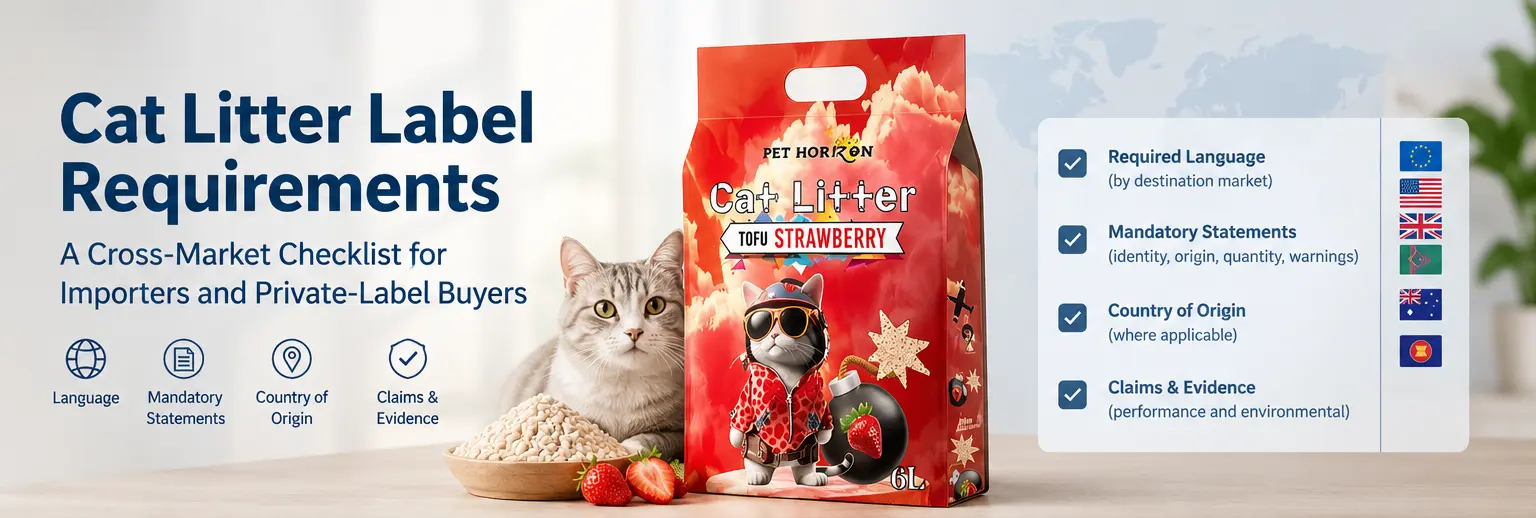
Cat litter label requirements vary sharply by destination market, and treating them as one global standard is a costly mistake for importers. A pouch cleared in one country can be flagged, delayed, or pulled in another for a missing language, mandatory statement, or unsubstantiated claim. This guide gives private-label and import buyers a practical, market-by-market checklist and a claims-substantiation framework to hand a supplier or compliance partner.
Cat litter label requirements vary by destination market; there is no single global label checklist for every SKU. Before printing, buyers should verify the applicable language, product identification, quantity marking, warnings, importer or responsible-business details where required, and evidence for every performance or environmental claim. The factory should provide accurate product specifications and supporting test data, while the importer or brand owner coordinates destination-market review and artwork approval. Legal responsibility depends on the applicable law and each party’s role, so responsibilities should be documented in the supply contract and confirmed with a qualified local adviser.
For an importer or private-label buyer, label approval starts with three questions: where will the cat litter be sold, what does the finished product contain, and what claims will appear on the package? These decisions affect the required language, applicable warnings, supporting documents, and final artwork. A label approved for one SKU or destination should not automatically be reused for another without checking the differences.
Why Cat Litter Has No Single Global Label Standard
Cat litter does not have one universal international retail-label template. Depending on the destination and formulation, the applicable rules may include general consumer-product safety, quantity marking, local-language requirements, chemical hazard communication, environmental marketing, packaging, and product-specific legislation.
The starting point is the actual SKU and its intended market—not simply the product name. A conventional tofu, bentonite, or pine cat litter may face a different compliance review from a formulation containing certain additives or carrying antimicrobial, disinfecting, or other regulated claims. Requirements can also differ between mandatory legal information and additional information requested by retailers or distributors.
For importers, the practical task is to identify which rules apply to the product, which label elements are mandatory, and which claims require evidence or additional authorization before the artwork is approved.
Dividing Label-Compliance Responsibilities
A practical OEM workflow separates product evidence from destination-market approval. The factory should provide an accurate SKU-level specification, including raw materials, particle-size range, moisture where relevant, clumping performance, dust-test results, additives, and supporting documentation for proposed claims.
The importer or brand owner should coordinate the destination-market review, confirm the required label information and language, approve the final artwork, and retain the relevant evidence. These are workflow responsibilities, not a universal statement of legal liability: the manufacturer’s, importer’s, distributor’s, and brand owner’s statutory duties depend on the applicable law and their respective roles.
For each SKU, document who supplies the technical data, who verifies the claims, who approves translations and artwork, and who authorizes the final print run. Contractual indemnities may allocate certain commercial risks between the parties, but they do not automatically remove statutory obligations.
A supplier statement is not a substitute for supporting evidence. For every quantitative or comparative claim, record the exact wording, test method, conditions, tested SKU or formula, and result. Qualifiers such as “typical” or “up to” should be used only when the underlying data supports them and the overall claim is not misleading.
Cat Litter Label Requirements by Destination Market
The checklist below is a screening tool for retail-packed cat litter, not a substitute for a country-specific legal review. Requirements depend on the destination, product formulation, packaging format, claims, and applicable product classification. Distinguish legally required label information from retailer requirements and recommended buyer practices.
| Market | Language to verify | Label fields and rules to check | Claims and market-specific risks |
|---|---|---|---|
| EU | Official language requirements in each destination Member State | Applicable quantity-marking rules, responsible economic operator information where required, chemical hazard information where applicable, and packaging obligations | Environmental claims, biocidal claims, substantiation, and PPWR obligations |
| UK | Applicable English-language expectations and any relevant national requirements | General product-safety duties, applicable importer or responsible-business information, quantity marking, and chemical hazard requirements where applicable | CMA Green Claims Code, misleading environmental claims, and unsupported performance statements |
| US | English is the practical default; verify any applicable state-specific rules | Federal and state requirements relevant to the product, applicable warnings, net quantity rules, and any chemical disclosure obligations triggered by the formulation or claims | FTC advertising rules, environmental claims, state-specific requirements, and EPA FIFRA implications for certain antimicrobial or pesticidal claims |
| Saudi Arabia and other GCC markets | Confirm Arabic and any bilingual-label requirements for the specific country and product classification | Applicable national or GCC technical regulations, importer details, origin information, quantity marking, and any required conformity or registration documentation | Do not assume one GCC-wide checklist applies to every country or cat litter SKU |
| Australia | Verify applicable consumer information and language requirements | Australian Consumer Law, applicable quantity and product-safety requirements, and any origin or disclosure obligations triggered by the product or its presentation | Environmental and performance claims must not mislead; check local wastewater guidance before making flushability claims |
| ASEAN | Verify requirements separately for each destination, such as Thailand, Vietnam, Indonesia, or Malaysia | Applicable national product classification, language rules, importer details, quantity marking, warnings, and any product-specific registration requirements | Consumer-protection, environmental-claim, and chemical requirements vary by country |
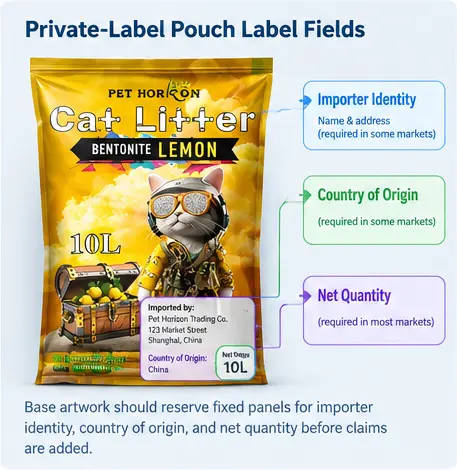
Before artwork approval, classify each proposed label element as legally required, conditionally required, retailer or buyer requested, or voluntary marketing content. Confirm the first two categories against current destination-market rules and obtain local advice where the requirements are unclear.
Cat Litter Label Claims: Evidence Buyers Should Request
Performance and environmental claims need evidence that supports the meaning a reasonable buyer or consumer would take from the wording. A supplier statement, a general material description, or a test conducted on a different formula may not adequately support a claim for the finished SKU.
The table below is a buyer-side evidence checklist, not a list of universal statutory testing requirements. The appropriate method depends on the claim, formulation, destination market, and applicable law.
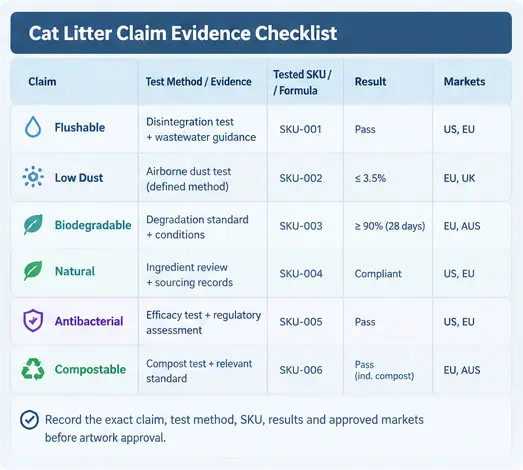
| Proposed claim | Evidence to request | Main risk to review |
|---|---|---|
| Flushable | Test data for the actual product, the defined test conditions, and documented review of relevant wastewater guidance | Passing a disintegration test does not establish that flushing is accepted or safe in every sewer system or municipality |
| Dust-free / low dust | A named dust-test method, test conditions, SKU-specific results, and a clear definition of the claim | “Dust-free” implies an absence of dust and may be harder to substantiate than a qualified comparative claim such as “low dust” |
| Biodegradable | Evidence relevant to the actual material, test environment, timeframe, and claimed extent of degradation | Results under one set of conditions do not prove degradation under every disposal condition |
| Natural | Formula and ingredient specifications, sourcing records where relevant, and a precise explanation of what “natural” means in the claim | The term can create a misleading overall impression if the composition or supporting explanation does not match the wording |
| Antibacterial / antimicrobial | Product-specific efficacy data and a regulatory assessment of the active substance, intended use, claim, and destination market | Certain claims may trigger biocide, pesticide, or other product-specific regulatory requirements |
| Compostable | Evidence for the finished product under the stated composting conditions, relevant standard or certification where applicable, and confirmation of the intended disposal route | Industrial compostability does not establish home compostability or local acceptance; material or packaging certification does not automatically certify the litter itself |
Before artwork approval, record the exact claim, the evidence supporting it, the applicable test method and conditions, the SKU or formula tested, and the markets in which the claim will be used. Where the evidence supports only a qualified claim, revise the wording rather than extending the conclusion beyond the test results.
EU Environmental Claims and Packaging Rules
EU cat litter labels can be affected by both consumer-protection rules and packaging legislation, but these are separate compliance questions.
Directive (EU) 2024/825 strengthens EU consumer-protection rules relating to misleading environmental claims and sustainability-related marketing. Member States were to transpose it by 27 March 2026, and it applies from 27 September 2026. Its application must be assessed alongside the relevant national transposition measures and the rules applicable to the specific claim.
Separately, Regulation (EU) 2025/40 on packaging and packaging waste (PPWR) has applied since 12 August 2026, subject to the regulation’s specific provisions, transitional arrangements, and implementation requirements. Importers and private-label buyers should review the packaging material, format, composition, applicable marking obligations, and relevant implementation timetable before approving new artwork.
Do not assume that every cat litter pouch requires the same recycling symbol or that a claim is compliant simply because it appears on packaging sold in another EU country. Check the applicable provisions and current official guidance for the specific packaging and market. For packaging-specific analysis, see our EU PPWR cat litter packaging compliance guide.
US Truth-in-Advertising and the FDA or AAFCO Boundary
In the United States, cat litter labels and marketing claims may be subject to the Federal Trade Commission Act’s prohibitions on deceptive practices, alongside any other applicable federal or state requirements. Environmental claims should be specific, accurate, and supported by appropriate evidence. The FTC’s Green Guides explain how businesses should approach claims such as “eco-friendly,” “biodegradable,” and “recyclable.”
A frequent error is to assume FDA or AAFCO regulates cat litter. The FDA does not regulate cat litter as a food or feed, and AAFCO’s model pet-food definitions and regulations are not a general cat-litter labeling standard. Buyers should not import a federal-approval claim, because it overstates US requirements.
Broad environmental claims such as “eco-friendly” or “green” can create a misleading overall impression when their meaning and supporting evidence are unclear. Prefer specific, verifiable statements that accurately describe the product or packaging attribute being claimed.
Certifications, Test Reports, and What They Actually Prove
Not every logo on a cat litter package represents a product certification, and none should be treated as a substitute for destination-market compliance.
- Social-compliance assessments: BSCI and SMETA are associated with supply-chain social-compliance assessment and auditing. Their presence should be verified against the actual facility, audit scope, and current records; they do not certify cat litter performance.
- Third-party testing: A laboratory report from SGS or another qualified testing provider can support a specific test result. Check the tested sample, method, date, laboratory scope, and whether the result applies to the formula being sold.
- Management-system certification: ISO 9001 relates to quality-management systems. It does not by itself establish that a cat litter SKU meets a particular safety, dust, clumping, or labeling requirement.
- Forest and packaging certifications: FSC or PEFC documentation may be relevant to eligible wood-based materials or packaging within the scope of the relevant scheme. It does not demonstrate that the litter itself is dust-free, compostable, or safe to flush.
For private-label buyers, request the underlying document rather than relying on a logo. Match each document to the correct factory, product, material, SKU, and claim, and verify that its scope supports the proposed use. Only display a mark when its owner, authorization, and applicable usage rules have been confirmed.
Practical Steps for Private-Label and Import Buyers
A workable process keeps the split-responsibility model clean:
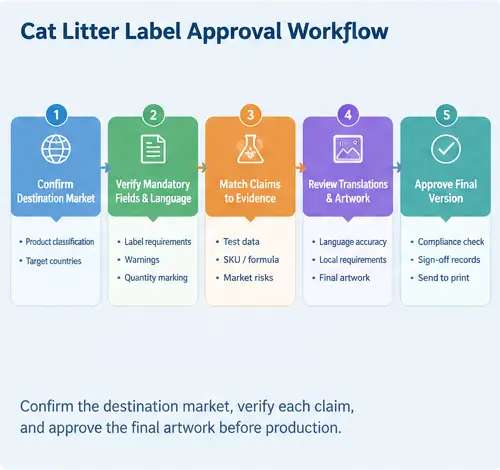
- Fix the destination market and its language rule before you brief the factory.
- Pull the mandatory statements for that market – identity, origin, net quantity, warnings.
- List every claim you want – flushable, low dust, natural, biodegradable – and assign each a test method and owner.
- Get supplier spec sheets and SKU-level test data; do not accept a single number as universal.
- Have local counsel or a customs broker review the artwork before print.
Recheck label compliance whenever the formula, packaging, destination market, or claim set changes, and monitor relevant regulatory updates. A periodic review of unchanged SKUs can also help identify outdated artwork or supporting documents, but the review frequency should reflect the product and market risks rather than being treated as a universal legal requirement.
What to Request from Your Cat Litter Manufacturer Before Printing
For a private-label order, request a current product specification for each SKU and confirm that the approved formula matches the product being manufactured. Depending on the product and the claims you intend to use, the document package may include:
- Raw-material and additive information relevant to the proposed label
- Particle-size, moisture, clumping, or dust-test data where applicable
- Supporting evidence for flushability, biodegradability, or other performance claims, if those claims will be used
- Applicable chemical safety information and test reports
- Final packaging specifications, approved translations, and the version of the artwork authorized for production
Not every document is mandatory for every cat litter product. The purpose is to match the evidence to the SKU, claim, and destination market before printing, rather than trying to resolve discrepancies after production or shipment.
For example, when evaluating bentonite cat litter for a private-label program, buyers can compare the agreed raw-material specification with the dust, particle-size, and clumping criteria required for their product. Confirm performance against the relevant SKU-level data rather than assuming that a material description alone guarantees the finished product’s results.
For a private-label program serving several markets, standardize the base artwork and maintain separate, approved market-specific versions for languages and mandatory information. This helps reduce avoidable artwork changes and the risk of using the wrong version for a shipment. Our private-label cat litter page explains the OEM program, while the cat litter import shipping guide covers import and shipment planning. If the formula contains fragrances, colorants, or other additives—or if the label makes antimicrobial claims—review the applicable ingredient, chemical, and claims requirements before approving the final pack.
Conclusion
Cat litter label requirements are market-specific by nature: general prepackaged-goods rules plus claims-substantiation duties, with no single global law. The factory should provide accurate product specifications and supporting test data, while the importer or brand owner coordinates destination-market review and artwork approval; legal responsibility depends on the applicable law and each party’s role. Build the label around the destination’s language and mandatory statements, substantiate every claim with named test evidence, and confirm specifics with a qualified local adviser before print.
Frequently Asked Questions
There is no dedicated EU cat-litter ingredient-list mandate comparable to food law. Material composition and certain hazard or warning statements may still be expected under general product-safety and chemical rules, especially where fragrances or biocides are present. Buyers should also check REACH duties for substances used and the destination member state’s fair-trading expectations before finalizing artwork.
English may be suitable for both markets, but using the same artwork does not automatically establish compliance. In the US, check applicable federal and state requirements, quantity declarations, warnings, and claim substantiation. In Australia, review the Australian Consumer Law and any product-specific requirements; country-of-origin claims must be accurate, but non-food products are not universally subject to mandatory country-of-origin labeling. A shared base layout may work if all market-specific requirements are checked before printing.
Arabic is typically required on consumer product labels in GCC states, often alongside or instead of English, with detail set by Saudi Standards and relevant authorities. Buyers should confirm current bilingual requirements with local counsel, because the exact mix of Arabic and English can change by product category and notification.
No. Both are marketing claims without a universal numeric threshold, but dust-free implies zero, which is harder to evidence, while low dust is comparative. Each needs a defined airborne-dust test method and SKU-level data; neither should be presented as a recognized standard or as equivalent to zero fines.
No. PPWR requirements depend on the applicable provision, packaging type, material, and implementation timetable. Do not assume that every cat litter pouch needs an identical recycling symbol from the same date. Importers should verify the current EU requirements for their packaging format and destination market before approving artwork.
Liability depends on the destination market, the nature of the claim, the applicable law, and each party’s role in placing or marketing the product. An importer or brand owner may face enforcement or consumer claims, while a manufacturer may also be responsible where its conduct or supplied information breaches applicable duties. Contractual indemnities can allocate certain losses between business partners, but they do not automatically eliminate statutory liability. Retain claim evidence, approved artwork, supplier specifications, and written sign-off records.