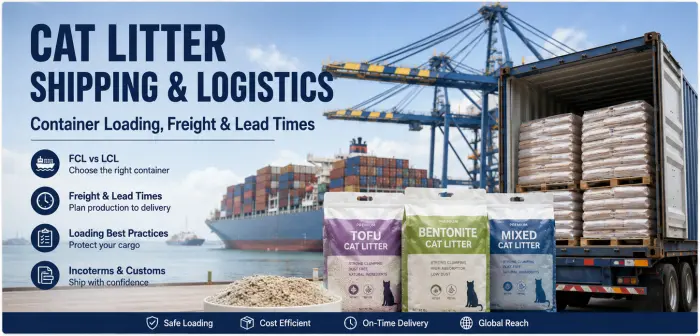


Cat litter container loading and pallet optimization determine how efficiently export orders fit into 20ft and 40ft shipping containers while remaining safe for transportation. For importers sourcing tofu cat litter, bentonite cat litter, or pine cat litter from Pet Horizon, loading efficiency depends on product density, retail pack weight, carton dimensions, and pallet configuration. This guide explains how to estimate container capacity, compare palletized and floor-loaded shipments, and reduce avoidable freight costs and cargo damage during export transportation.
Why Container Load Efficiency Matters for Cat Litter
Cat litter is governed by two constraints at once: weight and volume. Freight cost is driven not by price per tonne alone but by how much compliant, protected product fits in each container. An under-loaded container wastes paid space, while an overloaded one breaches weight limits and risks rejection at the weighbridge. Pallet stability during transit prevents crushed cartons and claims that erase margin.
Cat litter container load efficiency is the practice of fitting the maximum compliant, protected carton count into a shipment by balancing payload limits, volume, and pallet stability.
20ft vs 40ft: Which Fits Cat Litter Better
Whether a 20ft or 40ft container is more efficient for cat litter depends on the product’s packed density, carton dimensions, and available payload. A 40ft standard container offers approximately twice the internal volume of a 20ft container, but its permitted payload does not necessarily increase in proportion to its size. Dense bentonite litter may be limited by weight, while some tofu or pine litter configurations may use available volume more quickly. Importers should compare both limits using actual product and packaging specifications before selecting a container. The figures below are indicative only; actual dimensions and payload vary by equipment.
| Specification | 20ft container (typical) | 40ft container (typical) | Note for cat litter |
|---|---|---|---|
| Internal volume | About 33 cbm | About 67 cbm | Approximate; varies by equipment |
| Typical max payload | About 28,000 kg | About 26,500 kg | Illustrative reference only; confirm available payload with carrier |
| Pallet positions | 10 to 11 | 20 to 24 | Depends on pallet size |
| Typical application | Smaller FCL orders or weight-sensitive cargo | Larger-volume FCL orders | Choose according to actual payload, volume, and freight cost. |
How Different Cat Litter Types Affect Container Loading
Different cat litter materials create different container loading requirements. Product density, particle structure, moisture content, retail pack weight, and packaging dimensions all influence whether a shipment reaches its weight or volume limit first. Rather than applying one loading assumption to every product, importers should evaluate each formula using its actual packed specifications.
Bentonite Cat Litter
Bentonite cat litter is generally a dense mineral-based product, so gross carton weight and container payload deserve particular attention. Buyers should check the weight of each retail pack, the number of packs per carton, and the total pallet load before confirming shipment quantities.
Tofu Cat Litter
Tofu cat litter is a plant-based product whose packed density and shipping volume depend on formulation, pellet structure, and packaging specifications. Carton dimensions and gross weight should be evaluated together to determine whether available container volume or payload becomes the limiting factor.
Pine Cat Litter
Pine cat litter is supplied in pellet form, and its loading characteristics depend on pellet dimensions, compression, moisture content, and retail packaging. Pet Horizon supplies pine litter in both pure pine and activated-charcoal variants, whose pellet dimensions and retail packaging may differ between the two. Buyers should confirm actual carton dimensions and gross weight rather than assume a fixed density ranking against bentonite or tofu litter.
Pallet Patterns and Carton Orientation
Cat litter export orders can be loaded using palletized or floor-loaded configurations. For palletized shipments, a common export pallet footprint is 1,200 × 1,000 mm, although the buyer may specify other dimensions. Carton dimensions determine how many units fit per layer and how many layers can be safely stacked. Column stacking keeps cartons aligned vertically, while interlocking patterns may improve stability in some configurations. The suitable arrangement depends on carton compression strength, stacking height, and handling conditions. Stretch wrap, edge protectors, and suitable top protection help secure the load.
Floor-loaded shipments place cartons directly on the container floor without using pallets. This can improve space utilization by removing pallet tare weight, height, and footprint, but the actual quantity depends on carton strength, loading geometry, and permitted cargo weight. Floor loading also requires more manual handling and can increase unloading time. Palletized shipments generally offer easier forklift handling and warehouse distribution. Buyers should choose the method according to destination facilities, labor costs, packaging strength, and handling requirements.

Calculating Cartons per Container
A preliminary carton quantity can be estimated by comparing the weight-based and volume-based limits. Use the formula N = min(P / W, V / C), where P is the available payload for the cartons after accounting for pallets and other loading materials, W is the gross weight per carton, V is the usable cargo volume, and C is the external volume of one carton. For example, assume a 40ft container has approximately 60 CBM of usable cargo space, each carton occupies 0.02 CBM, and each carton has a gross weight of 5.2 kg. The theoretical volume-based limit is 3,000 cartons, while a 26,500 kg available payload would allow approximately 5,096 cartons by weight. In this example, volume is the limiting factor. Actual loading capacity may be lower because of carton arrangement, stacking height, pallet dimensions, dunnage, and transport weight restrictions. This calculation is an initial estimate rather than a confirmed loading quantity.
For private label orders, buyers should align retail pack sizes, carton dimensions, and pallet specifications during the OEM cat litter packaging discussion. Confirming these details before production helps avoid inefficient loading arrangements and unnecessary packaging changes.
For example, two cat litter suppliers may both offer 5 kg retail packs, but their export carton dimensions can differ because of bag shape, pack arrangement, and the number of bags per carton. Even when product net weight is identical, these packaging differences can change pallet layer counts and container utilization. Buyers should therefore compare the complete export carton specification rather than evaluate suppliers by retail pack weight alone.
Avoiding Damage and Claims
Stacking height, carton compression, pallet stability, and moisture exposure are important factors in preventing cat litter cargo damage. Pallet loads should remain within the manufacturer’s rated dynamic load capacity under actual handling conditions. Avoid carton overhang, distribute weight evenly, and use suitable moisture-resistant packaging for long ocean routes. Buyers can also review the cat litter manufacturing process to understand how production planning and packaging preparation fit into the overall export schedule. A pre-shipment loading inspection helps identify unstable stacks and packaging issues before container sealing.

Connect Load Planning to Lead Time and Sourcing
Container loading is the final stage of production and export planning. Vessel schedules, container availability, production completion, and port cut-off dates can all affect the dispatch timeline, particularly before seasonal retail peaks. Pet Horizon operates from its Dalian-based production facility and ships export orders through Dalian Port. Coordinating production schedules, packaging preparation, and container loading within this supply chain helps importers plan shipment arrangements more effectively. Buyers should also review MOQ, production lead time, loading requirements, and Incoterms together when using a cat litter sourcing and buying guide.
What Buyers Should Confirm Before Container Loading
Before approving an export order, importers should request a packaging and loading specification from their cat litter supplier. The confirmation should cover retail bag weight, bags per carton, external carton dimensions, carton gross weight, pallet footprint, maximum stacking height, and the proposed loading method. For private label projects, these details should be finalized alongside packaging artwork and MOQ confirmation rather than postponed until production is complete. Where necessary, buyers can request a preliminary container loading plan to compare expected carton quantities and identify potential space or weight restrictions before shipment booking.
Conclusion
Cat litter container loading and pallet optimization protect both margin and product quality. Plan the pallet pattern, calculate cartons by the lower of weight and volume limits, stabilize and center each load, and tie loading into lead time and sourcing decisions. Importers who treat container loading as engineering, not an afterthought, ship more units per dollar and arrive with fewer claims.
Frequently Asked Questions
There is no fixed carton quantity for every 40ft container. The result depends on carton gross weight, external dimensions, pallet configuration, and the available payload and loading space. For example, a 26,500 kg available payload divided by a 5.2 kg gross carton weight gives a theoretical weight-based limit of approximately 5,096 cartons. The actual shipment quantity may be lower after accounting for container dimensions, loading arrangements, and transport restrictions.
For most bentonite clay litters, weight limits bind first because bulk density is high relative to container payload. Lighter tofu litters can approach the volume limit, especially in larger packs. Pine litters may bind on either, so model both for each formula.
The common export pallet is 1.2 by 1.0 meters, with some buyers specifying 1.1 by 1.1 meters or Euro 0.8 by 1.2 meters. Carton dimensions should be designed to tile the chosen pallet footprint with minimal gap so layer count and stability are predictable.
Use N = min(P / W, V / C): payload divided by carton gross weight, and usable volume divided by carton volume, taking the lower. Subtract a small allowance for pallet height and dunnage, then verify against the carrier’s verified gross mass rule for the trade lane. This is a preliminary estimate to confirm with the booked equipment.
Floor-loaded shipments stack cartons directly on the container floor and can improve space utilization by removing pallet tare weight, but load slower and carry higher damage risk if not braced. Palletized loads cost some space yet protect cartons and load faster. Choose based on carton strength, handling equipment, and damage tolerance.
Common causes include excessive stacking pressure, carton overhang, unstable pallet wrapping, uneven weight distribution, and moisture exposure during ocean transportation. Appropriate carton strength, edge protection, balanced loading, and suitable moisture-resistant packaging can reduce these risks, although actual damage prevention also depends on handling and transport conditions.
Yes. Specify carton dimensions, gross weight, and pallet footprint in the OEM brief so the supplier designs packs that tile the pallet and the factory can plan loading. This avoids costly rework after production when cartons do not fit the pattern.