




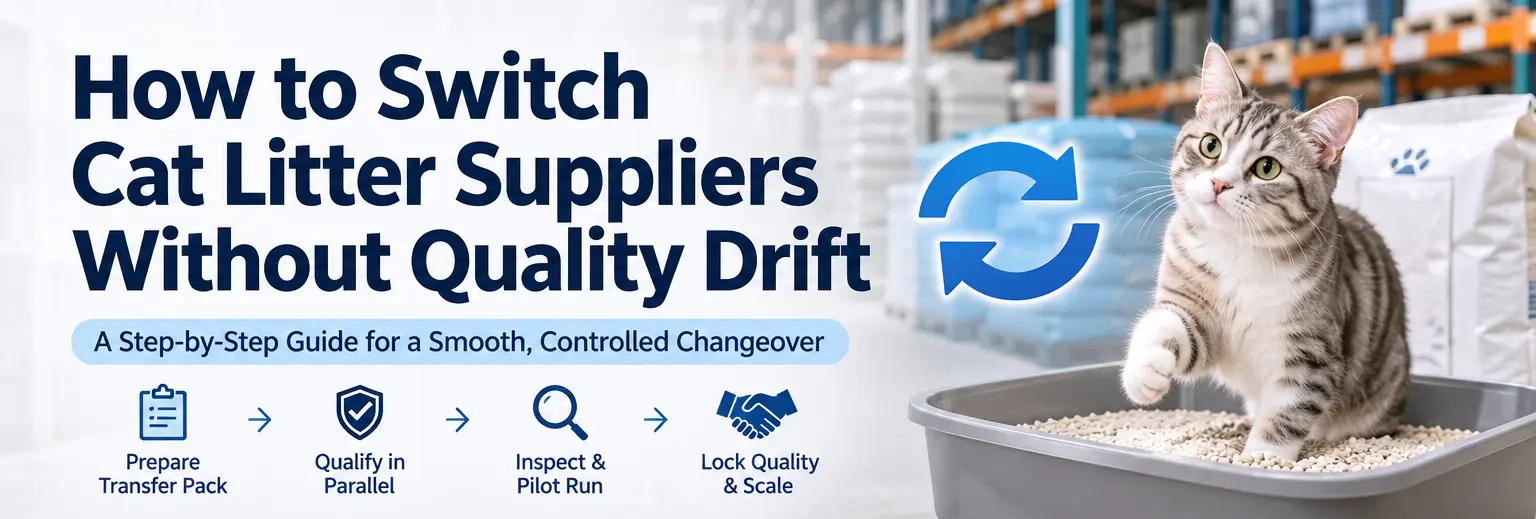
Switching cat litter suppliers involves more than approving a new sample and placing the next order. Differences in raw materials, production settings, moisture levels, or packaging can affect the finished product once regular manufacturing begins. For importers, distributors, and private-label brands, the challenge is to maintain consistent product quality while moving production from one factory to another.
A controlled supplier changeover reduces this risk. Instead of ending the existing supply arrangement immediately, qualify the replacement factory against the same specifications, approved samples, and inspection criteria. Transfer production in stages, monitor the first commercial batches closely, and keep the original supplier available until the new source has demonstrated consistent performance. This guide explains how to prepare a production transfer pack, qualify a replacement factory, and control quality throughout the changeover.
To switch cat litter suppliers without quality drift, qualify the replacement factory before reducing orders from the existing one. Provide both factories with the same product specifications, raw-material requirements, approved golden sample, packaging artwork, and inspection criteria. Check the replacement’s first production batch, run a pilot under normal manufacturing conditions, and apply tightened inspection to its first three commercial lots. Compare results against the same reference standard, require approval before material or process changes, and increase order volumes only after the new factory demonstrates consistent quality and delivery performance.
Why Quality Drift Happens During a Changeover
A sample is not proof of production capability. A factory can produce an excellent first sample with senior attention, premium material, or hand-finishing that will not be repeated at volume. Once recurring production begins, differences in operating practices, process settings, or raw-material sourcing can cause the finished product to move away from the approved sample.
The transition window — between deciding to leave the incumbent and the replacement reaching full readiness — is where drift and defects are most likely. That is why the sequence matters more than the speed. Treat the changeover as a gated qualification programme, not a purchase order.
Key takeaway: the replacement must earn the volume through demonstrated conformance. It should not receive volume by default because the incumbent created a crisis.
Step 1: Build the Transfer Pack Before You Request Quotes
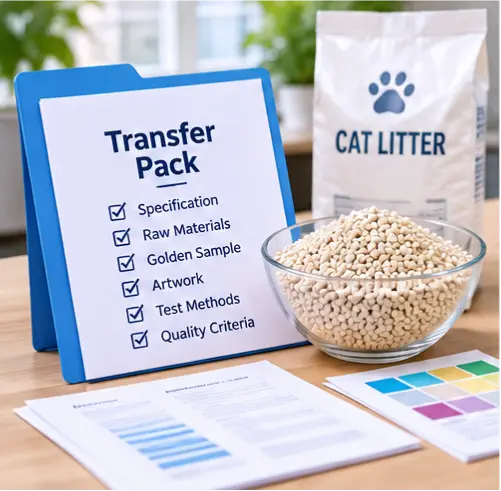
Most drift starts with an incomplete handover. If the new factory works from photographs of the finished bag rather than the controlling documents, it will interpret the product in its own way. Assemble a transfer pack that a buyer can hand to any candidate unchanged:
- Finished-product specification — format, particle size or stick dimensions, target moisture, clump or absorption performance, and odour-control requirements where applicable.
- Raw-material requirements — specify material type, grade, approved sources where relevant, key composition or processing requirements, and restrictions on substitutions. For tofu, bentonite, and pine litter, document the material characteristics that directly affect particle consistency, moisture, absorption, and clumping performance.
- Approved golden sample — a physical reference retained by the buyer, not a sample held only by the factory.
- Packaging specification and artwork — bag or pouch structure, film, print files, carton quantity, and labelling requirements for each destination market.
- Test methods and acceptance criteria — how each parameter is measured and what counts as a pass, so two labs are not grading different things.
- Defect reference and quality criteria — photographs and descriptions of known defects, with clear accept/reject boundaries.
- Process record where available — the approved production steps, not only the finished result.
If tooling or dedicated equipment is involved, confirm ownership and transferability in writing before assuming the replacement can use it. Where the current supplier owns undocumented process knowledge, the transition will take longer and the containment plan must account for that dependency.
Step 2: Qualify the Replacement in Parallel
The strategic error is treating a supplier switch as sequential: end the old factory, then start the new one. That is how a programme loses months of supply. Run the workstreams at the same time and keep the incumbent active until the replacement has passed validation.
| Gate | What happens | Evidence required before moving on |
|---|---|---|
| 1 — Qualify | Paper screening, questionnaire, factory audit (in person or remote — use the cat litter factory audit checklist), and reference checks; NDA signed. | Capacity, certifications, references, and a preliminary quote against your specification pack confirmed. |
| 2 — Sample and sign-off | Send the transfer pack; receive first articles; compare against the golden sample and iterate. | Signed first-article inspection report, material certificates, and packaging sign-off. |
| 3 — Pilot run | Small production batch at real line speed, using real tooling and packaging. | In-process quality records, finished-product inspection against the agreed AQL sampling plan, and documented corrective actions for any nonconformities. |
| 4 — Controlled volume | Place a limited share of a real order while the incumbent covers the balance. | Consistent quality across the initial commercial lots, acceptable defect rates, reliable delivery performance, and complete production and inspection records. |
Allow sufficient time for sample adjustments and approval. A supplier that can identify why a sample failed, implement corrective action, and demonstrate improvement in the next submission provides stronger evidence of its technical capability. Repeated failures without effective corrective action should be treated as a qualification concern.
Step 3: First-Article Inspection Against the Golden Sample
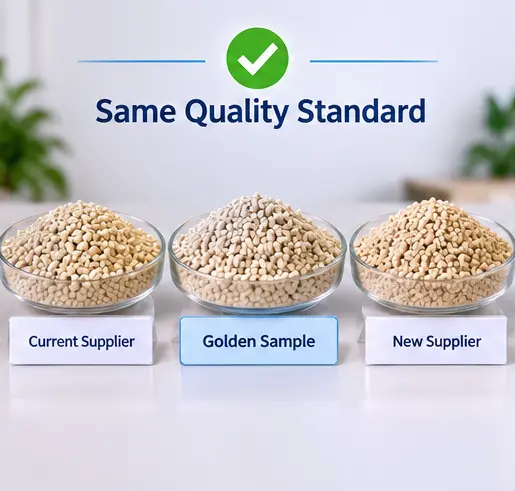
First-article inspection should confirm that the replacement factory can reproduce the approved product within the buyer’s specified tolerances. Use the same test methods and acceptance limits applied to the incumbent supplier, rather than relying on either factory’s internal quality standards. The cat litter sample testing protocol provides further guidance on evaluating product samples against an approved reference.
- Dimensional and physical match — particle-size distribution or stick dimensions, net weight, and pack configuration.
- Material verification — material certificates and traceability for the lots used in the sample. A written material-system reference, such as the parameters defined for bentonite cat litter, helps both plants interpret the same requirement.
- Moisture and performance checks — measured with the method defined in your specification, under stated conditions.
- Appearance comparison — place samples from both sources side by side under controlled lighting and photograph any visible difference.
- Packaging validation — confirm film, print, carton quantity, and barcode or label details match the approved artwork exactly.
Packaging drift between sources is an avoidable problem that shows up in the warehouse and downstream in retail. Include it in first-article sign-off rather than treating it as a separate later task.
Step 4: Run a Pilot at Real Line Speed
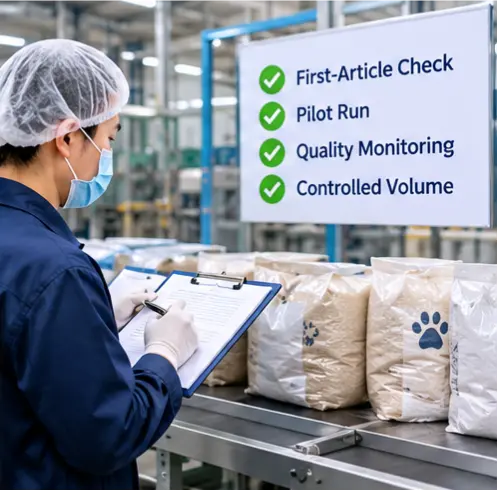
A pilot run tests whether the replacement factory can maintain the approved specifications under normal production conditions. Use the intended equipment, standard operating settings, and actual packaging materials rather than special arrangements prepared only for sample production. Check product consistency throughout the batch, record process deviations, and verify that finished goods remain within the agreed acceptance limits.
Track defect categories and compare them with the historical defect profile from the incumbent. New defect types indicate a process gap that needs corrective action before you scale. Measure on-time delivery to your warehouse rather than to the forwarder, and record how the supplier handles the first problem that inevitably appears. A controlled beginning looks uneventful on paper precisely because the issues were caught and closed early.
Step 5: Lock the Standard Across Both Sources
Once two factories produce the same SKU, the main risk is that each drifts toward its own internal standard while still appearing to pass inspection in isolation. The fix is a single shared reference and a change-control rule.
During the first three commercial lots, apply a tighter inspection plan than the routine sampling level. Record material lot numbers, production dates, key process settings, test results, and packaging details for each batch. Compare these records with the approved pilot and golden sample to identify gradual changes before they become recurring defects.
Once the replacement supplier demonstrates consistent results, move toward the normal inspection frequency defined in the quality agreement. Any significant deviation should trigger corrective action and, where necessary, partial or full re-qualification.
| Drift risk | Control mechanism | Review frequency |
|---|---|---|
| Material substitution or lot change | Written notice and sample approval before any material change. | Every lot change |
| Process parameter shift | Record and lock the qualified machine setup; re-qualify if parameters move outside the agreed window. | Each production run for parameter records; quarterly review of process stability |
| Product divergence | Compare each source against one shared golden sample and against the other source’s most recent run. | Every production run |
| Packaging or label change | Inspect against the packaging specification at incoming quality check before consolidation. | Every shipment |
Use the same inspector or the same checklist for both factories so the comparison measures the plants, not the inspectors. An independent third-party inspection is a neutral option where internal capacity is stretched. Where a single physical tool moves between factories, keep a maintenance log that travels with it and record its condition at each handover.
Step 6: Communicate the Structure and Wind Down Cleanly
Supplier communication should be handled carefully throughout the transition. Where the existing relationship allows, explain the qualification process without disclosing confidential commercial information about the replacement factory. Keep product specifications and inspection requirements consistent across both sources, and document responsibilities for ongoing orders, inventory, tooling, and outstanding materials.
Do not burn the bridge with the incumbent before the replacement is qualified. You may need one more production cycle from the current source to protect customer supply while defects are corrected. When the replacement is proven, transition volume deliberately and close out the incumbent on documented terms — including any tooling, remaining material, or outstanding obligations.
From Changeover to a Stable Supply Base
Switching cat litter suppliers is complete when the replacement factory can maintain the approved product specifications, deliver reliably, and follow the same quality-control requirements as the original source. The transition should be measured by consistent production results, not simply by the date the first order leaves the new factory. For importers and private-label brands, a properly qualified second source provides greater supply flexibility without forcing customers to accept an unexpected change in product quality.
Frequently Asked Questions
The timeline depends on product complexity, documentation readiness, sample approval, and production capacity. Products with established specifications and complete packaging files are generally easier to transfer than those requiring formula adjustments or new tooling. Running qualification alongside existing production helps prevent the transition from interrupting supply.
Two factories can produce cat litter that meets the same defined product specifications, but exact physical identity is not always realistic. Differences in natural raw materials, processing equipment, and production conditions may cause minor variations. A shared specification, consistent test methods, and an approved golden sample help keep these variations within acceptable limits.
It is the physical approved reference that defines the accepted product. The buyer should retain one master set and use it for pre-shipment checks from every source. If each factory holds only its own sample, both can drift while still passing their own inspection.
Because a sample can be made with extra attention and premium material that will not appear at volume. A pilot at real line speed exposes process differences, packaging errors, and defect patterns that a single sample cannot reveal.
Use the same inspection standard, the same checklist, and ideally the same inspector for both factories, comparing each against the shared golden sample. An independent third-party inspection removes the question of bias when internal capacity is limited.
It depends on the existing contract, commercial relationship, and confidentiality requirements. Where appropriate, informing the incumbent supplier can help maintain supply during the transition. However, buyers should review contractual obligations and avoid disclosing confidential information about the replacement factory. The priority is to maintain existing supply until the new source has passed qualification.
A material or material-lot change, a shift in process parameters outside the recorded window, a tooling move or repair, a packaging or label change, or a new defect pattern. Each should require written notice, sample approval, and a recorded sign-off before the change ships.