

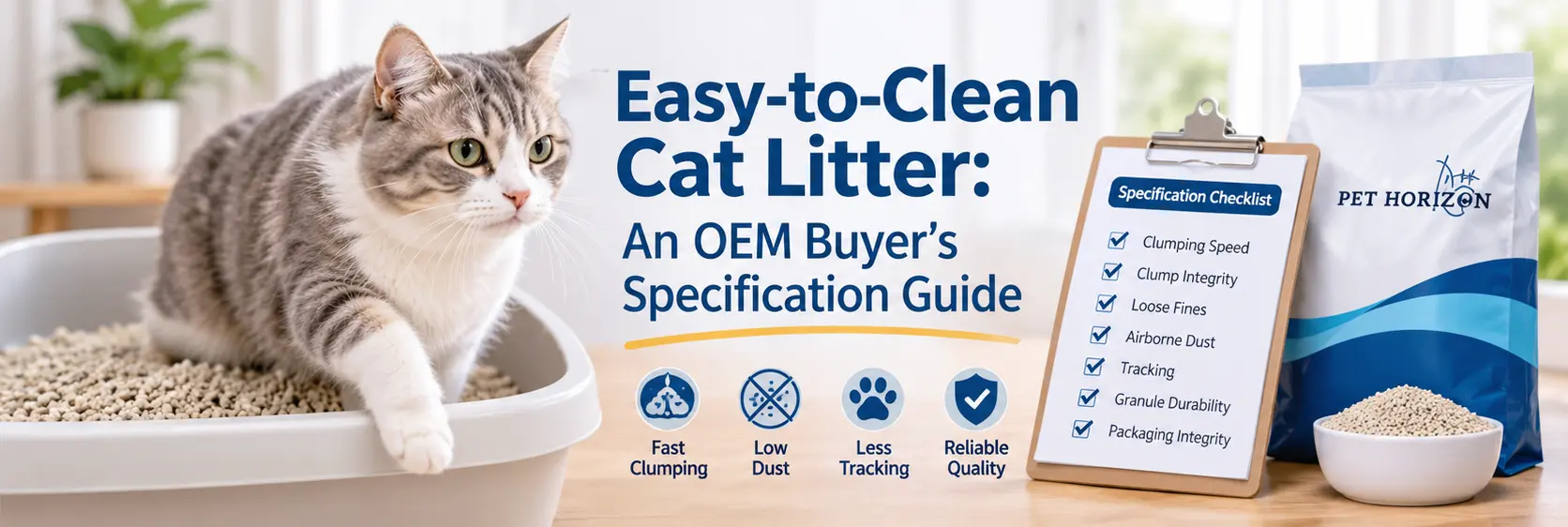
For cat litter importers and private-label brands, easy clean cat litter is more than a product description. It reflects performance factors that affect daily scooping, product handling and customer satisfaction, including clump integrity, loose fines, dust generation, tracking and granule durability. These characteristics cannot be verified through a marketing claim alone. Buyers need defined test methods, measurable acceptance limits and consistent batch controls before placing a bulk order. This guide explains how to translate easy-clean performance into practical OEM specifications, evaluate supplier test results and maintain consistent product quality across shipments.
To specify easy clean cat litter, define measurable requirements for clumping speed, clump integrity, loose fines, airborne dust, tracking and granule durability. Packaging integrity should also be included in the overall purchase specification. Each requirement needs a test method, sample preparation, reporting unit and acceptance limit. Establish an approved reference sample and a batch inspection procedure so production shipments stay consistent. Supplier figures are starting references; acceptance criteria must be agreed for the specific product and method.
What “Easy Clean” Means in a Buyer’s Specification
For procurement purposes, easy clean cat litter refers to a litter whose behaviour in daily scooping, pouring and refilling can be defined and checked before shipment. It is primarily determined by how well the litter forms stable clumps, how easily waste can be removed and how much loose material remains after scooping. Supporting factors include tracking, fines generation, airborne dust and granule durability, all of which affect handling and cleaning frequency. Odour control is an additional product-performance requirement that should be evaluated separately rather than treated as a direct measure of cleanability.
For an OEM order, the distinction is practical: buyers need requirements that can be communicated to a manufacturer, checked during production and verified during incoming inspection. A subjective description alone cannot provide that level of control.
Key takeaway: Easy clean is an outcome built from several measurable attributes. No single number describes it, and a supplier who offers one number is selling a claim, not a specification.
The Buyer Specification Matrix for Easy-Clean Performance
Hand a supplier the matrix below instead of an adjective. Each row separates a performance dimension from the way it is measured and the acceptance criterion a buyer should agree in writing. These are proposed procurement approaches rather than universal industry standards: buyers and suppliers should agree on sample conditioning, equipment, test procedures and limits before production. Results obtained using different methods should not be treated as directly comparable.
| Dimension | Test method | Buyer acceptance criteria |
|---|---|---|
| Clumping speed | Add a defined liquid volume to a fixed litter mass under stated conditions and record the time required for clump formation. | Maximum clumping time and the defined test conditions. |
| Clump integrity | Allow the formed clump to rest for a defined period, then lift it using a specified scoop procedure. Record the proportion of the clump retained, the amount of loose residue and any visible breakage. | Minimum retained-clump percentage or maximum allowable residue and breakage under the agreed test conditions. |
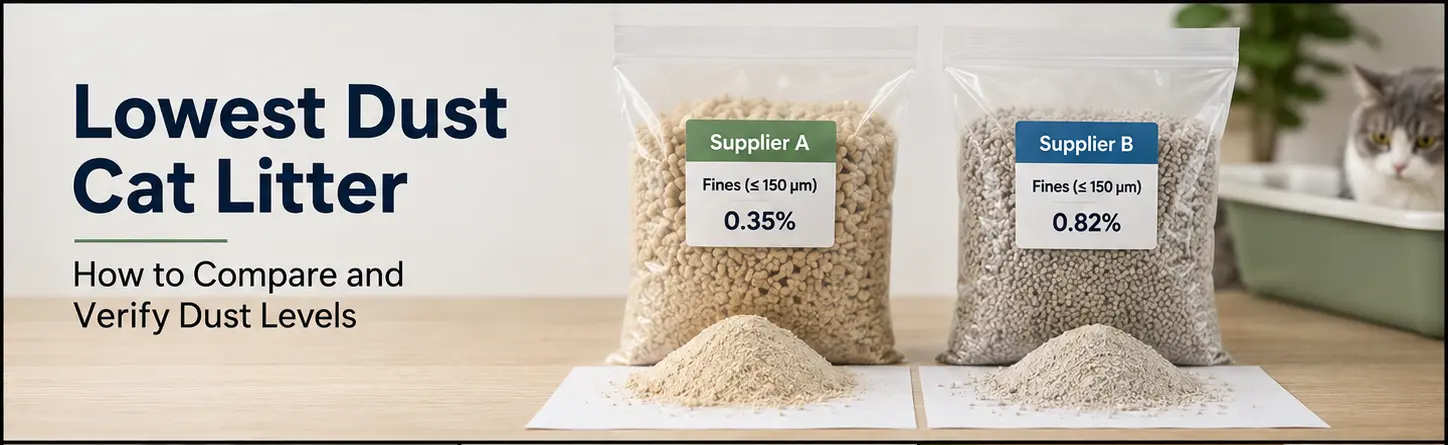
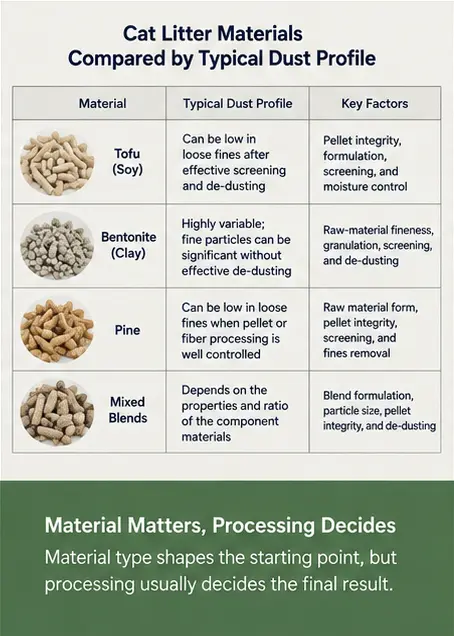
| Loose fines | Sieve a conditioned sample through specified mesh sizes and calculate the retained and passing fractions by particle-size range. | Maximum fines percentage for each specified size range. |
| Airborne dust | Measure dust generated during a standardized pouring or handling procedure, recording the apparatus and conditions. | Maximum dust reading under the agreed test method, kept separate from the fines limit. |
| Tracking | Conduct a controlled litter-box exit or standardized walking trial using fixed box dimensions, litter depth, walking distance and collection area. Collect and measure granules deposited outside the designated area. | Maximum tracked particle count or mass under fixed trial conditions. |
| Granule durability | Subject the sample to defined handling or tumbling conditions, then re-sieve to measure the increase in fines. | Maximum allowable fines increase after testing. |
| Packaging integrity | Inspect seals and conduct agreed drop or compression tests on packed cartons. | Acceptable defect rate and packaging damage limits. |
Loose fines and airborne dust should never be treated as interchangeable measurements. Sieve analysis identifies particles already present in a prepared sample, while a cat litter dust testing guide explains how particles released during a defined handling process are evaluated. Specify both requirements separately and name the method in your document rather than letting a supplier choose it after the fact.

Why “Easy Clean” and “Dust Free” Are Not Acceptance Criteria
Three confusions recur in almost every litter negotiation. The first is treating a marketing word as a measurable requirement. “Easy clean” and “dust free” describe an impression; neither tells a laboratory what to do. If the phrase appears in a purchase order without a method and a limit, two factories will interpret it differently and both will believe they complied.
The second is collapsing fines into airborne dust. Loose fines are particles already present in the product and are measured on a prepared sample. Airborne dust is what becomes suspended during a defined handling action, and the result depends on the method, sample preparation and conditions. A tight fines limit does not by itself prove low dust generation, and a low reading in one dust test says nothing about a different method. Specify them as two separate lines with two separate acceptance rules.
The third is treating one performance result as proof of overall product quality. A low fines percentage does not automatically mean low airborne dust, and fast clumping does not guarantee that a clump will remain intact during scooping. Buyers should evaluate related performance indicators together and avoid using a single test result to support broader product claims.
Key takeaway: A claim says what a product should feel like. A specification says how a buyer will judge it. Only the second is enforceable.
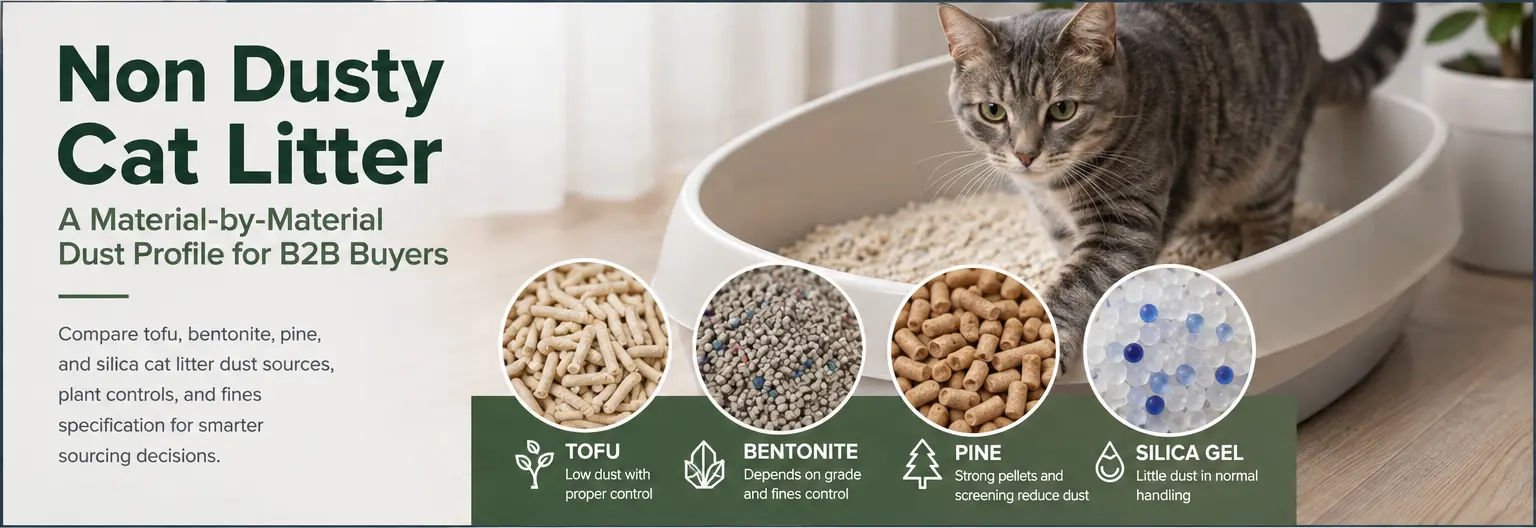
Typical Trade-Offs: Tofu, Bentonite, Pine and Mixed Litter
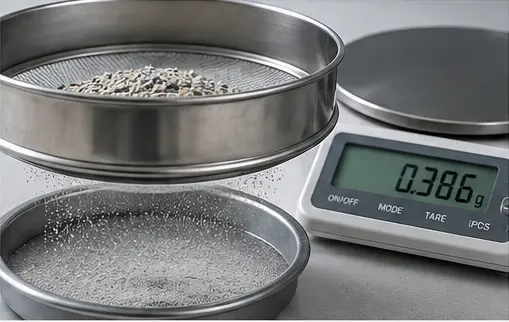
No material is universally easier to clean. Performance is an outcome of formulation, particle integrity, processing, screening, dedusting and handling. The table describes typical tendencies and the control point a buyer should question, not a ranking of one material over another.
| Material | Typical clumping behaviour | Typical dust or fines control point | Typical tracking consideration | What the buyer should check |
|---|---|---|---|---|
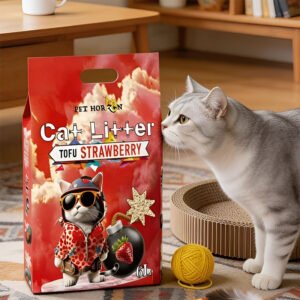
| Tofu | Typical tofu-based litters can be specified for fast clumping when fibre structure is consistent. | Typical control points are fibre structure and screening. | Typical sticks or pellets may track less when dry, subject to trial conditions. | Check clump time, breakage after handling and absorption against an agreed method. |
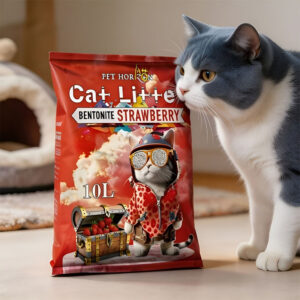
| Bentonite | Typical bentonite litters form a firm clump on hydration. | Typical control points are granule strength, dedusting and moisture control. | Typical finer granules can be tracked in high-traffic installations. | Check fines by sieve and airborne generation separately, plus clump integrity after lifting. |
| Mixed | Typical behaviour depends on the blend ratio and the characteristics of each component. | Typical control points are blend-ratio consistency, particle-size distribution and moisture stability. | Typical tracking depends on the size, shape and durability of the blended particles. | Check blend uniformity across lots, clump integrity and performance after transport. |
| Pine | Typical pure pine pellet formats generally do not form conventional scoopable clumps; performance depends on pellet structure and formulation, while activated charcoal is an additional formulation component rather than a clumping agent. | Typical control points are fibre consistency, screening and fines generated during pellet processing and handling. | Typical pellet size, surface condition and resistance to breakage affect tracking behaviour. | Check pellet durability, moisture, fines generation and absorption for the actual commercial formulation. |
Material selection should follow the intended product positioning and target-market requirements. Tofu and bentonite formulations generally require particular attention to clumping consistency, while pine products should be evaluated more heavily for pellet durability, absorption and fines generation. Mixed formulations need additional controls for blend uniformity. Buyers should therefore establish separate acceptance criteria for each material rather than applying one universal easy-clean specification across all product categories.
Pet Horizon supplies tofu, bentonite, pine in pure and activated-charcoal forms, and mixed cat litter. For example, one published tofu cat litter specification lists a bulk density of 600 g/L, a dust measurement below 3%, clumping within 8 seconds and absorption of 250%. These figures apply to the specified product and should be treated as supplier-specific references rather than universal performance benchmarks. Before using them in an OEM agreement, buyers should request the corresponding test methods, measurement units and acceptance conditions. The dust figure should not be interpreted as an airborne-dust concentration without supporting test documentation. For a tofu cat litter OEM programme, particular attention should be paid to fibre consistency, particle integrity and the production controls that maintain clumping performance across batches.
Turning the Matrix into Contract Language
A matrix only works if it survives contact with the purchase order. Five elements turn each row into an enforceable term.
- Defined test methods and conditions. Specify the test procedure, sample mass, preparation, environmental conditions, equipment and reporting unit so that results can be reproduced.
- Acceptance limits and sampling rules. Define the minimum or maximum acceptable result, the inspection sample size and the applicable AQL or lot-acceptance criteria where relevant. AQL suits agreed sampling and lot acceptance, not every performance test.
- An approved reference sample. Retain signed and dated reference samples approved by both buyer and supplier. Use them as benchmarks for product appearance, particle characteristics and agreed performance requirements, with each party maintaining a documented sample where practical.
- Non-conformance and corrective action. Establish how failed inspection results are handled, including retesting, batch segregation, replacement, corrective action and responsibility for associated costs.
- Change control. Require prior written approval and, where necessary, new sample testing before changes to raw materials, formulations, production processes or packaging are implemented.
Ask for supporting documents at the same time: applicable product test reports, raw-material traceability records, MSDS where relevant, and valid quality or social-compliance audit documentation. Pet Horizon can provide relevant BSCI and SMETA audit documentation, SGS testing reports, MSDS and its filed enterprise standard, subject to the specific product and document scope. BSCI and SMETA are audit records rather than product certifications, while an SGS report only supports the specific tests it covers. MSDS does not establish cleaning performance. Buyers should verify that each document applies to the actual SKU, production facility and requirement being evaluated. For buyers building a wider sourcing programme, a cat litter sourcing guide covers supplier evaluation beyond the product specification.
Writing an Easy-Clean Specification into Your OEM Purchase Order
A practical easy-clean specification should combine measurable performance requirements, agreed test methods, acceptance limits and an approved reference sample. Before mass production, buyers should review the supplier’s testing capabilities and confirm how each requirement will be monitored during manufacturing and final inspection.
For private-label and wholesale orders, these requirements should also be linked to the approved product formulation and packaging specifications. Any material, process or packaging change that could affect product performance should go through an agreed approval procedure before shipment.
Working with an experienced OEM cat litter manufacturer helps buyers establish product-specific quality requirements before placing bulk orders. Ultimately, easy-clean performance is not established by a marketing promise. It depends on clear specifications, repeatable production controls and consistent verification from one shipment to the next.
Frequently Asked Questions
Because cleanability depends primarily on clumping, clump integrity and how easily waste can be removed without leaving excessive residue. Supporting factors such as dust, tracking and granule durability also affect handling and cleaning frequency. No single measurement can represent all these performance characteristics, so buyers should define separate acceptance criteria for each relevant requirement.
No. A fines limit measures particles already present in a prepared sample, while “dust free” is a marketing phrase with no universal numerical meaning. Even an airborne-dust test only describes one method, so ask which method a supplier’s figure refers to before comparing quotes.
Clumping speed measures how quickly litter forms a clump, while clump integrity measures whether that clump remains intact during removal. A product may form a clump quickly but still leave residue if the clump breaks apart during scooping. Buyers should define both requirements and evaluate them using the same agreed test procedure.
Use it as a reference, not a rule. Published figures are measured for one SKU under that supplier’s conditions. Write your own method and acceptance limit, then verify production lots against an approved reference sample.
Run a defined scoop-and-walk trial with the sample and count or weigh the granules deposited outside the box. Keep the trial conditions identical between candidate suppliers so the comparison measures the product rather than the test.
It needs a defined method rather than necessarily a single number. Agree a reference, an observation window and a pass criterion. A controlled sensory comparison is more useful than an unqualified freshness claim that no one can reproduce.
Establish an approved reference sample, define batch inspection requirements and monitor critical production parameters such as raw-material consistency, particle-size distribution, moisture and screening performance. Require supplier approval before significant formulation or process changes. Periodic testing against the original specification helps identify performance deviations before they affect subsequent shipments.