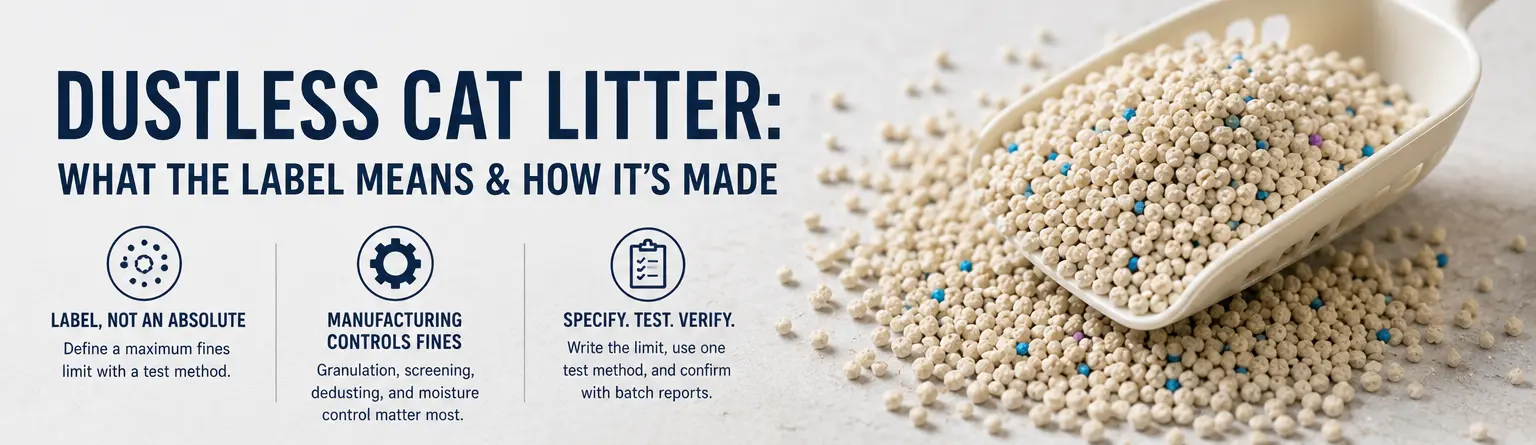





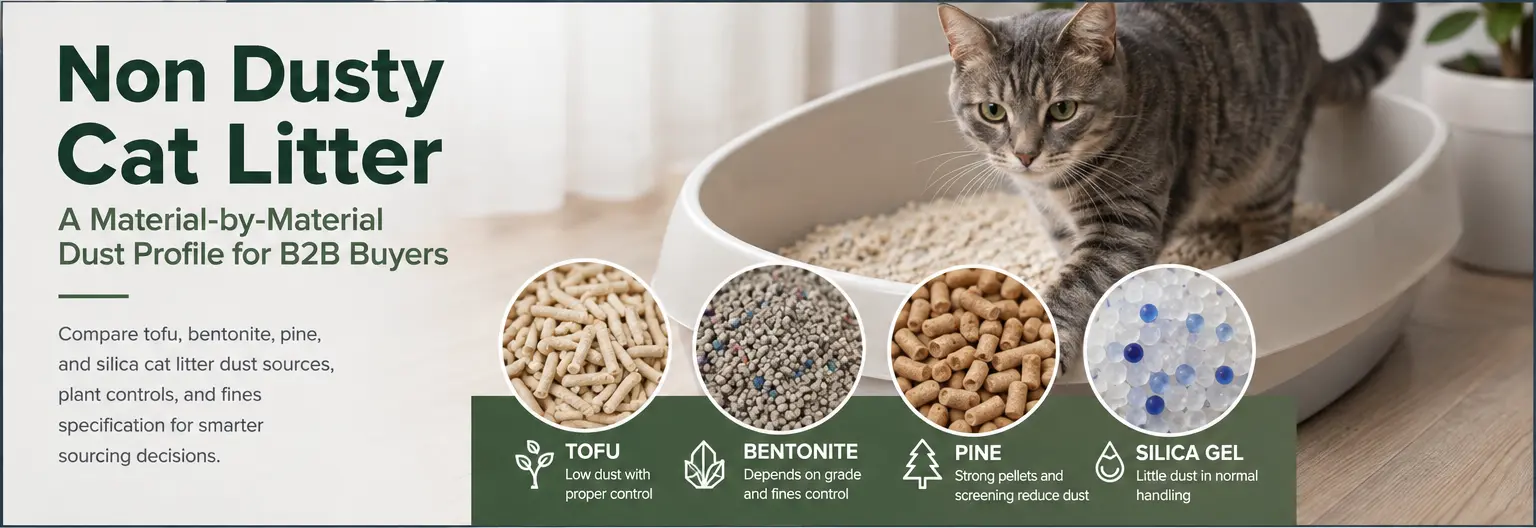
“Non dusty” is one of the most common claims on a cat litter spec sheet, but it means different things for different base materials. A tofu granule, a bentonite lump, and a pine pellet each generate fines through different physical and processing steps, so a buyer comparing suppliers needs to read the claim against the material, the finished-particle grade, and the test method. Our dustless cat litter guide explains how low-dust claims should be evaluated; this article compares the dust profile material by material and the plant controls used to reduce loose fines.
Quick answer: No single material is “non dusty” by default. Dust and loose fines can be created during crushing, agglomeration, extrusion, cutting, drying, screening, handling, and transport. Tofu and pine products can achieve low-dust performance when particle integrity and dedusting are well controlled, while bentonite typically requires tighter control of fines because it is mined and processed before agglomeration. Silica gel often produces little loose dust in normal handling, but it can still generate fines if the beads are damaged. The reliable way to specify “non dusty” is to require a defined test method, sample condition, and maximum fines or dust limit in the purchase specification rather than relying on the label alone.
Why “non dusty” depends on the base material
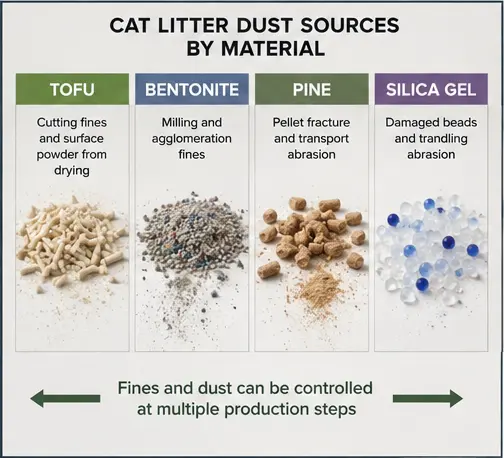
In this article, dust refers broadly to loose fine particles that can become airborne during pouring, scooping, filling, transport, or other handling. The amount and particle-size distribution depend on how the raw material behaves under mechanical stress and on the processing steps used to form the finished granule or pellet. A material that is milled into fine particles before being re-agglomerated will often carry more loose fines than one extruded as a continuous strand and cut to length. For a B2B buyer, the useful question is not “is this material dusty?” but “what fines does this process leave behind, and what does the plant do to remove or control them?”
This is also why a single “non dusty” badge is weak evidence on its own. The same word can describe a clay litter screened to a coarse grade and a pine pellet with almost no loose powder, two very different products with different handling and filling behavior. The claim only becomes comparable when it is attached to a material and a test limit.
Dust profile by material
The four materials below are common reference points for private-label and bulk cat litter programs. We produce tofu, bentonite, and pine litters and can specify dust and fines limits for each; silica gel is included as a comparison point because buyers often evaluate it alongside these materials, but it sits outside our standard production range.
Tofu cat litter
Tofu litter is made by extruding a soy- or pea-fiber paste into strands that are cut and dried. Dust mainly comes from two sources: trimming fines at the cutter and surface powder if the drying step is too aggressive. A well-run line keeps these low by controlling moisture at cut, then passing the finished granules through a dedusting screen. In our experience, a properly screened tofu granule can shed little loose dust during normal scooping and pouring, which makes low-dust performance a useful product-positioning attribute when it is supported by a defined test result.
Bentonite cat litter
Bentonite is mined, crushed, and agglomerated into clumps. Because the starting material is processed into fine particles before granulation, bentonite can carry more loose fines than many extruded materials, and the final dust level depends heavily on particle size, agglomeration quality, screening, and dedusting. A coarse, well-dedusted bentonite grade can achieve a low dust result under a defined test method, while finer grades generally require tighter process control to limit powder. Specifiers should name the grade and the maximum percentage passing a defined fine-particle threshold rather than rely on the category name alone.
Pine cat litter
Pine litter is commonly produced from dried wood fibers or shavings pressed into pellets. The dominant dust source is fine wood material released when pellets fracture or abrade during production, filling, transport, or use. Pellet density, mechanical integrity, moisture control, and final screening therefore have a major effect on the result: intact, durable pellets can shed little loose powder, while damaged or poorly compacted pellets can generate noticeable fines. For B2B programs, pellet durability and post-production screening should be evaluated together with the stated dust limit.
Silica gel cat litter (comparison only)
Silica gel is a porous synthetic silica material rather than a clay or plant-fiber litter. Its relatively large granules or beads often produce little loose dust during normal handling, but damaged particles can still generate fines during manufacturing, transport, or use. It is a distinct product class with its own handling, weight, absorption, and disposal considerations, and we mention it only for comparison — it is not part of our standard production range. Buyers comparing it with tofu, bentonite, or pine should evaluate dust performance alongside the product’s other functional characteristics.
| Material | Typical main dust source | Key process control | What the buyer should check |
|---|---|---|---|
| Tofu | Cutting fines and surface powder from drying | Moisture at cut, dedusting and screening | Fines limit and, where required, dust test result |
| Bentonite | Milling and agglomeration fines | Particle grade, agglomeration, screening, dedusting | Fines limit stated by grade and test method |
| Pine | Pellet fracture and transport abrasion | Pellet strength, moisture control, post-production screening | Pellet durability and relevant fines or dust result |
| Silica gel | Damaged beads and handling abrasion | Particle integrity and screening | Dust or fines test result under a defined method |
What the plant controls to keep litter non dusty
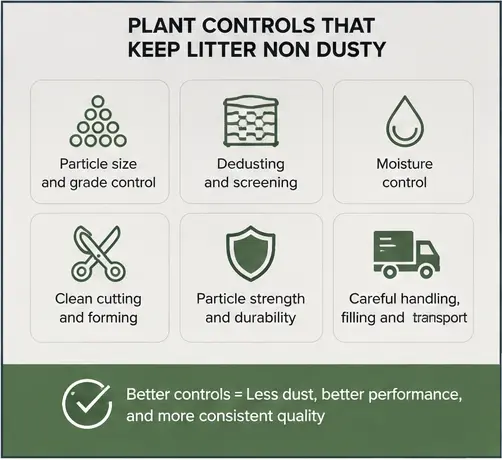
Across materials, a manufacturer has a small set of levers that decide the final dust reading. Understanding them helps a buyer write a spec that a plant can actually meet and verify.
- Particle size and grade: a controlled particle-size distribution helps limit excessive fines and improves consistency between batches.
- Dedusting and screening: a post-processing air or sieve step removes loose surface powder before packing.
- Moisture control: excessive dryness can increase fracture and powder generation, while excessive moisture can affect particle integrity and stability.
- Cutting and forming: clean extrusion cuts and controlled forming reduce fines generated during shaping.
- Particle strength: durable granules or pellets are less likely to fracture during filling, palletizing, and transport.
- Filling, sealing, and transport: controlled filling and packaging reduce abrasion and help prevent new fines from forming before the product reaches the customer.
Workplace respirable-dust exposure is a separate occupational-health issue from a finished cat litter’s consumer dust claim, and it is addressed by agencies such as the U.S. National Institute for Occupational Safety and Health. Buyer-facing specifications should therefore use a finished-product test and acceptance limit rather than substitute a workplace exposure limit for product performance.
How a B2B buyer should read a “non dusty” claim
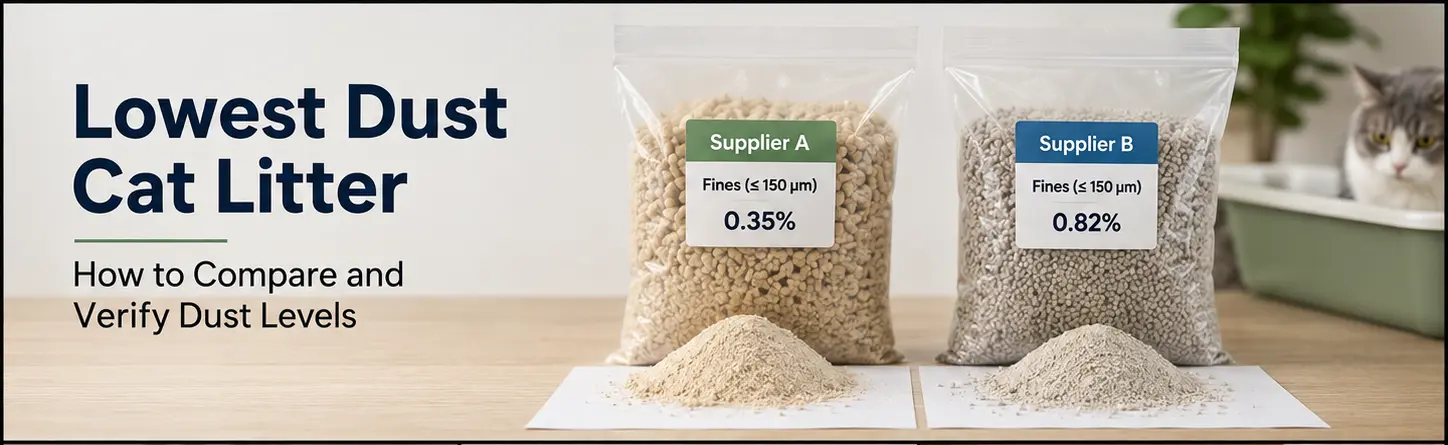
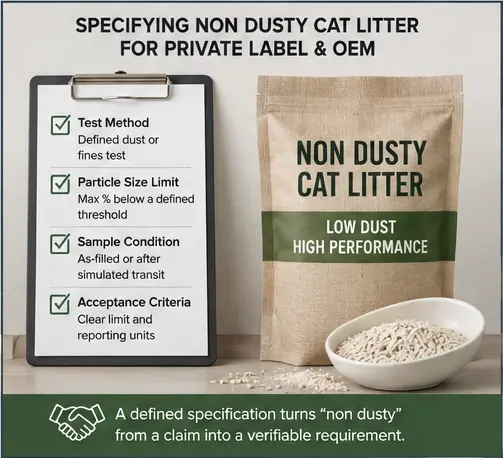
A “non dusty” claim without a defined test method or acceptance criterion is weak as a purchasing specification. To make the claim comparable across suppliers, ask for the test procedure, the reported fines or dust limit, and the sample condition (such as as-filled or after simulated transit). Two suppliers can both print “non dusty” on the bag while working to very different internal limits; only a defined test and acceptance criterion let you compare them objectively.
General particulate-matter guidance, such as that published by the U.S. Environmental Protection Agency, explains why airborne fine particles matter for air quality, but environmental or workplace limits should not be substituted for a cat litter product specification. The contract limit should be based on the agreed litter test method, particle-size threshold, sample condition, and reporting units.
Specifying non dusty litter for private label and OEM
For a private-label or OEM program, the practical move is to fix the dust and fines requirements in the purchase specification alongside clumping, absorption, and scent. Our dust-free clumping cat litter is one reference formulation built around a low-dust profile, and a cat litter manufacturer can help define the test method, particle grade, and dedusting controls needed to meet an agreed product specification. The final marketing claim should then be checked against the labeling and claim requirements applicable in the destination market. Written as a verified performance requirement rather than a label word, “non dusty” becomes a more defensible and checkable part of the product specification.
Conclusion
“Non dusty cat litter” is not a property guaranteed by a material name; it is a finished-product performance that depends on formulation, particle integrity, processing, screening, dedusting, and handling. Tofu and pine products can achieve low-dust performance when these factors are well controlled; bentonite performance varies substantially with grade, agglomeration, and fines removal; and silica gel is a separate product class that often produces little loose dust in normal handling but can still generate fines when damaged. For B2B buyers, the reliable path is to specify the test method, particle-size or fines limit, sample condition, and acceptance criteria, then verify the result batch to batch rather than compare label words alone.
Frequently asked questions
There is no single least-dusty material across all suppliers because finished-product dust depends on particle size, strength, processing, screening, and handling. Silica gel often produces little loose dust in normal handling, while properly processed tofu and pine products can also achieve low-dust performance. Bentonite varies more widely with grade and fines control. Compare finished-product test results rather than material names alone.
It can be. Tofu litter is extruded and cut, so loose fines can come mainly from trimming and surface powder generated during drying and handling. A line that controls forming conditions and uses screening or dedusting after processing can produce a granule with low loose-dust performance under a defined test method. Always ask for the actual test method and acceptance limit rather than assuming from the material name.
Bentonite starts as milled rock, so it can carry more loose fines than many extruded materials, and its dust level depends on the grade, agglomeration quality, and how thoroughly the plant screens and dedusts. A coarse, well-dedusted grade can produce a low dust result under a defined test method; a fine grade generally requires tighter process control to reach the same limit. The grade and the test result, not the material name, decide it.
Pine pellets can achieve low-dust performance when they have good mechanical integrity and are properly screened. Dust commonly increases when pellets fracture or abrade during production, filling, transport, or use, so pellet durability and post-processing screening should be evaluated together. Specify the particle grade, relevant fines limit, and test method rather than relying on the wood type alone.
In normal handling, silica gel beads often produce little loose dust because the granules are relatively large. Fines can still appear if beads are damaged during manufacturing, transport, or use. It is a different product class from clay or plant litters, with its own absorption and disposal considerations, and it sits outside our standard production range; we list it only for comparison when buyers ask.
Manufacturers and laboratories may evaluate cat litter dust using different approaches, including controlled agitation or dust-generation tests, airborne-particle measurements, and sieve analysis for loose fines. These methods do not measure exactly the same property, so a result is only meaningful for supplier comparison when the test procedure, equipment or method reference, particle-size threshold, sample condition, and reporting units are clearly defined. For procurement, specify the exact method and acceptance limit rather than referring generally to a “dust test.”
Set a maximum percentage of material below a defined particle-size threshold as a fines specification, and, where airborne dust performance is commercially important, add a defined dust-generation or airborne-particle test. State whether the sample is tested as filled, after simulated transport, or under another agreed condition. The exact acceptance limit should be based on the material grade, product format, test method, and the performance required for the destination market rather than using one universal number for every litter type.
There is no single universal “non dusty” certification for cat litter; the defensible approach is a contract limit with a defined test method and batch verification. Avoid presenting a self-declared label as a certified standard, and keep any claim aligned with the tested result and the labeling rules applicable in the destination market at the date of sale.