




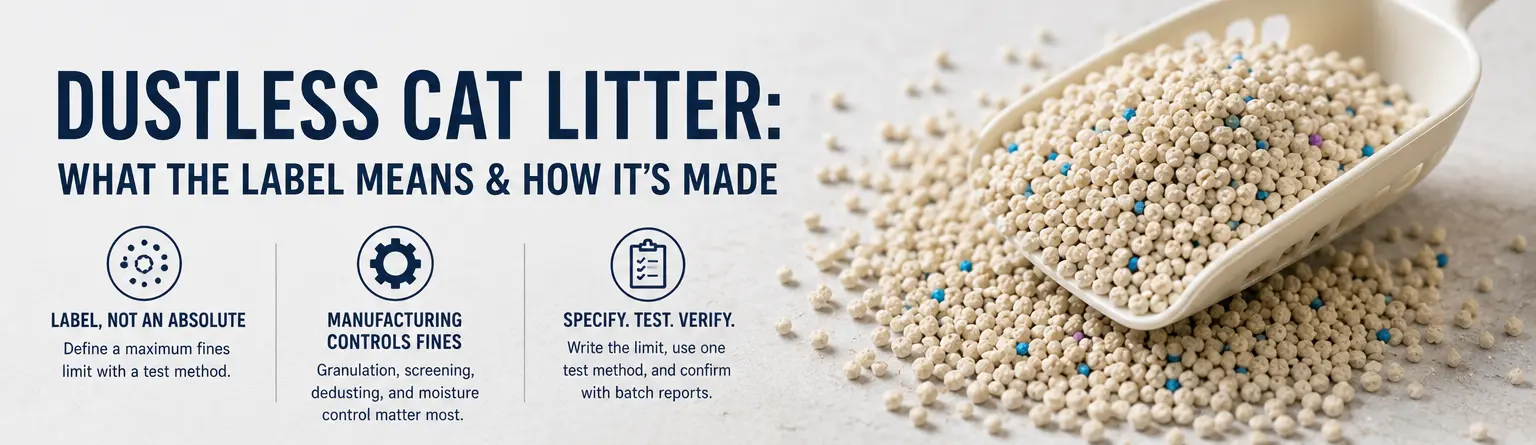
Buyers see “dustless” on many cat litter listings, but the term does not represent one universal product specification or a single mandatory dust limit. For distributors, private label brands, and bulk importers, the practical question is which test method and acceptance threshold the supplier uses to support the claim. Buyers who need the testing-method details can review our cat litter dust testing standards guide, and buyers comparing procurement-side specifications can also see our no dust cat litter guide.
“Dustless cat litter” is best understood as a performance claim rather than a fixed raw material category. In commercial sourcing, the claim becomes meaningful only when the buyer and supplier define what is being measured—such as loose powder, fines, or dust released during handling—and set a maximum acceptance limit under an agreed test method. The same litter material can produce different dust results when granulation, screening, dedusting, drying, and handling controls differ.
Quick Answer: Dustless cat litter is a performance claim, not a specific material. For B2B sourcing, buyers should define the dust or fines metric, test method, sampling conditions, and maximum acceptance limit, then verify the result through batch or third-party testing. Granulation, screening, dedusting, moisture control, and transport handling all affect the final dust level.
What “Dustless” Actually Refers To
In cat litter, “dust” can refer to loose fine particles already present in the product or to particles released when the litter is poured, scooped, conveyed, or otherwise disturbed. Loose fines describe particles already present in the product, while dustiness describes particles released when the product is disturbed. These are related but different measurements, so a “dustless” claim is meaningful only when the supplier states what is being measured and how. “Dustless” is a buyer-facing claim that the loose fraction is controlled below a level the buyer accepts, not a regulated absolute with one mandatory pass/fail number that every supplier uses; two litters both sold as dustless can therefore carry very different actual fines levels. The reliable move for a buyer is to treat “dustless” as a starting point and ask for the underlying limit, the test method, and the sampling conditions. Product-level dust testing is different from workplace airborne-dust exposure testing used for factory occupational safety.
| Term | Practical meaning |
|---|---|
| Dustless | Marketing or performance claim requiring a defined measurement |
| Low dust | Relative performance claim indicating reduced dust |
| Dust-free | Stronger marketing wording that should still be backed by a defined test |
These words are not legal definitions, and their use varies across markets, brands, and product labels. The practical step is to anchor each claim to a written test method and acceptance limit rather than to the word itself.
The Production Steps That Control Fines
A litter becomes low in loose fines because of how it is processed, not because of the material name on the bag. The controls that matter most are upstream of packaging.
Granulation and Agglomeration
Well-formed, properly compacted granules shed far less powder than loosely milled or poorly bound material. Tighter granule integrity reduces the fine particles generated when litter is handled, scooped, or shipped. This is why two litters made from the same base can differ sharply in dust if their granulation is controlled differently.
Mechanical Screening and Dedusting
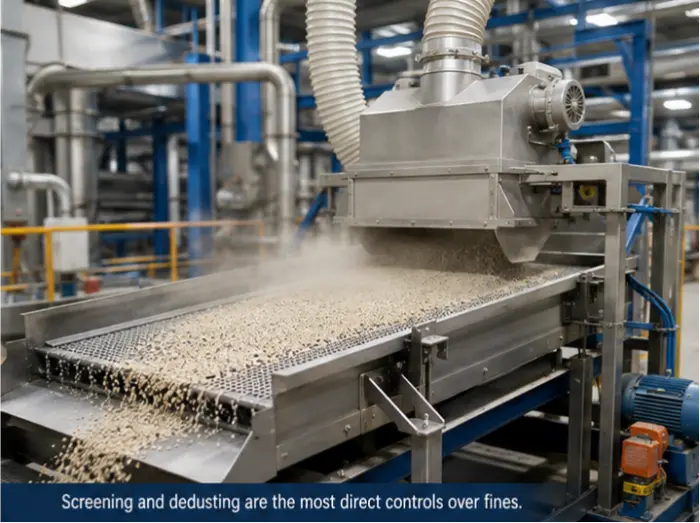
After granulation, sieving removes the loose surface fines before bagging. Dedusting steps — often a controlled air or vibration pass — pull the remaining free powder out of the stream. Screening and dedusting are the most direct levers for the loose fraction, which is exactly what a dustless claim depends on.
Moisture and Drying Control
Uneven drying or an unsuitable moisture level can weaken granule structure and increase fines during handling and transport. Stable moisture control helps maintain granule integrity, while excessive drying can make some formulations more brittle. The target is therefore a controlled moisture window appropriate to the formula, not simply the lowest possible moisture level.
| Process step | How it reduces loose fines |
|---|---|
| Granulation and compaction | Stronger granules shed less powder during handling |
| Mechanical screening | Removes loose surface fines before bagging |
| Dedusting pass | Removes free powder from the product stream using controlled air, vibration, or other separation methods |
| Moisture and drying control | Less friable surface, fewer transit-generated fines |
| Packaging and handling | Limits in-transit powder migration and abrasion |
Why Material Choice Does Not Decide Dustlessness
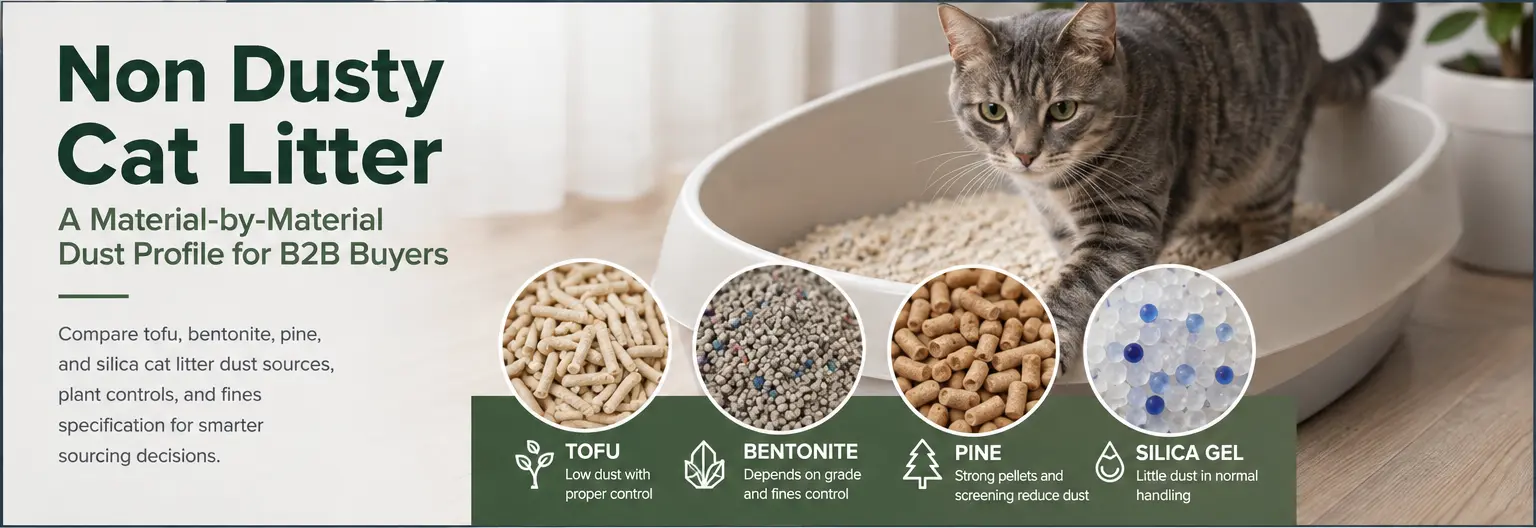
Tofu, bentonite, and pine cat litter can all be formulated for low dust performance, but their dust-generation mechanisms can differ. Plant-based granules may generate fines when the structure is too brittle or drying is uneven; mineral litter can contain fines from crushing, milling, and handling; and wood-based pellets can generate fines when pellets fracture or contain excessive fine material. These are tendencies rather than fixed rules. Buyers should compare finished products under the same defined test method instead of assuming that one raw material is inherently dustless.
Specifying “Dustless” for OEM and Bulk Orders
When you work with a cat litter manufacturer on OEM or bulk programs, translate the dustless claim into contract language. A vague request for “dustless” can lead to inconsistent acceptance criteria between shipments; a written fines or dust limit creates a measurable quality requirement for every reorder. A dust-free clumping cat litter may be used as a commercial product specification, but the contract should still define the measurement method, sampling conditions, acceptance limit, and batch documentation rather than relying on the product name alone.
| Spec item | Why it matters |
|---|---|
| Maximum dust or fines limit | Sets the acceptance threshold for loose powder |
| Test method and conditions | Ensures supplier and buyer measure fines the same way |
| Sampling procedure | Makes batch results comparable across reorders |
| Batch test report | Documents actual fines results against the spec |
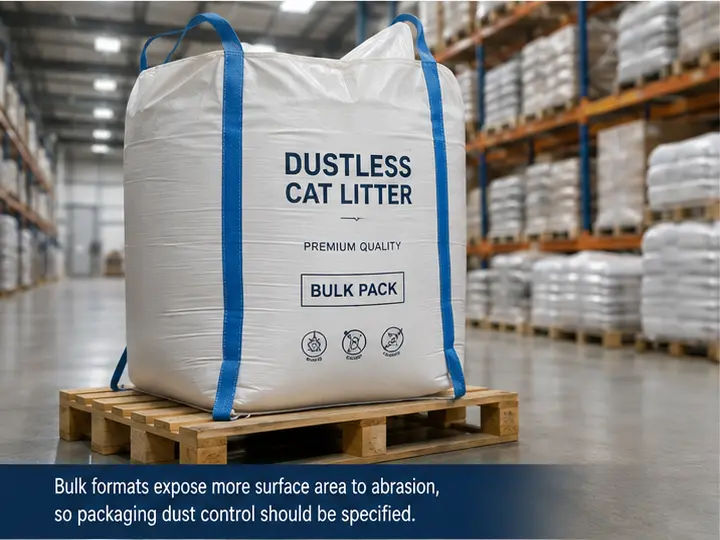
| Packaging dust control | Reduces in-transit powder migration for bulk formats |
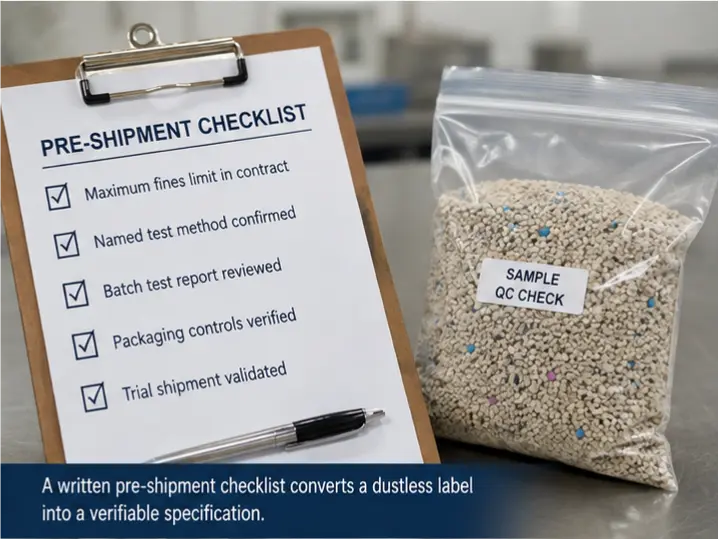
Buyer Pre-Shipment Checklist
Before confirming a production run, buyers can use a short checklist to verify the dustless claim is backed by a real spec: (1) confirm a maximum fines limit is written into the contract; (2) confirm the limit uses a named test method; (3) request a batch test report showing the actual fines result; (4) confirm packaging controls abrasion for the intended pack format; (5) validate the specification with a small trial shipment before scaling to full containers. This checklist turns a marketing label into a measurable, repeatable standard.
Conclusion
“Dustless” is a label, not a fixed material or a single industry number. Litters earn a low loose-fine result through granulation, screening, dedusting, and moisture control, and those controls — not the raw material name — decide the outcome. Buyers get the most reliable result by defining a maximum fines limit with one agreed test method, requiring batch reports, and working with a supplier that controls the process end to end. For OEM and bulk programs, a written fines specification turns a fuzzy claim into a repeatable, shippable standard.
Frequently Asked Questions
It is a buyer-facing claim that the loose fine fraction is controlled below a level the buyer accepts. It is not a regulated absolute with one mandatory pass/fail number, so the reliable step is to ask for the underlying fines limit, the test method, and the sampling conditions used to measure it.
They overlap in meaning but are not identical labels. Both describe controlled loose fines rather than a fixed material. For B2B specs, the word used on the listing matters less than the written maximum fines limit and the named test method behind it.
Dust can be evaluated in different ways depending on whether the buyer is measuring loose fines, particle-size distribution, or dust released during handling. The test method, sample preparation, and acceptance limit should therefore be stated together. For a detailed comparison of applicable testing approaches, see our cat litter dust testing standards guide.
Screening and dedusting directly remove loose fines that are already present in the product stream, while granulation and moisture control reduce the amount of new fines generated during handling. The relative contribution depends on the formulation and process, so a reliable dust specification should evaluate the finished product rather than assume one manufacturing step determines the result.
Yes. Before placing a large order, ask the supplier for a recent test report or quality record showing the dust or fines result, the method used, and the tested product specification. Then request a representative sample and, for a larger OEM program, verify the first production batch before approving a full shipment. This provides stronger evidence than relying on the “dustless” claim on the product listing.
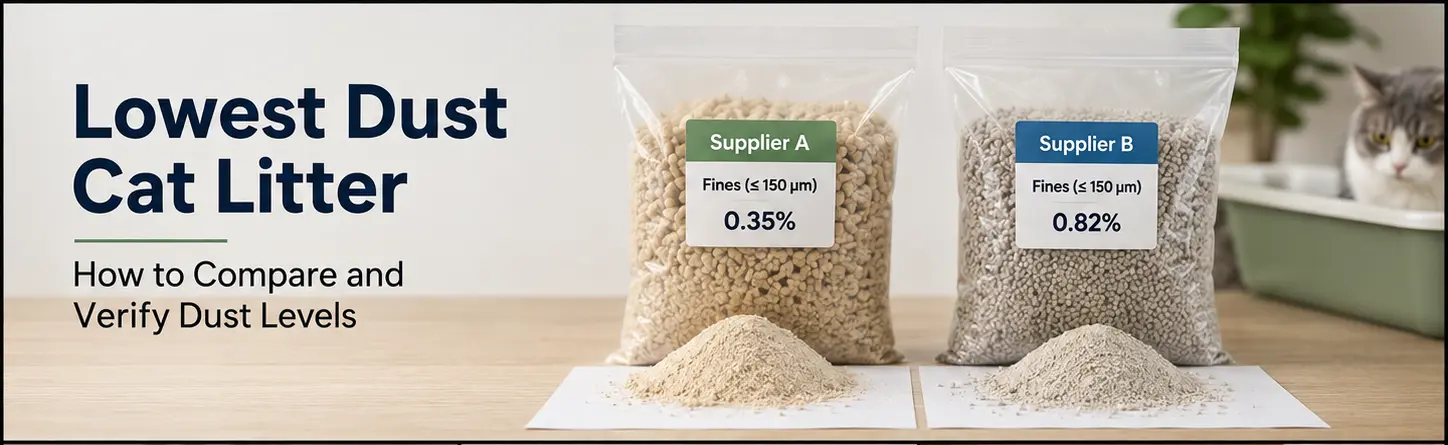
There is no single limit that fits every cat litter formula and test method. A bulk specification should state the measured parameter, test method, sample size and conditions, particle or sieve threshold where applicable, and maximum acceptable result. For example, a contract might define a maximum percentage of material passing a specified sieve, while a dynamic dust specification may define the amount of dust released under a stated handling test. The key is that both buyer and supplier use the same method and acceptance criterion.
They differ in dust-generation mechanism, not in an automatic ranking. Plant-based granules may generate fines when the structure is too brittle or drying is uneven; mineral litter can contain fines from crushing, milling, and handling; wood-based pellets can generate fines when pellets fracture or hold excessive fine material. None is inherently dustless; process control decides the outcome for every base material.
Yes. A dustless or low-fines format is a common OEM and private label specification. The key is to write the fines limit and test method into the contract rather than assume the product name guarantees them, then verify both through batch testing on each reorder.
Compare them under the same named fines test on the same batch size and conditions, then read the batch reports side by side. If each supplier uses a different method or no written limit, the dustless labels are not directly comparable until you set one common specification for both.