


Introducción
El mercado mundial de arena para gatos ha experimentado un crecimiento constante durante la última década, impulsado por el aumento de la tenencia de mascotas, las tendencias de cuidado de mascotas de alta gama y la creciente demanda de los consumidores de productos de arena prácticos y de alto rendimiento.
Hoy en día, la arena para gatos ya no se considera un artículo básico para mascotas. Los consumidores buscan activamente productos que ofrezcan un mayor control del olor, mejor aglomeración, menor cantidad de polvo y materiales ecológicos. Como resultado, categorías como la arena de tofu, la de bentonita, la desechable por el inodoro y otras soluciones premium siguen ganando cuota de mercado en Norteamérica, Europa y los mercados emergentes.
Para emprendedores, distribuidores, mayoristas, minoristas y vendedores de comercio electrónico, la arena para gatos representa una atractiva oportunidad de negocio debido a su ciclo de compra recurrente y a la creciente demanda mundial.
Sin embargo, antes de lanzar una marca o ampliar una cartera de productos, hay que tomar una decisión crucial:
¿Debería elegir arena para gatos de fabricante original o de marca blanca?
Ambos modelos de fabricación permiten a las empresas vender arena para gatos bajo su propia marca, pero difieren significativamente en cuanto a la personalización del producto, la propiedad, los requisitos de inversión, los plazos de entrega y el potencial de crecimiento a largo plazo.
Elegir el modelo adecuado puede influir en todo, desde los costes iniciales y la diferenciación del producto hasta la rentabilidad y la competitividad de la marca.
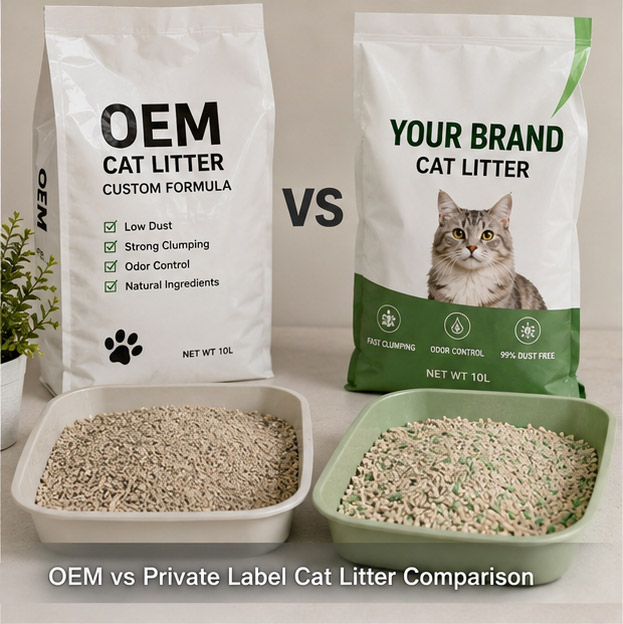
En esta guía, comparamos en detalle la arena para gatos de marca propia (OEM) y la de marca blanca, ayudándote a comprender las ventajas, las limitaciones y las aplicaciones ideales de cada opción para que puedas tomar una decisión empresarial informada.
Arena para gatos de marca propia frente a arena para gatos de marca blanca: una comparación rápida.
Antes de entrar en detalles, la siguiente tabla resume las principales diferencias entre los dos modelos.
| Factor | Arena para gatos OEM | Arena para gatos de marca propia |
|---|---|---|
| Propiedad de la fórmula | Propiedad de la marca | Propiedad de la fábrica |
| Personalización de productos | Alto | Limitado |
| Personalización de envases | Completo | Básico |
| Cantidad mínima de pedido | Más alto | Más bajo |
| Tiempo de desarrollo | Más extenso | Más corto |
| Inversión inicial | Más alto | Más bajo |
| Diferenciación de mercado | Fuerte | Limitado |
| Propiedad intelectual | Propiedad de la marca | Propiedad de la fábrica |
| Adecuado para | Marcas consolidadas | Empresas emergentes y pruebas de mercado |
| Potencial de ganancias | Mayor a largo plazo | Moderado |
Si bien la marca blanca ofrece una entrada al mercado más rápida y con menor riesgo, la fabricación para terceros (OEM) brinda mayores oportunidades para la diferenciación de la marca y la rentabilidad a largo plazo.
¿Qué es Arena para gatos OEM?
OEM significa Fabricante de Equipos Originales.
En la industria de la arena para gatos, el término OEM se refiere a un modelo de fabricación en el que la marca desarrolla o especifica el producto, mientras que la fábrica lo produce de acuerdo con los requisitos de la marca.
En una colaboración con un fabricante de equipos originales (OEM), la marca tiene un control significativo sobre el producto y puede personalizar prácticamente todos los aspectos de la solución final.
Estos elementos pueden incluir:
- Selección de materia prima
- Composición de la fórmula
- Tamaño de partícula
- Opciones de fragancias
- Normas de control del polvo
- Capacidad de aglomeración
- Diseño de envases
- Especificaciones del producto
- Estándares de calidad
En términos sencillos:
La marca crea el concepto del producto y el fabricante lo hace realidad.
Por ejemplo, una marca podría querer:
- Arena para gatos de bentonita con muy bajo contenido de polvo
- Arena para gatos con aroma a tofu y lavanda
- Arena para gatos desechable por el inodoro para mercados de alta gama
- Fórmulas ecológicas de origen vegetal
- Tamaños de partículas personalizados para gatos de pelo largo
A continuación, el fabricante desarrolla y produce el producto de acuerdo con estos requisitos.
Como resultado, el producto final se convierte en un elemento exclusivo de la marca.
Ventajas de la arena para gatos OEM
Personalización completa del producto
La fabricación OEM permite a las marcas crear productos verdaderamente diferenciados.
En lugar de vender la misma fórmula que utilizan múltiples competidores, las empresas pueden desarrollar características y especificaciones exclusivas adaptadas a sus clientes objetivo.
Algunos ejemplos son:
- Fórmulas con mayor capacidad de aglutinación
- Control de olores mejorado
- Menor contenido de polvo
- Fragancias personalizadas
- Ingredientes ecológicos de primera calidad
Esta flexibilidad resulta especialmente valiosa en mercados altamente competitivos.
Propiedad exclusiva del producto
Una de las mayores ventajas de la fabricación OEM es la propiedad.
La marca posee:
- Especificaciones del producto
- Fórmulas personalizadas
- Diseños de envases
- Posicionamiento del producto
En la mayoría de los casos, los fabricantes no pueden ofrecer legalmente el mismo producto personalizado a las marcas de la competencia.
Esto crea una ventaja competitiva significativa y ayuda a establecer una diferenciación de mercado a largo plazo.
Identidad de marca más sólida
Los consumidores prefieren cada vez más las marcas con propuestas de valor únicas.
Los productos OEM permiten a las empresas construir identidades de marca más sólidas a través de:
- Características únicas del producto
- Embalaje personalizado
- Puntos de venta exclusivos
- Mayor valor percibido
Esto suele traducirse en una mayor fidelidad de los clientes y un mayor poder de fijación de precios.
Mayor potencial de ganancias a largo plazo
Si bien los productos de fabricantes de equipos originales (OEM) suelen requerir una mayor inversión inicial, a menudo generan mayores márgenes de beneficio con el tiempo.
Las marcas pueden evitar la competencia directa de precios y centrarse en ofrecer un valor único a los clientes.
Como resultado, muchas marcas de mascotas exitosas acaban pasando de los productos de marca blanca a las soluciones OEM a medida que su negocio crece.
¿Qué es Arena para gatos de marca propia?
La arena para gatos de marca blanca es un modelo de fabricación en el que la fábrica ya tiene productos terminados y la marca simplemente añade su propio logotipo y embalaje.
A diferencia de la fabricación OEM, la marca no desarrolla una fórmula exclusiva.
En cambio, selecciona productos ya existentes del catálogo del fabricante y los vende bajo su propia marca.
Este modelo se ha vuelto extremadamente popular entre las empresas emergentes y los vendedores novatos porque reduce tanto la complejidad como el riesgo financiero.
Entre los productos típicos disponibles a través de programas de marca blanca se incluyen:
- La arena para gatos de tofu
- La arena para gatos de bentonita
- La arena para gatos mixta
- Arena para gatos que se puede tirar por el inodoro
- Arena para gatos sin polvo
La fábrica se encarga del desarrollo, las pruebas y la producción del producto, mientras que la marca se centra en el marketing y las ventas.
Ventajas de la arena para gatos de marca propia
Entrada más rápida al mercado
Una de las ventajas más significativas de la fabricación de marcas blancas es la rapidez.
Dado que el producto ya existe, las empresas pueden lanzarlo mucho más rápido.
En muchos casos:
- La selección de productos solo lleva unos pocos días.
- La aprobación del embalaje tarda varios días.
- La producción y el envío pueden comenzar de inmediato.
Esto permite a las marcas entrar rápidamente en el mercado y aprovechar las tendencias emergentes.
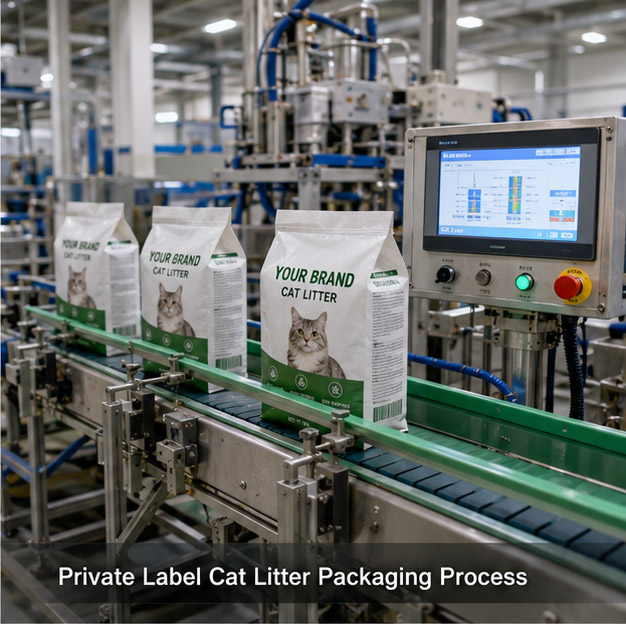
Menores costos de puesta en marcha
La marca blanca elimina muchos de los gastos asociados al desarrollo de productos.
Las empresas generalmente evitan:
- Costos de desarrollo de fórmulas
- Gastos de prueba de productos
- Costos de desarrollo de moho
- inversiones en I+D
Esto reduce significativamente la barrera financiera de entrada.
Cantidades mínimas de pedido más bajas
Muchos fabricantes ofrecen requisitos de cantidad mínima de pedido (MOQ) más bajos para los programas de marca propia.
Esto facilita lo siguiente:
- demanda de prueba
- Validar la adecuación del producto al mercado.
- Lanzar nuevas líneas de productos
- Gestionar el riesgo de inventario
Para las empresas nuevas, unos requisitos de cantidad mínima de pedido más bajos pueden reducir drásticamente el riesgo operativo.
Gestión simplificada de la cadena de suministro
Dado que la fábrica ya produce y prueba el producto, los vendedores pueden centrarse en:
- Herrada
- Marketing
- Adquisición de clientes
- Distribución
Esta sencillez convierte a la marca blanca en una opción atractiva para los emprendedores que se inician en el sector de los productos para mascotas.
Arena para gatos de marca propia frente a marca blanca: personalización del producto
La personalización suele ser el factor más importante a la hora de comparar las soluciones OEM y de marca blanca.
Con la fabricación OEM, las marcas pueden personalizar prácticamente todos los aspectos del producto.
Algunos ejemplos son:
- Composición de la fórmula
- Capacidad de aglomeración
- Niveles de polvo
- Perfiles de fragancias
- Forma de la partícula
- Variaciones de color
- Materiales de embalaje
- Especificaciones del producto
Esta flexibilidad permite a las marcas desarrollar productos que se ajusten estrechamente a las preferencias de los clientes.
Por el contrario, la personalización de marca privada generalmente se limita a:
- logotipos de marcas
- Nombres de productos
- Gráficos de empaque
- Texto publicitario
El producto subyacente generalmente permanece sin cambios.
Para las empresas que buscan una posición única en el mercado, la fabricación para terceros (OEM) ofrece una ventaja significativa.
Arena para gatos de marca propia frente a arena para gatos de marca blanca: Diferenciación de productos
Uno de los mayores retos en la industria de la arena para gatos es la homogeneización del producto.
Muchos productos en el mercado comparten fórmulas y características de rendimiento similares.
Con la fabricación OEM, las empresas pueden crear productos diferenciados en función de las necesidades específicas de cada cliente.
Por ejemplo:
- Arena para gatos de alta calidad y baja emisión de polvo para propietarios de apartamentos.
- Fórmulas de alto rendimiento para el control de olores en hogares con varios gatos.
- Productos ecológicos para consumidores concienciados con el medio ambiente.
- Arena especializada diseñada para gatitos o gatos mayores.
Estas características únicas ayudan a las marcas a diferenciarse de la competencia.
Sin embargo, los productos de marca blanca suelen basarse en las mismas fórmulas de fábrica que utilizan varias marcas.
En consecuencia, la diferenciación se limita principalmente al embalaje y la imagen de marca.
Cuando los consumidores comparan productos, el precio suele ser el factor decisivo.
Esto puede generar una presión significativa sobre los márgenes de beneficio.
Arena para gatos de marca propia frente a arena para gatos de marca blanca: Estructura de costes
El coste suele ser uno de los factores más importantes a la hora de seleccionar un modelo de fabricación.
Sin embargo, las empresas deben evaluar tanto los costes a corto como a largo plazo.
La fabricación OEM normalmente implica:
- gastos de desarrollo de productos
- Pruebas de fórmulas
- Personalización del embalaje
- Costos de configuración de producción
- Cantidades mínimas de pedido más elevadas
La inversión inicial es mayor, pero el producto resultante puede generar márgenes más sólidos y un mayor valor de marca.
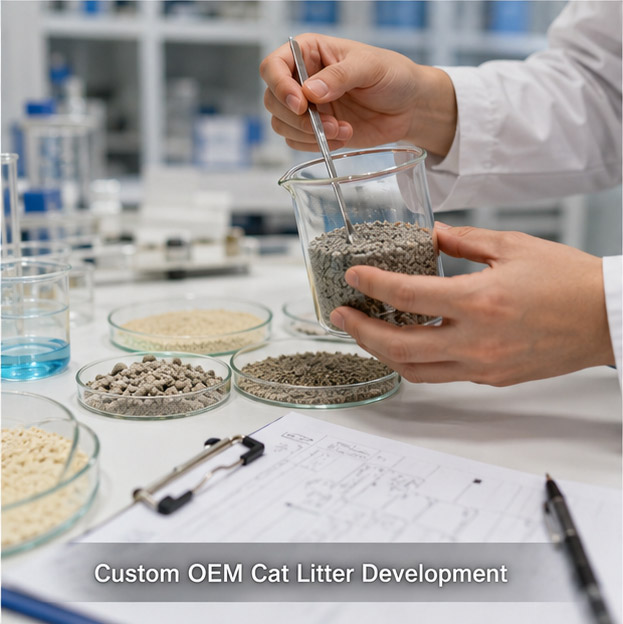
La fabricación de marcas blancas generalmente requiere:
- Costos de diseño de empaques
- Gastos de etiquetado
- Compras de inventario inicial
Dado que el producto ya existe, los costes iniciales son sustancialmente menores.
Para las empresas con presupuestos limitados, la marca blanca suele ser la vía más rápida para acceder al mercado.
Arena para gatos de marca propia frente a marca blanca: cantidad mínima de pedido, propiedad intelectual y rentabilidad
Arena para gatos de marca propia frente a marca blanca: cantidad mínima de pedido y plazo de entrega.
La cantidad mínima de pedido (MOQ) y el plazo de entrega de producción pueden afectar significativamente la gestión de inventario, el flujo de caja y el riesgo empresarial.
Estos factores son especialmente importantes para las empresas emergentes y las marcas en crecimiento.
Cantidad mínima de pedido y plazo de entrega para arena para gatos OEM
Los proyectos de arena para gatos OEM generalmente requieren:
- Desarrollo de fórmulas
- Pruebas de producto
- Aprobación de la muestra
- Personalización del embalaje
- Configuración de la línea de producción
Dado que el fabricante debe asignar recursos específicamente para su producto, los proyectos OEM suelen requerir series de producción más grandes.
Dependiendo del producto y del nivel de personalización, los requisitos de cantidad mínima de pedido (MOQ) pueden oscilar entre varios miles y decenas de miles de bolsas.
Los plazos de entrega también son más largos.
Un proyecto típico de un fabricante de equipos originales (OEM) puede requerir:
- De 7 a 15 días para el desarrollo de la muestra.
- De 7 a 15 días para revisiones y aprobación
- De 10 a 20 días para la producción
Todo el proceso suele durar entre 20 y 45 días.
Para productos altamente personalizados, los ciclos de desarrollo pueden ser incluso más largos.
Cantidad mínima de pedido y plazo de entrega para marcas privadas
Los productos de marca propia ya están desarrollados y listos para la producción.
Como resultado:
- No se requiere el desarrollo de ninguna fórmula.
- No se requieren pruebas exhaustivas.
- Las líneas de producción ya están optimizadas
Muchos fabricantes ofrecen requisitos de cantidad mínima de pedido (MOQ) significativamente más bajos para los programas de marca propia.
Esto permite a las empresas:
- Probar nuevos mercados
- Lanzamiento rápido
- Reducir la presión sobre el inventario
- Minimizar el riesgo financiero
En muchos casos, los productos pueden prepararse y enviarse en un plazo de 3 a 7 días después de la aprobación del embalaje.
Para los vendedores novatos, esta rapidez puede suponer una gran ventaja.
Arena para gatos de marca propia frente a arena para gatos de marca blanca: propiedad intelectual y titularidad del producto
Muchas empresas nuevas se centran principalmente en los costes de los productos, pasando por alto los derechos de propiedad intelectual.
Sin embargo, la propiedad intelectual suele determinar la competitividad a largo plazo.
Propiedad del producto OEM
En un acuerdo OEM, las marcas generalmente son propietarias de los aspectos personalizados del producto.
Entre ellos pueden figurar:
- Fórmulas patentadas
- Envases a medida
- Posicionamiento del producto
- Especificaciones específicas de la marca
Como resultado, los competidores no pueden replicar fácilmente el mismo producto.
Esto crea valor a largo plazo y ayuda a proteger la cuota de mercado.
Para las marcas que planean construir un negocio sostenible, la propiedad del producto puede convertirse en uno de los activos estratégicos más importantes.
Propiedad de productos de marca propia
Los productos de marca propia funcionan de manera diferente.
El fabricante suele ser propietario de:
- Fórmulas de productos
- procesos de producción
- Especificaciones técnicas
Varias marcas pueden comprar y vender el mismo producto bajo diferentes etiquetas.
Si bien este modelo ofrece comodidad y menores costos, también crea limitaciones.
Las empresas tienen menos control sobre:
- Mejoras del producto
- Ajustes de fórmulas
- diferenciación de características
A medida que aumenta la competencia, resulta más difícil destacar.
Arena para gatos de marca propia frente a marca blanca: diferenciación de mercado y ventaja competitiva.
Uno de los mayores retos a los que se enfrentan hoy en día las marcas de arena para gatos es la saturación del mercado.
Los consumidores tienen acceso a miles de productos similares a través de canales online y offline.
La capacidad de diferenciar se vuelve cada vez más importante.
Cómo el fabricante de equipos originales (OEM) apoya la diferenciación de marca
La fabricación OEM permite a las empresas crear productos que resuelven problemas específicos de los clientes.
Por ejemplo:
Hogares con varios gatos
Una marca puede desarrollar:
- Control de olores mejorado
- Rendimiento de aglomeración más rápido
- Frescura prolongada
Dueños de mascotas premium
Una marca puede centrarse en:
- Fórmulas con muy bajo contenido de polvo
- Ingredientes naturales
- Envase ecológico
Mercados internacionales
Las empresas que se dirigen a Europa o Norteamérica pueden necesitar:
- Materiales biodegradables
- Abastecimiento sostenible
- Cumplimiento normativo específico
La personalización OEM permite a las marcas alinear sus productos estrechamente con estos requisitos.
Esto suele justificar precios más elevados y una mayor fidelización de los clientes.
Desafíos de la diferenciación de productos de marca propia
Los productos de marca blanca aún pueden tener éxito.
Sin embargo, las oportunidades de diferenciación suelen ser más limitadas.
Debido a que varias marcas pueden vender la misma fórmula de fábrica, la competencia a menudo se desplaza hacia:
- Precios
- Publicidad
- Distribución
- Servicio al cliente
Si bien estos factores son importantes, puede que no generen ventajas competitivas sostenibles.
Por este motivo, muchas marcas de éxito acaban optando por soluciones OEM tras conseguir una tracción inicial en el mercado.
¿Qué modelo debería elegir?
La respuesta depende de los objetivos de su negocio, su presupuesto y su estrategia de crecimiento.
Ninguno de los dos modelos es intrínsecamente mejor.
Cada una satisface diferentes necesidades empresariales.
Elija arena para gatos de marca propia si:
- Eres nuevo en la industria de la arena para gatos.
- Quieres probar la demanda rápidamente
- Tienes un capital inicial limitado.
- Prefieres un menor riesgo de inventario.
- Necesitas un cronograma de lanzamiento más rápido.
- Estás validando un nuevo mercado.
La marca blanca suele ser el punto de entrada más rápido y de menor riesgo para las empresas emergentes.
Muchas marcas exitosas comienzan con productos de marca blanca antes de pasar a soluciones personalizadas.
Elija arena para gatos OEM si:
- Quieres productos exclusivos
- Planeas construir una marca a largo plazo.
- Necesitas fórmulas diferenciadas
- Quieres un mayor control sobre los estándares de calidad.
- Te diriges a segmentos de clientes de alta gama.
- Buscas mayores márgenes de beneficio
La fabricación de equipos originales (OEM) requiere una mayor inversión, pero ofrece más oportunidades para un crecimiento sostenible.
Lo que hemos aprendido al trabajar con clientes OEM y de marca propia.
Como fabricante de arena para gatos que presta servicios tanto a clientes OEM como a clientes de marca blanca, hemos observado varios patrones comunes.
Muchas empresas exitosas comienzan con productos de marca propia porque permiten una rápida entrada al mercado y un menor riesgo.
Una vez que se valida la demanda y se estabilizan los canales de venta, estas empresas suelen pasar a la fase de desarrollo OEM.
La razón es simple:
A medida que aumenta la competencia, la diferenciación cobra mayor importancia.
Las fórmulas exclusivas, las características únicas de los productos y una imagen de marca más sólida suelen ayudar a las empresas a conseguir mayores márgenes de beneficio y a fidelizar a sus clientes.
Para las marcas centradas en el crecimiento a largo plazo, la fabricación OEM suele ser el siguiente paso tras la validación inicial del mercado.
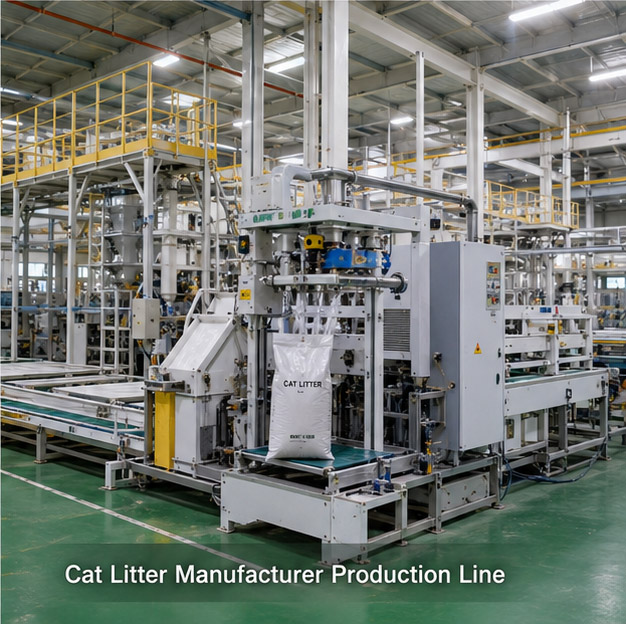
Cómo elegir un fabricante de arena para gatos confiable
Elegir el modelo de fabricación adecuado es solo una parte del proceso de toma de decisiones.
La calidad y las capacidades de su socio fabricante son igualmente importantes.
Antes de seleccionar un proveedor, las empresas deben evaluar:
- Capacidad de fabricación
- Sistemas de control de calidad
- Consistencia del producto
- Capacidades OEM
- Experiencia en exportación
- Opciones de embalaje
- fiabilidad de la cadena de suministro
Si está evaluando posibles proveedores, nuestra guía sobre Cómo elegir un fabricante de arena para gatos confiable proporciona un marco detallado para las auditorías de fábrica y la selección de proveedores.
Comprender el proceso subyacente de fabricación de la arena para gatos también puede ayudar a los compradores a evaluar la calidad de la producción e identificar socios de fabricación fiables.
Reflexiones finales
Al comparar la arena para gatos de marca propia con la de marca blanca, no existe una respuesta que sirva para todos los casos.
Ofertas de marca blanca:
- Menores costos de puesta en marcha
- Lanzamientos de productos más rápidos
- Requisitos de MOQ más pequeños
- Riesgo reducido
Ofertas OEM:
- Exclusividad del producto
- Mayor diferenciación
- Propiedad intelectual
- Mayor rentabilidad a largo plazo
Para las empresas emergentes y las pruebas de mercado, la marca blanca suele ser la solución más práctica.
Para las empresas centradas en la creación de marca y el crecimiento a largo plazo, la fabricación OEM suele ofrecer mayores ventajas estratégicas.
Las marcas de arena para gatos más exitosas suelen utilizar ambos modelos en diferentes etapas de su desarrollo.
Comienzan con productos de marca blanca para validar la demanda del mercado y, posteriormente, hacen la transición a productos OEM a medida que desarrollan el reconocimiento de la marca y la fidelización de los clientes.
Preguntas frecuentes
¿Cuál es la diferencia entre la arena para gatos de marca propia (OEM) y la de marca blanca?
La arena para gatos OEM se desarrolla según las especificaciones de la marca, mientras que la arena para gatos de marca blanca utiliza productos de fábrica ya existentes con una marca y un embalaje personalizados.
¿Qué opción es mejor para las empresas emergentes?
En general, la marca blanca es mejor para las empresas emergentes porque requiere una menor inversión, requisitos de cantidad mínima de pedido más bajos y una entrada al mercado más rápida.
¿Es más rentable la arena para gatos fabricada por el fabricante original?
Los productos de fabricantes de equipos originales (OEM) suelen alcanzar mayores márgenes de beneficio a largo plazo porque ofrecen una mayor diferenciación y una menor competencia directa.
¿Puedo cambiar de marca privada a OEM más adelante?
Sí. Muchas marcas exitosas comienzan con productos de marca blanca y luego pasan a la fabricación OEM tras validar la demanda del mercado.
¿El fabricante de equipos originales (OEM) exige una cantidad mínima de pedido (MOQ) más alta?
En la mayoría de los casos, sí. La fabricación OEM generalmente implica tiradas de producción más grandes debido a la personalización y a los requisitos de configuración de la producción.
¿Qué modelo es mejor para construir una marca?
La fabricación por contrato (OEM) suele ser mejor para la construcción de marca a largo plazo porque proporciona productos exclusivos, propiedad intelectual y una mayor diferenciación.