




Introduction
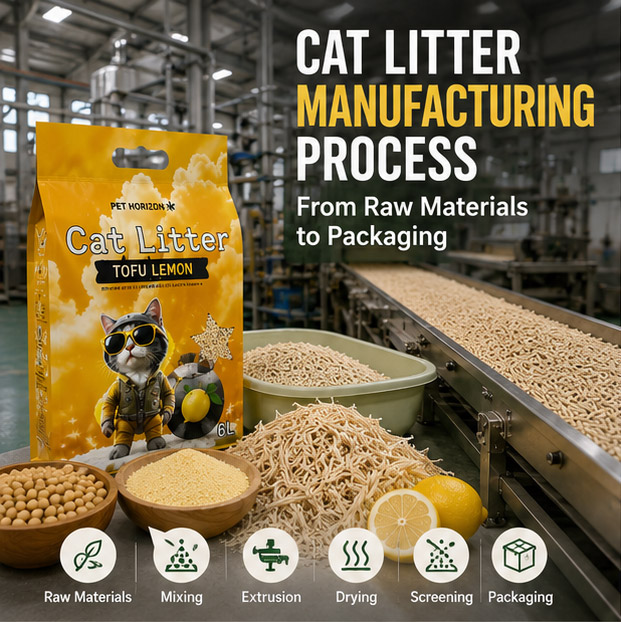
As the global pet care industry continues to grow, cat litter has evolved from a basic pet product into a highly competitive category with increasing demand for quality, sustainability, and performance. Among various litter types, tofu cat litter has become one of the fastest-growing segments in both domestic and international markets due to its low dust content, flushability, natural ingredients, and strong clumping performance.
For importers, distributors, private-label brands, and pet product retailers, understanding the cat litter manufacturing process is essential when evaluating suppliers and selecting reliable manufacturing partners. Product quality is determined not only by raw materials but also by every stage of production, from ingredient preparation and extrusion to drying, dust removal, quality inspection, and packaging.
As a cat litter manufacturer serving OEM and private-label customers, we have found that consistent quality depends on strict control of moisture, particle hardness, dust levels, and production parameters throughout the entire manufacturing process.
This guide explains the complete cat litter manufacturing process, highlights critical quality control points, and outlines common production challenges and optimization methods used by modern cat litter factories.
What Raw Materials Are Used in Cat Litter Manufacturing?
Understanding the Core Ingredients of Tofu Cat Litter
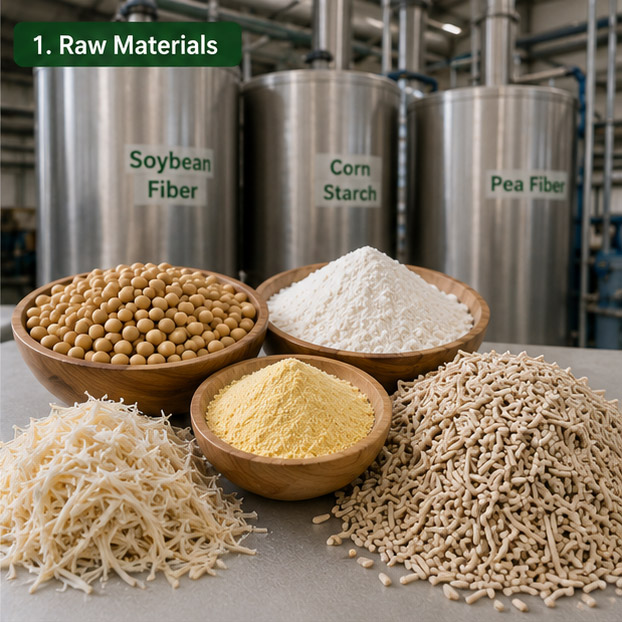
Tofu cat litter differs significantly from traditional clay-based litter products. Instead of relying on bentonite or mineral materials, tofu litter is primarily manufactured using plant-based ingredients that offer better environmental performance and easier disposal.
The most common raw materials include:
- Soybean fiber (soybean residue)
- Pea fiber
- Corn starch
- Pea starch
- Plant cellulose
- Food-grade deodorizing additives
- Natural binders
These ingredients work together to provide:
- Strong clumping ability
- Fast liquid absorption
- Low dust performance
- Flushability
- Natural odor control
As consumer demand shifts toward environmentally friendly pet products, tofu cat litter has become particularly popular in North America, Europe, Japan, and South Korea.
For long-haired cat breeds such as Ragdolls, Persian cats, and Maine Coons, litter performance standards are even higher. End users typically prioritize:
- Low dust
- Minimal tracking
- Reduced fur adhesion
- Effective odor control
These requirements directly influence manufacturing parameters and quality standards throughout the production process.
Raw Material Inspection and Acceptance Standards
One of the most overlooked aspects of the cat litter production process is raw material quality control.
Even the most advanced production line cannot compensate for poor-quality ingredients.
Upon arrival at the factory, every batch of raw materials should undergo inspection for:
- Moisture content
- Mold contamination
- Ash content
- Particle consistency
- Storage stability
Soybean residue generally falls into two categories:
Fresh Soybean Residue
- Moisture content: 55%–70%
- Requires immediate processing
- Higher transportation cost
Dried Soybean Residue
- Moisture content: ≤12%
- Easier storage
- More common in industrial production
Quality control teams typically reject materials showing:
- Visible mold growth
- Excessive moisture
- Foreign contaminants
- Severe caking
Mold-contaminated materials may contain aflatoxins that can negatively affect pet health and damage brand reputation.
For export-oriented factories, raw material traceability has become a standard requirement during customer audits and factory inspections.
Auxiliary Materials and Formula Design
Besides the primary ingredients, manufacturers use various functional additives to improve product performance.
Common additives include:
Baking Soda
Used to enhance odor absorption and neutralization.
Plant Cellulose
Improves absorption speed and liquid retention.
Guar Gum
Increases particle toughness and reduces breakage during transportation.
Natural Deodorizing Agents
Provide long-lasting odor control without introducing harsh chemicals.
The formulation varies depending on market positioning.
Premium Export Formula
- Soybean residue: 65%
- Starch: 28%
- Functional additives: 7%
Standard Domestic Formula
- Soybean residue: 75%
- Starch: 20%
- Functional additives: 5%
For OEM and private-label projects, formulas are often customized according to customer requirements, target markets, and pricing strategies.
Customized formulations are one of the key capabilities that buyers evaluate when selecting a cat litter factory.
Raw Material Preparation and Processing
Crushing and Grinding
Raw materials cannot be used directly in production.
Before entering the mixing stage, soybean residue and starch materials must be processed into a uniform powder.
The crushing process generally consists of two stages.
Stage One: Coarse Crushing
Large agglomerates are reduced to particles measuring approximately 2–5 mm.
Stage Two: Fine Grinding
Materials are further processed into powder ranging between 80 and 120 mesh.
Particle size directly affects product performance.
If the powder is too coarse:
- Dust levels increase
- Clumping becomes inconsistent
- Surface texture becomes rough
If the powder is too fine:
- Particles become excessively hard
- Water absorption slows
- Clumping speed decreases
In our manufacturing experience, maintaining a consistent grinding range is one of the most important factors affecting final product quality.
Screening and Impurity Removal
After grinding, materials pass through a multi-layer vibration screening system.
The screening process removes:
- Stones
- Plastic fragments
- Fiber lumps
- Oversized particles
Only qualified fine powder proceeds to the next production stage.
The screened material is then transferred to sealed storage silos to prevent contamination and moisture absorption.
A well-controlled screening process contributes significantly to the low-dust performance expected from premium tofu cat litter products.
Mixing and Conditioning in the Cat Litter Production Process
Automated Batching Systems
Modern cat litter manufacturing process facilities increasingly rely on PLC-controlled batching systems instead of manual weighing.
Automated systems improve:
- Formula consistency
- Production efficiency
- Quality stability
- Traceability
Typical batching accuracy can reach ±0.5%.
By comparison, manual weighing often introduces errors ranging from 3% to 8%.
Even small formulation deviations can cause significant product issues.
Too Little Starch
May result in:
- Weak clumps
- Particle breakage
- Poor product durability
Excessive Starch
May cause:
- Overly hard particles
- Reduced absorption speed
- Inferior user experience
For OEM customers, batching records are often retained as part of production traceability documentation.
Moisture Conditioning and High-Speed Mixing
Once ingredients have been weighed and transferred to the mixer, controlled amounts of purified water are introduced through atomized spray systems.
The objective is to achieve a moisture content between:
28% and 33%
This moisture range allows the material to form a cohesive mixture suitable for extrusion.
High-capacity ribbon mixers continuously blend:
- Soybean residue powder
- Starch
- Functional additives
- Water
Mixing time generally ranges from:
8 to 12 minutes
The result is a uniform mixture with stable consistency throughout the batch.
Moisture control is one of the most critical factors in the entire cat litter manufacturing process.
If moisture is too high:
- Particles stick together
- Drying costs increase
- Product quality declines
If moisture is too low:
- Extrusion becomes unstable
- Particle breakage increases
- Production efficiency decreases
At Pet Horizon, moisture levels are continuously monitored and adjusted throughout production to maintain consistency and reduce quality variation between batches.
Extrusion and Granulation: The Core of Cat Litter Manufacturing
Twin-Screw Extrusion Technology
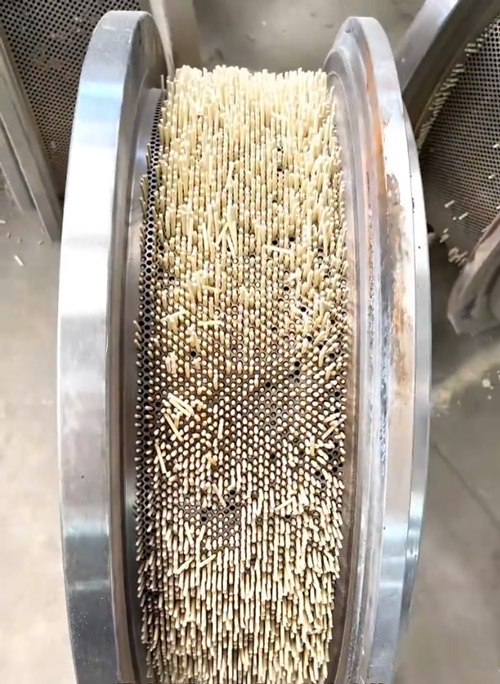
Extrusion is the stage where raw materials are transformed into cat litter particles.
The conditioned mixture enters a twin-screw extruder where pressure, temperature, and mechanical force work together to create stable particle structures.
Typical temperature settings include:
Feeding Zone
55–65°C
Cooking Zone
95–110°C
Forming Zone
70–80°C
Under these conditions, starch undergoes gelatinization and becomes a natural binding agent.
The material is then pushed through a die plate to form continuous cylindrical strands.
Die diameter determines particle size.
Common specifications include:
- 1.5 mm for fine-particle litter
- 2.0 mm for standard litter
- 3.0 mm for larger particle products
For long-haired cat breeds, many premium brands prefer finer particle sizes because they reduce tracking and improve comfort.
Particle Cutting and Initial Screening
After extrusion, continuous strands move through an automatic cutting system.
Most tofu cat litter products are cut into lengths ranging from:
6–8 mm
This size provides an effective balance between:
- Clumping performance
- Tracking resistance
- Durability
Oversized particles may be carried outside the litter box by cats, while excessively short particles often generate additional dust.
Following cutting, the semi-finished particles enter an initial screening system where:
- Qualified particles move forward
- Broken particles are recycled
- Agglomerated material is reprocessed
Efficient recycling systems can achieve raw material utilization rates above 98%, significantly reducing manufacturing costs while improving sustainability.
Drying and Cooling in the Cat Litter Manufacturing Process
Multi-Stage Drying and Moisture Control
After extrusion and cutting, tofu cat litter particles still contain approximately 30% moisture. At this stage, the product lacks sufficient hardness and stability for storage and transportation.
Drying is therefore one of the most critical stages in the entire cat litter manufacturing process.
Most modern cat litter production lines utilize multi-stage mesh belt dryers that gradually remove moisture while maintaining particle integrity.
A typical drying system includes three stages:
Stage 1: Pre-Drying
Temperature: approximately 60°C
The objective is to remove surface moisture and prepare particles for deeper dehydration.
Stage 2: Main Drying
Temperature: 85–95°C
This stage removes most of the internal moisture and significantly increases particle strength.
Stage 3: Final Setting
Temperature: approximately 70°C
The particle structure is stabilized and hardened to achieve consistent performance.
Ideal Moisture Content for Finished Cat Litter
One of the most common questions from buyers is:
What moisture level should high-quality cat litter have?
In our experience as a cat litter manufacturer, the optimal moisture content generally falls between:
8%–12%
This range provides the best balance between:
- Clumping performance
- Product durability
- Dust control
- Shipping stability
When moisture exceeds 14%:
- Mold growth risk increases
- Product shelf life decreases
- Container shipments become vulnerable to moisture damage
When moisture falls below 6%:
- Particles become brittle
- Breakage increases
- Dust levels rise significantly
For export markets, many customers require finished moisture levels below 10% to ensure product stability during long-distance ocean transportation.
Cooling and Secondary Screening
After drying, particle temperatures often exceed 60°C.
Packaging hot products directly can cause:
- Condensation inside bags
- Moisture regain
- Product caking
To avoid these issues, cat litter particles pass through an air-cooling conveyor system until they reach ambient temperature.
The cooled product then enters a secondary screening process.
This stage removes:
- Oversized particles
- Fine dust
- Agglomerated material
- Production debris
Only qualified particles proceed to the finishing stage.
For premium OEM projects, many factories add additional negative-pressure dust collection systems during this phase to further improve product cleanliness.
Dust Removal, Polishing, and Product Enhancement
Drum Polishing Process
One characteristic that separates premium tofu cat litter from low-cost alternatives is particle surface quality.
After screening, qualified particles enter a rotating polishing drum.
During polishing:
- Surface burrs are removed
- Loose dust is eliminated
- Particle appearance improves
- Product consistency increases
Unpolished cat litter often contains rough edges that can:
- Increase dust generation
- Cause tracking
- Adhere more easily to long-haired cats
For premium export products, polishing has become a standard manufacturing requirement.
Based on customer feedback, polishing can significantly improve user satisfaction and reduce complaints related to dust and fur adhesion.
Advanced Dust Removal Technology
Dust control remains one of the most important quality indicators in the cat litter industry.
Modern cat litter factories often utilize:
- Cyclone separators
- Negative-pressure collection systems
- Multi-stage filtration units
These technologies remove floating dust generated during:
- Grinding
- Screening
- Drying
- Packaging
For premium low-dust products, finished dust levels can be controlled below 0.5%.
This is particularly important for:
- Multi-cat households
- Long-haired cat breeds
- Customers sensitive to airborne dust
Deodorization and Functional Enhancement
After polishing, some manufacturers apply functional coatings to improve performance.
These coatings may include:
Natural Deodorizing Agents
Designed to neutralize odors from urine and feces.
Plant-Based Odor Absorbers
Provide longer-lasting odor control.
Functional Additives
Improve antibacterial performance and freshness.
The additives are typically applied through atomized spraying systems that ensure even distribution across the particle surface.
Premium export products usually include this additional process, while economy-grade products often rely solely on the natural odor-control properties of the raw materials.
Quality Control in Cat Litter Manufacturing
Why Quality Control Matters
Even small production inconsistencies can lead to customer complaints and brand damage.
For this reason, every batch should undergo comprehensive quality testing before packaging.
Reliable cat litter manufacturers typically maintain dedicated laboratories to monitor product performance.
Key Testing Standards
Moisture Content Test
Ensures the product meets storage and transportation requirements.
Target range:
8%–12%
Dust Content Test
Measures airborne particles generated during handling.
Premium products often target:
≤0.5%
Water Absorption Test
Measures liquid absorption speed.
A common benchmark is:
5 ml of water absorbed within 8 seconds.
Clumping Strength Test
Evaluates the durability of formed clumps.
High-quality clumps should remain intact after being dropped from approximately one meter.
Water Solubility Test
Particularly important for flushable tofu cat litter.
Qualified products should disintegrate completely after approximately 30 minutes in water.
Microbial Testing
Verifies product safety and prevents contamination issues.
Common tests include:
- Mold count
- Yeast count
- Microbial contamination screening
These testing procedures help ensure consistent quality and provide confidence for distributors, wholesalers, and private-label customers.
Packaging and Warehousing
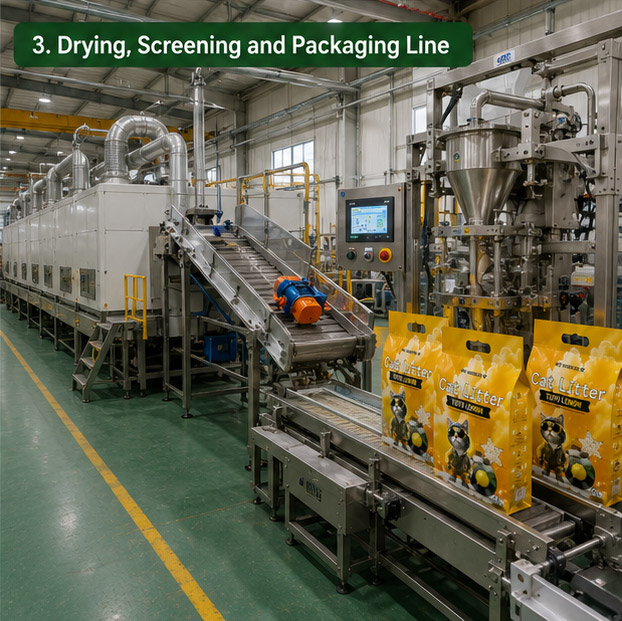
Automatic Packaging Systems
Once quality inspections are completed, the finished product moves to the packaging department.
Modern packaging lines typically support multiple package sizes.
Common retail formats include:
- 1.5 kg
- 2.5 kg
- 6 kg
Export and wholesale customers often prefer:
- 10 kg bags
- 20 kg bags
- Customized private-label packaging
Automatic packaging systems perform:
- Filling
- Weighing
- Sealing
- Date coding
- Batch tracking
Packaging accuracy is critical because weight inconsistencies can create customer complaints and regulatory issues.
Finished Product Storage
Proper warehouse management is essential for maintaining product quality.
Recommended warehouse conditions include:
Relative Humidity
45%–60%
Pallet Storage
Products should be stored above floor level to prevent moisture absorption.
Batch Separation
Different formulas and production batches should be clearly identified and separated.
This system improves inventory management and supports product traceability.
Outbound Inspection and Traceability
Before shipment, a final inspection verifies:
- Product specifications
- Packaging quality
- Batch records
- Quality reports
For export shipments, additional documentation may include:
- Customs paperwork
- Product inspection certificates
- Shipping records
A complete traceability system allows manufacturers to quickly investigate customer feedback and resolve quality issues when necessary.
Common Production Problems and Solutions
Excessive Dust
Common causes include:
- Improper grinding size
- Over-drying
- Inadequate dust removal
Solutions include:
- Maintaining 80–110 mesh grinding standards
- Controlling moisture at 9%–11%
- Adding polishing and dust collection systems
Weak Clumping Performance
Possible causes include:
- Insufficient starch content
- Incorrect moisture ratios
- Low extrusion temperatures
Optimization requires strict formula control and equipment calibration.
Mold Growth During Storage
Common causes include:
- Excessive moisture
- Packaging leakage
- Poor warehouse conditions
Solutions include:
- Improved drying control
- Better sealing systems
- Humidity-controlled storage facilities
Future Trends in Cat Litter Manufacturing
Sustainable Production Technologies
Environmental requirements continue to influence manufacturing practices worldwide.
Many factories are replacing traditional drying equipment with energy-efficient heat pump systems capable of reducing energy consumption by more than 30%.
Other sustainability initiatives include:
- Closed-loop dust recovery
- Raw material recycling
- Reduced packaging waste
- Renewable energy integration
These improvements support both environmental goals and operational efficiency.
Customized Cat Litter Formulations
As pet ownership becomes increasingly specialized, demand for customized products continues to grow.
Manufacturers are developing formulas tailored to:
- Long-haired cats
- Kittens
- Senior cats
- Multi-cat households
- Sensitive pets
Flexible production systems capable of rapid formula changes are becoming a major competitive advantage.
Data-Driven Product Improvement
The most successful manufacturers continuously refine products based on customer feedback.
As a cat litter manufacturer working with OEM and private-label customers, we have found that customer feedback often reveals improvement opportunities that traditional laboratory testing cannot identify.
Examples include:
- Reducing fur adhesion
- Improving odor control duration
- Lowering dust generation
- Enhancing clumping strength
This feedback-driven approach creates a cycle of continuous improvement and long-term product development.
How Buyers Can Evaluate a Cat Litter Manufacturer
Understanding the cat litter manufacturing process is only one part of selecting the right supplier. Buyers should also evaluate raw material sourcing, quality control systems, production capacity, OEM experience, and export capabilities before making a decision. If you’re sourcing products for your own brand, our guide on How to Choose a Reliable Cat Litter Manufacturer explains the key factors to consider during supplier evaluation and factory audits.
Conclusion
The cat litter manufacturing process is a complex system involving raw material selection, crushing, mixing, extrusion, drying, polishing, quality control, and packaging.
Every production stage influences the final performance of the product. Consistent quality requires strict control of moisture, particle size, formulation, dust levels, and manufacturing parameters throughout the entire production cycle.
For buyers, distributors, and private-label brands, understanding how cat litter is manufactured provides valuable insight when evaluating suppliers and selecting a reliable manufacturing partner.
As demand for eco-friendly and high-performance cat litter continues to grow, manufacturers that invest in quality control, technological innovation, and customer-focused product development will be best positioned for long-term success.
Frequently Asked Questions
What is the cat litter manufacturing process?
The cat litter manufacturing process includes raw material preparation, grinding, mixing, extrusion, drying, cooling, dust removal, quality inspection, packaging, and warehousing.
How is tofu cat litter produced?
Tofu cat litter is produced using soybean fiber, starch, and natural additives. These ingredients are mixed, extruded into particles, dried, polished, tested, and packaged before shipment.
What equipment is used in a cat litter factory?
Common equipment includes crushers, mixers, twin-screw extruders, dryers, vibrating screens, polishing drums, dust collectors, and automatic packaging machines.
What moisture level is ideal for cat litter?
Most manufacturers target a moisture content between 8% and 12% to achieve optimal clumping performance and storage stability.
How do manufacturers reduce dust in cat litter?
Dust reduction is achieved through controlled grinding, optimized drying, polishing systems, and negative-pressure dust collection equipment.
What quality tests are performed on cat litter?
Typical tests include moisture content, dust content, water absorption, clumping strength, water solubility, and microbial analysis.
How long does cat litter production take?
Depending on production scale and drying capacity, a complete production cycle generally takes several hours from batching to packaging.
What should buyers look for when choosing a cat litter manufacturer?
Buyers should evaluate raw material quality, production capacity, quality control systems, OEM capabilities, product consistency, and traceability procedures.