




The dust-free cat litter manufacturing process is not a single production step but an engineered system: it begins with raw material screening, continues through closed-loop forming and multi-stage negative-pressure dust removal, and ends with sealed, transport-resistant packaging. Unlike a standard cat litter production process, every stage of a true dust-free cat litter manufacturing process is built specifically to suppress free fine powder — the airborne, PM10-scale particles that trigger feline respiratory irritation and fail international compliance testing — and to resist pulverization during weeks of ocean freight. This guide breaks down the materials, equipment, process controls, cost economics, OEM cooperation model, and international testing standards that define dust-free cat litter manufacturing for export-grade factories serving the EU, North America, the Middle East, and Southeast Asia. It is written for pet product brands, foreign trade buyers, and cross-border sourcing teams who need a working technical understanding of how low dust cat litter production actually happens on the factory floor — not a marketing summary.
Key Takeaways
- A dust-free cat litter manufacturing process controls two distinct phenomena — primary dust (free fine powder) and secondary dust (pulverization from transport friction) — not just one finished-product dust number.
- More than 80% of finished-product dust problems originate at the raw material stage, which is why pretreatment (screening, negative-pressure dust removal, washing, homogenization) is the real starting point of low dust cat litter production, not the forming machine.
- Dedicated cat litter manufacturing equipment — closed pulverizers, twin-screw extruders or hydraulic dry molding machines, multi-stage negative-pressure dust removal, and particle polishing — is what separates export-grade dust performance from ordinary production lines.
- International dust thresholds are tiered by market: entry-level (≤0.3% powder content), high-end US/Australia (≤0.1%), and top-tier EU/Japan/South Korea (≤0.05%), each requiring third-party accredited testing (CNAS, CTI, SGS, BV, TÜV).
- OEM cat litter manufacturing buyers increasingly require documented, traceable dust-control systems — raw material records, in-process parameters, dust-removal inspection reports, and finished-batch certificates — not just a single compliance certificate.
Table of Contents
- 1. Why Dust Control Now Defines Cat Litter Manufacturing Globally
- 2. Raw Materials: The First and Most Decisive Control Point
- 3. Cat Litter Manufacturing Equipment Built for Dust Suppression
- 4. The Dust-Free Cat Litter Manufacturing Process, Step by Step
- 5. Cost Structure of Dust-Free Cat Litter Manufacturing
- 6. OEM Cat Litter Manufacturing: Cooperation Models and Customization
- 7. Cat Litter Quality Control: Standards That Define Dust-Free Status
- 8. International Testing Standards for Low-Dust Cat Litter
- 9. Packaging Standards That Preserve Dust-Free Quality in Transit
- 10. Industry Outlook: Where Dust-Free Cat Litter Manufacturing Is Heading
- References
1. Why Dust Control Now Defines Cat Litter Manufacturing Globally
1.1 The Market Context Behind Low-Dust Demand
Global pet ownership has pushed cat litter from a basic toilet-storage product into a recurring household consumable with strict, regulated quality expectations. According to Statista’s 2025 industry data, the global cat-owning population has surpassed 650 million, with cat-household penetration exceeding 38% across EU member states and 42% in the United States, while emerging Southeast Asian markets are growing cat ownership at over 12% annually. The global cat litter market is projected to exceed USD 18 billion in 2025, with a compound annual growth rate forecast at roughly 8.7% through 2030.
This growth has not been uniform across product tiers. The fastest-growing segment within that figure is specifically low-dust and dust-free product lines, driven by two converging forces: consumer awareness of feline respiratory health, and tightening regulatory thresholds in mature import markets. A decade ago, “low dust” was a marketing claim attached loosely to almost any clay-based litter. Today, it is a measurable, testable, and enforceable specification — and the gap between factories that can document it and factories that cannot has become the primary differentiator in cross-border sourcing decisions.
1.2 What “Dust” Actually Means in a Manufacturing Context
In a dust-free cat litter manufacturing process, “dust” refers to two distinct but related phenomena that must each be controlled separately:
- Free fine powder (primary dust): loose, sub-particle material present in the raw material or generated during crushing, mixing, and forming. This is what becomes airborne the moment a bag is opened or litter is poured.
- Pulverization (secondary dust): dust generated after the product leaves the factory — from friction during transport, handling, scooping, and digging by the cat. A particle that tests clean for primary dust can still fail badly on pulverization resistance if its internal structure is weak.
A genuine dust-free cat litter manufacturing process must control both. Factories that only address primary dust at the point of packaging — without engineering particle hardness and structural integrity — routinely produce litter that tests acceptably in-house but arrives at the destination port full of fine powder after four to six weeks at sea.
1.3 Why Ordinary Cat Litter Fails International Access Standards
Ordinary high-dust litter is associated with feline asthma-like symptoms, conjunctival irritation, and measurable household air contamination. The EU, the United States, and Australia have each introduced safety thresholds for pet product dust emission, harmful impurity content, and permitted chemical additives. Ordinary high-dust cat litter increasingly cannot clear the supply chain requirements of mainstream supermarket chains or major cross-border e-commerce platforms — not because of brand positioning, but because of failed compliance testing at the point of import.
This is precisely why low dust cat litter production has shifted from being a premium add-on to being a baseline requirement for any factory seeking sustained access to developed export markets. Understanding the full dust-free cat litter manufacturing process — not just the finished-product dust number — has become essential due diligence for OEM buyers, importers, and pet brand sourcing teams evaluating new suppliers.
2. Raw Materials: The First and Most Decisive Control Point
More than 80% of finished-product dust problems can be traced back to the raw material stage: uneven particle size distribution, residual fine powder carried over from mining or harvesting, excessive impurity content, and inconsistent material stability between batches. A genuine dust-free cat litter manufacturing process therefore begins with material classification and pretreatment — not with the forming machine, and certainly not with a dust-removal step bolted on at the end of the line. International high-end manufacturers follow three governing principles at this stage: control dust at the source, ensure compliance in material selection, and adapt material choice to the regulatory and climate profile of the destination region.
2.1 Plant-Based Materials for Low-Dust Production
Plant-based raw materials are the fastest-growing and most compliance-friendly category in global low dust cat litter production. Core materials include cassava starch, corn starch, pea fiber, millet flour, and bamboo fiber. These materials are biodegradable, non-toxic, naturally low in dust, and agglomerate readily — a combination that aligns closely with EU REACH environmental regulations and US FDA pet-contact safety expectations. As a result, plant-based substrates dominate sourcing for the EU, North America, and Japan/South Korea markets.
Food-grade cassava starch and corn starch see the widest use because their raw particles are naturally uniform and structurally stable. After standardized pretreatment, fine-powder content in these materials can be driven below 0.1%, making them the preferred base substrate for premium, top-tier dust-free product lines. Pea fiber and bamboo fiber, by contrast, are valued for being lightweight and highly absorbent; they appear most often in composite low-dust formulas designed for sensitive-use cases such as households with infants or multiple pets.
2.2 Mineral-Based Materials and Dust Stability
Mineral-based raw materials — principally high-quality sodium bentonite, zeolite, and silica gel — remain the dominant substrate in cost-sensitive regions such as Southeast Asia, the Middle East, and Latin America, owing to strong water absorption, effective odor control, and favorable cost-performance. Ordinary, unprocessed bentonite carries a high fine-powder content and is, on its own, incompatible with international low-dust standards.
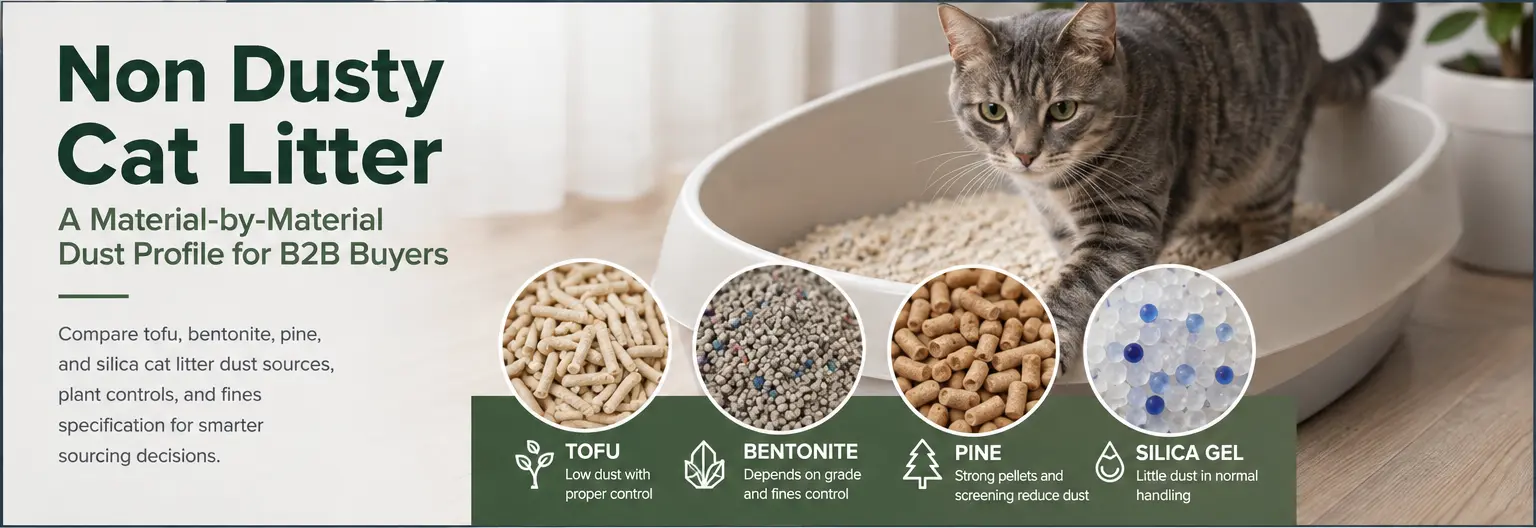
What separates export-grade mineral litter from ordinary bentonite is upstream selection: imported, high-purity sodium bentonite that has been field-selected, washed, and screened to strip out impurities and fine powder before it ever reaches the production line. Combined with the downstream dust-removal equipment described in Section 3, this pretreated bentonite can meet low-dust thresholds while retaining strong clumping performance — making it the core raw material for mid-tier cross-border low-dust products. Silica gel litter sits at a further extreme, requiring very high raw material purity and tightly controlled micropore uniformity; it serves a narrow, premium, non-clumping niche concentrated in European and North American specialty retail.
2.3 Composite Modified Materials
Composite modified raw materials represent the current research-and-development frontier in dust-free cat litter manufacturing. By scientifically blending plant starch, mineral particles, natural deodorizing agents, and binders, manufacturers can achieve a formula that performs well simultaneously on dust suppression, clumping, odor control, and bacteriostasis — without the single-point weaknesses that pure plant-based or pure mineral-based formulas tend to carry. Composite materials also demonstrate superior resistance to pulverization during long-distance ocean transport, which is why this category is most frequently specified by international first-tier pet brands running OEM cat litter manufacturing programs that require consistent performance after weeks in a shipping container.
2.4 Compliant Binders, Deodorants, and Functional Additives
Beyond the core substrate, accessory materials — binders, natural deodorants, and bacteriostatic additives — directly affect both product safety and dust stability. Industrial-grade or harmful chemical additives are strictly prohibited across every major export market. Globally compliant accessories include sodium carboxymethyl cellulose (CMC), modified starch, plant extracts, and biological enzyme preparations. CMC in particular functions as the core binder in most low-dust formulas: it strengthens particle compactness and substantially reduces dusting during transport and use, and it has cleared FDA and EU food-contact safety certification without irritation or residue concerns.
Regional regulation further narrows acceptable accessory choices. The EU market prohibits additives containing formaldehyde, benzene, or heavy metals. The US market requires every accessory to meet AAFCO pet product safety standards. Southeast Asia’s humid climate market prioritizes moisture-proof, mold-resistant, bacteriostatic auxiliary materials specifically to prevent raw material caking — caking that, if it occurs, generates a fresh round of secondary dust. Every batch of raw material, regardless of category, should be tested before entering the production line to keep moldy, damp, or impurity-laden inputs out of the dust-free cat litter manufacturing process entirely.
2.5 The Four-Step International Pretreatment Standard
Controlling dust at the source is the non-negotiable premise of any dust-free cat litter manufacturing process. Every raw material batch must pass through a standardized pretreatment sequence designed to strip out primary fine powder, irregular particles, and impurities before mixing begins. The table below summarizes the international baseline for raw material pretreatment and dust control in cat litter manufacturing.
| Pretreatment Step | Method | Dust-Control Function | Result |
|---|---|---|---|
| Fine Screening | 60–100 mesh classification screening | Removes ultrafine powder and oversized particles | Uniform base particle size |
| Negative Pressure Dust Removal | Vacuum extraction of surface fine powder | Strips loose dust before mixing | ≥95% primary dust removal |
| Water-Washing Purification | High-pressure washing (mineral materials only) | Removes mineral dust and impurities | Reduced fine-powder residue |
| Homogeneous Mixing | Sealed, accurate-ratio blending | Prevents localized pulverization | Consistent batch-to-batch material stability |
Each step exists to eliminate a specific failure mode. Fine screening removes the granulometric extremes that later cause uneven forming pressure. Negative-pressure dust removal extracts loose surface powder that would otherwise remain trapped inside the finished particle and shed gradually over the product’s shelf life. Water-washing purification, used exclusively on mineral substrates, removes the residual mineral dust that conventional dry screening cannot fully capture. Homogeneous mixing, performed in sealed equipment, ensures that binder and deodorant additives are distributed evenly across every batch rather than concentrated unevenly, which would otherwise create localized weak points prone to pulverization.
3. Cat Litter Manufacturing Equipment Built for Dust Suppression
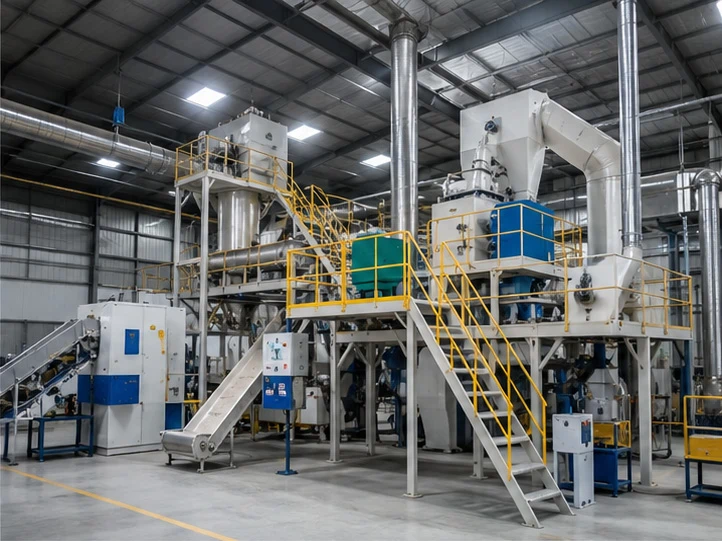
Generic, open-line cat litter manufacturing equipment — the kind built for low-cost domestic litter — cannot meet international dust thresholds no matter how carefully the operator runs it. The accuracy and automation level of the equipment line is itself a primary determinant of dust performance, and it is one of the first things international brands audit when qualifying a new OEM factory. Export-grade dust-free cat litter manufacturing runs on fully automatic, closed, high-precision production lines organized into six core modules: raw material pretreatment, forming, dust removal, drying, screening, and packaging.
3.1 Pretreatment Equipment
Pretreatment equipment is the first line of mechanical dust control, and it is built around four core machines: a closed pulverizer, a multi-stage vibrating screen separator, a vacuum negative-pressure dust removal unit, and an automatic stirring homogenizer.
Unlike an ordinary open pulverizer, the closed pulverizer used in low-dust lines applies low-temperature shear pulverization, which avoids generating excess fine powder and keeps raw material particle size within a tight standard range — preventing the downstream dust that uneven crushing would otherwise cause. The multi-stage vibrating screen machine typically carries four to six groups of screens at different mesh counts, enabling precise classification that automatically removes both fine powder and oversized particles, with screening accuracy held within ±0.02mm — the tolerance international high-end buyers expect for particle uniformity.
The vacuum negative-pressure dust removal unit is the central dust-control machine at this stage. Running six negative-pressure dust-removal structures across both pipeline and box dust-removal modes, it strips essentially all free dust from incoming raw material, bringing powder content down below 0.3% before the material ever reaches the mixer. The fully automatic stirring homogenizer then completes the stage with a sealed mixing structure that blends raw material and accessories without generating new dust in the process — eliminating the batch-to-batch quality variation that uneven mixing would otherwise introduce.
3.2 Forming Equipment: Twin-Screw Extruders vs. Hydraulic Dry Molding
Forming equipment determines particle compactness and pulverization resistance, making it the single most consequential machine category in the entire cat litter production process. Two equipment types dominate the international market, each suited to a different product position and order profile.
The twin-screw extruder is the standard choice for large-scale export factories. Compared with single-screw equipment, it delivers more stable shear pressure and higher material-forming density, producing a dense protective surface layer on each particle that resists the bumping and friction of ocean shipping. This translates directly into a lower transportation pulverization rate and highly stable finished-product dust performance, which is why twin-screw lines supply the bulk of mainstream EU and North American supermarket orders.
The hydraulic dry low-temperature molding machine occupies the premium end of cat litter manufacturing equipment. It forms particles without added water, at low temperature, which preserves the natural fiber structure of plant-based raw materials. Particle hardness on this equipment can exceed 60N, with excellent wear and pulverization resistance; finished powder content can be stabilized within 0.1%, comfortably exceeding most international industry standards. The trade-off is throughput: hydraulic dry molding runs at lower mass-production efficiency than twin-screw extrusion, which is why it is generally reserved for small-batch, high-premium orders from EU, Japanese, and Korean niche brands rather than mass-market supermarket supply. Both equipment types use fully enclosed forming structures, eliminating dust overflow during the forming stage itself and keeping the production environment clean.
3.3 Post-Treatment Equipment: Drying, Screening, and Polishing
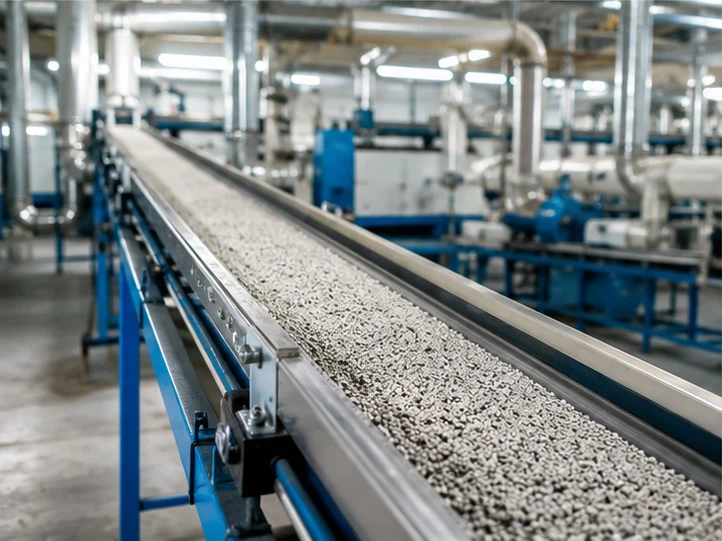
Formed particles require post-treatment and secondary dust removal to reach final low-dust performance. The core machines here are a low-temperature drying unit, a multi-stage fine screening machine, a secondary negative-pressure dust removal system, and a particle polishing machine.
The low-temperature drying unit holds drying temperature strictly within 60–80°C, avoiding the particle cracking and internal pulverization that high-temperature drying causes, while keeping finished-product moisture content within the international standard range of 8–12%. Moisture control here is a genuine dust-control variable, not just a shelf-life consideration: litter that is too wet tends toward mold and clumping defects, while litter that is too dry becomes brittle and dust-prone.
The multi-stage fine screening machine performs a second classification pass on the formed product, removing damaged particles and fine-powder fragments to preserve particle integrity. The secondary negative-pressure dust removal system focuses specifically on floating surface dust generated during forming and drying, capturing it through circulating airflow before it can settle back onto the product. Finally, the particle polishing machine smooths particle edges and corners, reducing the friction-generated dust that rough-edged particles would otherwise shed during bagging, shipping, and daily scooping — an essential machine for any factory producing premium low dust cat litter production volumes.
3.4 Automated Packaging and Inline Quality Control Equipment
International export of dust-free cat litter requires high packaging tightness, full automation, and strict batch consistency. Supporting equipment includes automatic weighing-and-packaging machines, vacuum sealing machines, metal detectors, and batch-traceability coding machines. Automatic weighing-and-packaging equipment holds per-bag weight error to within ±5g while sealing throughout the process to prevent dust ingress during packaging itself. Metal detectors screen finished product for metal contaminants, meeting EU and US pet product safety access standards and preventing costly cross-border quality-inspection failures. Batch-traceability coding allows every production batch to be tracked individually — a feature increasingly demanded by international brand quality-control systems and required for compliance with overseas supermarket and cross-border platform sourcing rules.
4. The Dust-Free Cat Litter Manufacturing Process, Step by Step
Combining the equipment described above with international quality-control practice, mainstream export factories run an eight-stage, fully closed-loop cat litter production process: raw material inspection and pretreatment, precision batching and mixing, closed forming, low-temperature setting, multi-stage dust removal, fine screening, finished-product re-inspection, and automated packaging. The entire line is sealed end to end, controlling dust generation at every transfer point while keeping product performance and batch consistency stable — a structure built specifically for cross-border mass production.
4.1 Raw Material Inspection and Pretreatment
Before production starts, every batch of base material and accessory undergoes full inspection against international raw material access standards — moisture content, fine-powder content, impurity rate, heavy metal content, and harmful component screening. Any batch that fails is returned immediately rather than entering the line. Material that passes proceeds through four sequential pretreatment steps — coarse screening for impurity removal, negative-pressure primary dust removal, fine crushing, and secondary screening — unifying particle size and removing more than 95% of primary fine powder, while also confirming that raw material dryness meets standard so that moisture-induced caking does not compromise later forming and dust-control performance. Pretreated material is then stored by category in a sealed raw material warehouse to prevent secondary dust contamination and moisture exposure before use.
4.2 Precision Batching and Sealed Homogenization
Following the product formula — whether plant-based, mineral-based, or composite — raw materials and accessories are weighed and combined through an automated intelligent batching system, with matching accuracy held within 0.1% to guarantee formula consistency across every batch. The combined material then moves into a fully sealed stirring homogenizer for low-temperature, low-speed mixing, which avoids generating new fine powder through high-speed agitation while ensuring binder and deodorizing additives are evenly distributed across every particle surface. This step strengthens particle compactness and improves anti-pulverization performance at the formula level, before the material ever reaches the forming machine. Mixed material is then transported to forming equipment through fully sealed transfer, with no open-air handling anywhere in the sequence — eliminating dust overflow and impurity contamination at the transfer point.
4.3 Closed Forming and Low-Temperature Setting
Material reaches the forming equipment through closed piping, with twin-screw extrusion or hydraulic dry molding selected according to product positioning; the entire forming stage runs sealed, with no dust leakage. During forming, intelligent temperature- and pressure-control systems precisely adjust forming parameters to keep particle density uniform and structurally complete, preventing the hollow, cracked, or incomplete particles that are a leading cause of in-use dust generation. Once formed, wet or primary particles move directly into the low-temperature drying and setting line, where moisture content is reduced through stepped gradient drying rather than a single high-temperature pass — avoiding the brittle cracking and internal pulverization that abrupt drying would cause, and bringing particle hardness and stability up to international low-dust product standards.
4.4 Multi-Stage Dust Removal and Fine Screening
Formed and set particles then enter the stage that most clearly distinguishes a genuine dust-free cat litter manufacturing process from an ordinary cat litter production process. First, particle polishing smooths surfaces and edges to reduce the friction-induced dust risk inherent in rough particles. The material then passes through a six-pass vacuum negative-pressure dust removal system, which strips both surface floating dust and internal fine dust through a combination of pipeline negative-pressure adsorption and box-layered dust removal. Finally, multi-stage vibration fine screening automatically separates complete, qualified particles from damaged fragments, fine powder, and impurities. After this stage, finished-product powder content is typically stabilized at ≤0.1% with a pulverization rate of ≤0.5% — meeting the international high-end low-dust standard required for entry into EU, US, and Japan/Korea markets.
4.5 Finished-Product Re-Inspection and Sealed Packaging
Qualified particles emerging from dust removal and screening then undergo finished-product re-inspection, with random sampling against core indicators — dust rate, agglomeration speed, water absorption, bacteriostatic performance, and moisture content — before release to packaging. Packaging itself runs fully automated and closed, with differentiated specifications and sealing standards applied according to destination market requirements; weighing, bagging, sealing, coding, and palletizing all run automated to prevent dust contamination at the final stage. Once packaged, product is stored sealed and categorized to avoid secondary dust generation from moisture or friction during warehousing, preserving the dust performance achieved on the line through to the point of shipment.
5. Cost Structure of Dust-Free Cat Litter Manufacturing
From a cross-border production standpoint, the cost structure of dust-free cat litter manufacturing differs substantially from ordinary litter production, and the difference is concentrated almost entirely in one variable: what it costs to engineer dust out of the product at every stage. Raw material selection, dust-removal technology, high-precision equipment, and dust-specific testing are the four cost centers that exist, in their current scale, specifically because the product must meet a dust specification — not because of any other quality attribute. Costs vary significantly by region of production (China, Southeast Asia, Europe, North America) and by product category (plant-based, mineral-based, composite). Understanding which portion of each cost line is attributable to dust control — rather than to manufacturing in general — is essential for foreign trade factory pricing, OEM order negotiation, and realistic profit-margin planning.
5.1 Raw Material Costs: Paying for Pretreated, Low-Dust Inputs
Raw material cost is the single largest cost component in dust-free cat litter manufacturing, typically representing 55–65% of total production cost — substantially higher than in ordinary litter production. The core driver is not the base substrate itself but the dust-related pretreatment it must undergo before use: high-purity, food-grade, pre-screened, pre-washed raw material costs more per ton than the unscreened equivalent, precisely because achieving a low starting fine-powder content rules out the cheaper, lower-grade inputs ordinary litter can use. Plant-based dust-free litter carries the highest raw material cost, since substrates like food-grade cassava starch and pea fiber are exposed to global agricultural commodity price swings on top of the pretreatment premium; the 2023–2025 period saw plant raw material cost fluctuations of roughly 20% tied to global food price movements, with high-quality modified starch and compliant accessories pushing per-ton raw material cost 18–25% above ordinary plant litter.
Mineral-based dust-free litter shows comparatively stable raw material costs, though high-purity sodium bentonite prices have risen 15–20% over the past three years due to global mine consolidation and tighter environmental mining regulation — even so, mineral-based remains more cost-effective than plant-based, making it the default choice for mid-tier export products. Composite dust-free litter sits in between, balancing cost and performance through scientific blending and suiting mid-tier bulk international orders. The cost factor most directly attributable to dust control, however, is raw material pretreatment loss — the fine-powder and impurity-screening loss inherent in bringing input material down to a usable low-dust starting point. This loss runs around 8–12% for dust-free products, roughly 3–5 percentage points higher than for ordinary litter, and represents pure dust-control overhead: material that is physically discarded specifically because it would otherwise raise the finished product’s powder content above threshold.
5.2 Equipment and Energy Costs: The Price of Sealed, Multi-Stage Dust Removal
Automated dust-free production line equipment carries a far higher capital cost than ordinary equipment, and the difference is concentrated specifically in the dust-control hardware: closed pulverizers, multi-stage negative-pressure dust removal units, sealed homogenizers, particle polishing machines, and secondary dust-removal systems. Depreciation on this dust-control equipment subset alone accounts for roughly 10–12% of total cost. A single ordinary, simplified production line — without dedicated dust-removal stages — might require an investment under RMB 500,000, while a single international export-standard dust-free mass production line can exceed RMB 2,000,000, with the gap almost entirely explained by the additional sealing, negative-pressure, and multi-stage screening systems that ordinary lines simply do not have.
Energy cost is the second-largest operating expense, typically 8–15% of total cost, and here too the dust-control share is identifiable: multi-stage negative-pressure dust removal systems and fine screening equipment run continuously, 24 hours a day, generating an energy expenditure that exists purely to keep dust suppression active rather than to drive the core forming process. Wet forming processes additionally require substantial drying energy, with electricity sometimes accounting for 25–30% of process cost, while dry low-temperature forming keeps energy cost closer to 10% — making equipment choice itself a meaningful lever for controlling the dust-related energy premium. Factories in China and Southeast Asia hold a clear energy-cost advantage over Europe and North America, where industrial electricity prices run roughly two to three times higher, which is one structural reason Asian OEM factories can sustain continuous-running dust-removal equipment at a lower marginal cost than Western competitors.
5.3 Labor, Dust Testing, and Quality Control Costs
Dust-free cat litter requires measurably higher labor specialization than ordinary manufacturing, with labor cost representing roughly 7–10% of total cost. Fully automated lines do not need large basic-operator headcounts, but they do require technicians specifically trained to calibrate negative-pressure dust-removal parameters, interpret hourly dust sampling data, and respond to in-line readings that fall outside dust thresholds — a skill set ordinary production staff do not need. This specialized labor commands a real cost premium over generic manufacturing roles.
Quality-control cost is where the dust-control premium is most direct. Export products require dedicated dust-testing equipment (screening-and-weighing apparatus, mechanical vibration/friction testers for pulverization rate), testing consumables, and recurring third-party dust and safety testing and certification fees, together running roughly 3–5% of total cost — well above what domestic ordinary litter production typically incurs, since ordinary litter rarely undergoes formal dust-specific testing at all. Routine maintenance of high-precision dust-removal equipment, sealed conveying systems, and negative-pressure units adds further fixed operations cost, because keeping dust performance stable batch after batch requires these systems to be serviced more frequently than the simpler equipment used in ordinary production.
5.4 Cross-Border Logistics, Packaging, and Compliance Costs
For export-oriented dust-free production, cross-border supporting costs are a major expenditure, and a meaningful share exists specifically to preserve dust performance between the factory gate and the destination warehouse. Packaging cost — moisture-proof, dust-proof, explosion-resistant export bags, hot-press full sealing, reinforced buffer layers, and traceability labeling — typically runs 15–20% above ordinary packaging cost, with the premium driven almost entirely by the dust-containment function described in Section 9, not by branding or printing. Logistics costs — ocean freight, destination customs clearance, and overseas warehousing — typically represent 10–18% of total export cost; within that figure, the added cost of reinforced buffer packaging and climate-controlled storage exists specifically to prevent the secondary pulverization that ordinary packaging and storage conditions would allow during weeks at sea.
Compliance certification cost is the clearest dust-specific line item of all: products must clear dust-specific testing under EU REACH/CE, US FDA/AAFCO, and equivalent regional frameworks, with annual audit, dust-parameter sampling, and compliance rectification generating ongoing expense that has no equivalent in ordinary litter production. Taken together, the all-in cost of exporting dust-free cat litter typically runs 25–40% above domestic ordinary litter production, and the majority of that premium can be traced directly back to the raw material pretreatment loss, dust-removal equipment depreciation, dust-testing labor, and dust-containment packaging described above — not to general manufacturing overhead. The corresponding international retail premium is generally higher still, leaving overall margin more favorable for factories that can document and sustain this dust-control cost structure.
6. OEM Cat Litter Manufacturing: Cooperation Models and Customization
In the global dust-free cat litter market, brand owners concentrate on market operations, brand marketing, and channel strategy, while production is heavily outsourced to specialized factories — making OEM/ODM cooperation the dominant structure of the international industry. China currently supplies more than 60% of the world’s low dust cat litter production capacity through OEM arrangements, serving hundreds of pet brands across Europe, North America, Southeast Asia, and the Middle East through a combination of mature industrial infrastructure, established technology, and cost advantage.
6.1 OEM vs. ODM: Two Distinct Cooperation Models
International OEM cat litter manufacturing splits into two core models suited to different brand stages and market needs. Standard OEM provides standardized mass-production service: the factory relies on established formulas and standardized lines to produce dust-free litter under the brand’s own packaging and identification. Its core advantages are production speed, cost control, and quality stability, making it the most common cooperation model globally today.
ODM (custom R&D manufacturing) provides full-chain customized service — formula R&D, process adjustment, dust-index customization, performance optimization, packaging design, and regulatory adaptation — with the factory developing a product exclusively around the brand’s target market, positioning, and differentiation strategy. The brand typically retains exclusive rights to the resulting formula and product. ODM suits emerging and premium niche brands seeking differentiated products, offering higher margin potential alongside a longer development cycle, and demanding considerably more R&D, quality-control, and compliance capability from the factory.
6.2 Customization Dimensions That Matter Most to International Buyers
Dust-index customization is the single most commercially significant variable in OEM cat litter manufacturing negotiations. EU, Japan, and South Korea buyers typically specify finished powder content ≤0.05% and pulverization rate ≤0.4%, requiring top-tier dust-removal technology and carefully selected raw materials. Mainstream US market specification sits at powder content ≤0.1% and pulverization rate ≤0.5%. Cost-oriented markets across Southeast Asia and the Middle East generally accept conventional low-dust thresholds while still requiring basic dust control to be demonstrably in place.
Formula and performance customization adapts to regional climate and consumer habit. EU and North American buyers tend to favor pure natural, additive-free, degradable plant-based dust-free litter emphasizing bacteriostasis, odor control, and environmental credentials. Middle Eastern and Latin American buyers, operating in arid climates, prioritize mineral-based dust-free litter with strong water absorption and storage resistance. Southeast Asian buyers, facing hot, humid conditions, prioritize moisture-proof, mold-resistant, anti-caking composite formulas. Beyond these regional baselines, fragrance, particle size, hardness, and clumping speed can all be customized to a brand’s specific positioning.
Packaging and compliance customization follows the same regional logic. EU orders typically require environmentally friendly, degradable, plastic-free packaging carrying REACH compliance marks. US orders require FDA traceability labeling and packaging specifications compatible with major cross-border e-commerce platforms. Middle East orders typically require multilingual printing and reinforced moisture-proof packaging. A mature factory will offer packaging design, certification, and label-compliance auditing as a bundled service, reducing the cross-border quality-inspection risk a brand would otherwise carry alone.
6.3 The Standardized OEM Cooperation Workflow
Mature international dust-free cat litter manufacturing factories run a standardized eight-stage cooperation process: qualification review, demand alignment, sample proofing, index confirmation, batch trial production, mass production, quality inspection and shipment, and after-sales traceability. The process begins with two-way qualification review — the factory must hold ISO9001 quality system certification, ISO14001 environmental certification, relevant pet product certifications, and export customs clearance capability, while the brand must demonstrate legitimate brand authorization and overseas sales qualification.
Once qualification clears, the demand-alignment stage locks in target market, product specification, customization parameters, packaging requirements, and order volume. Sample proofing follows, with third-party authoritative testing run in parallel to confirm dust, safety, and performance indicators meet specification and to produce an internationally recognized test report. Once samples are confirmed, small-batch trial production verifies process stability and scalability before mass production begins under dedicated quality-control protocols throughout. Completed bulk orders are inspected, packaged, and shipped batch by batch, with full traceability documentation and compliance certificates accompanying each shipment to support customs clearance and platform listing at the destination.
6.4 The Global OEM Competitive Landscape
The global dust-free cat litter OEM industry currently follows a pattern best described as “China leading, Southeast Asia supplementing, Europe/North America focused on high-end self-development.” Backed by a complete raw material supply chain, mature production technology, rigorous quality-control systems, and strong cost-performance, Chinese factories dominate the global mid-to-high-end OEM segment, serving everything from first-tier international brands to emerging cross-border challenger brands. Southeast Asian factories concentrate on lower-cost, lower-tier standardized OEM suited to budget-driven mass markets, generally with weaker dust-control and quality-control stability that falls short of high-end international access standards. European and North American local factories, facing very high labor and energy costs, tend to focus narrowly on high-end self-developed niche products and rarely take on external OEM work. As global dust-free standards continue tightening, Chinese OEM factories combining advanced dust-control technology, full compliance qualification, and genuine R&D customization capability are positioned to keep expanding their share of global supply.
7. Cat Litter Quality Control: Standards That Define Dust-Free Status
Quality control is the structural guarantee behind every claim of dust-free cat litter manufacturing — it is what allows a factory to meet international market access requirements, protect brand reputation, and reduce cross-border after-sales risk. Unlike sampling-based domestic quality control, international export production runs a closed-loop, full-process, full-batch, multi-dimensional cat litter quality control system spanning raw material intake, production-line monitoring, finished-product release, and warehousing and logistics — benchmarked against unified EU, US, and global pet industry standards, with primary focus on dust indicators, safety indicators, and performance indicators.
7.1 Raw Material Intake Quality Control
Source-level quality control is the first line of defense in any dust-free cat litter manufacturing process. Every batch of raw material and accessory must be inspected before entering the line, with core test items covering particle uniformity, primary fine-powder content, moisture content, impurity rate, mold contamination, heavy metal content, formaldehyde residue, and other harmful chemical content. Plant-based materials are tested primarily for pesticide residue, mycotoxins, and microbial indicators against food-grade safety standards, while mineral-based materials are tested primarily for heavy metals, radioactive substances, and mineral dust residue against international pet safety standards. All test data is retained and filed to build a raw-material batch traceability record, with non-compliant material returned immediately — eliminating dust and safety risk at the earliest possible point.
7.2 Dynamic Quality Control During Production
Real-time dynamic quality control runs throughout the production process itself, with dedicated quality-control staff monitoring the line, intelligent equipment tracking production parameters in real time, and process adjustments made dynamically to maintain batch-to-batch consistency. During pretreatment, screening accuracy and dust-removal efficiency are monitored continuously to confirm fine-powder removal is hitting target. During batching, ingredient ratios are checked intelligently to prevent formula deviation. During forming, equipment pressure, temperature, and rotation speed are monitored in real time to prevent incomplete, cracked, or uneven-density particles. During drying, temperature, humidity, and duration are precisely controlled to stabilize finished-product moisture and hardness. During dust removal, negative-pressure parameters are monitored continuously to confirm multi-stage dust removal is hitting target and to prevent secondary dust residue. Hourly sampling throughout production checks core dust, particle, and moisture indicators, with the line stopped immediately for correction if any reading falls out of range — preventing the production of large defective batches.
7.3 Finished-Product Release Standards
Before leaving the factory, finished product undergoes rigorous batch inspection against international high-end dust-free standards, covering eight core indicators: powder content, pulverization rate, particle integrity, water absorption rate, clumping speed, bacteriostatic rate, moisture content, and overall safety. International standards typically specify finished powder content ≤0.1% (≤0.05% for premium customized orders), pulverization rate ≤0.5% (with secondary post-transport pulverization rate ≤0.3%), particle integrity ≥98%, moisture content stable within 8–12%, and zero formaldehyde, heavy metal, or harmful residue. All finished product undergoes double inspection — internal self-inspection plus third-party sampling — with international quality inspection reports and compliance certificates issued only after passing, before the product is cleared for shipment.
7.4 Warehousing and Logistics Quality Control
Product quality stability is heavily influenced by warehousing and logistics conditions, since long-distance ocean shipping is particularly prone to moisture exposure, friction-induced pulverization, and secondary dust generation — making dedicated quality control essential at this stage. After production, finished product is stored in a sealed, dry, climate-controlled warehouse, organized by category to avoid crushing, moisture, and cross-contamination, with periodic sampling of stored product for dust and moisture indicators. The packing process uses dust-free, sealed packing technology to prevent dust ingress during packing itself. For ocean shipping orders specifically, packaging protection is reinforced with thickened materials and added buffer structure to reduce particle pulverization from transport vibration and friction, with logistics conditions tracked throughout the journey and packaging or storage adjustments made for high-temperature, high-humidity routes — ensuring the product that arrives at the destination matches the quality that left the factory.
8. International Testing Standards for Low-Dust Cat Litter
International markets enforce mandatory testing and compliance access systems for dust-free cat litter, with each region maintaining its own authoritative testing standards and required test items. Products must clear the relevant testing and obtain compliance certification before entering local supermarkets, cross-border e-commerce platforms, or offline retail channels. This section covers four core testing categories — dust-specific testing, safety testing, performance testing, and environmental testing — to give sourcing teams an accurate reference point for compliance planning.
8.1 Global Dust-Specific Testing Standards
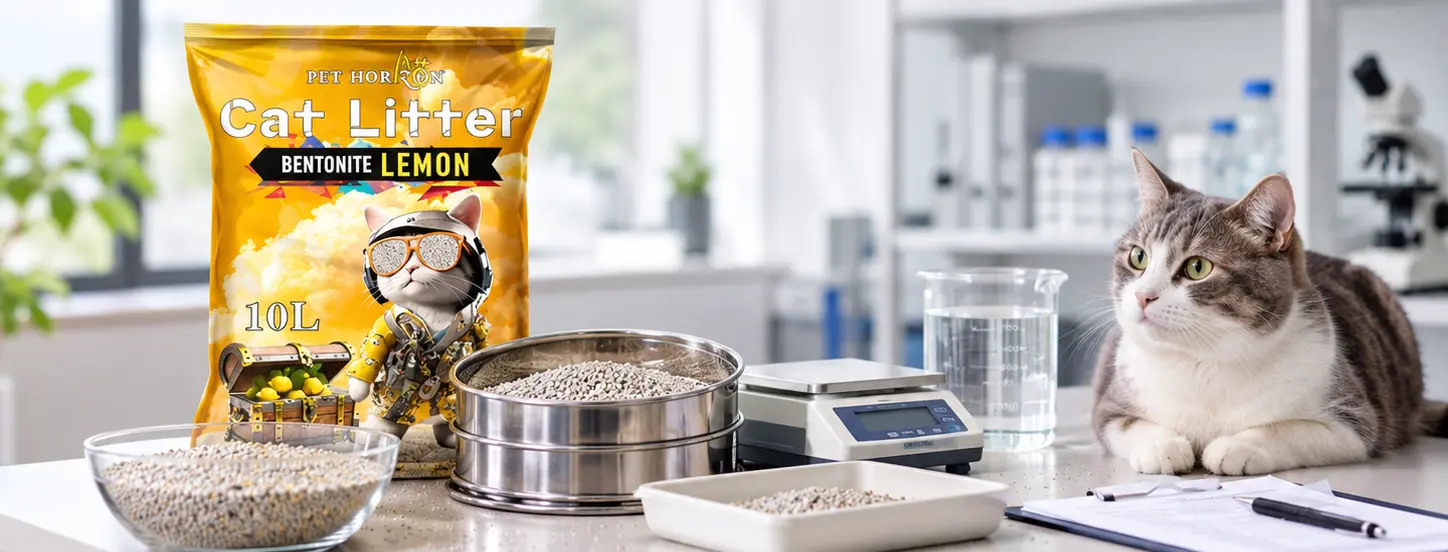
Dust performance is the core testing category for dust-free cat litter and the primary basis for differentiated market access internationally. Two indicators dominate: powder content and pulverization rate, each tied to a standardized test method. Powder content testing measures the proportion of free fine powder present on the surface and interior of the finished product, using an internationally standardized screening-and-weighing method — passing the product through a standard mesh screen and weighing the separated fine powder to determine baseline dust level. Pulverization rate testing simulates long-distance transport and daily-use friction through mechanical vibration and friction testing, measuring the proportion of secondary dust generated by particle breakage to assess transport and handling resistance.
International grading is clearly tiered. Entry-level low-dust standard requires powder content ≤0.3% and pulverization rate ≤0.8%, suited to mass markets in Southeast Asia and the Middle East. High-end standard requires powder content ≤0.1% and pulverization rate ≤0.5%, suited to mainstream US and Australian market access. Top-tier standard requires powder content ≤0.05% and pulverization rate ≤0.4%, required for the most demanding EU, Japanese, and South Korean markets. All dust test data must be traceable and reproducible, with test reports issued by internationally recognized accredited bodies — such as CNAS and CTI — before overseas markets will accept them.
8.2 Regional Safety and Performance Testing Requirements
The EU market enforces REACH regulation, CE certification, and dedicated pet product safety standards, mandating testing for formaldehyde, benzene compounds, heavy metals, and polycyclic aromatic hydrocarbons, while prohibiting restricted chemical additives outright. EU buyers additionally expect degradability, low environmental impact, and dust emission performance consistent with EU indoor air quality standards. The US market follows AAFCO pet product standards and FDA food-contact safety standards, with particular focus on non-toxicity, microbial indicators, and dust safety — ensuring that accidental ingestion by a cat and incidental human contact carry no measurable health risk.
Japan and South Korea run especially strict pet product quality certification, with particular emphasis on ultra-fine dust content, antibacterial performance, and odor residue — representing the highest fineness and safety requirements globally. Emerging markets across Southeast Asia and Latin America generally concentrate on baseline safety testing, focused on heavy metals, mold, and harmful impurities, with dust performance admitted once basic thresholds are met. General performance testing across all regions covers water absorption rate, clumping speed, clump compactness, odor-control rate, bacteriostatic rate, and moisture resistance, confirming that core use performance meets international consumer expectations.
8.3 Third-Party Authoritative Testing and Annual Compliance Auditing
International export of dust-free cat litter does not recognize factory self-inspection reports as sufficient; periodic batch sampling and annual full inspection by an accredited third-party testing body is required. Mainstream cooperating agencies include CTI Huace, SGS, BV, and TÜV, whose reports carry broad cross-border recognition. Mass-production factories generally establish an annual compliance audit mechanism, completing system certification review, product testing, and process compliance correction every year to maintain ongoing alignment with international standards. Given periodic spot checks by cross-border platforms and overseas market regulators, maintaining inspection records and documentation in advance is essential to avoiding the risk of product delisting, returns, or penalties.
As global cross-border e-commerce oversight tightens, testing compliance has become a hard threshold for market entry, and finished-product sampling alone is no longer sufficient for sustained trade relationships. International buyers increasingly require factories to maintain a complete inspection ledger and quality traceability system — covering raw material inspection records, production process parameter archives, dust-removal process inspection reports, and finished-product batch inspection certificates — so that the full chain from raw material intake to finished-product shipment can be reviewed, traced, and re-verified on demand.
Sampling frequency and required test items also shift dynamically by country. The EU, for instance, periodically expands its requirements around micro-dust emission ratios and degradable component content, while US cross-border platforms place growing emphasis on microbial content and contact safety review — requiring production enterprises to track international standard updates in real time and adjust testing protocols accordingly. A complete, well-documented third-party testing and compliance record is also a meaningful competitive asset, strengthening a factory’s position in international brand tendering and OEM partnership negotiations. A disciplined, continuously updated testing system not only reduces cross-border compliance risk but also stabilizes batch-to-batch product quality, reducing returns, negative reviews, and brand disputes — laying a durable foundation for long-term international market presence.

9. Packaging Standards That Preserve Dust-Free Quality in Transit
Packaging is the final link in dust protection, brand presentation, and cross-border compliance for dust-free cat litter. It carries both a physical protection function — preventing dust, moisture, and damage — and a regulatory function, since packaging must meet the labeling and environmental requirements of each destination market while matching local consumer expectations. International dust-free cat litter packaging differs from domestic packaging in its emphasis on sealing strength, protective structure, regulatory compliance, and brand presentation, with differentiated customization built for each regional market.
9.1 Core Protective Design for Dust-Free Products
The core protective objective of dust-free cat litter packaging is preventing secondary dust generation during transport, storage, and unpacking, while protecting particles from damage and moisture exposure. High-end export packaging typically uses a three-layer composite structure: an outer layer of high-strength, wear-resistant kraft paper or PE film; a middle buffer-protection layer; and an inner layer of food-grade sealed dust-proof film. Combined sealing performance, pressure resistance, and dust-proofing significantly exceed ordinary packaging. Sealing uses hot-press full-sealing technology, eliminating gaps through which powder could leak, while the bag itself is thickened and compressed to withstand ocean-shipping compression and reduce particle friction and pulverization. Premium packaging often adds a breathable moisture-proof valve to balance internal air pressure, preventing dampness and mold without creating any dust-leak pathway — a design well suited to long-distance cross-border logistics.
In the complex logistics environment of international cross-border trade, packaging’s dynamic protective performance directly determines terminal product quality consistency, and it is a core inspection point for overseas buyers conducting factory audits. Unlike short-distance domestic transport, cross-border ocean shipping involves sudden temperature swings, high humidity and salt spray exposure, multi-layer stacking, and repeated loading and unloading — conditions under which ordinary, simplified packaging is prone to cracking, seam failure, powder leakage, and moisture damage, ultimately producing excessive dust readings and visible product damage that trigger returns, claims, and reputational harm. Export-grade dust-free packaging is therefore subjected to a full set of simulated-condition tests before shipment, including pressure-stacking testing, high-and-low temperature cycle testing, moisture-seal testing, and drop-friction testing — confirming the packaging can maintain stable dust protection even under extreme logistics stress.
Packaging technology itself has also become more refined, reinforcing the premium positioning of dust-free product lines. Export packaging is increasingly produced through automated packing in clean workshop conditions, avoiding the dust contamination and sealing defects that manual packing can introduce. Packaging is further differentiated by transport mode — lightweight, pressure-resistant reinforcement for air freight orders, strengthened moisture-proof and dust-proof structure for ocean freight orders, and optimized wear protection for long-distance overland transport. This customized protective approach directly addresses the dust-shedding pain point inherent in cross-border circulation of dust-free cat litter, aligning with the broader global trend toward refinement and quality in premium pet products, and has become a meaningful competitive advantage for Chinese dust-free cat litter manufacturers pursuing high-end international market share.
9.2 Regional Packaging Compliance and Labeling Standards
Packaging identification and material compliance requirements differ significantly by market, requiring precise regional adaptation to avoid customs clearance failure or platform delisting. The EU market requires degradable, environmentally friendly packaging materials and prohibits non-degradable plastics outright; packaging must display an environmental recycling label, CE certification number, ingredient ratio, production traceability information, and multilingual descriptions (commonly English, German, and French). False or exaggerated dust-free claims are prohibited — dust parameters must be accurately labeled and consistent with the underlying test report.
US market packaging must meet FDA traceability requirements, clearly displaying product composition, net weight, production batch, shelf life, manufacturer information, importer information, and safety warnings, while conforming to the packaging specifications of major platforms such as Amazon and Walmart — omitting any required label is not permitted. Southeast Asian and Middle Eastern markets favor simple, durable packaging supporting multilingual printing (commonly English, Spanish, and Arabic), with emphasis on moisture-proofing, dust-proofing, and storage warnings suited to local high-temperature, high-humidity, or dry-and-dusty conditions. Across every export market, prohibited imagery and false advertising claims are disallowed, and local advertising and packaging regulations must be followed strictly.
9.3 Packaging Specifications and Brand Customization
The international market has settled into a standardized packaging specification system tailored to different sales channels. Supermarket channels typically use 2kg, 5kg, and 10kg retail-size packaging convenient for end-consumer purchase and storage. Cross-border e-commerce channels favor lightweight 2kg and 4kg packaging suited to international express logistics standards. Overseas warehousing and wholesale channels use 20kg and 25kg industrial-size packaging to reduce bulk-supply cost. Alongside these standard formats, factories typically support full brand customization — color schemes, logo layout, product selling-point labeling, and visual styling tailored to local aesthetic preferences — strengthening shelf competitiveness at the destination. Premium brands can further add anti-counterfeiting marks, traceable QR codes, and exclusive packaging technology to build a differentiated brand image.
As global pet product trade becomes increasingly standardized, packaging detail has become an important implicit signal that overseas consumers and buyers use to judge product quality — and a key visual differentiator between commodity-grade and premium dust-free product lines. Beyond core protective function, dust-free cat litter packaging increasingly needs to align with each market’s environmental policy direction and evolving consumer expectations around the unboxing experience. EU and North American markets are actively pursuing packaging-reduction policy, placing over-packaging, non-degradable accessory materials, and non-recyclable film coatings on an effective blacklist — driving export factories toward simple, high-strength composite materials that satisfy low-carbon and environmental requirements while preserving dust-proof and pressure-resistant performance.
Refined, transparent packaging information disclosure also meaningfully strengthens consumer trust. Export-grade packaging increasingly displays dust test parameters, raw material composition, degradation timeline, usage precautions, and cross-border after-sales contact information directly on the bag — aligned with the more research-driven purchasing behavior of overseas consumers. For brands distributing across multiple regions simultaneously, unified multilingual packaging layout reduces customization cost and improves distribution efficiency, while compliant packaging design tailored to cross-border e-commerce platform requirements helps avoid oversized dimensions, non-compliant materials, and missing labeling — reducing return rates and platform penalty risk, and providing a more reliable foundation for the international expansion of dust-free cat litter products.
10. Industry Outlook: Where Dust-Free Cat Litter Manufacturing Is Heading
Across the full industrial chain reviewed in this guide, dust-free performance has become both the baseline requirement for market entry and the primary direction of ongoing upgrade across the global cat litter industry. International market competition is shifting away from simple price competition toward a more comprehensive contest of quality, technology, compliance, and service capability. On the raw material side, food-grade, degradable, and composite modified materials are gradually displacing traditional lower-grade inputs, with environmental performance, safety, and dust control becoming the core criteria for material selection. On the equipment and technology side, fully automated, sealed, refined dust-control equipment is becoming the production standard, with low-temperature forming, multi-stage negative-pressure dust removal, and intelligent quality control increasingly treated as baseline rather than premium. On the cost side, continued investment in advanced technology and quality control modestly raises production cost, but rising product premium and expanding market access continue to widen the available profit margin for factories that can sustain the quality bar.
From an OEM industry-structure perspective, Chinese factories combining full-chain customization capability, international compliance qualification, and stable dust-free quality performance are positioned to continue dominating the global high-end segment, while lower-end, simplified production capacity is gradually being pushed out of competitive contention. From a quality-control and testing perspective, pet product safety standards worldwide continue to tighten, with dust, safety, and environmental indicator requirements rising steadily — making full-process closed-loop quality control and third-party authoritative testing an increasingly non-negotiable industry baseline rather than a differentiator. From a packaging and market perspective, environmentally friendly, lightweight, branded, and compliant packaging is becoming the mainstream expectation, with scenario-specific and audience-specific customized dust-free products positioned for continued strong growth. Taken together, the dust-free cat litter manufacturing process is on a long-term upward trajectory, with process standardization, premium quality positioning, market compliance, and product differentiation defining the industry’s core development direction going forward.
References and Standards Cited
This guide draws on publicly available market data and the regulatory frameworks that govern international pet product compliance. Figures and standards referenced throughout include:
- Statista — global pet ownership and cat litter market sizing data (2025)
- European Union REACH Regulation — chemical safety and restricted substances for consumer products
- EU CE Certification framework for consumer and pet product market access
- US FDA — food-contact and pet-contact material safety guidance
- AAFCO (Association of American Feed Control Officials) — US pet product safety standards
- ISO 9001 (Quality Management Systems) and ISO 14001 (Environmental Management Systems)
- ISO 22000 — food safety management systems referenced in accessory and binder compliance
- CNAS (China National Accreditation Service) — accredited testing body recognition
Dust performance thresholds and testing methodologies referenced in this guide reflect commonly applied industry benchmarks reported by accredited third-party inspection bodies, including CTI Huace, SGS, Bureau Veritas (BV), and TÜV. Specific certification requirements vary by destination market and should be confirmed against the current regulatory text for each jurisdiction before finalizing OEM orders.
Conclusion: Building a Reliable Dust-Free Cat Litter Manufacturing Process
A genuine dust-free cat litter manufacturing process is the product of coordinated control across raw materials, dedicated cat litter manufacturing equipment, multi-stage dust removal, rigorous cat litter quality control, and transport-grade packaging — not the result of any single step in isolation. For brands and importers evaluating suppliers, the most reliable signal of manufacturing maturity is verifiable third-party dust testing data, documented process control, and a traceable quality-control record — not marketing language. Factories able to document powder content, pulverization rate, and batch traceability across the full dust-free cat litter manufacturing process described in this guide are the ones genuinely equipped to meet EU, US, and Asia-Pacific compliance requirements consistently, order after order.
Looking for an OEM partner with verified low-dust manufacturing capability? Contact our team to request dust-test reports, sample proofing, and OEM/ODM customization options for your target market.
FAQ
What is a dust-free cat litter manufacturing process?
A dust-free cat litter manufacturing process is a production system designed to minimize airborne dust from raw material preparation to final packaging. It combines particle screening, closed conveying, controlled molding, multi-stage dust removal, and quality testing to produce cleaner, safer cat litter for international markets.
What causes dust during cat litter manufacturing?
Dust is mainly generated by fine raw material particles, particle breakage during production, equipment friction, drying, transportation, and packaging. Manufacturers reduce these issues through raw material pretreatment, enclosed production lines, negative-pressure dust collection, and optimized processing parameters.
What equipment is used to manufacture dust-free cat litter?
Manufacturers evaluate powder content, particle breakage, moisture content, particle strength, and transportation durability. Many export-oriented factories also perform laboratory testing and third-party inspections to verify that products meet customer specifications and international quality requirements.
Why is low-temperature drying important in dust-free cat litter production?
Low-temperature drying helps preserve particle strength and prevents excessive cracking. Compared with high-temperature drying, it reduces the risk of particle breakage, helping manufacturers maintain lower dust levels during transportation, storage, and daily use.
Which raw materials are best for dust-free cat litter manufacturing?
Both plant-based materials, such as cassava starch and pea fiber, and high-quality mineral materials, such as purified sodium bentonite, can be used. The key is selecting clean, consistent raw materials and applying proper pretreatment to reduce fine particles before production.
Is dust-free cat litter more expensive to manufacture?
Yes. Dust-free cat litter generally requires higher-quality raw materials, advanced dust-control equipment, stricter quality inspections, and additional processing steps. Although production costs are higher, these products often achieve greater market value and stronger demand in premium international markets.
Can OEM manufacturers customize dust-free cat litter for different markets?
Yes. Professional OEM manufacturers can customize formulas, dust-control performance, particle size, fragrance, packaging, and labeling to meet the regulations and consumer preferences of different regions, including Europe, North America, Southeast Asia, and the Middle East.