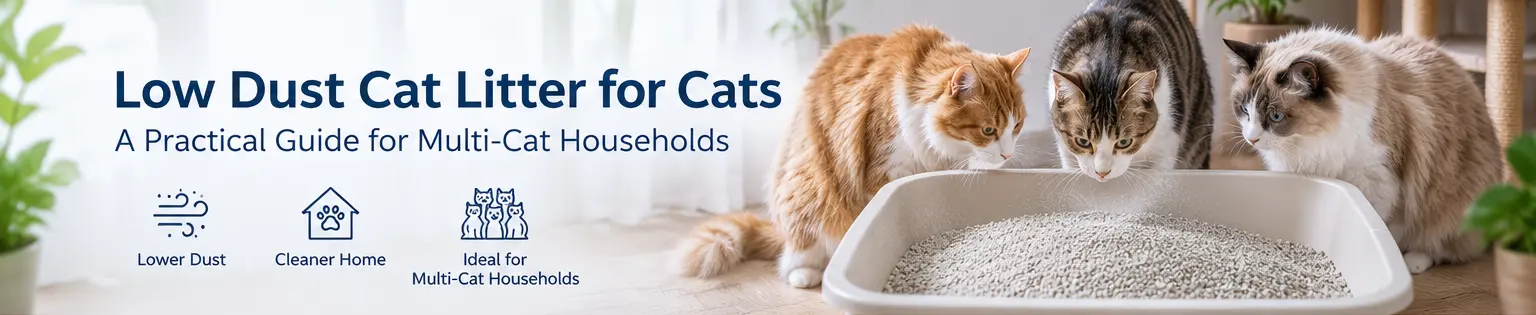





Cat litter dust control has become one of the most common purchasing filters used by overseas retailers and B2B buyers evaluating cat litter suppliers, yet most buyers never see what actually happens on the factory floor to achieve it. Effective dust control is not a single finishing step. It is the cumulative result of decisions made at every stage of manufacturing — raw material grading, particle size, drying, mixing, screening, polishing, additive selection, and final inspection. This guide walks through the six-stage system behind low dust cat litter manufacturing at our facility, and explains what buyers should ask before choosing a supplier.
Why Cat Litter Dust Control Requires a System, Not a Single Machine
A common misconception among first-time importers is that “dust-free” simply means an extra filter or a dust remover bolted onto the end of the line. In practice, dust behaves like a byproduct of mechanical stress: it is created wherever particles are crushed, dried too aggressively, rubbed against each other, or handled roughly. A machine at the end of the line can only catch dust that has already formed — it cannot prevent it. An effective dust collection system has to be built into the line itself, not added after it, starting at raw material intake and continuing through every mechanical and thermal step of manufacturing, ending with testing before the product ever reaches a bag.
Where Does Dust Come From in Cat Litter Manufacturing?
Before discussing solutions, it helps to map where dust actually originates. Dust is generated or released at seven points in the supply chain:
- Crushing and milling of raw bentonite or plant fiber
- Particle breakage during mixing and extrusion
- Over-drying, which makes particles brittle
- Screening and grading of finished granules
- Packaging and bag-filling
- Transportation, including sea freight vibration
- Storage in humid or dry overseas warehouses
Dust begins long before packaging, which is why source-level control matters more than any single downstream fix.
Step 1: Raw Material Selection and Regional Grading
The most reliable way to reduce dust is to reduce it at the source, rather than removing it afterward — the same logic behind established European and American brands. We run a centralized raw material supply chain with region-specific sourcing: EU-bound orders use low-sodium bentonite ore, water-eluted before leaving the mine, keeping primary dust near 2.1%; North American orders use bentonite suited to two-stage dry powder pretreatment; Southeast Asian orders use food-grade corn starch and pea fiber, with any fiber powder finer than 80 mesh screened out before it reaches the line.
Every incoming batch is tested with a laser particle size analyzer under a three-level sampling protocol. Our internal red lines: bentonite raw material with more than 7% fine powder below 80 mesh is rejected, and plant fiber raw material with more than 4% fine powder at 100 mesh is rejected. Batches outside these limits are returned rather than blended into production. Source-level grading like this removes an estimated 45% of secondary dust that would otherwise be generated later in processing, which also reduces the load on downstream filtration equipment. This is the first and most cost-effective layer of cat litter dust reduction, since correcting a fine-powder ratio at the raw material stage is far cheaper than filtering the same dust out further down the line.
Step 2: Particle Size and Mesh Control
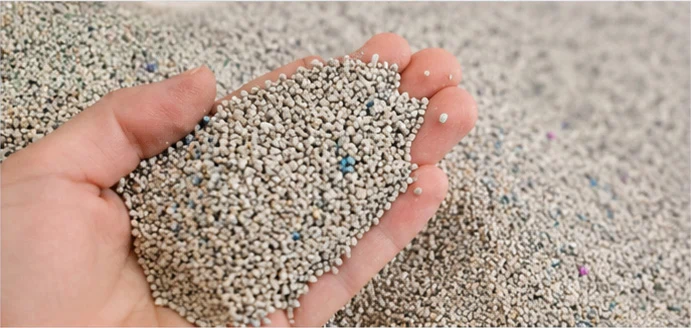
Mesh size is not just a grinding setting — it is a variable that directly trades off dust, clumping strength, and shelf appearance. Coarser mesh (roughly 80) tends to produce less dust but can affect absorption speed, while finer mesh (closer to 100) improves texture but raises the risk of fine powder if not tightly controlled. We calibrate mesh selection per product line and destination market rather than using one universal setting, since a mesh profile that performs well for a North American clumping formula is not automatically correct for a Southeast Asian tofu-based formula.
Step 3: Moisture Control During Drying
Drying is one of the least visible but most influential steps in dust control. If material is dried too aggressively, particles become brittle and fracture during later handling, generating fine dust that a mesh screen alone can’t fully remove. Instead of a traditional hot-air direct-exhaust dryer, we use a closed-loop waste heat recovery drying system that collects dust-laden vapor in a dedicated chamber rather than venting it directly. This keeps workshop airborne dust below 0.4 mg/m³ — under the 0.5 mg/m³ reference ceiling used in EU factory environmental standards — and prevents dry and wet dust particles from re-adhering to finished granules.
Step 4: The Dust Collection System That Runs Through the Production Line
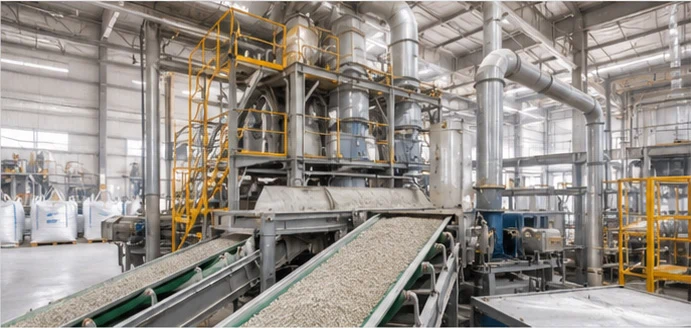
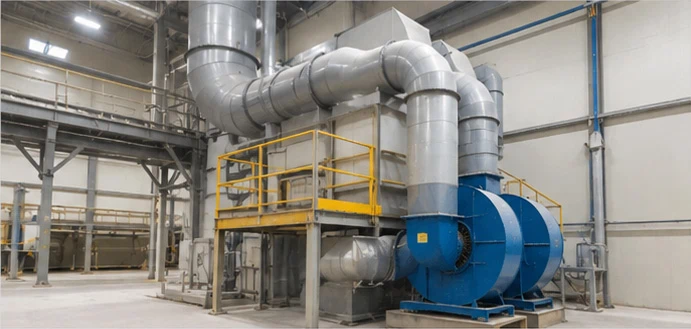
This is the core of our cat litter dust control system, and the stage most buyers never see during a standard factory audit. Crushing uses a closed toothed roller crusher rather than a traditional hammer crusher, reducing the impact force that creates ultrafine powder, feeding a single-point negative-pressure suction line into a central cyclone separator that spins out heavier dust before it reaches a filter. Mixing happens in a double-layer sealed bin at a constant -120Pa, keeping floating dust drawn inward instead of escaping into the workshop; remaining fine particulate is captured downstream by a bag filter bank before air recirculates. Extrusion uses calibrated die tooling to keep particle density uniform and reduce hollow-core granules that tend to break apart later.
After forming, finished granules pass through a four-stage gradient screening process: a coarse screen removes oversized clumps, an intermediate-frequency vibrating screen separates fine slag below 20 mesh, a low-speed air separation stage (constant at 0.8 m/s, calibrated to avoid crushing intact granules) lifts loose surface dust away, and a static settling chamber allows granules to rest for roughly 12 minutes so ultrafine floating dust can settle out naturally. Many product lines then go through a light polishing pass, which knocks loose surface fines off each granule without changing its core structure — this is a major factor in how much loose powder a customer sees when they first open a bag. All collected dust is returned to the raw material stage for re-granulation, which avoids waste and keeps the process aligned with circular production goals. The combined result is a finished-product static dust rate stable in the 0.08%–0.25% range.
Step 5: Compliant Dust-Suppression Additives by Region
Some lower-cost factories rely on industrial talc or light calcium carbonate as a cheap dust-suppressing coating. These bind dust effectively but generally fail REACH or EPA chemical review — a common reason cross-border shipments get flagged or returned. We use three compliance-graded additive formulas matched to destination:
| Target Market | Reference Standard | Typical Finished-Product Dust Threshold | Compliant Additive Used |
|---|---|---|---|
| European Union | REACH; EN13432 degradability | ≤0.1% (boutique tier) / ≤0.3% (entry tier) | Food-grade modified corn syrup + plant microcrystalline cellulose (zero synthetic additives) |
| North America | ASTM F963-tested raw materials (where applicable); USDA bio-based materials | ≤0.3% | Food-grade mineral-modified binder, heat-cured to seal surface pores |
| Southeast Asia / Middle East | TUV Singapore certification | ≤0.3% | Purified diatomite composite, suited to high-heat and high-humidity storage |
| All regions (test method baseline) | ISO 12103-1 dust test protocol | Used to measure the thresholds above | — |
Every additive batch is verified through SGS testing before use, with traceable documentation available for cross-border customs sampling.
Step 6: Final Dust Testing and Batch Inspection Before Packaging
Production does not end at the screening stage. Every batch goes through dual-mode dust testing built around recognized cat litter dust testing standards, reflecting real-world conditions rather than lab-only assumptions. Static floating dust testing, run under ISO 12103-1, measures dust released when a sealed container is vibrated — approximating what happens when a customer opens a bag at home. Dynamic use testing simulates a cat scraping and digging in the litter, measuring friction-generated dust, which is closer to how overseas retail platforms evaluate products during quality review.
Each batch gets a bilingual report covering particle size distribution, dust settlement rate, and free powder content — usable directly for marketplace filing on platforms like Amazon, Temu, or Walmart. Dust testing is one part of a broader cat litter quality control process that also checks clumping strength and moisture, but dust is the metric most overseas buyers ask about first. These cat litter dust testing standards are backed by an MES-driven digital process control system, which adjusts crushing airflow, screening frequency, coating spray volume, and negative-pressure levels in real time by destination — for example, a 12% coating-spray increase and longer settling window for Germany-bound batches, and tighter fine-powder tolerances for Australia-bound batches.
Protecting Dust Levels During Storage, Packaging, and Shipping
A batch can pass every internal test and still arrive dusty if storage and transport aren’t controlled. Humidity swings cause granules to absorb moisture, crack, and rub against each other, generating dust that was never present at the factory. We run climate-tuned finished-product warehouses by destination: EU-bound stock at 45%–50% humidity, Middle East-bound stock at 30%–35% with light surface misting, and Southeast Asia-bound stock wrapped in moisture-proof film ahead of the rainy season. Warehouses also run scheduled central dust settling and a pre-loading air sweep, so dust readings stay consistent from factory exit through overseas warehouse arrival.
Packaging is double-layered: an inner food-grade PE microporous film locks residual surface dust in place while still allowing airflow, and an outer wear-resistant woven bag with heat-sealed, sewn seams prevents powder leakage. Small retail packs (1.8–5 kg) get an added dust-suppression spray film; bulk OEM shipments (around 20 kg) use a customized dust-proof container interlayer with pre-loading spray. The measured result across recent shipments is a logistics-stage dust increase below 0.02%, versus an industry average closer to 0.15%.

How Buyers Can Evaluate a Low-Dust Cat Litter Manufacturer
Marketing copy is easy to write; a real dust control program is not. When vetting a low-dust cat litter manufacturer, ask for specifics rather than taking “dust-free” at face value:
- Request static and dynamic dust test reports referencing ISO 12103-1 and other applicable cat litter dust testing standards
- Ask what fine-powder ratio their raw materials are graded against, and at what mesh
- Confirm additive compliance with REACH, EPA, or USDA, backed by SGS documentation
- Ask whether the factory’s cat litter dust control system runs crushing and mixing under negative pressure, and whether collected dust is recovered in a closed loop
- Ask how storage humidity is controlled for your specific destination climate
- Ask whether process parameters (screening, coating, drying) are digitally logged per batch
A supplier that can answer these questions with batch-level data, rather than a general claim, is far more likely to hold up under repeated container-scale orders.
Final Decision
Real cat litter dust control is not delivered by one machine or one additive — it is the outcome of source-level raw material grading, calibrated particle size, controlled drying, a closed-loop dust collection system, region-compliant additives, and batch-level testing working together. Manufacturers who can document each of these stages, rather than asserting a single “dust-free” claim, are the ones capable of holding consistent dust performance across large-volume, cross-border orders.
For product-specific dust test data or OEM formulation options, view our low-dust cat litter product line, browse the full cat litter category, or contact us directly about OEM and private-label dust control specifications.
Frequently Asked Questions
Can the same cat litter formula meet dust standards in different countries?
Yes. Raw material grading, coating additive, and screening parameters can be fine-tuned per destination without building a separate production line. Finished products can be issued with bilingual reports referencing ASTM, REACH, or ISO standards depending on the target market.
How much more does low-dust cat litter cost to produce?
Compliant low-dust production typically runs 7%–11% higher than standard output, partly offset by closed-loop material recovery. Retail-side, low-dust products in Europe and North America can carry a price premium of up to 20%, keeping margins stable for both manufacturer and importer.
Does reducing dust weaken clumping or absorption performance?
No, when done correctly. Surface-level dust-locking treatments seal only the outer pores of a granule without altering the internal absorbent structure. SGS testing on our low-dust formulas shows clumping hardness and absorption performance consistent with standard formulas.
Is “100% dust-free” cat litter realistic?
Not in a literal sense. Genuine zero-dust output is not achievable with current manufacturing technology, which is why terms like “99% dust-free” in marketing are generally understood industry-wide as relative, not absolute, claims. A static dust rate in the 0.08%–0.25% range is considered a strong result by current international benchmarks.
What equipment is actually part of a cat litter dust collection system?
Typically a combination of negative-pressure ducting at each dust-generating point, a cyclone separator to pull out heavier particles first, and a bag filter bank to capture the remaining fine dust before air is recirculated or vented. Screening and polishing stages downstream handle whatever dust escapes mechanical processing.
How is this different from a general cat litter manufacturing process guide?
Our earlier article, Dust-Free Cat Litter Manufacturing Process, covers the full production workflow from raw material to finished bag. This article focuses specifically on the dust-control engineering layered across that workflow — the systems, thresholds, and testing that determine whether a batch actually qualifies as low-dust.