




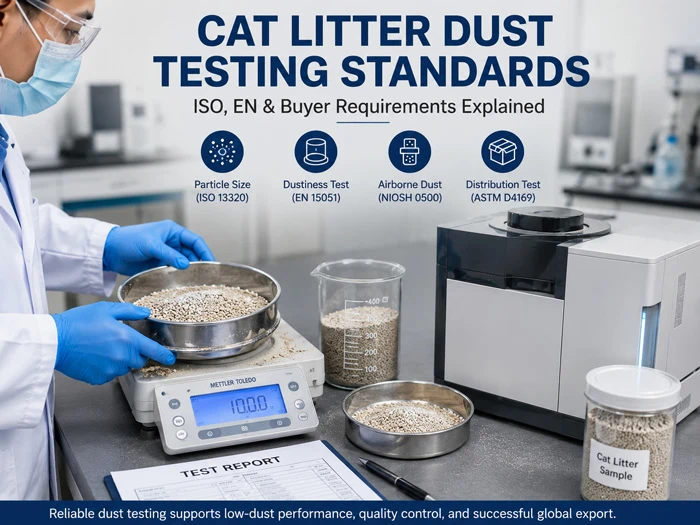
Dust is one of the most common reasons overseas buyers reject or return cat litter shipments.Fine airborne particles not only affect user experience but are also one of the quality indicators buyers evaluate when sourcing cat litter. As exports of tofu, bentonite, and mixed-mineral litter continue to grow, understanding cat litter dust testing standards has become increasingly important for manufacturers and importers alike.
Most sourcing conversations stall on the same question: which cat litter dust testing standards actually prove a batch is “low dust”? The honest answer is that no international body has published a cat-litter-specific mandatory dust limit — but that doesn’t mean dust testing is unregulated guesswork. A defined set of general-purpose ISO, EN, and NIOSH methods are what third-party labs and retail auditors actually use, and the resulting numbers function as commercial procurement thresholds rather than legally mandated limits.
No Mandatory Standard, But a Common Testing Basis
No ISO, ASTM, or EN standard was written specifically for cat litter dust. This is normal across most consumer bulk-material categories: standards bodies publish general-purpose test methods, and industries adopt whichever ones fit their material. For cat litter, dust testing borrows from three adjacent fields — powder and particle metrology, occupational dustiness testing, and packaging/distribution testing — rather than from a single pet-industry rulebook.
What third-party labs actually apply are general particulate detection methods, and it’s this general methodology — not a cat-litter-specific regulation — that has become the de facto shared basis for testing worldwide, including for audits by major online marketplaces and pet retail chains. Because there’s no single mandatory ceiling, the specific numeric thresholds discussed below (such as a static dust rate under 1%) are best understood as commercial procurement conventions commonly referenced by export QC teams and cross-border buyers — not legally binding limits set by any standards body.
Which Cat Litter Dust Testing Standards Actually Apply?
Three real, checkable methods make up the core of how cat litter dust is tested internationally today.
ISO 554 — Standard Atmospheres for Conditioning and Testing
Before any dust test begins, the sample has to sit under controlled temperature and humidity so moisture content doesn’t skew the result. ISO 554 defines the standard laboratory conditioning atmosphere used across materials testing — 23°C ± 2°C and 50% ± 5% relative humidity — which is why labs condition cat litter samples for roughly 24 hours before testing begins.
ISO 13320 — Particle Size Analysis by Laser Diffraction
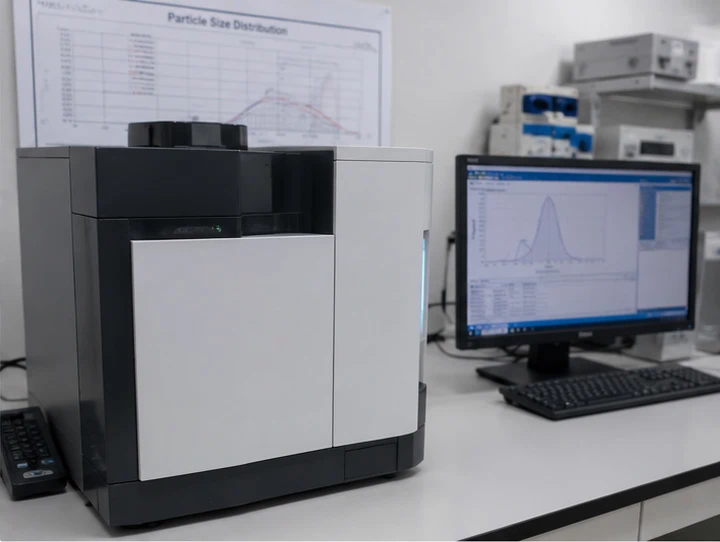
This is the standard method for measuring how particle size is distributed across a powder or granular sample using laser diffraction. Applied to cat litter, it separates dust into size bands — commonly reported around the ≤10 µm (PM10, inhalable) range, the 10–100 µm suspended range, and the >100 µm range that settles quickly. It’s genuinely general-purpose and is the correct method to cite when a report discusses particle size distribution.
EN 15051 — Measurement of the Dustiness of Bulk Materials
EN 15051 (Parts 1–3) is a European workplace dustiness standard developed for powdered, granular, and pelletized bulk materials. Although it was not written specifically for cat litter, its testing methodology is well suited to evaluating dust released during handling, and it is increasingly used as a reference by laboratories testing cat litter products. It uses a rotating drum or continuous-drop apparatus to agitate the material under controlled conditions and measures the inhalable, thoracic, and respirable dust fractions released — this is the closest real-world match to what buyers mean when they ask for “dynamic dust” data: how much dust the product throws off when scooped or disturbed, not just how much it sheds sitting still.
Supplementary Methods: NIOSH 0500 and ASTM E11
NIOSH 0500 is a U.S. occupational-hygiene method for collecting and weighing total airborne particulate on a filter. It wasn’t designed for retail products, but some labs use it as a supplementary cross-check alongside EN 15051 or ISO 13320 results. Static sieve testing, meanwhile, typically uses test sieves built to ASTM E11 specifications, even though the sieving procedure itself is a general gravimetric technique rather than a single named standard.
ASTM D4169 — Performance Testing of Shipping Containers
Cat litter that tests clean in the factory can still generate secondary dust after weeks at sea. ASTM D4169 is the standard practice for simulating the distribution environment — vibration, stacking, and handling shocks — that shipping units encounter in transit. Some export-focused labs adapt this framework to measure how much additional fine dust a packed product generates after simulated transport, which is a meaningful data point for buyers importing by ocean freight.
Five Core Dust Indicators Used in Cross-Border Procurement
Based on general industry testing practice, five indicators come up repeatedly in cross-border cat litter procurement. As above, the testing methods follow the recognized standards described here — the specific threshold values are commercial conventions commonly referenced by export QC teams and buyers, not official mandatory limits.
1. Static Dust Rate
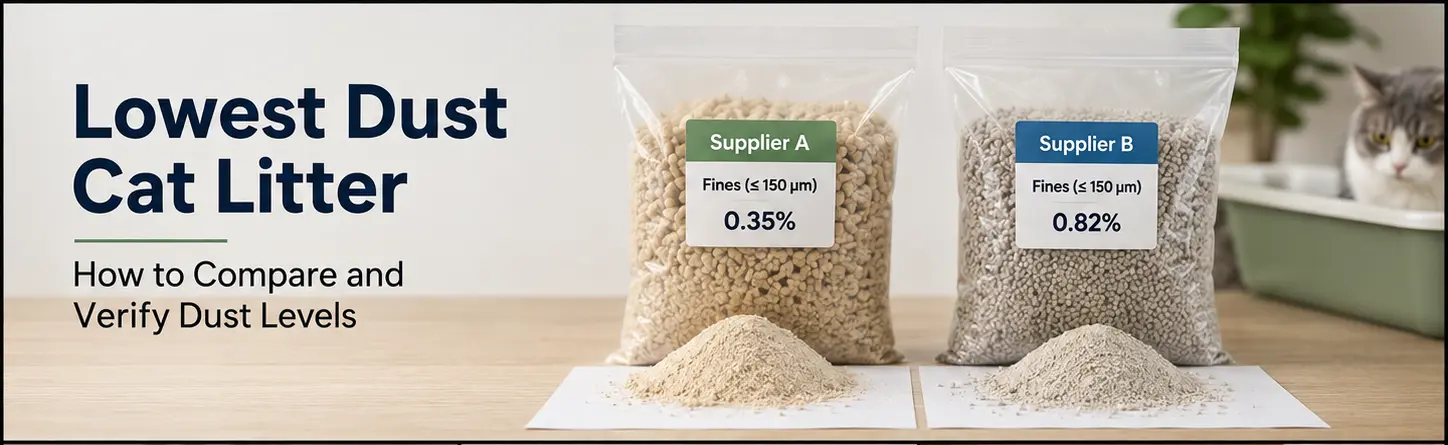
Measured by passing a weighed sample through a fine test sieve and weighing the fines collected underneath. A static dust rate at or below roughly 1% is a commonly cited baseline for cross-border orders, with buyers targeting premium, low-dust channels often looking for 0.5% or lower. In practice, common bulk bentonite typically runs higher than film-coated or re-granulated tofu and mixed-mineral litters. For a broader comparison of dust performance, clumping behavior, odor control, and cost, see our Bentonite vs. Tofu Cat Litter guide.
2. Particle Size Distribution
Based on ISO 13320 laser diffraction results, buyers commonly look at the split between the ≤10 µm inhalable fraction, the 10–100 µm suspended fraction, and the >100 µm fraction that settles quickly. A lower share of inhalable dust is generally treated as a stronger health-oriented selling point for premium channels.
3. Static and Dynamic Release Concentration
Tested in an enclosed chamber, this measures how much dust becomes airborne at rest (static) versus after simulated scooping or handling (dynamic, per EN 15051-style agitation). It’s common for a product to pass a static test comfortably while failing the dynamic one — dynamic performance is often the harder bar to clear and the one that determines whether a product can move beyond low-end wholesale channels into supermarket chains.
4. Dust Settling Time
How long it takes for disturbed dust to fully settle after handling. Buyers in markets with stricter indoor air expectations tend to look for settling within roughly 30 minutes; longer settling times generally correlate with lower repurchase intent, since fine dust lingering indoors is one of the more noticeable complaints from end users.
5. Transport Dust Increment
The increase in fine dust after simulated transport vibration and handling (see ASTM D4169 above), reported as an added weight fraction relative to the original sample. This indicator specifically targets particle attrition during long-distance shipping — a factor that’s easy to overlook if testing only covers the product as it leaves the factory, not as it arrives.
The Standardized Testing Workflow
Third-party labs generally follow a consistent four-step sequence so that results from different labs and countries can be compared on equal footing.
Step 1: Sample Conditioning
A representative sample (commonly around 500g) is pulled, cleared of packaging debris and large clumps, and conditioned per ISO 554 (23°C ± 2°C, 50% ± 5% RH) for approximately 24 hours so moisture content doesn’t distort the result.
Step 2: Static Sieve Test
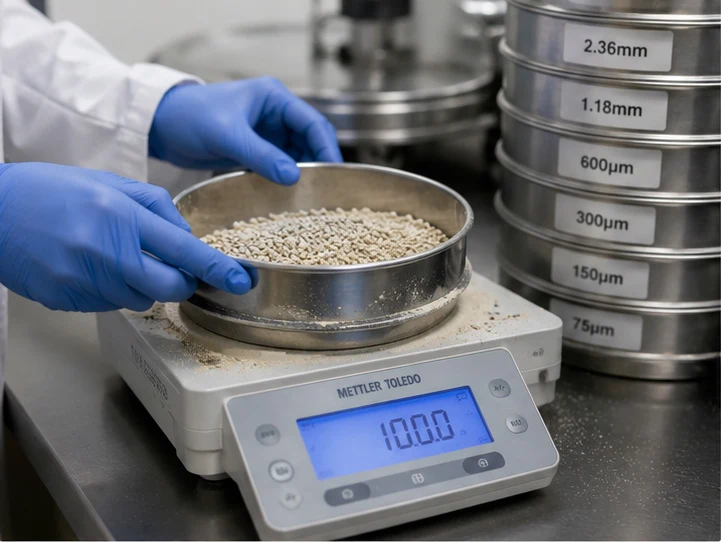
The conditioned sample is weighed, passed through a standard test sieve (built to ASTM E11 specification), and mechanically shaken for a set duration. The fines that pass through are weighed, and the static dust rate is calculated as a percentage of the original sample weight.
Step 3: Dynamic Dust and Settling Test
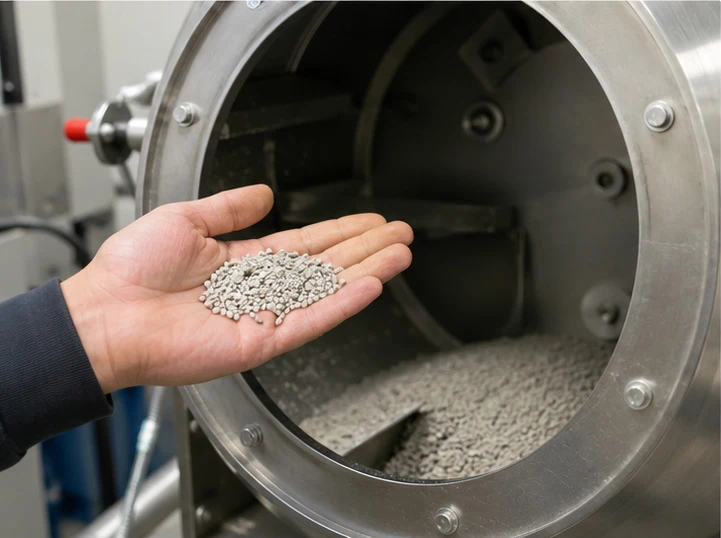
A sample goes into an enclosed test chamber where a built-in mechanism agitates it for a fixed period to simulate scooping or handling, following the general principles of EN 15051-style dustiness testing. A dust monitor records peak concentration during agitation, and the time for dust to fully settle is timed separately.
Step 4: Laser Diffraction Particle Size Analysis
Dust collected from the sieve and chamber tests is analyzed via laser diffraction per ISO 13320, producing a breakdown of the inhalable, suspended, and quick-settling particle fractions, typically issued as an attachment to the main test report for premium or OEM-facing channels.
How Buyer Expectations Differ by Region
On top of this shared testing basis, procurement thresholds vary in practice by destination market — these reflect buyer and retailer conventions rather than government regulation:
- EU market: Buyers tend to focus most closely on the inhalable (PM10) fraction, often expecting it to stay under roughly 30% of total measured dust.
- North American market: Retail buyers tend to weight dynamic peak concentration heavily, along with a settling time that clears within about 30 minutes.
- Southeast Asia and Middle East markets: Entry requirements are generally lighter, with buyers more often satisfied by a basic static dust report without a full particle size or dynamic dust breakdown.
Chinese domestic pet-product standards exist separately from these international testing conventions and aren’t something overseas buyers typically require, though some export-oriented labs can issue a bilingual comparison report for internal reference.
Why Dust Testing Matters for Cat Litter Manufacturers
Meeting recognized cat litter dust testing standards isn’t just a compliance checkbox — it affects the commercial outcome of an order in several concrete ways:
- Fewer returns and disputes. Dust complaints are consistently cited by distributors as a leading cause of end-customer returns and post-sale disputes.
- Retailer audit pass rates. Large chains and marketplaces increasingly ask for particle size or dustiness data before approving new SKUs, and products without documentation are often declined outright.
- Review scores and repurchase. Dust is one of the most frequently mentioned complaints in negative online reviews for litter products, which affects both conversion and repeat purchase.
- OEM credibility. Private-label buyers evaluating multiple factories use test reports as a fast way to screen out suppliers who can’t substantiate their claims — and, increasingly, to screen out suppliers whose cited standards don’t hold up to a quick check.
How to Verify a Supplier’s Dust Test Report
Before accepting a dust claim at face value, it’s worth checking whether the cited method is a real, checkable standard — not every number on a spec sheet is. A quick search of the standard’s issuing body is usually enough to confirm it. This is one of the simplest ways to tell a credible supplier from one padding a report, and it’s the same standard we hold our own documentation to.
Beyond confirming the standard itself is real, a complete report should also cover the following:
- The testing lab is named and independently verifiable — not an internal or unnamed “laboratory”
- The report includes a test date and sample batch number, not just a general product claim
- The method distinguishes static dust (settled dust already present) from dynamic or dustiness testing (dust generated by handling)
- Units and thresholds are stated clearly, with the test conditions (sample size, environment, duration) disclosed
A supplier that can walk through these details without hesitation is a stronger signal than any single number on a spec sheet.
What Overseas Buyers Typically Request
For OEM and private-label projects, buyers evaluating cat litter dust testing standards commonly ask suppliers to provide:
- Particle size distribution reports (ISO 13320)
- Dustiness or dynamic dust reports (EN 15051 or an equivalent chamber test)
- Batch traceability linking the test sample to the production run
- Laboratory accreditation details for the testing body
- Retained samples in case of a dispute or re-test request
Suppliers who can produce this documentation as a standard part of order paperwork — rather than scrambling to arrange testing after a buyer asks — tend to move through supplier audits faster.
How Manufacturers Reduce Dust in Production
Testing identifies a dust problem; production process is what actually fixes it. Tofu-based and coated mineral litters generally hold up better under dynamic disturbance than uncoated bentonite, largely because of differences in raw material selection, granulation, drying control, and surface treatment. We cover this in full in our dust-free cat litter manufacturing process article.
| Method | What It Measures | Best Used For |
|---|---|---|
| ISO 554 | Standard laboratory conditioning atmosphere | Pre-test sample preparation |
| ISO 13320 | Particle size distribution via laser diffraction | Reporting PM10 / inhalable dust fraction |
| EN 15051 | Dust released when a bulk material is agitated (rotating drum / drop method) | Simulating handling and scooping |
| NIOSH 0500 | Total airborne particulate by gravimetric filter sampling | Supplementary total-dust cross-check |
| ASTM D4169 | Distribution environment simulation (vibration, handling) | Transport-induced dust increment |
For buyers comparing formulations, our low dust cat litter line is tested using this same framework as part of standard OEM documentation.
If you’re evaluating multiple cat litter suppliers, we can provide OEM samples together with third-party dust testing documentation upon request. Contact Pet Horizon to discuss your project requirements.
FAQ
Is there a global mandatory dust limit for cat litter?
No. No ISO, ASTM, or EN body has published a cat-litter-specific mandatory limit. Buyers instead rely on general particulate testing methods (like ISO 13320 or EN 15051) combined with commercial procurement thresholds.
What’s the difference between static and dynamic dust testing?
Static testing measures dust already loose in the bag at rest. Dynamic or dustiness testing (e.g. EN 15051) measures dust generated when the material is handled, scooped, or agitated — which better reflects real household use.
How do I know if a cat litter is genuinely low-dust?
Ask for a report citing a real, checkable standard (ISO 13320 for particle size or EN 15051 for dustiness), issued by a named independent lab, with a test date and batch number — not just a marketing claim of “99% dust-free.”
Do all cat litter manufacturers perform dust testing?
No. Dust testing adds cost, so many smaller producers skip it unless a buyer specifically requires it. It’s worth confirming testing practices directly with a supplier rather than assuming it’s standard.
Which standard should I ask for when selling into the EU?
EN 15051 is the more directly relevant method for EU buyers since it’s a European standard built for bulk powdered and granular materials. ISO 13320 particle size data is commonly requested alongside it.
What does “99% dust-free” actually mean?
There’s no single, standardized definition. Different manufacturers use different test methods, sample conditions, and particle size cutoffs to arrive at it, so “99% dust-free” figures from different suppliers usually aren’t directly comparable. Ask what method and threshold the number is based on before using it to compare products.
Can dust testing be customized for OEM projects?
Yes. Testing methods and thresholds can be selected based on the buyer’s requirements or the expectations of the destination market — for example, prioritizing EN 15051 dustiness data for an EU-bound order or ISO 13320 particle size data for a buyer focused on PM10 reporting.