




What Is a Cat Litter Dust Test?
As the global pet care industry continues to expand, product quality standards for cat litter are becoming increasingly strict, especially in terms of airborne dust control and indoor air safety. A Cat Litter Dust Test refers to a standardized evaluation process used to measure the amount of fine particles released during production, transportation, and daily use of cat litter products.
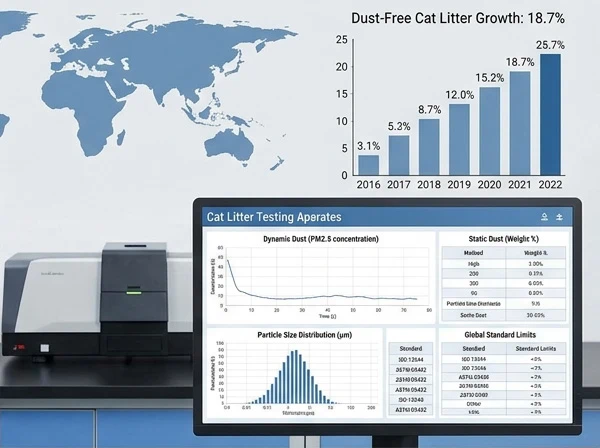
This test plays a critical role in determining product quality, consumer safety, and international market compliance. With the global cat litter market exceeding 12.8 billion USD and low-dust products growing at a rapid annual rate, dust performance has become one of the most important competitive indicators for manufacturers and brands.
From a B2B perspective, importers, distributors, and OEM buyers increasingly require validated dust test data before selecting suppliers. Therefore, understanding how dust is measured is essential for both product development and international trade compliance.
Why Cat Litter Dust Testing Matters
Dust generated by cat litter is not just a visual inconvenience; it is a measurable air quality factor that directly affects both animals and humans.
Impact on Cats
Fine particles smaller than 10μm can enter a cat’s respiratory system, potentially leading to:
- Chronic sneezing and coughing
- Bronchial inflammation
- Allergic reactions
- Long-term respiratory sensitivity
In addition, dust particles can adhere to fur and paws, increasing the risk of ingestion during grooming.
Impact on Humans and Indoor Air Quality
According to indoor air quality principles referenced in ISO 16000 series methodologies, fine particulate matter from cat litter can temporarily increase indoor PM2.5 levels significantly during use.
Sensitive individuals may experience:
- Eye irritation
- Throat discomfort
- Skin allergies
- Respiratory sensitivity
Dust particles can also carry bacteria and allergens, contributing to overall indoor pollution load.
Industry Compliance Pressure
In regulated markets such as Europe and North America, cat litter dust performance is indirectly evaluated under general particulate and indoor air quality standards. Buyers often require laboratory reports before approving suppliers.
Core Dust Indicators in Cat Litter Testing
A complete Cat Litter Dust Test is usually evaluated through multiple indicators rather than a single metric.
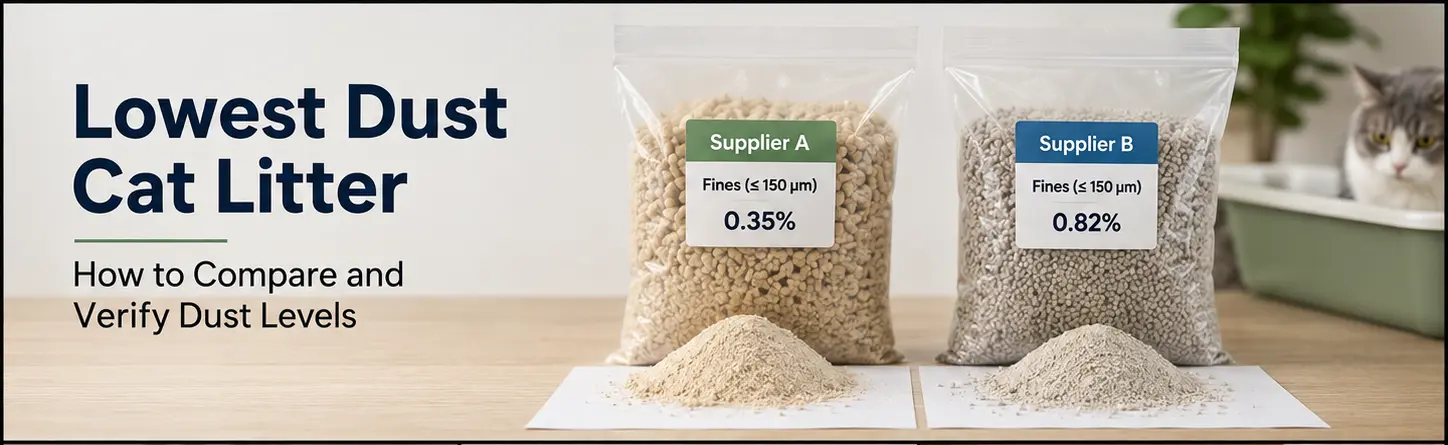
Total Dust Content
This refers to the mass percentage of fine powder separated from the main granules during testing.
- High-quality products: ≤ 1%
- Standard products: ≤ 2%
Inhalable Particle Fraction (≤10μm)
This is one of the most critical safety indicators, as particles in this range can enter respiratory systems.
- Recommended threshold: ≤ 5% of total dust fraction
Dust Suspension Behavior
This evaluates how long particles remain airborne after disturbance.
- High-end products typically settle within 10 seconds
- Poor-quality products may remain suspended significantly longer
Particle Size Distribution
Particle distribution determines dust formation potential during handling, packaging, and usage.
Cat Litter Dust Testing Methods
There are three major internationally used approaches to measuring cat litter dust levels.
Laboratory Weight Screening Method
This is one of the most widely used standardized approaches for quality control.
Procedure:
- A representative 500g sample is collected
- The sample is stabilized for 24 hours
- The sample is passed through a 100-mesh sieve
- Fine dust is collected and weighed
- Dust ratio is calculated and averaged over multiple trials
This method provides stable and repeatable results and is widely used in factory QC systems.
Laser Particle Size Analysis
This method uses laser diffraction technology to determine particle size distribution.
It is mainly used to:
- Identify respirable particle fractions
- Analyze micro-dust distribution (0.1–100μm)
- Support high-end product certification
Compared to manual screening, this method provides higher precision and is commonly used in third-party laboratories.
Simulated Environmental Dust Test
This method simulates real household usage conditions.
Test process:
- Cat litter is placed in a controlled chamber
- Mechanical disturbance simulates digging behavior
- PM2.5 concentration is measured at multiple time points
- Dust settlement time is recorded
This method reflects real-world consumer experience more accurately than laboratory-only testing.

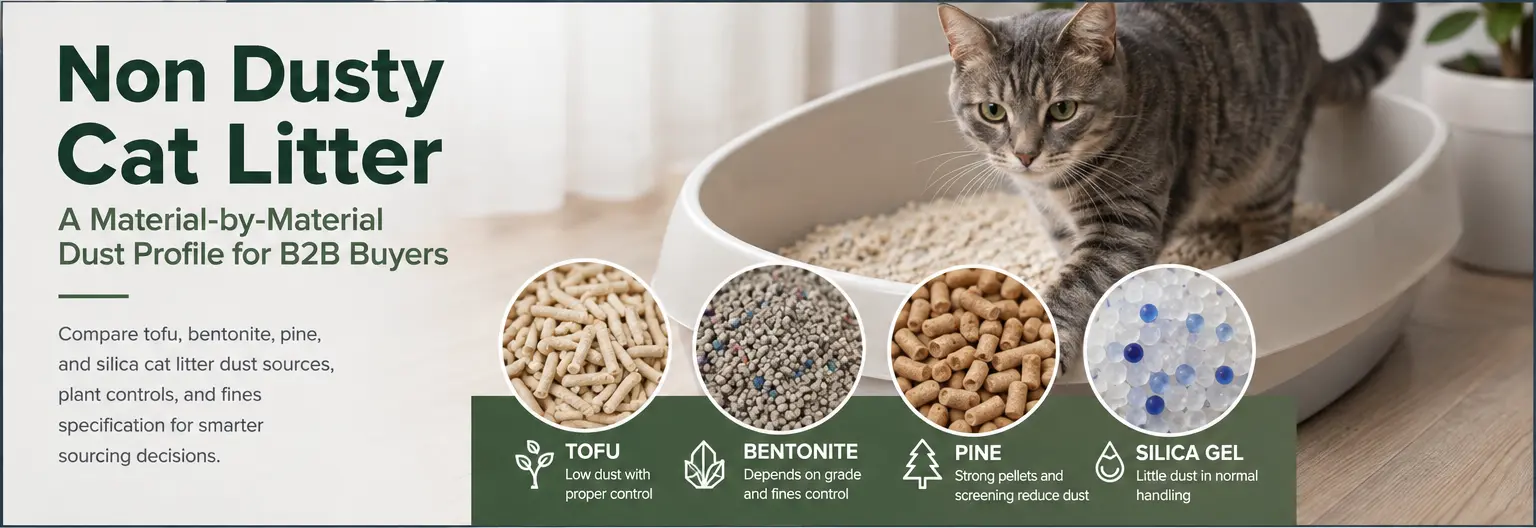
Dust Performance Comparison Across Cat Litter Types
Different raw materials significantly affect dust generation behavior.
| Type | Total Dust Level | Inhalable Dust | Suspension Time | Overall Performance |
|---|---|---|---|---|
| Bentonite Cat Litter | High (2.1–3.5%) | 8–12% | 15–25s | Strong clumping but high dust |
| Tofu Cat Litter | Low (0.6–1.5%) | 2–4% | 5–8s | Balanced performance |
| Crystal Cat Litter | Very Low (0.3–0.7%) | Minimal | Fast | Low dust but fragile |
| Pine Cat Litter | Medium (1.0–1.8%) | Low | Moderate | Natural but slower settling |
| Mixed Cat Litter | Low–Medium (0.9–1.2%) | Low | 6–10s | Balanced cost-performance |
Tofu-based and optimized bentonite formulations generally provide the best balance between performance and dust control in international markets.
Key Factors Affecting Dust Test Results
Manufacturing Process
Particle uniformity, drying techniques, and surface coating directly affect dust generation. Poorly controlled processes produce higher levels of fine powder.
Transportation and Handling
Mechanical vibration during logistics can increase secondary dust formation by damaging particle structure.
Environmental Conditions
Humidity and temperature influence particle adhesion and dispersion behavior, affecting test consistency.
Equipment Calibration
Inaccurate calibration of testing instruments can significantly distort particle size and dust ratio results.
Industry Applications and Compliance Requirements
For global B2B trade, Cat Litter Dust Test reports are increasingly required in:
- OEM supplier qualification
- Cross-border e-commerce compliance
- Retailer onboarding
- Private label product development
Manufacturers targeting EU and US markets must provide consistent dust performance data to meet buyer expectations and reduce customs or compliance risks.
In addition, brands focusing on premium positioning often use dust test data as a marketing differentiation tool.
Conclusion
A Cat Litter Dust Test is a fundamental quality evaluation system that defines the performance, safety, and international competitiveness of cat litter products. As global demand for low-dust and high-performance products continues to grow, manufacturers must adopt standardized testing methods and optimize production processes accordingly.
Understanding dust levels, testing methodologies, and influencing factors allows brands and buyers to make more informed decisions in product selection and development.
Ultimately, consistent dust control is a key benchmark for premium cat litter products in the global market.
FAQ
What is considered low dust cat litter?
Generally, products with total dust below 1–2% are considered low-dust formulations.
Which cat litter has the lowest dust?
Crystal cat litter typically has the lowest dust content, followed by tofu-based formulations.
What is the main cause of cat litter dust?
Dust is mainly caused by broken particles during production, transportation, and usage.
Can home testing replace lab testing?
No. Home testing is only for reference and cannot replace certified laboratory testing.
What standards are used for dust testing?
Common references include ISO-based particle analysis methods and ASTM environmental testing procedures.
How can manufacturers reduce dust levels?
By improving particle screening, coating processes, and optimizing material formulation.