




The EU Packaging and Packaging Waste Regulation (PPWR) — Regulation (EU) 2025/40 — is the single biggest change to cat litter export compliance in a decade. It applies directly to every cat litter bag, sack, box and pail placed on the European market, including products manufactured outside the EU. For cat litter manufacturers, OEM suppliers, private label providers and wholesalers, the regulation reshapes packaging design, material sourcing and documentation from 12 August 2026.
This guide explains, in practical B2B terms, what the PPWR is, which requirements hit cat litter packaging, and what each player in the supply chain must do to keep selling into the EU.
TL;DR — The 5 Things That Matter Most
- PPWR applies to imported packaging. Non-EU cat litter exporters are in scope; the EU importer or brand owner carries legal responsibility.
- Substance limits start 12 Aug 2026: heavy metals (Pb+Cd+Hg+CrVI) ≤ 100 mg/kg; PFAS restricted in food-contact packaging.
- Recyclability floor from 2030: packaging below 70% recyclable (Grade C) is banned from the EU market.
- Recycled content is mandatory: most plastic cat litter bags need ≥35% recycled plastic by 2030.
- Labelling + EPR + Declaration of Conformity become standard requirements for every EU-bound shipment.
What Is the EU PPWR?
The PPWR (Regulation (EU) 2025/40) is the European Union’s flagship packaging law. Adopted on 19 December 2024, it entered into force on 11 February 2025 and has a general application date of 12 August 2026. It fully replaces the old Packaging and Packaging Waste Directive (94/62/EC), which had stood for nearly 30 years.
The decisive change is the shift from a directive to a regulation. A directive must be transposed into national law by each member state, which created 27 slightly different rulebooks. A regulation is directly and uniformly applicable in all 27 EU countries with no national transposition. For cat litter exporters, that means one single compliance standard across Germany, France, the Netherlands, Poland, Spain and every other member state.
Its objective is to make all packaging on the EU market recyclable in an economically viable way by 2030, safely increase recycled plastic content, phase out hazardous substances such as PFAS, and cut packaging waste per capita.
Does the PPWR Apply to Cat Litter Exported to the EU?
Yes — unambiguously. Article 2 of the PPWR covers all packaging and packaging waste placed on the EU market, irrespective of the material (plastic, paper, metal, glass, composite) and irrespective of where the company is based. Imported products are explicitly included. The regulation names four economic operators who hold obligations:
- Manufacturers — produce packaging or packaged products.
- Importers — bring packaged goods from outside the EU.
- Distributors — make packaged goods available on the market.
- Brand owners / private label holders — whose name or trademark appears on the packaging.
For a typical China- or Asia-based cat litter factory shipping to a European brand, the EU importer or brand owner is the “manufacturer” under PPWR and owns the conformity duties. The OEM factory supports them with material data, recyclability grading and the Declaration of Conformity. A “mirror clause” also means imported plastic packaging must meet the same environmental standards as plastic made inside the EU.
Key PPWR Requirements That Affect Cat Litter Packaging
1. Substance Restrictions — Heavy Metals and PFAS (Article 5)
From 12 August 2026, packaging material and its components (including prints and inks) must respect:
- Heavy metals: the combined concentration of lead, cadmium, mercury and hexavalent chromium must not exceed 100 mg/kg.
- PFAS: in food-contact packaging, limits are 25 ppb for an individual non-polymeric PFAS, 250 ppb for the sum of non-polymeric PFAS, and 50 ppm total fluorine (including polymeric PFAS). If total fluorine exceeds 50 mg/kg, the supplier must provide fluorine-content proof.
Cat litter packaging is generally non-food-contact, so the PFAS food-contact limits do not bind it directly. However, leading EU buyers increasingly demand PFAS-free packaging as a voluntary specification, and a broader Substances of Concern list is expected under the PPWR framework. Designing PFAS out of repellent coatings now is the lower-risk path.
2. Recyclability Grades A / B / C and the 2030 Market Ban (Article 6)
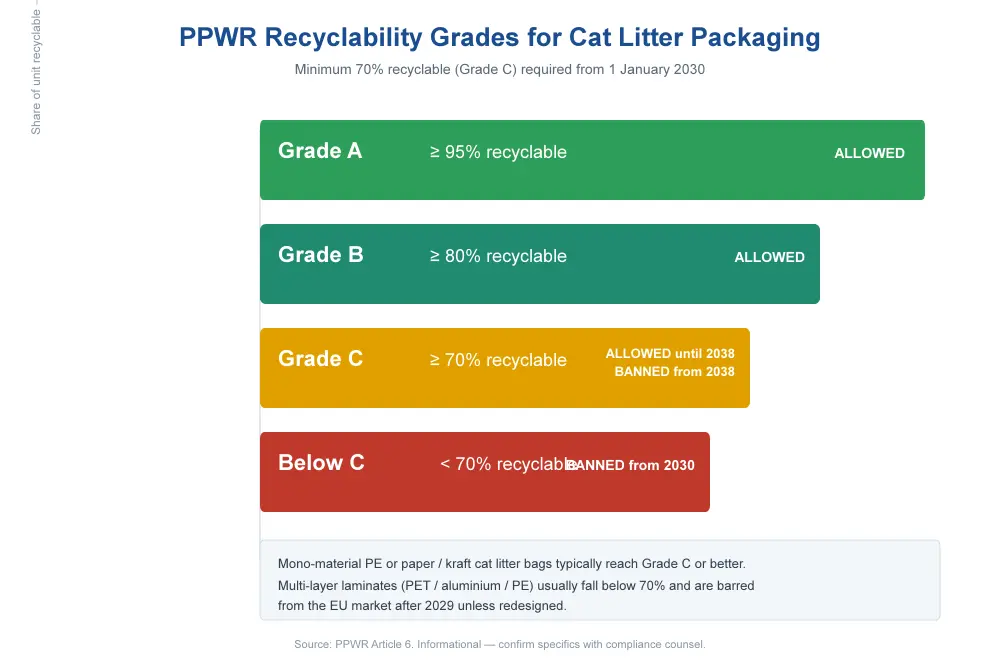
From 1 January 2030, every package on the EU market must be recyclable and meet a minimum performance grade based on the share of the unit (by weight) that is recyclable in existing EU infrastructure:
| Grade | Recyclable share | Status from 2030 | Status from 2038 |
|---|---|---|---|
| A | ≥ 95% | Allowed | Allowed |
| B | ≥ 80% | Allowed | Allowed |
| C | ≥ 70% | Allowed | Banned |
| Below C | < 70% | Banned | Banned |
For cat litter, this is the most consequential rule. A mono-material PE bag or a paper / kraft bag can typically reach Grade C or better. A multi-layer laminate (PET / aluminium / PE) or a plastic-coated paper bag usually falls below 70% and will be barred from the EU market after 2029 unless redesigned. The “design for recycling” technical standard applies from 2030 (or 24 months after the relevant implementing act).
3. Minimum Recycled Content for Plastic Packaging (Article 7)
Plastic packaging must contain a minimum share of post-consumer recycled plastic. For cat litter, the relevant band is “other plastic packaging” (non-food-contact):
| Packaging type | 2030 target | 2040 target |
|---|---|---|
| Other plastic packaging (e.g. cat litter bags) | 35% | 65% |
| Contact-sensitive plastic (non-PET) | 10% | 25% |
| PET contact-sensitive (excl. bottles) | 30% | 50% |
| Single-use plastic beverage bottles | 30% | 65% |
This means a standard PE cat litter bag must contain at least 35% recycled content by 2030. Suppliers must keep mass-balance documentation and be ready to prove the percentage with supplier declarations and third-party testing.
4. Compostable and Biodegradable Claims (Article 9)
Vague environmental claims are a liability. Under PPWR Article 9, compostable packaging must meet certification (typically EN 13432 industrial composting) and must be designed so it prioritises material recycling and does not contaminate other waste streams. “Biodegradable” or “eco” wording without certification is high-risk under EU green-claims enforcement. For cat litter, the safer and more defensible positioning is recyclable mono-material packaging plus credible, certified compostable options only where the end-of-life infrastructure exists.
5. Packaging Minimisation and Void Space (Article 10)
From 2030, packaging must be reduced to the minimum necessary weight and volume for its function. For grouped, transport and e-commerce packaging, the empty-space (void) ratio must not exceed 50%. Cat litter shipped in oversized boxes with excess filler, or multipacks with unnecessary layers, will need re-engineering. “Marketing reasons” are explicitly not an acceptable justification.
6. Harmonised Labelling and Digital Data Carrier (Article 12)
From 12 August 2028, packaging must carry harmonised EU labelling: standardised pictograms identifying the material (paper, plastic, glass, metal, wood, textiles, composites) plus sorting instructions. A QR code or other digital data carrier may link to a Digital Product Passport with full material composition, recyclability score and recycled-content data. For cat litter bags, this means a clear material code on every SKU and a scannable link to compliance data.
7. Producer / Importer Identification and Declaration of Conformity (Articles 15, 18, 38, 39)
From 12 August 2026, each packaging unit must carry the producer’s / importer’s name, registered trademark and postal address, plus a type, batch or serial identifier. Every packaging type placed on the EU market must be backed by a EU Declaration of Conformity (DoC) and technical documentation covering recyclability grade, recycled content, substance compliance and REACH confirmation.
8. EPR Registration and Authorised Representative (Articles 44, 45)
Brand owners and importers must register with the national EPR scheme in every member state where they sell packaged products, pay modulated fees (better recyclability grades pay less), and report volumes by material. Non-EU companies must appoint an authorised representative in the EU to manage these obligations. This is a hard prerequisite for market access.
Which Cat Litter Packaging Formats Are Affected?
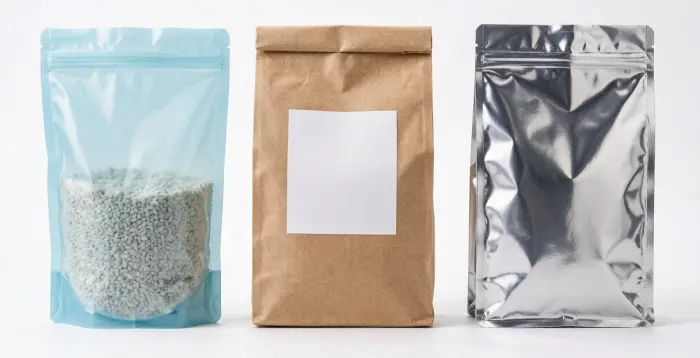
| Format | PPWR exposure | Action |
|---|---|---|
| Mono-material PE bag (inner) | Moderate — recyclable, needs 35% rPET/rPE by 2030 | Verify recyclability grade; secure rPE supply |
| Paper / kraft bag | Low–moderate — usually high recyclability | Avoid PFAS repellents; confirm fibre recyclability |
| Woven PP sack (outer) | Moderate — recyclable but check laminate | Mono-material preferred; document grade |
| Plastic-coated paper bag | High — often below 70% recyclable | Redesign to mono-material or certified compostable |
| Multi-layer laminate (PET/AL/PE) | Very high — typically banned after 2029 | Replace before 2030 |
| Cardboard shipper / display box | Low — exempt from reuse targets | Keep <50% void space; high-recycled-content board |
Compliance Checklist by Supply-Chain Role
For Cat Litter Manufacturers (Asia / non-EU)
- Audit every bag, sack and box against PPWR criteria (recyclability, recycled content, substances).
- Redesign multi-layer formats to mono-material before 2030.
- Build a supplier database for recycled-content proof and PFAS / heavy-metal test reports.
- Issue a Declaration of Conformity and technical file per packaging type for your EU customers.
For EU Importers and Brand Owners
- Register for EPR in each selling member state and appoint an authorised representative if non-EU based.
- Collect and store DoCs from your OEM supplier; you are legally the “manufacturer”.
- Re-cost quotations to include compliance, certification and EPR fees.
- Verify “recyclable / compostable” claims have evidence before publishing them.
For Private Label and OEM Customers
- Treat PPWR-compliant packaging as a sellable feature, not a cost.
- Request mono-material, high-recycled-content bag options and the associated grade + DoC.
- Use compliant packaging to differentiate in tender processes against suppliers who cannot document it.
For Wholesalers and Distributors
- Before listing a SKU, confirm the producer’s identification, EPR status and labelling readiness.
- Non-compliant packaging can be blocked at the border and trigger distributor liability.
How Pet Horizon Supports PPWR-Compliant Cat Litter Supply
Pet Horizon develops sustainable cat litter and packaging systems engineered for the European market. Our B2B programme helps importers and private label brands stay ahead of PPWR:
- Mono-material PE and paper-based bag options engineered to reach PPWR recyclability Grade C or better.
- Recycled-content roadmaps toward the 35% (2030) / 65% (2040) plastic targets, with mass-balance documentation.
- PFAS-free repellent coatings as standard on request.
- Per-SKU Declaration of Conformity and technical files to support your EPR and labelling obligations.
- OEM and private label flexibility so your brand owns a compliant, defensible packaging specification.
Explore our manufacturing capabilities, OEM services and wholesale programme for EU-ready cat litter programmes.
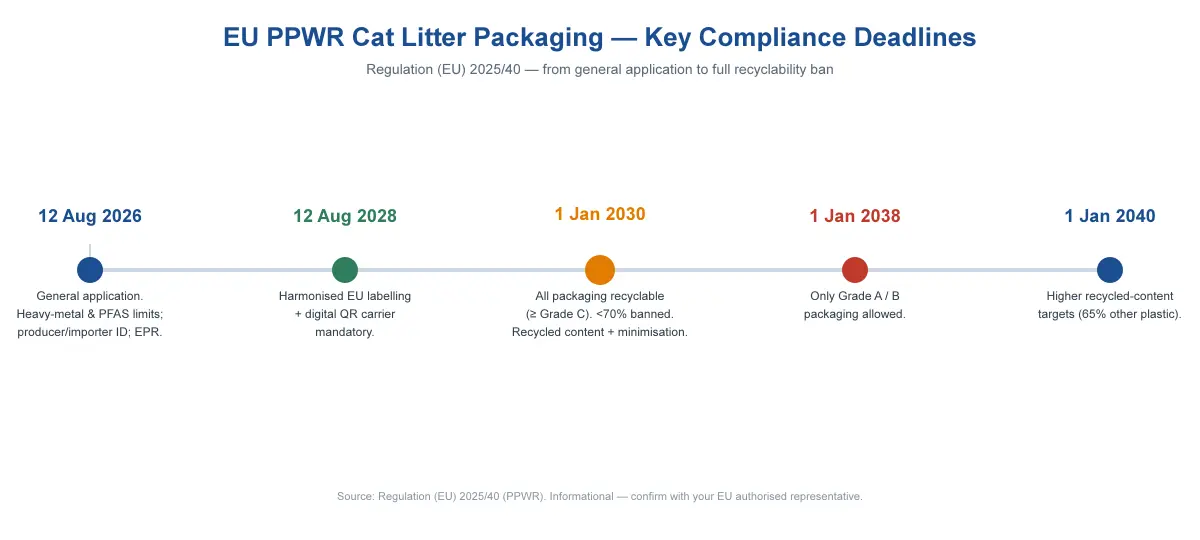
Key PPWR Deadlines at a Glance
| Date | Requirement |
|---|---|
| 12 Aug 2026 | General application; heavy-metal & PFAS (food-contact) limits; producer/importer ID; EPR registration |
| 12 Aug 2028 | Harmonised labelling + digital data carrier (QR) mandatory |
| 1 Jan 2030 | All packaging recyclable (≥ Grade C); <70% banned; recycled-content targets apply; minimisation rules |
| 1 Jan 2038 | Only Grade A / B packaging allowed |
| 1 Jan 2040 | Higher recycled-content targets (e.g. 65% for other plastic) |
Conclusion
The PPWR is not a distant 2030 problem — its substance limits, identification, EPR and documentation rules land on 12 August 2026. Cat litter suppliers that redesign packaging to mono-material, high-recycled-content, PFAS-free formats now will protect EU market access and turn compliance into a competitive edge. Those relying on multi-layer laminates or undocumented bags risk a hard stop at the border after 2029.
For a PPWR-ready cat litter programme — manufacturing, OEM, private label or wholesale — contact Pet Horizon to review your packaging specification against Regulation (EU) 2025/40.
Frequently Asked Questions
Does the EU PPWR apply to cat litter packaging imported from outside the EU?
Yes. The PPWR applies to all packaging placed on the EU market regardless of where it is produced. Cat litter bags, sacks, boxes and pails exported to Europe must comply, and the EU-based importer or brand owner is responsible for conformity, while the non-EU supplier must provide the supporting data and Declaration of Conformity.
When does the EU PPWR take effect for cat litter packaging?
Regulation (EU) 2025/40 entered into force on 11 February 2025 and its general application date is 12 August 2026. From that date, substance limits (heavy metals and PFAS in food-contact packaging), producer/importer identification and EPR registration apply. Recyclability grades become a market ban from 1 January 2030.
What recycled content is required for plastic cat litter bags under PPWR?
Most plastic cat litter bags are “other plastic packaging”. PPWR Article 7 requires at least 35% recycled plastic content by 2030 and 65% by 2040. Contact-sensitive plastic packaging has lower near-term targets (10% in 2030, 25% in 2040), but bags are generally non-food-contact and fall under the higher “other plastic” threshold.
Can cat litter packaging be called compostable or biodegradable under PPWR?
Only with evidence. PPWR Article 9 restricts compostable claims to certified applications (e.g. industrial composting to EN 13432) and requires that compostable packaging prioritise material recycling and not contaminate other waste streams. Vague “biodegradable” claims without certification are high-risk under EU green-claims enforcement.
What recyclability grade does cat litter packaging need to keep selling in the EU after 2030?
From 1 January 2030, packaging with less than 70% recyclability (Grade C floor) cannot be placed on the EU market. Mono-material PE or paper-based cat litter bags can typically reach Grade C or better; multi-layer laminates with aluminium or mixed plastics usually fall below 70% and will be banned unless redesigned.
Who is responsible for PPWR compliance — the factory or the EU brand?
The EU importer or brand owner is the legal “manufacturer” under PPWR and owns conformity, EPR registration and labelling. The non-EU factory supports them with material data, recyclability grading and the Declaration of Conformity. Both must keep and exchange the documentation.
Sources: Regulation (EU) 2025/40 (Packaging and Packaging Waste Regulation), European Commission — Packaging Waste; EU PPWR implementation guidelines and FAQs (March 2026); national PPWR guidance (Austria, Philippines DTI); MOFCOM PPWR interpretations. This article is informational and not legal advice — confirm specifics with your EU authorised representative and compliance counsel.