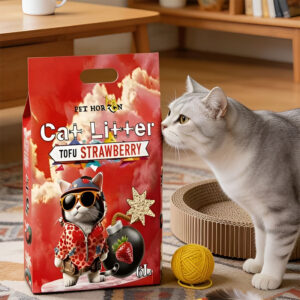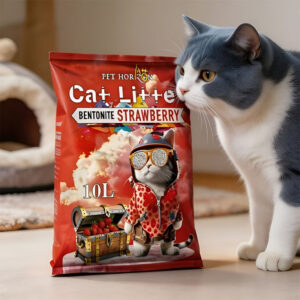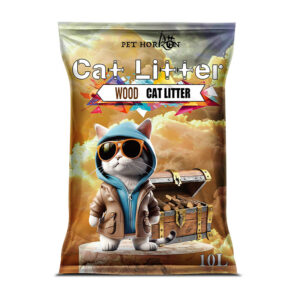






Cat litter brands have long leaned on words like “eco-friendly,” “natural,” “biodegradable,” and “sustainable” to win shelf space and trust in the European market. From 27 September 2026, that habit becomes a legal liability. The EU’s EmpCo Directive (Directive (EU) 2024/825, short for Empowering Consumers for the Green Transition) bans vague, unsubstantiated environmental claims across all consumer-facing communication — packaging, e-commerce listings, marketplaces, and social media — and it applies to every company selling into the EU, including manufacturers and private-label suppliers based outside Europe.
For importers, brand owners, and OEM buyers, this is no longer a marketing nuance. It is a hard compliance gate that affects which SKUs can be listed, what documentation a supplier must hand over, and how much risk sits inside a “green” product line.
Quick Answer
Yes. From 27 September 2026, the EU bans generic environmental claims such as “biodegradable,” “eco-friendly,” and “sustainable” on cat litter unless they are specific, measurable, and backed by independent evidence or a recognized certification. Non-compliant brands and their suppliers face fines of up to 4% of EU turnover, product withdrawal, and public naming.
What the EmpCo Directive Actually Bans — and When It Applies
The EmpCo Directive amends two existing EU laws — the Unfair Commercial Practices Directive (2005/29/EC) and the Consumer Rights Directive (2011/83/EU). It was adopted on 28 February 2024, entered into force on 26 March 2024, and had to be transposed into national law by 27 March 2026. It becomes enforceable against traders from 27 September 2026, with no transition period beyond that date.
Importantly, the directive does not introduce a brand-new framework. It hard-codes a set of banned practices into the EU “blacklist” of unfair commercial practices. If a claim appears on that list, it is illegal under all circumstances — authorities do not have to prove that any individual consumer was actually misled.
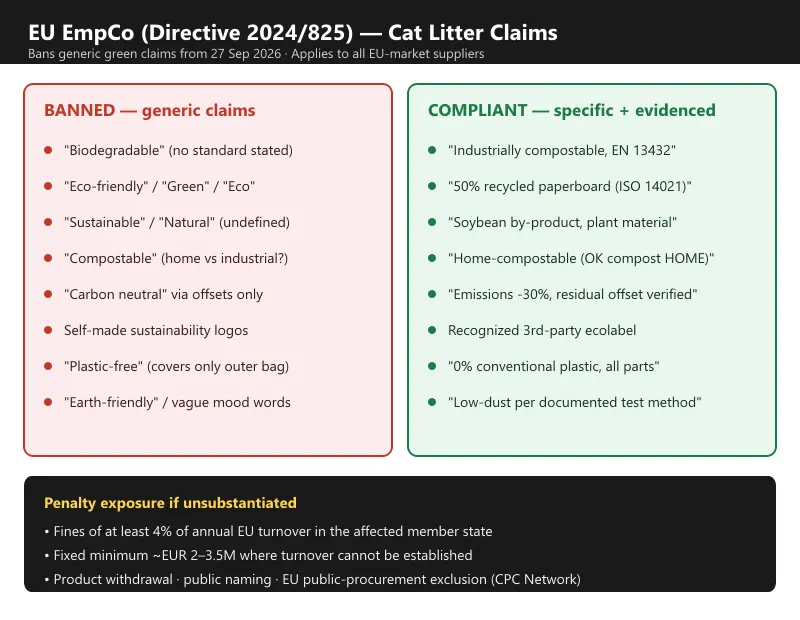
The following generic environmental claims are prohibited unless backed by specific, verifiable evidence: “eco-friendly,” “eco,” “green,” “sustainable,” “sustainable by design,” “environmentally friendly,” “biodegradable,” “climate-friendly,” and “carbon neutral” where based solely on offsetting. Self-created sustainability logos that are not based on a third-party certification scheme or public authority are also banned.
The burden of proof sits with the trader. National consumer-protection authorities can demand substantiation of any environmental claim at any time, and the cost of getting it wrong is steep: member states must set a minimum penalty of at least 4% of annual turnover in the affected member state, with fixed minimum fines (commonly cited at EUR 2–3.5 million) where turnover cannot be established. Regulators can also order product withdrawal, publicly name the offender, and exclude the company from public procurement.
Why the timing matters for 2026 planning
Enforcement is coordinated through the EU Consumer Protection Cooperation (CPC) Network, so a greenwashing finding in one member state can trigger action across the entire single market. With the transposition deadline already missed by roughly 20 member states (the European Commission opened infringement proceedings in May 2026), traders should assume the ban applies to them on 27 September 2026 regardless of how their specific market has implemented it.
Why Cat Litter Is Squarely in the Firing Line
Few consumer categories rely as heavily on vague green language as cat litter. The products most exposed are exactly the ones growing fastest in the European premium segment:
- Tofu and plant-based litters routinely marketed as “100% natural,” “biodegradable,” or “compostable.”
- Clumping tofu variants sold on “eco” and “flushable” positioning.
- Flushable litters whose environmental benefit depends on local wastewater rules, not on the product alone.
- Compostable and “plastic-free” litter bags bundled with the product.
- Bentonite and clay litters described as “natural” or “earth-friendly” without qualification.
Each of these claims can be legitimate — but only when it is specific, scoped, and evidenced. A bare “biodegradable” stamp on a tofu litter, with no standard, no condition, and no certification behind it, is precisely the practice EmpCo outlaws.
High-Risk Claims for Cat Litter Brands (and What Replaces Them)
The table below maps the claims most common on cat litter packaging to the compliant alternative an EU-bound SKU should carry.
| Common claim | Why it is high-risk | Compliant alternative | Typical evidence |
|---|---|---|---|
| “100% biodegradable” | No standard, timeframe, or environment stated. “Biodegradable” alone is a banned generic term. | “Industrially compostable according to EN 13432” | Third-party test report + seedling or equivalent mark |
| “Eco-friendly” / “green” | Vague, unmeasurable, no specific benefit identified. | “Made with 50% recycled cardboard packaging (ISO 14021)” | Material certificate + mass-balance documentation |
| “Natural” | No harmonized definition; implies environmental superiority. | “Made from soybean by-product, a renewable plant material” | Raw-material specification + supplier declaration |
| “Compostable” | Often undefined as home vs industrial composting. | “Certified home-compostable (OK compost HOME)” or “industrially compostable (EN 13432)” | Certification scope statement |
| “Plastic-free packaging” | Must cover all components, not just the outer bag. | “Packaging contains 0% conventional plastic by weight” | Bill of materials + lab verification |
| “Carbon neutral” | Banned if based solely on offset purchase. | “Emissions reduced 30% vs 2023 baseline; residual offset verified by [scheme]” | Verification by recognized scheme + methodology |
How to Substantiate an Environmental Claim the Compliant Way
EmpCo does not forbid environmental claims. It forbids unsubstantiated ones. A defensible claim shares four traits:
- Specific. It names a single, clearly identified benefit (e.g., recycled content, compostability under a named standard), not a mood.
- Measurable. It uses a number or a defined condition a buyer or inspector can check.
- Evidence-based. It rests on recognized scientific method and, where relevant, international standards such as ISO 14021.
- Independently verified. It is supported by a third-party certification scheme or a public-authority label, not a self-made logo.
The evidence must be accessible at the point of sale. A claim on a marketplace listing should link or refer to the underlying certificate or test summary, not sit in an internal file no inspector can reach.
A worked example
Instead of printing “Eco-friendly tofu litter” on the bag, a compliant label reads: “Packaging made from 50% post-consumer recycled paperboard, certified to ISO 14021. Litter is industrially compostable per EN 13432.” That single change moves the claim from banned-generic to defensible-specific, and it gives the importer a document to show an authority.
Certifications and Standards That Satisfy EmpCo
The directive itself names the types of evidence it trusts rather than an exhaustive list. For cat litter, the most relevant instruments are:
| Claim type | Recognized standard / scheme | What it proves |
|---|---|---|
| Industrially compostable | EN 13432 (+ seedling mark) | Breaks down in industrial composting under defined conditions |
| Home compostable | OK compost HOME / NF T51-800 | Breaks down in a home compost environment |
| Recycled content | ISO 14021 (self-declared) | Stated percentage of recycled material, with method |
| General eco-label | EU Ecolabel or national ecolabel where applicable | Independent, multi-criteria verification |
| Dust / safety claims | Documented test method + report | Supports “low-dust” or “safe” positioning (links to dust control standards) |
A useful clarification for 2026: the European Commission withdrew the standalone Green Claims Directive proposal in 2025. That withdrawal does not relax the rules — EmpCo (Directive 2024/825) is a separate, already-adopted law and remains fully in force from 27 September 2026. Brands that paused compliance planning waiting for the Green Claims Directive should resume it now.
What Importers and Buyers Must Check in Supplier Documentation
Because the burden of proof falls on the trader placing the product on the EU market, importers and brand owners must treat supplier documentation as a compliance asset, not a formality. Before listing a “green” SKU, verify:
- A copy of the actual certificate (not a screenshot of a logo), with the product and material scope matching the SKU.
- The certifying body is an independent third party, not the factory’s own mark.
- Test reports specify the standard (EN 13432, ISO 14021, etc.) and the exact claim wording approved.
- Certificate validity dates and renewal obligations are tracked.
- Packaging copy has been reviewed against the approved claim wording before print.
- Any “natural” or “flushable” claim is scoped to what the evidence actually supports.
A practical way to operationalize this is the supplier qualification checklist, which should now include a dedicated environmental-claims dossier for every EU-bound product.
OEM and Private-Label Implications
For factories running OEM cat litter programs and private-label lines destined for the EU, EmpCo shifts compliance from the brand’s problem to a shared contractual obligation. Expect EU customers to require:
- Compliance documentation packaged per SKU, in English and the destination language.
- Contract clauses stating which party owns the claim, the certificate, and the liability if a claim is challenged.
- Pricing that reserves budget for third-party certification and re-testing at renewal.
- Pre-clearance of all EU-bound packaging and listing copy before production.
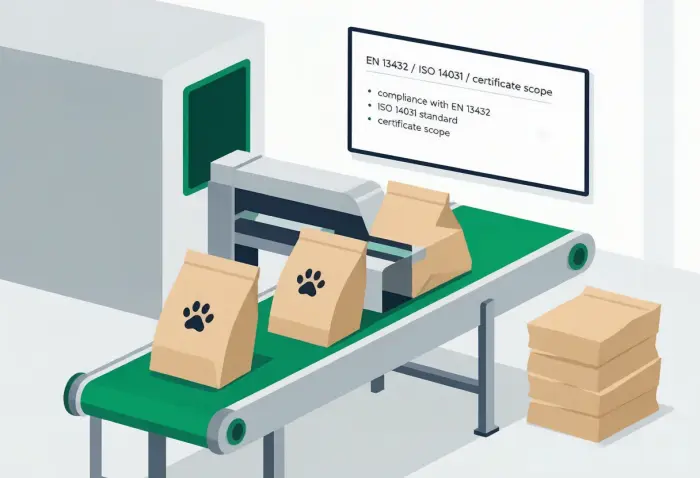
This is a differentiator, not just a cost. A manufacturer that can hand an EU retailer a ready compliance folder — covering compostability, recycled content, and dust testing — shortens the retailer’s time-to-shelf and reduces their legal exposure. In a market where generic “eco” language is now a liability, verified evidence becomes a sales asset.
A Practical Compliance Workflow for Manufacturers
From a production standpoint, aligning with the cat litter manufacturing process already in place, the workflow is straightforward:
- Audit every environmental claim currently on packaging, websites, and marketplace listings.
- For each claim, assemble or commission the underlying evidence (test report, certificate, standard).
- Rewrite vague language into specific, measurable wording matched to the evidence.
- Remove self-made sustainability logos; replace with recognized third-party marks where held.
- Train sales and marketing teams so new EU-bound SKUs are cleared before launch, not after.
- Keep the evidence file updated and accessible at the point of sale.
The same discipline applies to performance claims. A “low-dust” or “99% dust-free” statement, for example, should reference a documented dust-control method and test rather than a slogan — the regulator treats unverified performance claims the same way it treats unverified environmental ones.
Conclusion
The EU EmpCo Directive turns “biodegradable cat litter” from a marketing phrase into a compliance commitment. From 27 September 2026, generic eco language on cat litter is banned unless it is specific, measurable, and independently verified — and the law reaches every supplier selling into the EU, wherever they are based. Importers, brand owners, and OEM buyers who build an environmental-claims dossier now will protect their EU revenue, reduce penalty exposure, and turn compliance into a credible competitive advantage.
Frequently Asked Questions
Is biodegradable cat litter banned in the EU from 2026?
No. The litter itself is not banned. What is banned is the generic claim “biodegradable” without evidence. A litter can still be marketed as compostable if the claim specifies the standard (such as EN 13432) and is backed by third-party certification.
Does the EU greenwashing ban apply to manufacturers outside Europe?
Yes. EmpCo applies to any trader making consumer-facing environmental claims in the EU market, regardless of where the company is registered. A Chinese or Turkish factory supplying an EU private-label brand is in scope through its customer’s EU placement of the product.
What certificate proves a cat litter is compostable under EU rules?
Industrial compostability is typically evidenced against EN 13432, often shown with the seedling mark. Home compostability requires a different standard such as OK compost HOME. The certificate scope must match the actual product and claim wording.
Can we still say our packaging is “recycled” or “plastic-free”?
Yes, if it is specific and evidenced. “Made with 50% recycled paperboard (ISO 14021)” is defensible; a bare “eco packaging” is not. “Plastic-free” must cover every component, not just the outer bag, and should be supported by a bill of materials.
What happens if a claim is challenged after 27 September 2026?
The national authority can demand substantiation at any time. If the trader cannot provide it, penalties include fines of at least 4% of annual EU turnover in the affected state, product withdrawal, public naming, and exclusion from public procurement, coordinated across the EU via the CPC Network.
Is the EU Green Claims Directive the same as EmpCo?
No. The Green Claims Directive proposal was withdrawn by the Commission in 2025. EmpCo (Directive (EU) 2024/825) is a separate, already-adopted law that remains fully in force and becomes enforceable on 27 September 2026.
What should an OEM buyer ask a cat litter factory before EU launch?
Request the environmental-claims dossier: certificates with product scope, test reports naming the standard, validity dates, and approved claim wording. Also confirm who carries liability in the contract and whether pricing reserves budget for certification renewal.
Do “natural” and “flushable” claims need the same evidence?
They need evidence, though the standards differ. “Natural” must specify the material source rather than imply superiority. “Flushable” depends on local wastewater rules and should be scoped to what is actually supported, not used as a blanket environmental claim.