




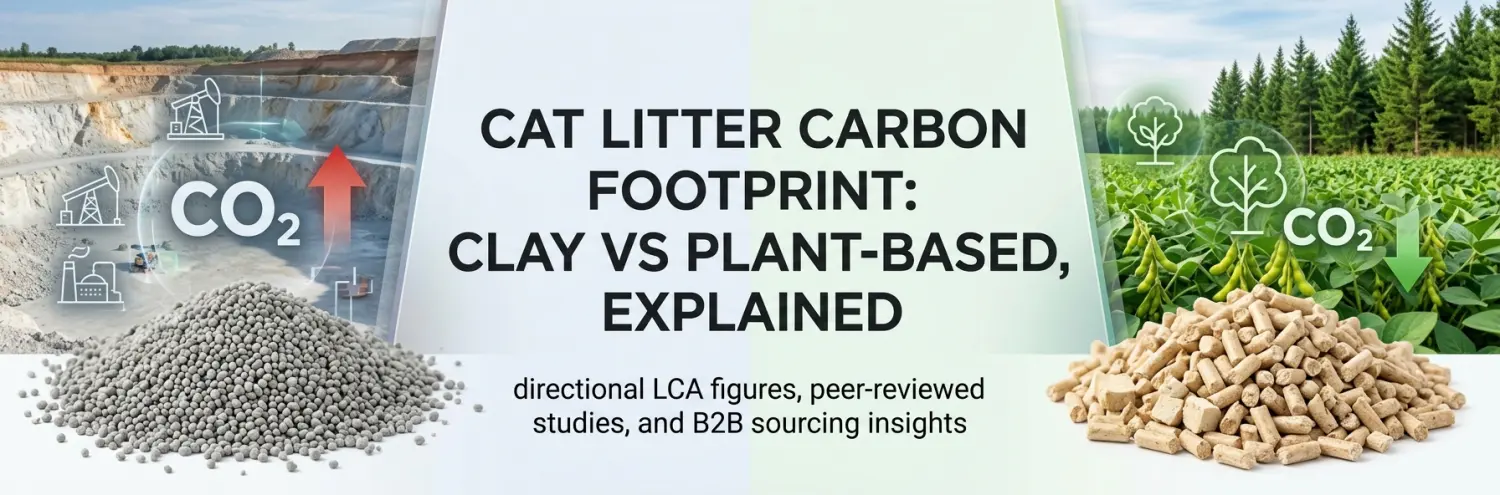
As importers and retailers face their own Scope 3 emissions targets, the carbon footprint of cat litter has moved from a niche concern to a procurement question. Buyers now ask: which litter has the lower footprint, and how should the numbers be interpreted? This guide explains what life-cycle assessment (LCA) actually measures for cat litter, compares clay and plant-based ranges with directional figures, addresses the transport caveat, and shows how a manufacturer can support eco-importers with honest, defensible data.
Quick Answer
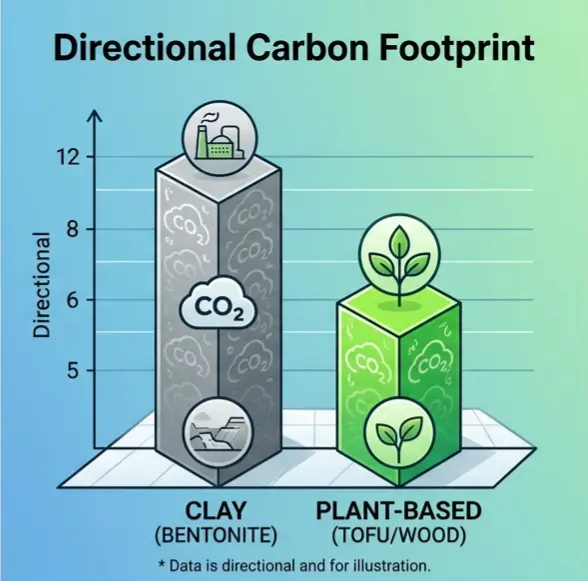
Plant-based litters generally show substantially lower cradle-to-gate carbon dioxide emissions than mineral clay. Directional market data put clay litter at around 12 kg CO2 per bag, tofu around 8 kg, and pine around 5 kg, while peer-reviewed LCAs have found wood- and coconut-based litters emitting 60–84% less CO2 than bentonite. The gap is driven by energy-intensive mining and calcination for clay versus by-product feedstock for plant-based litters. All figures should be treated as directional, not universal.
What an LCA Actually Measures
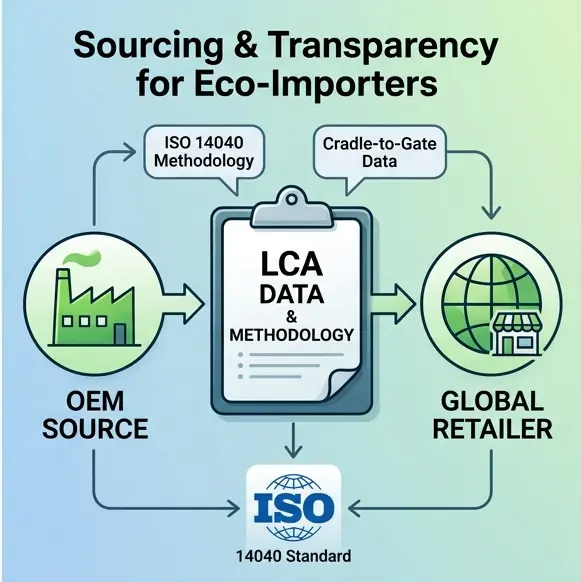
A life-cycle assessment quantifies environmental impacts from raw material extraction through manufacturing, transport, use, and end-of-life. For cat litter, the most cited metric is cradle-to-gate or cradle-to-grave CO2-equivalent (kg CO2e). A credible LCA follows ISO 14040 and ISO 14044 methodology and, ideally, third-party verification. The key caution: results depend on boundaries, energy mix, and transport distance, so a single number never applies to every product, and comparing two studies with different boundaries is meaningless without context.
Directional Market Figures
Market-research aggregators provide useful ballparks (directional, not product-specific):
| Litter type | Approx. CO2 per bag | Approx. water per ton |
|---|---|---|
| Clay (bentonite) | ~12 kg | ~10,000 gallons |
| Tofu (soy) | ~8 kg | ~3,000 gallons |
| Pine (wood) | ~5 kg | lower than clay |
These figures illustrate the trend rather than a specification for any single SKU, and they should never be printed on a pack as if they were measured for that product.
What Peer-Reviewed Studies Show
Independent LCAs reinforce the direction. A 2022 peer-reviewed study on coconut litter found roughly 2.1 kg CO2-equivalent per cat per month versus about 12.8 kg for sodium bentonite — approximately an 84% reduction. A 2019 LCA-journal study found wood- and paper-based litter produces about 60% less CO2 than clay. These studies use different system boundaries, but they consistently place plant-based litters below mineral clay, which is the practical takeaway for buyers.
Why Clay Is More Carbon-Intensive
Bentonite litter’s footprint is dominated by extraction and processing. Mining, crushing, and calcination (heat treatment) are energy-intensive, and the raw material is heavy, which raises transport emissions per unit of product. Clay is also water-hungry in processing — roughly 10,000 gallons per ton versus about 3,000 for tofu. For importers with carbon-reduction commitments, the energy and water intensity of clay is the single largest driver to model.
Why Plant-Based Litters Score Lower
Tofu litter is made from soy meal by-product, and pine litter from sawdust — both are renewable or waste-stream feedstocks rather than mined minerals. That alone removes the mining and calcination steps. The trade-off is transport: Asian plant-based litter shipped to North America can add an estimated 2–3 kg CO2 per shipment, which narrows but rarely closes the gap with clay. Sourcing region therefore matters almost as much as material choice.
The cat litter types guide compares these base materials in detail for buyers weighing performance against footprint, and it is the reference point for deciding which formula fits both the cat and the carbon target.
Honest Labeling Matters
Because LCA results are boundary-dependent, eco-claims must be qualified. A supplier should:
- Present numbers as directional, never as if universal.
- State the system boundary (cradle-to-gate vs cradle-to-grave).
- Reference ISO 14040/14044 methodology.
- Prefer third-party verification over self-declaration.
The U.S. EPA’s Sustainable Materials Management program offers a reference framework for how agencies treat material- and waste-related emissions, underscoring why methodology discipline matters and why vague “green” language invites scrutiny.
How a Manufacturer Supports Eco-Importers
Importers with carbon-reduction commitments need more than a marketing sentence. A capable OEM can:
- Offer LCA-backed plant-based ranges (tofu, pine, mixed) with documented cradle-to-gate emissions.
- Provide ISO 14040/14044-methodology summaries rather than unsupported “green” claims.
- Support “lower-carbon” positioning with third-party verification where available.
- Help model the transport component so buyers see the full picture, including ocean freight.
For buyers sourcing a tofu cat litter manufacturer, requesting the cradle-to-gate footprint is now a reasonable specification, not an unusual ask, and it separates serious suppliers from those using green language loosely.
Footprint Versus Price
Buyers sometimes assume the lower-footprint option costs more, but that is not automatic. Plant-based litters built on by-product feedstock can be price-competitive with clay once freight and density are accounted for, especially for nearby Asian markets. The footprint advantage is therefore a positioning opportunity, not merely a cost. The honest framing is “lower-carbon and cost-comparable,” supported by methodology rather than assertion.
Avoiding Greenwashing Traps
Two traps recur. The first is claiming a single product’s exact footprint without an LCA — regulators and retailers reject this. The second is ignoring end-of-life: a lower cradle-to-gate number can be offset if the product is landfilled in a high-emission scenario. Defensible positioning states the boundary, cites methodology, and avoids absolutes.
Connecting Footprint to Production
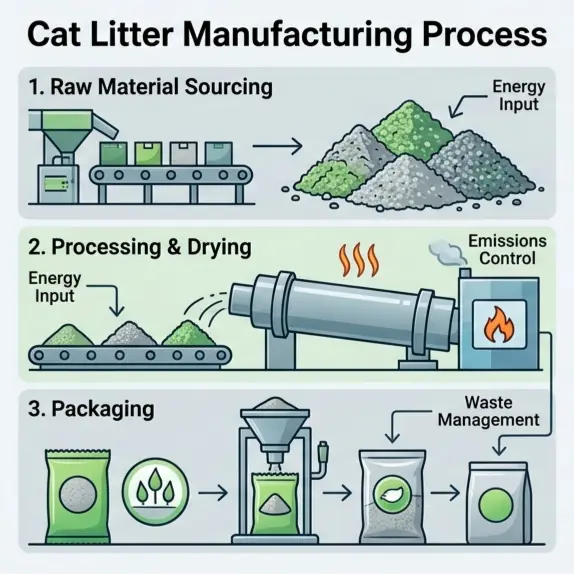
Footprint is shaped at the factory, not just on the spec sheet. The cat litter manufacturing process determines energy use, by-product feedstock, and transport efficiency — the three levers that move the CO2 number. Buyers who visit the line and ask about energy source and feedstock provenance get the most reliable footprint story.
Conclusion
Plant-based cat litters consistently show lower carbon footprints than mineral clay, with directional figures and peer-reviewed LCAs pointing the same way. The advantage comes from by-product feedstock and avoided mining, partly offset by transport. Importers should request methodology-backed, qualified figures — and a plant-based OEM range is the most defensible way to meet eco-procurement goals without overstating the claim.
Frequently Asked Questions
Plant-based litters — especially pine and tofu — generally show the lowest cradle-to-gate CO2, with pine around 5 kg CO2 per bag directionally.
Directional market data put clay at about 12 kg CO2 per bag, driven by mining, crushing, and calcination.
No. They are directional and boundary-dependent; a credible LCA follows ISO 14040/14044 and should be third-party verified.
Bentonite requires energy-intensive mining, crushing, and calcination, plus heavy transport per unit.
Tofu and pine use by-product or renewable feedstock (soy meal, sawdust), avoiding mining and calcination.
It narrows the gap — adding an estimated 2–3 kg CO2 per shipment to North America — but rarely closes it.
A 2022 study found coconut litter ~84% lower CO2 than bentonite; a 2019 study found wood/paper ~60% lower than clay.
State the system boundary, cite ISO methodology, and prefer third-party verification over self-declaration.
A capable OEM can supply cradle-to-gate emissions and methodology summaries for plant-based SKUs.
Cradle-to-gate covers extraction through manufacturing; cradle-to-grave adds use and end-of-life.