




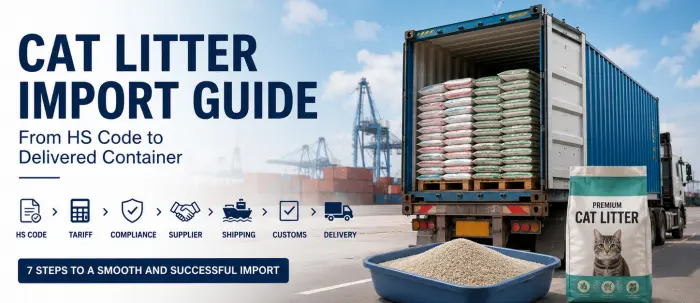
Importing cat litter for the first time — or scaling from trial orders to container volumes — is a sequence of decisions, not a single purchase. Classify the product, confirm the duty, verify market compliance, choose a supplier and commercial model, request a tight quote, arrange freight, and clear customs. Miss one step and the container stalls. This guide walks the full B2B import sequence end to end, linking to the deeper resources you need at each stage.
Quick Answer
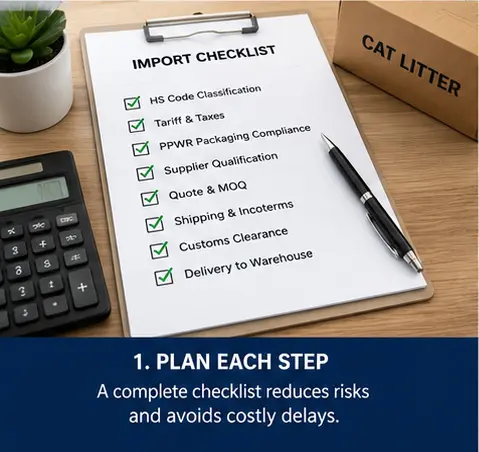
Successful cat litter import requires a structured process rather than simply placing an order. A complete cat litter import process includes product classification, HS code verification, duty and tax calculation, packaging compliance, supplier qualification, quotation review, freight planning, customs clearance, and final delivery. Following these seven steps helps wholesalers, distributors, supermarkets, and private label brands reduce customs risks, control landed costs, and build a reliable long-term supply chain.
Why Careful Cat Litter Import Planning Matters
Importing cat litter involves much more than comparing supplier prices. Incorrect HS codes, unexpected tariffs, non-compliant packaging, incomplete shipping documents, or poor supplier selection can all increase landed costs and delay customs clearance. Whether you are importing tofu cat litter, bentonite cat litter, or private label products, planning each stage before production begins helps reduce commercial risk and improve supply chain reliability.
For most professional importers, success depends on controlling the entire import workflow—from product classification and supplier qualification to freight planning and customs documentation—instead of focusing only on unit price.
Step 1 — Classify Your Product (HS Code)
Start with what the litter is made of. Bentonite, tofu, pine, and mixed litters classify differently, and there is no single “cat litter” code. Confirm the HS subheading for each formulation with your broker or supplier before anything else — it drives duty, documents, and clearance speed. Full method: cat litter HS code guide.
Step 2 — Confirm Duty and Taxes
With the HS code, look up the rate in your destination’s official schedule (US HTS, EU TARIC, UK tariff, or national schedule). Model duty and import tax into landed cost before you quote a customer — they are usually the largest variable line items. Remember that country of origin can add duties on top of the base rate. Full detail: cat litter import tariffs guide.
Step 3 — Verify Market Compliance
Compliance is now a packaging question as much as a product one. If you sell into the EU, the PPWR (Regulation (EU) 2025/40) makes packaging a regulated component from August 2026 — specify compliant, lower-impact packaging from the start. Review sustainable packaging trends and confirm labeling and any market-specific rules before you commit.
Step 4 — Choose a Commercial Model and Supplier
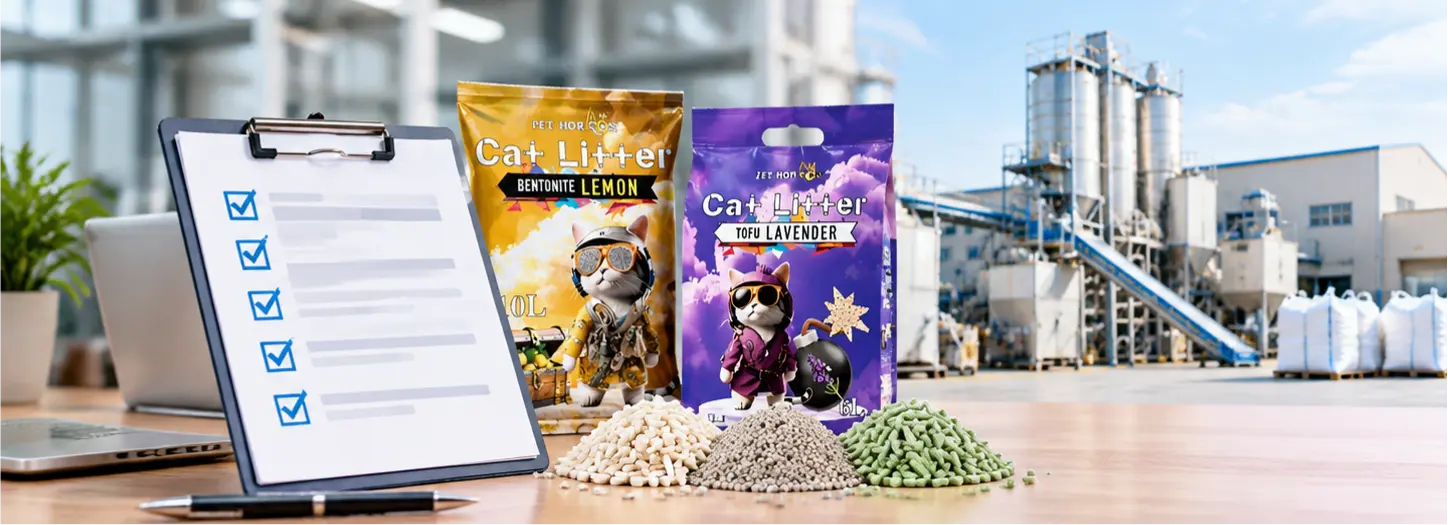
Decide how you want to buy: OEM (your or co-developed formula), private label (supplier’s formula, your brand), or wholesale (existing products in volume). Then qualify the manufacturer on in-house production, batch QC, formulation flexibility, certifications, and export documentation. Use our manufacturer checklist and the manufacturing and QC hub to verify capability.
Importer Tip
Many first-time importers compare suppliers only by FOB price. In practice, supplier experience, export documentation, production consistency, and packaging quality often have a much greater impact on total landed cost than small differences in unit pricing.
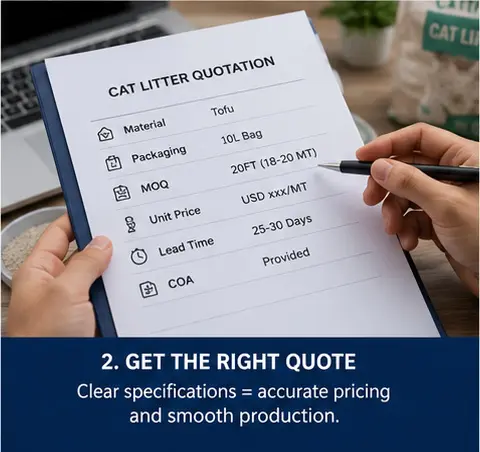
Step 5 — Request a Quote With the Right Specs
A vague “send me a price” gets a useless quote. Specify material, format, fragrance, packaging, target MOQ, and destination. Ask for unit price, tooling/sampling cost, production lead time, and the certificate of analysis per batch. Pet Horizon returns MOQ, unit pricing, and estimated lead time per specification via our contact page.
Before approving production, ask the supplier to confirm material specifications, packaging dimensions, pallet configuration, estimated container loading quantity, and batch Certificate of Analysis (CoA). These details make it much easier to compare quotations accurately and calculate your real landed cost.
Step 6 — Arrange Freight and Incoterms
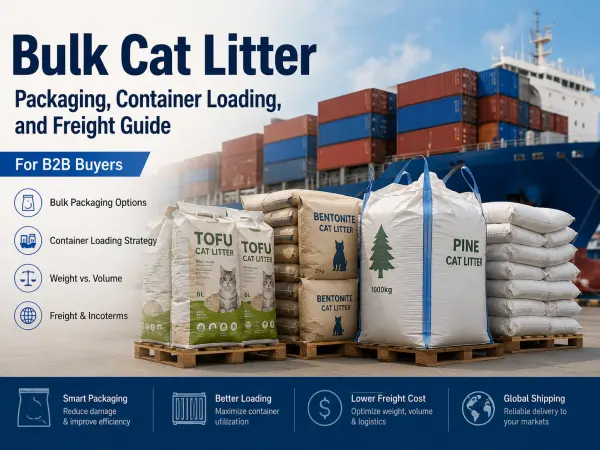
Once the order is confirmed, plan the move. Most volume ships FCL by ocean; bentonite fills a 20ft by weight before space. Choose an Incoterm (FOB, CIF, EXW, DDP) that matches your control preference, palletize and brace the load, and build production-plus-transit-plus-clearance into your lead time. Full playbook: cat litter shipping and logistics guide.
Shipping schedules can change during peak seasons, so experienced importers normally build additional buffer time into production and logistics planning. Allowing extra time helps reduce the impact of port congestion, customs inspections, and vessel schedule changes.
Step 7 — Customs Clearance and Delivery
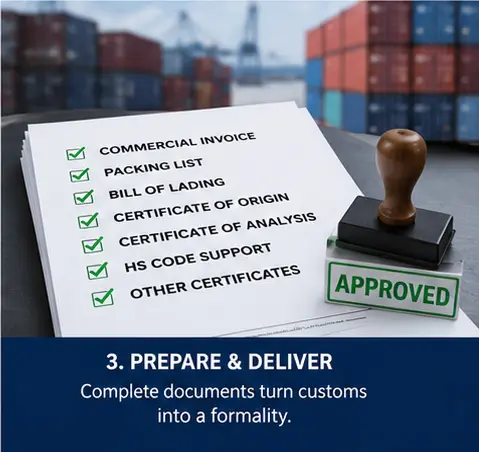
Assembly the documents early: commercial invoice, packing list, bill of lading, CoA per batch, certificate of origin, HS support, and certifications. Clean paperwork is what keeps clearance fast. After release, move the container to your warehouse and reconcile against the quote so your next order is even tighter.
Common Cat Litter Import Mistakes to Avoid
- Using the wrong HS code for different litter materials.
- Comparing suppliers based only on FOB pricing.
- Ignoring packaging regulations in destination markets.
- Failing to verify export documentation before shipment.
- Ordering production without confirming MOQ and lead time.
- Not requesting a Certificate of Analysis (CoA).
- Underestimating freight costs and customs clearance time.
A systematic import process helps avoid these common mistakes and significantly reduces the risk of delays, unexpected costs, and customer complaints.
Conclusion
A successful cat litter import is the result of careful planning rather than a single purchasing decision. By following a structured process—from HS code classification and tariff verification to supplier qualification, packaging compliance, freight planning, and customs clearance—you can reduce risks, improve supply chain efficiency, and better control landed costs.
Whether you are sourcing tofu cat litter, bentonite cat litter, or developing a private label brand, working with an experienced export manufacturer helps simplify documentation, improve production consistency, and support long-term business growth.
If you are preparing your next container shipment, Pet Horizon can provide OEM solutions, private label services, export documentation support, and customized quotations based on your target market and purchasing requirements.
Frequently Asked Questions
What is the first step in importing cat litter?
Classify the product by material with the correct HS code. It determines your duty rate, documents, and clearance speed, so confirm it with your broker or supplier before anything else.
Do I need to worry about packaging law when importing?
Yes, if you sell into the EU. The PPWR makes packaging a regulated component from August 2026. Specify compliant, lower-impact packaging during sourcing to avoid rework — see our PPWR guide.
OEM, private label, or wholesale — which should I choose?
It depends on how much formulation control and brand differentiation you want. OEM gives the most control, private label is fastest to launch, and wholesale buys proven products in volume. Compare in our OEM and private label guides.
What should I put in a quote request?
Material, format, fragrance, packaging, target MOQ, and destination — plus a request for unit price, sampling cost, production lead time, and a certificate of analysis per batch. Specifics return a usable landed-cost number.
How do I avoid customs delays?
Classify correctly, keep the formulation sheet as evidence, and assemble clean documents early (invoice, packing list, B/L, CoA, certificate of origin, HS support, certifications). Good paperwork makes clearance a formality.
How long does the whole import take?
From confirmed order to warehouse: production lead time plus ocean/rail transit plus clearance plus last-mile — typically weeks. Build buffer for peak season and customs holds.
Can one supplier handle the whole process?
An integrated manufacturer can support formulation, documentation, and export-ready packaging, but the importer still owns classification and clearance. Pet Horizon provides OEM, private-label, and wholesale across tofu, bentonite, pine, and mixed, with export documentation support.
Can different types of cat litter be imported in the same container?
Yes. Many importers combine tofu cat litter, bentonite cat litter, or mixed products in one shipment. However, each product may have different HS classifications, so invoices, packing lists, and customs documentation should clearly identify each item.
What documents should I request before shipment?
Ask your supplier for the commercial invoice, packing list, bill of lading, Certificate of Analysis (CoA), certificate of origin where applicable, and any required inspection or compliance documents. Reviewing these documents before shipment helps reduce customs delays.
How can I reduce the total landed cost of importing cat litter?
Instead of focusing only on product price, optimize container loading, select suitable Incoterms, verify duty rates, choose reliable suppliers, and minimize customs delays through complete documentation. These factors often have a greater impact on landed cost than small differences in unit price.