




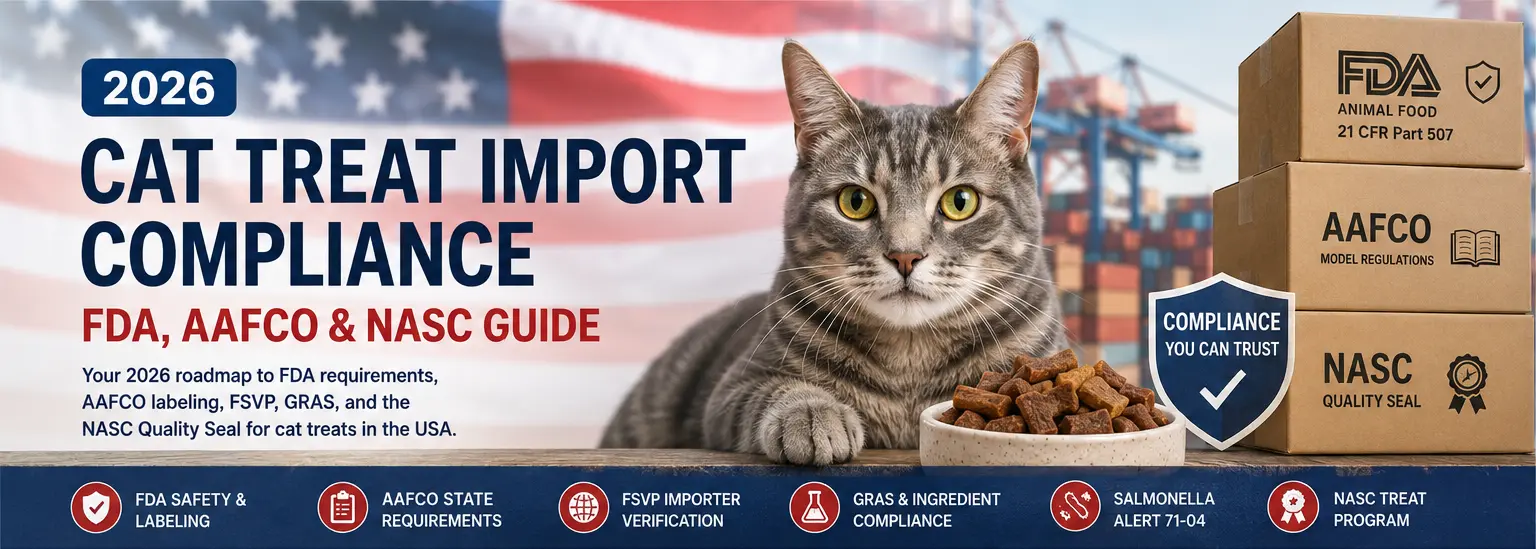
Importers, distributors, and private-label buyers bringing cat treats into the United States need to manage federal FDA requirements, state feed and labeling rules, FSVP, ingredient status, claims, and food-safety controls. This 2026 guide explains how FDA, AAFCO-based state requirements, the proposed GRAS notification rule, FDA Import Alert 71-04, and the NASC Treat Program affect cat treat imports—so buyers can review labels, suppliers, and compliance documents before shipment.
Quick answer: To import cat treats into the USA, the product must comply with FDA safety and labeling requirements under the Federal Food, Drug, and Cosmetic Act, while applicable state feed laws may add AAFCO-based labeling and registration requirements. Under the Foreign Supplier Verification Program (FSVP), the U.S. FSVP importer—generally the U.S. owner or consignee, or a qualifying U.S. agent when no owner or consignee is present at entry—must verify the foreign supplier. In 2026, buyers should also monitor FDA’s August 10 proposed GRAS notification rule, the expanded NASC Treat Program, and FDA Import Alert 71-04 for animal food, including pet treats, found to contain Salmonella. A qualified supplier should be able to provide food-safety records, ingredient documentation, lot-level traceability, and claim substantiation.
- FDA: Federal safety, labeling, facility, and animal-food requirements.
- State rules: State feed laws may adopt AAFCO model requirements and require registration or label filing.
- FSVP: The U.S. FSVP importer must verify the foreign supplier.
- Ingredients and claims: Each ingredient needs an appropriate legal basis, and functional claims require careful substantiation.
- Salmonella: FDA Import Alert 71-04 now covers animal food, including pet treats, containing Salmonella.
Why US Cat Treat Compliance Matters in 2026
For U.S. buyers, the compliance challenge is not limited to the finished product. A cat treat must be supported by a compliant label, legally acceptable ingredients and claims, appropriate food-safety controls, and an importer-side verification process. This makes supplier qualification part of the import-compliance process rather than a separate purchasing task.
The U.S. Food and Drug Administration (FDA) regulates the safety and labeling of animal food, including cat treats, under federal law. The Association of American Feed Control Officials (AAFCO) develops model regulations and ingredient definitions that are incorporated into the feed laws of many states, but AAFCO itself does not enforce those laws.
For a buyer, the practical takeaway is simple: the product, the label, and the paper trail behind both affect whether a shipment can enter and remain on the U.S. market. Cat treats are generally regulated as animal food, so buyers need to evaluate the product under the applicable animal-food safety, labeling, ingredient, and claims requirements.
The FDA Framework for Cat Treats
The FDA Center for Veterinary Medicine regulates pet food and treats under the Federal Food, Drug, and Cosmetic Act and the Food Safety Modernization Act (FSMA). For registered animal-food facilities subject to these requirements, 21 CFR Part 507 establishes current good manufacturing practices and, where applicable, hazard analysis and risk-based preventive controls. Importers should therefore look beyond a supplier’s HACCP certificate and review its hazard analysis, preventive controls, sanitation controls, monitoring, verification, and related food-safety records.
What the FD&C Act Requires
Under the FD&C Act and applicable FSMA requirements, cat treats must be safe, produced under sanitary conditions, and truthfully labeled. Facilities that are required to register with FDA must comply with applicable requirements in 21 CFR Part 507, including current good manufacturing practices and, where applicable, hazard analysis and risk-based preventive controls. Canned or hermetically sealed low-acid foods may also be subject to the low-acid canned food requirements in 21 CFR Part 113.
Labeling Rules Importers Must Meet
A compliant cat treat label generally needs the product identity, net quantity statement, guaranteed analysis where required, ingredient statement, and the name and place of business of the manufacturer, packer, or distributor, together with any other disclosures required by applicable federal and state rules. Ingredient statements generally list ingredients in descending order by weight. Federal FDA requirements and individual state feed laws both matter, and federal compliance does not automatically mean that a label is registered or accepted in every state.
The GRAS Shift: FDA Proposed Mandatory Notification in August 2026
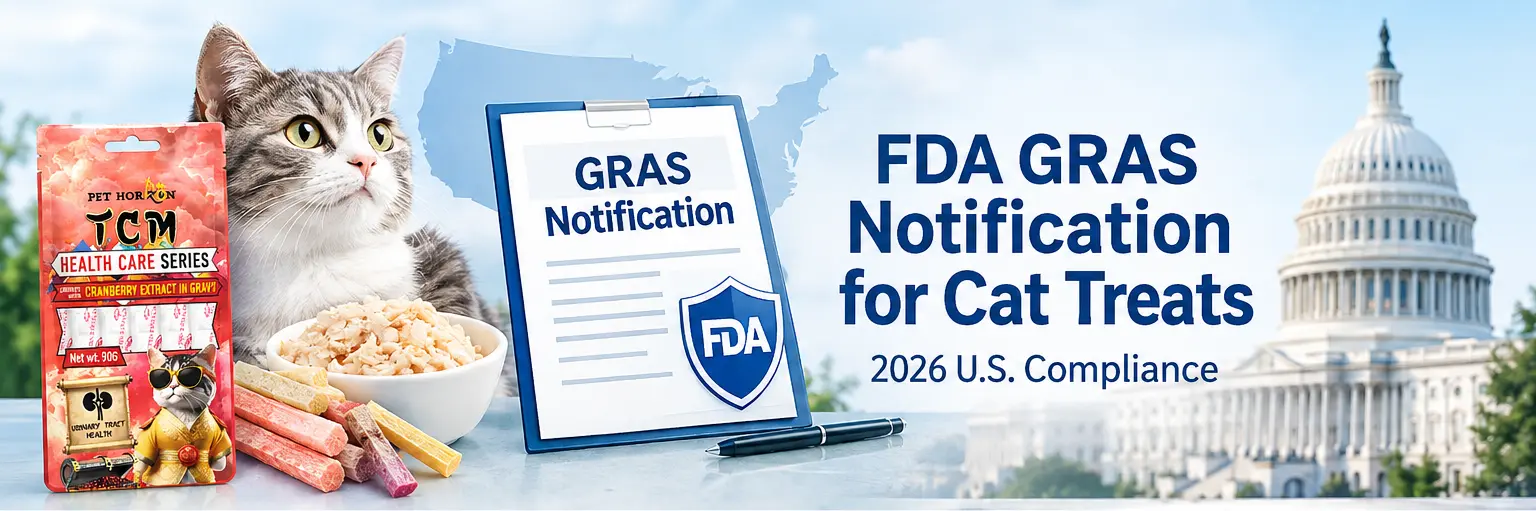
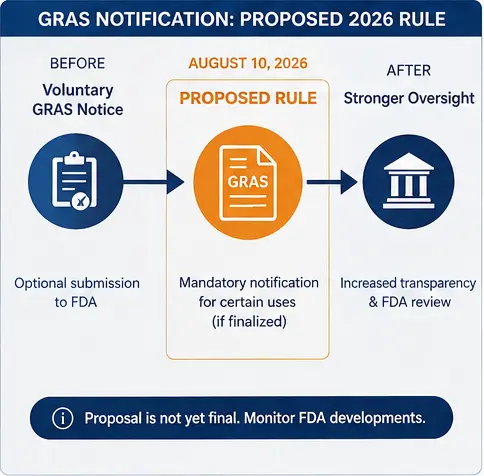
Most cat treat ingredients must either be generally recognized as safe (GRAS) for their intended use, qualify under another applicable exclusion from the food-additive definition, or be approved food additives. Under the current framework, submitting a GRAS notice to FDA is voluntary. On August 10, 2026, however, FDA proposed a rule that would require GRAS notices for certain uses of substances in human and animal food. The proposal is not yet a final rule, so importers should treat it as a regulatory development to monitor rather than as a current mandatory filing requirement. For supplier qualification, buyers should still request documentation supporting the regulatory status of each relevant ingredient.
The Foreign Supplier Verification Program (FSVP)
FSVP is the importer-side pillar of FSMA. The FSVP importer is generally the U.S. owner or consignee of the food at the time of entry, or a qualifying U.S. agent when no U.S. owner or consignee is present. The FSVP importer must evaluate hazards, approve and verify foreign suppliers, determine appropriate verification activities, and maintain the required records. A strong manufacturer food-safety system does not replace the importer’s FSVP obligations.
FSVP matters to buyers because supplier documentation supports the U.S. importer’s verification process. A contract manufacturer can support the process with hazard-analysis records, preventive-control documentation, sanitation records, supplier controls, testing results, and lot traceability, but the U.S. FSVP importer remains responsible for carrying out and documenting the required verification activities. FDA also maintains Import Alert 99-41 for human and animal foods imported by firms that are not in FSVP compliance, making FSVP a practical border-risk issue as well as a recordkeeping requirement.
Salmonella and FDA Import Alert 71-04
On August 13, 2026, FDA updated Import Alert 71-04, “Detention Without Physical Examination of Food for Animals Due to the Presence of Salmonella.” The alert now covers all animal food, including pet treats, found to contain Salmonella. Pet treats previously covered under Import Alert 72-03 were incorporated into 71-04, and 72-03 was deactivated. Products subject to the alert may be detained without physical examination at the U.S. border.
For importers, the practical priority is documented Salmonella control. FDA states that pet food contaminated with Salmonella may be considered adulterated when it will not subsequently undergo a commercial heat step or other commercial process that kills the organism. This is particularly relevant to low-moisture, freeze-dried, and other ready-to-feed treats where no validated post-contamination kill step may exist. Buyers should ask suppliers for the Salmonella control program, relevant process controls, finished-product testing where applicable, and lot-specific test records before shipment.
AAFCO Model Regulations and State Adoption
AAFCO does not enforce law, but its model regulations and ingredient definitions are the backbone of most state feed laws. Understanding where AAFCO ends and state law begins prevents costly label rework.
Label Modernization and Ingredient Definitions
For U.S. market entry, importers should review the ingredient statement against applicable AAFCO definitions and the requirements of each destination state. Where an ingredient is not covered by an applicable AAFCO definition, buyers should confirm its legal basis for use under federal and state requirements before finalizing the label.
Claims That Trigger Data Requirements
Claims such as “maintains urinary tract health,” “low magnesium,” or “hairball control” need to be evaluated for their wording, intended use, and supporting evidence. FDA guidance addresses certain animal-food and pet-food claims, while a claim that represents a product as treating, preventing, or diagnosing disease can move the product into new animal drug territory. Buyers should therefore review functional claims with qualified regulatory counsel and require a substantiation file before approving packaging or marketing copy.
The NASC Quality Seal and Its 2026 Treat Program
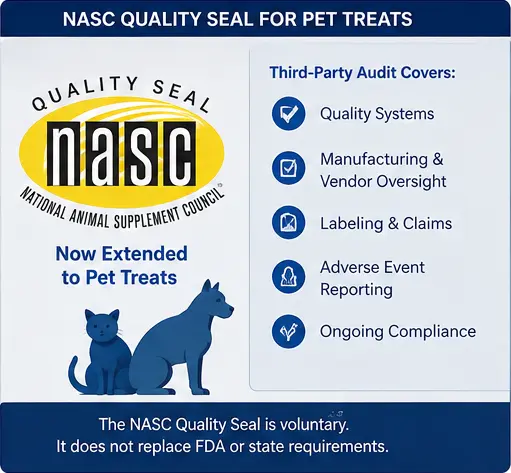
NASC expanded its quality and compliance programs to treat products for dogs, cats, and horses, with the new Treat Program rolling out in 2026. The program extends NASC’s audit and quality-system framework to treats, including requirements covering quality systems, vendor and manufacturing oversight, labeling and claims, adverse-event reporting, and ongoing compliance. The NASC Quality Seal is voluntary and does not replace FDA or state regulatory requirements, but it can provide an additional third-party quality signal for brands and retailers evaluating suppliers.
Important: The NASC Quality Seal is a voluntary third-party quality program. It does not mean that FDA has approved the product, and it does not replace federal or state regulatory requirements.
A Compliance Checklist for Importers and Private-Label Buyers
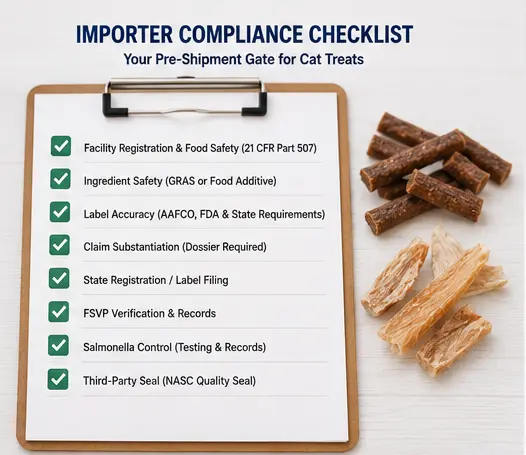
Use the table below as a pre-shipment gate. Each row names the requirement, what to verify, the evidence to collect, and who typically owns it.
| Requirement | What to verify | Evidence | Owner |
|---|---|---|---|
| Facility registration and sanitary processing | FDA registration where required, 21 CFR Part 507 food-safety plan or applicable preventive-control documentation, sanitation records | Facility registration, food-safety plan, sanitation records | Manufacturer |
| Ingredient safety (GRAS or food additive) | Documentation for every additive and novel ingredient | GRAS / food-additive documentation | Ingredient supplier / manufacturer |
| Label accuracy | Identity, net quantity, guaranteed analysis, ingredient order, distributor information | Final artwork / label review | Brand / importer |
| Claim substantiation | Dossier for urinary, hairball, or pH-related claims | Substantiation file | Brand / manufacturer |
| State registration | Check each destination state’s feed registration rules | State registration / label filing confirmation | Brand / importer |
| Importer verification (FSVP) | Documented FSVP for each foreign supplier and product | FSVP records, hazard analysis, verification records | U.S. FSVP importer |
| Salmonella control | Supplier testing protocol and results; verify whether a validated commercial kill step applies | COA / lab report / process records | Manufacturer / ingredient supplier |
| Third-party seal (optional) | NASC Quality Seal audit and ongoing compliance | NASC audit certificate / program enrollment | NASC member / participating treat company |
How a Manufacturing Partner Reduces Compliance Risk
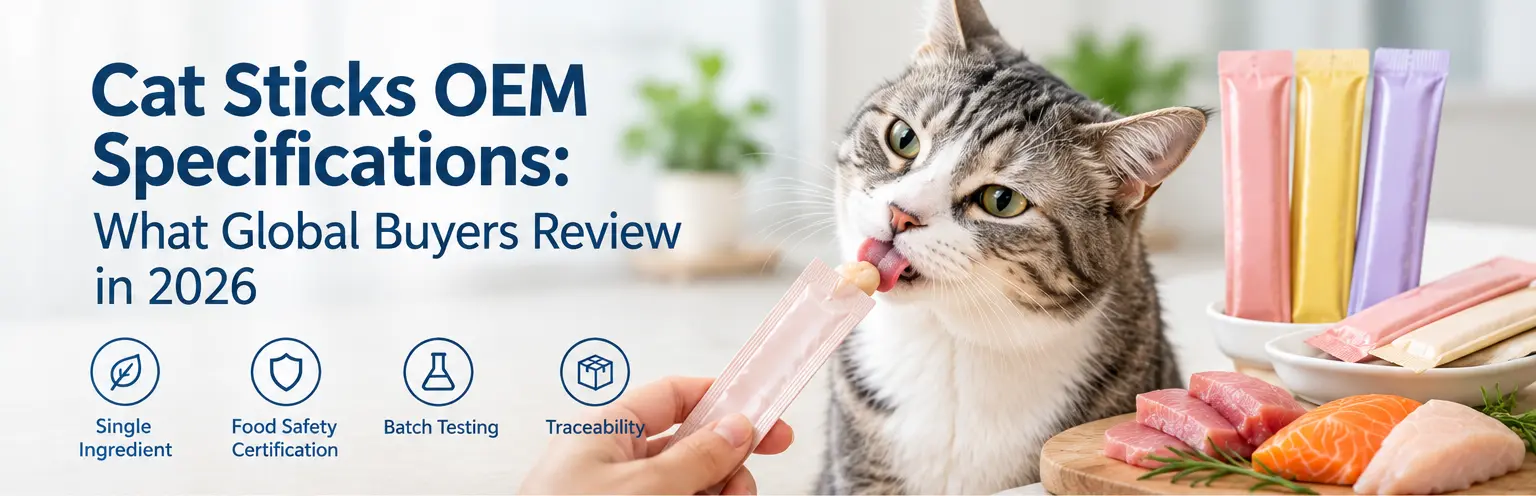
The fastest way to reduce compliance risk is to qualify a contract manufacturer that can provide the records needed for the U.S. importer’s regulatory review. Look for documented food-safety controls under the applicable FDA animal-food framework, hazard analysis and preventive-control records, sanitation and testing records, lot-level traceability, ingredient regulatory documentation, and experience preparing labels for U.S. state requirements. The manufacturer should also be able to support claim substantiation and provide the records needed for the importer’s FSVP verification process.
Format choice also affects the compliance review. Single-ingredient and functional treats can create additional scrutiny around ingredient status and claim language. Our cat sticks and fish fillets can be developed for private-label programs, with product specifications and supporting documentation reviewed as part of the buyer’s U.S. compliance process.
Common Mistakes That Delay US Market Entry
- Assuming a federally compliant label satisfies every state feed law.
- Printing functional claims such as “hairball control” without documented substantiation.
- Using ingredients whose GRAS, food-additive approval, or other legal basis for use cannot be documented.
- Lacking lot-level traceability, which can complicate recalls, investigations, and border reviews.
- Failing to establish and document the required FSVP verification process for the foreign supplier.
- Assuming freeze-dried or low-moisture treats are Salmonella-safe without evaluating the process and applicable testing controls.
- Treating cat treats as a low-risk product category and overlooking FDA animal-food, state feed, labeling, and claims requirements.
Each of these is fixable before production, and expensive after. Build the documentation checklist into the supplier qualification step, not the customs step.
Conclusion
U.S. cat treat compliance in 2026 runs across several connected layers: FDA safety and labeling requirements, FSMA requirements for applicable animal-food facilities, AAFCO-based state feed rules, the importer-side Foreign Supplier Verification Program, and voluntary third-party quality programs such as the NASC Treat Program. FDA proposed a rule on August 10, 2026 that would require GRAS notices for certain uses if finalized, while FDA Import Alert 71-04 now covers animal food, including pet treats, containing Salmonella. Buyers who qualify manufacturers on food-safety controls, ingredient documentation, traceability, FSVP support, and claim substantiation will be better positioned to reduce U.S. import risk. To explore a manufacturing partner for private-label cat treats, see our cat snacks product category.
Frequently Asked Questions
Cat treats do not generally require individual pre-market approval as finished products, but they must comply with FDA safety, manufacturing, and labeling requirements. Facilities subject to registration must meet applicable FDA requirements, and each ingredient must have an appropriate legal basis for its intended use, such as GRAS status, food-additive approval, or another applicable regulatory basis.
The FDA enforces federal law on safety and labeling. AAFCO publishes model regulations and ingredient definitions that states adopt. Most state feed laws are built on the AAFCO model, so both shape what appears on your label.
Such claims are allowed only with substantiation. The FDA reviews specific feline claims and provides guidance (GFI #55 and GFI #284) on the data required. A claim that implies treating disease can trigger a new animal drug pathway.
Not currently. Under the existing framework, submitting a GRAS notice to FDA is voluntary. On August 10, 2026, FDA proposed a rule that would require GRAS notices for certain uses of substances in human and animal food if the rule is finalized. Importers should therefore monitor the proposal and maintain documentation supporting the regulatory status of relevant ingredients.
No. The NASC Quality Seal is voluntary and does not replace FDA or state regulatory requirements. NASC’s Treat Program extends its quality-audit and compliance framework to treat products for dogs, cats, and horses, giving participating companies an additional third-party quality signal.
Many states require feed registration and label filing before sale, and they often base rules on AAFCO models. Importers should check each destination state rather than assume federal clearance is enough.
Yes, provided the product meets FDA and applicable state rules and the label carries the US distributor’s information. The brand or importer remains responsible for label accuracy and claim substantiation.
Depending on the product and verification process, buyers may need facility registration information, preventive-control and sanitation records, ingredient regulatory documentation, the final label and ingredient statement, claim-substantiation materials, testing records, and lot-level traceability records. The U.S. importer should also maintain the records required for its FSVP.
FSVP is an FSMA requirement for U.S. importers of human and animal food. The FSVP importer is generally the U.S. owner or consignee at the time of entry, or a qualifying U.S. agent when no U.S. owner or consignee is present. The FSVP importer must conduct and document the required foreign-supplier verification activities, including hazard evaluation and appropriate supplier verification.
Yes. FDA Import Alert 71-04, updated on August 13, 2026, covers animal food, including pet treats, found to contain Salmonella and provides for detention without physical examination. FDA explains that contaminated pet food may be considered adulterated when it will not subsequently undergo a commercial heat step or other process that kills Salmonella. Buyers should therefore review the supplier’s process controls and relevant testing records before shipment.