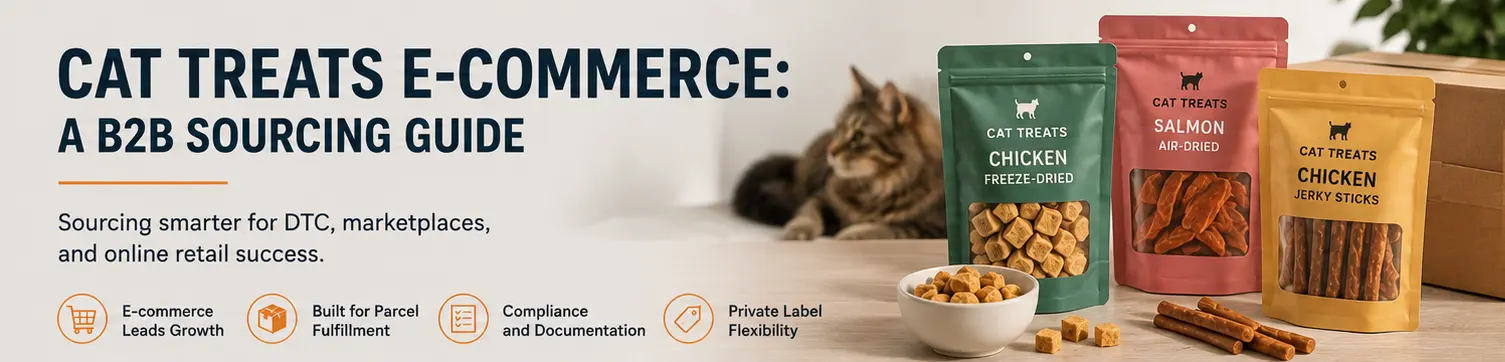





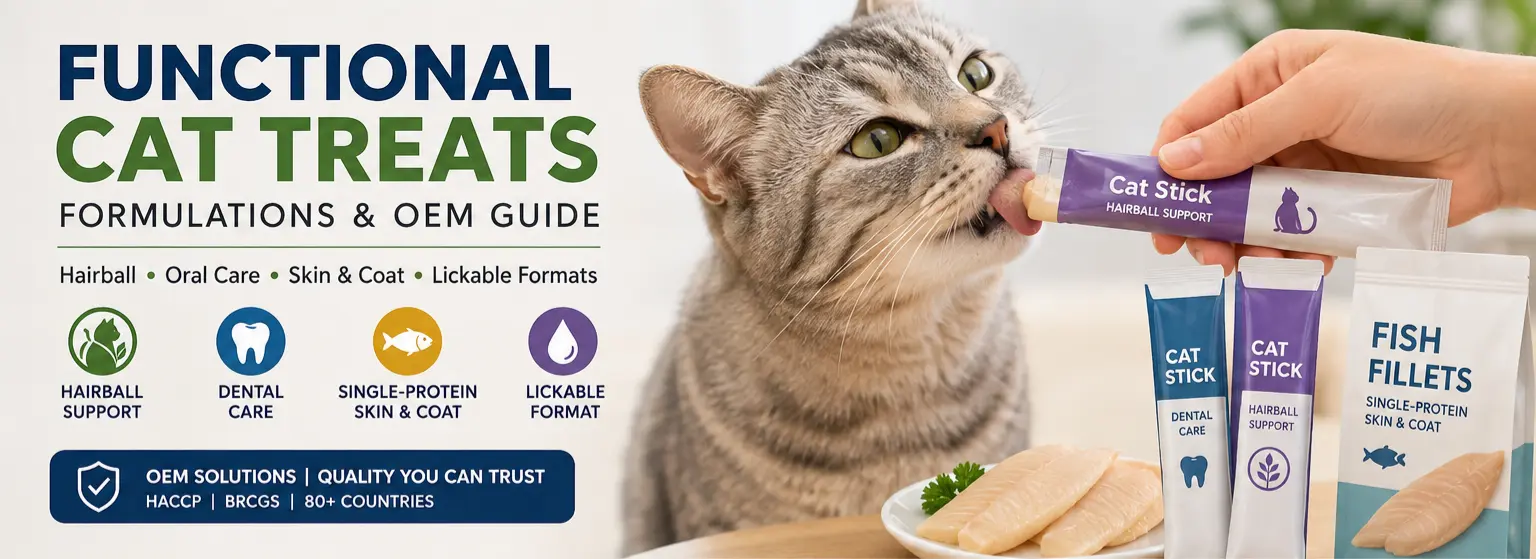
Cat treats have moved from simple rewards to targeted wellness products. Buyers and brand owners now evaluate treats by what they do — support hairball management, provide oral-care benefits, or offer focused nutritional positioning — not just by flavor. For an OEM or private-label program, the real question is which functional directions are worth building, and which format delivers them reliably. This guide centers on the two formats Pet Horizon manufactures: cat sticks (lickable tubes) and fish fillets (single-protein fillets).
Quick Answer
Pet Horizon’s current OEM range covers three functional directions across two core product formats, with the lickable tube serving as an additional delivery-format advantage: hairball and oral-care support in cat sticks, and single-protein skin-and-coat positioning in fish fillets. Lickable cat sticks also offer practical format advantages, including high moisture content, strong palatability, and convenient hand-feeding. These format benefits should be distinguished from functional claims, which depend on the formulation, ingredient levels, evidence, and applicable market regulations.
What Makes a Cat Treat “Functional”?
A functional cat treat is formulated with an active ingredient or nutrient profile intended to support a specific physiological outcome — such as digestive, oral, or skin health — beyond basic palatability.
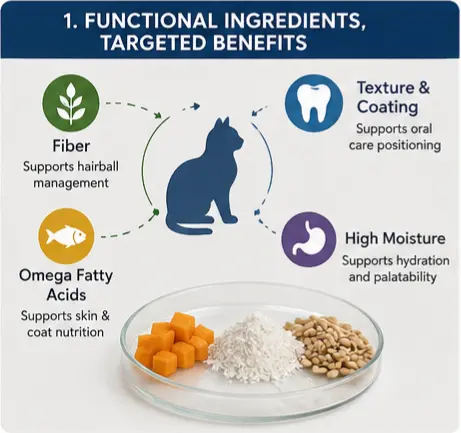
Functionality comes from a defined formulation and intended benefit: fiber and selected oils may be used in hairball-support recipes, while specific textures, coatings, or ingredients may support an oral-care positioning. A single named protein can also support a limited-ingredient or single-protein product concept, which may simplify ingredient disclosure and allergen-management procedures. The credibility of any functional claim depends on the formulation, ingredient level, manufacturing controls, supporting evidence, and destination-market requirements.
Functional Cat Treat Types Pet Horizon Offers
Pet Horizon’s cat treat OEM focuses on the functional directions that map cleanly onto its two core formats. These are the lines an importer or private-label brand can actually order today.
Hairball Support (Cat Sticks)
Hairball-support cat sticks can be formulated with selected dietary fibers and other nutritional ingredients intended to support normal digestive function and the passage of ingested hair. Ingredients such as psyllium or pumpkin may be considered depending on the target recipe, while oils containing omega fatty acids can support broader nutritional positioning. The final ingredient combination and inclusion level should be determined through formulation testing, palatability trials, and destination-market requirements.
Dental and Oral Care (Cat Sticks)
For dental cat treats, buyers should distinguish between general oral-care positioning and substantiated dental-efficacy claims. The Veterinary Oral Health Council (VOHC) provides a recognized third-party acceptance program for qualifying dental products, making VOHC acceptance a strong credibility signal for brands seeking substantiated dental claims. Any Pet Horizon dental cat-stick program should be evaluated against the applicable testing, formulation, manufacturing, and documentation requirements before specific VOHC-related claims are used in market-facing materials.
Single-Protein and Skin & Coat (Fish Fillets)
Fish fillets use a named animal protein as the primary protein source, supporting a single-protein or limited-ingredient product concept. Depending on the selected fish species and formulation, naturally occurring nutrients such as omega fatty acids can also support a skin-and-coat nutritional positioning.
Lickable Tube Format (Cat Sticks)
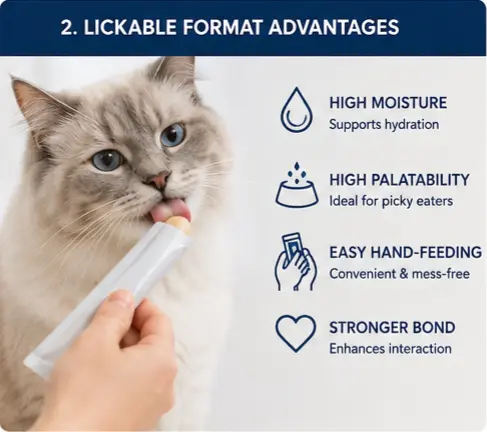
Lickable treats — including squeeze-up tubes and purees — have become an important growth format in the cat-treat category. Their high moisture content, strong palatability, and interactive feeding experience make them attractive for brands targeting convenience and engagement. For manufacturers, lickable formats also require tight control of texture, pH, microbiological safety, filling accuracy, and shelf stability, creating a different process profile from baked or extruded crunchy treats.
- Moisture: high-moisture recipes can complement dry-food feeding routines.
- Palatability: smooth textures and strong aromas can appeal to selective eaters.
- Convenience: single-serve tubes are easy to portion and hand-feed.
- Interaction: hand-feeding creates an engaging owner-cat feeding experience.
From an OEM perspective, these requirements make process capability especially important. Pet Horizon operates both extrusion and pouch-filling processes within a qualified facility, supporting development and production across its lickable cat stick and fish fillet programs.
The Broader Category: What Pet Horizon Does Not Currently Offer
Joint and mobility support and calming or stress-related positioning are also established directions in the wider functional-treat category. Common ingredients include glucosamine, chondroitin, MSM, L-theanine, and alpha-casozepine, depending on the product concept and market. These directions are outside Pet Horizon’s current standard cat-stick and fish-fillet range and should therefore be treated as custom-development opportunities rather than existing off-the-shelf SKUs.
Formulation Guardrails Buyers Should Know
Functionality must sit within safe feeding and compliance boundaries. Three guardrails matter most.
Calorie Control
Calorie density is an important consideration when developing functional cat treats. Pet obesity research — including surveys by the Association for Pet Obesity Prevention (APOP) — estimates that roughly 60% of cats are overweight or obese. Common veterinary feeding guidance recommends keeping treats to roughly 10% or less of a cat’s daily calorie intake, with the remainder coming from a complete and balanced diet. For OEM programs, brands should therefore evaluate calories per piece or serving alongside the intended functional positioning.
Single-Ingredient and Clean Label
Single-protein and limited-ingredient recipes — the foundation of Pet Horizon’s fish fillet line — can support limited-ingredient positioning and may simplify allergen-management procedures. These also align with clean-label expectations for private-label programs.
U.S. Claim and Labeling Boundaries
In the United States, functional cat treats must be developed and marketed within applicable pet-food labeling and claim requirements. A nutritional or functional statement should not imply that a treat diagnoses, prevents, cures, or treats a disease unless the claim is legally supported and appropriate for the product category. OEM buyers should review ingredient status, guaranteed analysis, feeding directions, label language, and any functional or health-related claims for the destination market before commercialization.
OEM Formulation Capability as a Differentiator
Functional treats convert formulation capability into a commercially useful product proposition, but execution depends on ingredient control, process consistency, testing, and documentation. Pet Horizon supports OEM programs with HACCP-certified food-safety controls, BRCGS-aligned manufacturing practices, export experience across 80+ country markets, and formulation development for cat sticks and fish fillets. Buyers should verify the specific certifications, test reports, ingredient specifications, and claim-support documents applicable to their destination market.
When qualifying a functional-treat OEM, verify:
- Documented active-ingredient sourcing and dosing rationale.
- Batch testing for nutrient guarantees and microbiological safety.
- Defined dental-claim substantiation path (for example, VOHC acceptance where applicable).
- Claim and labeling documentation aligned with the applicable regulatory and industry requirements of the destination market, including AAFCO- or FEDIAF-based frameworks where relevant.

Conclusion
Functional cat treats are an increasingly important segment of the premium cat-treat category. For importers and brand owners, the key is to partner with an OEM that treats formulation as a discipline — validating ingredients, respecting calorie and claim boundaries, and documenting compliance — while matching functional positioning to formats that cats and owners actually use. Pet Horizon’s cat sticks and fish fillets provide a starting point for hairball, oral-care, and single-protein product concepts, with lickable formats offering additional moisture, palatability, and feeding convenience.
Frequently Asked Questions
Treats formulated with active ingredients for a specific benefit — most commonly hairball control, dental or oral care, and single-protein skin-and-coat support — beyond basic palatability.
Pet Horizon’s OEM range centers on hairball support and dental care through cat sticks, and single-protein skin-and-coat support through fish fillets. Joint and calming actives are category trends handled as custom-development discussions.
No. Lickable cat treats have developed into an established product format rather than a short-term trend. Their high moisture content, palatability, and convenient hand-feeding experience make them suitable for both everyday treats and premium functional-treat concepts.
Dental claims should be supported by appropriate formulation, testing, and documentation. VOHC acceptance can provide valuable third-party credibility for qualifying dental products, while general oral-care positioning should not be presented as a proven dental-efficacy claim without supporting evidence.
Common veterinary feeding guidance recommends keeping treats to roughly 10% or less of a cat’s daily calorie intake; low-calorie options help stay within that limit.
Single-protein cat treats use one primary named animal protein and are commonly positioned as limited-ingredient products. They can simplify ingredient disclosure and support brands developing focused product lines, although they should not automatically be marketed as hypoallergenic or suitable for cats with diagnosed food allergies.
Yes, provided the manufacturer has the appropriate formulation, processing, filling, packaging, and shelf-life capabilities for each format. Buyers should verify the specific equipment, process controls, product specifications, and validation records rather than assuming that one production line can support every treat format.
Buyers should look for an appropriate food-safety system such as HACCP and, where relevant, a recognized GFSI-benchmarked certification such as BRCGS. They should also verify ingredient specifications, laboratory test results, traceability records, product specifications, label and claim documentation, and any third-party substantiation required for dental or other functional claims in the destination market.