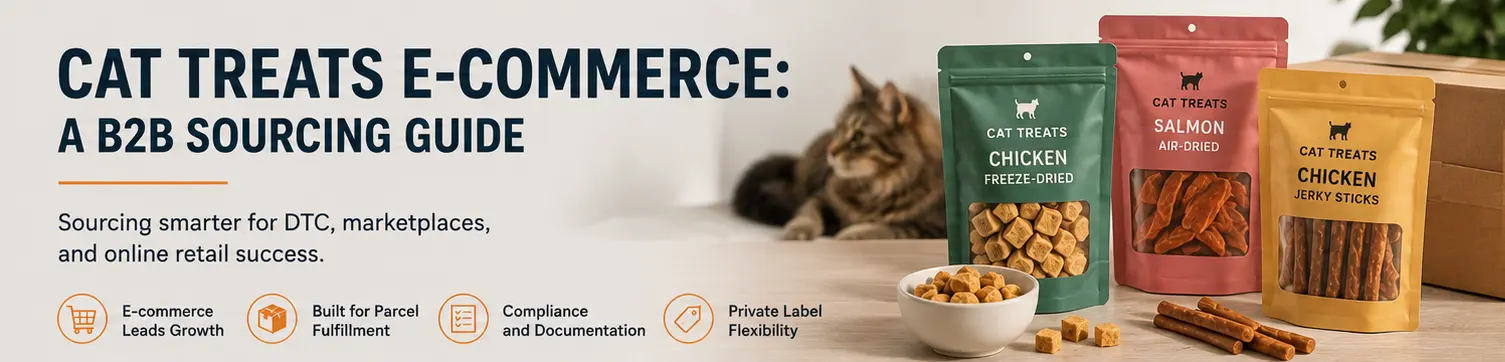





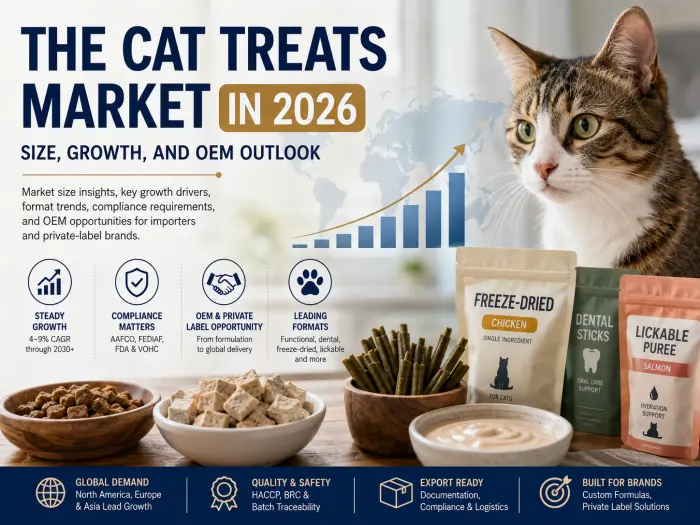
The cat treats category has shifted from an occasional indulgence into a structured and increasingly important segment of the pet nutrition economy. For importers, brand owners, and private-label buyers, understanding where the market is heading — and which suppliers can meet tightening quality and compliance standards — is now a sourcing decision, not a marketing afterthought.
Quick Answer
Published estimates place the global cat treats market in a wide range for 2026 because analysts use different definitions, product scopes, and base years. Across the available estimates, the category is expected to grow through 2030 and beyond, with premium, functional, dental, freeze-dried, and lickable formats among the key areas of development. For importers and private-label buyers, the more useful question is not the headline market size but which formats, regions, and supplier capabilities are expanding fastest.
How Big Is the Cat Treats Market?
Market sizing varies widely because analysts define “cat treats” differently — some count treats only, others bundle treats with snacks or broader cat-food adjacencies, and base years differ. Treat the figures below as a directional range rather than a single precise number. The table draws on several published analyst reports, including Morgan Reed Insights, which sizes the category at roughly USD 8.9 billion in 2026.
“Cat treats” in this context refers to supplementary feline products — crunchy biscuits, soft chews, freeze-dried proteins, dental sticks, and liquid lickable purees — distinct from staple cat food rations.
| Source (published) | Base value | Forecast | Stated CAGR |
|---|---|---|---|
| Morgan Reed Insights (2026) | USD 8.9B (2026) | USD 16.9B (2035) | 7.4% |
| Grand View Research — snacks/treats segment | USD 5.3B (2022) | USD 7.3B (2030) | 4.1% |
| Citius Research (2023 base) | USD 3.5B (2023) | USD 6.5B (2030) | 9.5% |
| 6Wresearch (2024 base) | USD 2.1B (2024) | USD 3.6B (2031) | 8.4% |
| Stratistics MRC — functional snacks | USD 3.1B (2026) | USD 5.1B (2034) | 6.5% |
Key takeaway: Despite the differences in market definitions and forecast periods, the cited estimates point to continued category growth. For buyers, the more actionable issue is how demand is shifting across premium, functional, dental, freeze-dried, and convenience formats rather than relying on a single headline market valuation.
For buyers researching cat treats market size 2030, the main challenge is comparability: published forecasts use different category boundaries, base years, and treatment of adjacent snack segments. Forecast direction is therefore more reliable than comparing headline numbers across reports.
What Is Driving Category Growth?
Humanization and Premiumization
Owners increasingly treat cats as family members and reallocate discretionary spend toward higher-quality, natural, and functional snacks. This sustains trade-up behavior even in softer economic periods.
Functional and Dental Formats
Treats are no longer just rewards. Dental sticks validated by the Veterinary Oral Health Council (VOHC) and treats fortified with taurine, omega-3s, or probiotics command shelf space in veterinary and premium retail channels.
Channel Shift to E-commerce and DTC
Direct-to-consumer and subscription models now account for a substantial and growing share of treat sales, lowering barriers for niche and private-label brands while raising expectations for traceability and packaging quality.
Regional Concentration
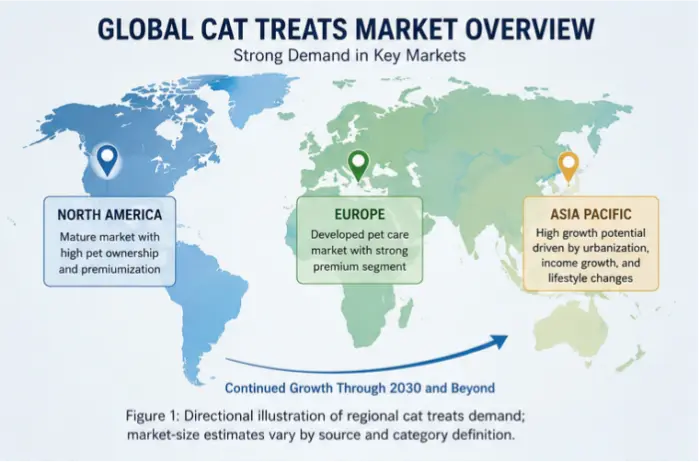
Demand is particularly developed in mature pet-care markets such as the United States and Germany, while China and other Asia-Pacific markets continue to offer significant growth opportunities as pet ownership, premiumization, and urban lifestyles expand.
Category Segmentation Buyers Should Know
| Format | Typical profile | Primary use case |
|---|---|---|
| Dry / crunchy | 20–35% crude protein, moisture <10% | Daily reward, palatability, enrichment |
| Soft-moist | Higher palatability, moderate moisture | Picky eaters, training |
| Freeze-dried | Moisture <3%, minimal processing | Premium, single-protein, raw-leaning |
| Dental | Mechanical scrape + coating | Oral care, where supported by product testing and applicable claims |
| Lickable / liquid | Puree or squeeze-up, hydrating | Hydration support, palatability, bonding |
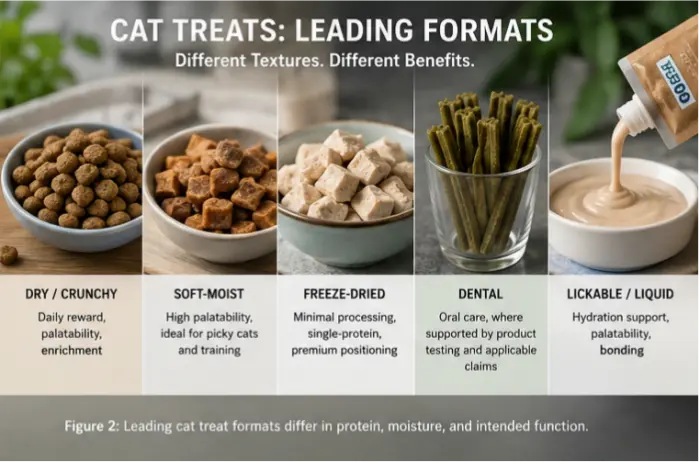
For freeze-dried cat treats wholesale programs, buyers should pay particular attention to protein sourcing, moisture control, packaging barrier performance, shelf-life validation, and batch consistency.
Why Compliance Is Reshaping the Supplier Base
Growth is not evenly accessible. Regulatory frameworks in the two largest import markets are raising the floor for who can supply treats at scale.
AAFCO, FEDIAF, and Market-Specific Requirements
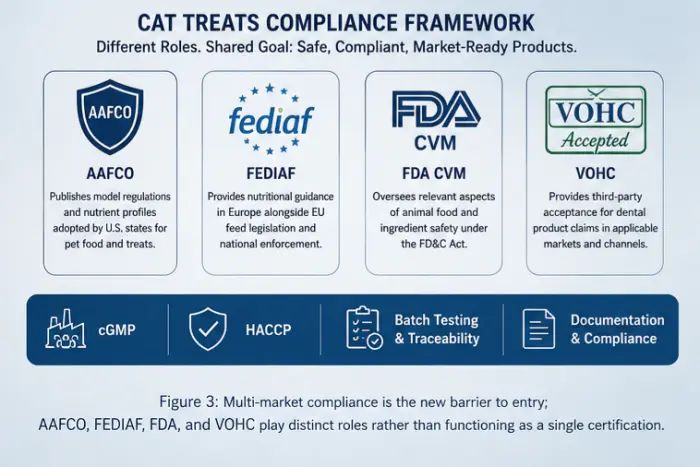
In the United States, AAFCO model regulations and nutrient profiles provide an important framework for pet-food formulation and labeling, while FDA and state requirements determine how products and ingredients can be marketed. In Europe, FEDIAF nutritional guidance works alongside EU feed legislation and national enforcement requirements. For exporters, the practical challenge is aligning formulation, ingredients, labeling, documentation, and market-specific registration requirements before launch.
FDA CVM and Ingredient Safety
The FDA Center for Veterinary Medicine oversees relevant aspects of animal food and ingredient safety in the United States under the Federal Food, Drug, and Cosmetic Act. Treats making nutritional or health-related claims may also require additional review of ingredients, labeling, and applicable claim requirements.
VOHC Acceptance for Dental Claims
VOHC acceptance can provide important third-party support for dental-product claims in the markets and channels where such recognition is relevant. Buyers developing dental treats should verify the applicable claim rules, product testing requirements, and target-market labeling requirements rather than treating VOHC acceptance as a universal regulatory requirement. For dental treats, qualified suppliers should be able to support the required product testing, formulation controls, manufacturing consistency, and documentation needed for the target market and claim strategy.
Why this matters for buyers: compliance capability has become an important supplier differentiator. Factories with established food-safety systems and batch-level documentation are generally better positioned to meet retailer, importer, and destination-market requirements.
The OEM and Private-Label Opportunity
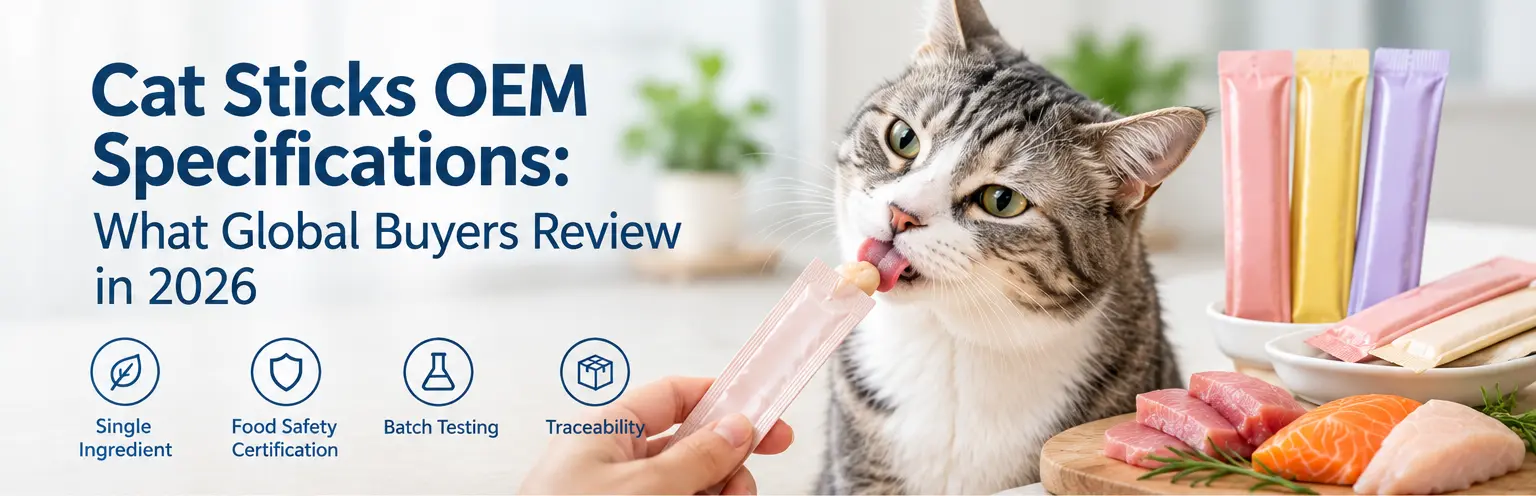
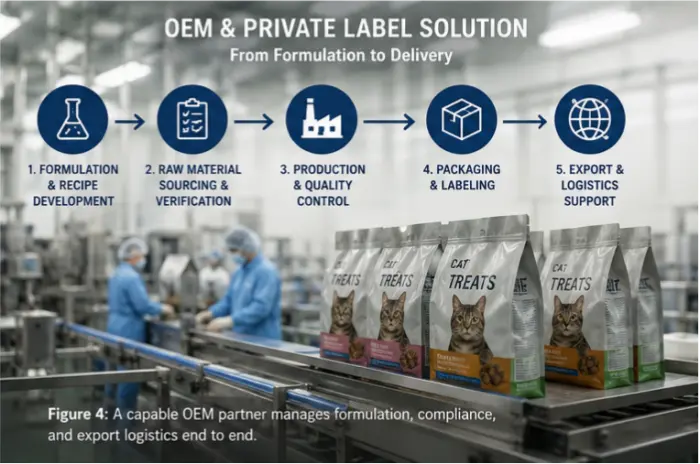
As qualified suppliers become more important to brand owners and retailers, the OEM opportunity increasingly centers on formulation support, quality control, documentation, and export readiness. Buyers evaluating a cat stick treats or fish fillet treats OEM partner should assess these capabilities before comparing unit prices.
For importers, the practical implication is to qualify suppliers early on certifications, batch testing, traceability, formulation capability, and destination-market documentation. Reviewing a supplier’s published capabilities — for example on its manufacturer homepage — helps confirm whether it can coordinate these requirements from product development through final shipment.
Buyer Priorities at a Glance
| Buyer Priority | What to Verify | Why It Matters |
|---|---|---|
| Product fit | Treat format, protein source, texture, and target positioning | Determines consumer fit and production requirements |
| Quality | HACCP/GFSI-aligned systems, batch testing, traceability | Reduces food-safety and retailer compliance risks |
| Regulatory support | Ingredients, labeling, claims, and destination-market documentation | Helps prevent delays before market launch |
| Commercial terms | MOQ, packaging, lead time, and repeat-order flexibility | Determines launch economics and inventory risk |
| Export capability | Shipping documents and experience with target markets | Reduces execution risk after production |
What Importers and Brand Owners Should Verify
- Certifications: HACCP, BRC or equivalent, and any market-specific food-safety registration.
- Batch testing: nutrient guarantees, moisture, and microbiological controls per lot.
- Traceability: lot-level ingredient tracking to satisfy retailer and regulator mandates.
- MOQ: confirm the supplier’s MOQ by format, SKU, packaging configuration, and production program rather than assuming a standard container quantity.
- Formulation capability: ability to build single-protein, limited-ingredient, or functional recipes.
- Export documentation: certificates, labeling files, and destination-market compliance support.
Conclusion
The cat treats market is expanding across premium, functional, dental, freeze-dried, and convenience formats, although published market-size estimates vary by scope. For importers and private-label brands, the opportunity is increasingly tied to supplier capability: formulation support, food-safety systems, traceability, compliance documentation, and reliable export execution.
Frequently Asked Questions
Published estimates vary substantially because market researchers use different definitions of treats, snacks, and related cat-food segments. The cited estimates place the 2026 market at roughly USD 3 billion to USD 9 billion, but this range should be treated as directional rather than as a single authoritative market size.
The United States, China, and Germany lead volume and value, driven by high pet ownership, premiumization, and indoor-cat lifestyles. Asia-Pacific shows the fastest incremental growth.
Lickable and freeze-dried formats are among the key growth areas in the category. Freeze-dried treats appeal to buyers seeking minimally processed, single-protein positioning, while lickable products are associated with palatability, hydration, and bonding use cases.
Common buyer requirements include HACCP and, depending on the target market and retailer, a recognized GFSI-aligned food-safety scheme such as BRC. Additional registrations, testing, documentation, and dental-product acceptance may apply depending on the product and destination market.
AAFCO publishes model regulations and nutrient profiles that U.S. states adopt for pet food and treats. Treats positioned with health benefits must sit within these recognized compliance boundaries.
Freeze-dried treats can support premium and single-protein positioning, but the economics depend on ingredient costs, processing requirements, packaging, and target-market pricing. Buyers should also evaluate moisture control, shelf-life validation, and batch consistency before committing to a private-label program.
A common import minimum is one 20-foot container, frequently negotiable depending on the program, formulation complexity, and repeat-order commitment.
There is no universal MOQ for cat treats. Some suppliers quote by SKU, production batch, packaging run, or container quantity. Importers should confirm MOQ based on the treat format, recipe, packaging, and whether the order is a first production run or a repeat program.