




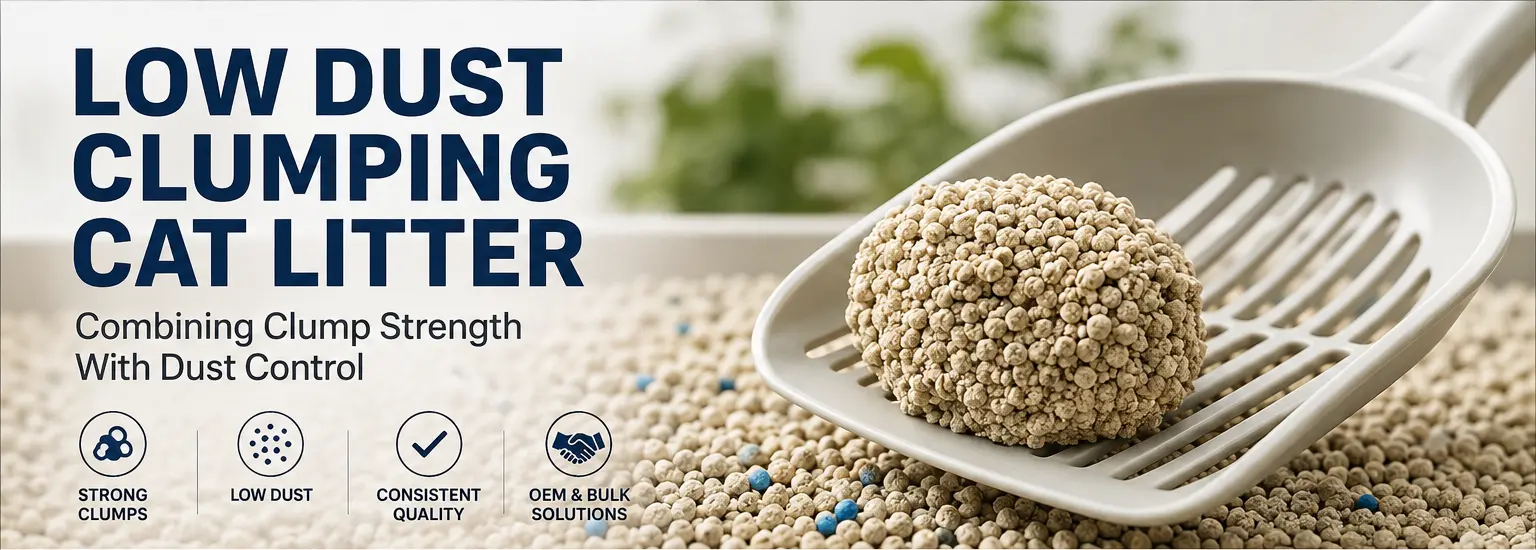
Buyers sourcing clumping cat litter often evaluate clumping performance and dust control together. Clumping makes daily tray maintenance easier, while controlled dust limits loose powder during filling, scooping, packing, and transport. For distributors, private-label brands, and bulk importers, defining both attributes can help reduce handling issues and improve consistency between production batches. Buyers comparing production-side controls can also review our no dust cat litter guide for a broader procurement view of dust-control specifications.
“Low dust clumping cat litter” is not one fixed product category. It describes a performance combination: litter that forms usable clumps while limiting loose fine particles and, where applicable, airborne dust generated during handling. The practical B2B approach is to define the required clump performance and specify a measurable fines or dust-control limit with a documented test method, then verify both against the same specification during batch QC rather than relying on a product-name or label claim.
Quick Answer: Low dust clumping cat litter is a performance specification, not a single material category or universal product standard. A B2B buyer should define clump performance separately from dust control—for example, clump set time and scoopability alongside a maximum fines limit and, where needed, an agreed airborne-dust test. The same sampling and test conditions should then be used for supplier qualification, batch QC, and pre-shipment approval.
Why Buyers Want Clumping and Low Dust Together
Clumping and dust control address two different performance requirements. Clumping allows users to remove waste without replacing the entire tray, while dust control limits loose powder during filling, scooping, and handling. A low dust cat litter clumping format that delivers both is a common private label and bulk specification because it serves both the end user and the handler. The important B2B point is to treat clumping and dust control as two measurable specifications rather than as a single marketing claim.
For procurement, these should be treated as separate acceptance criteria because a litter can form strong clumps while still generating excessive fines, or produce relatively little loose powder while failing to deliver the clump strength and scoopability required by the buyer. A supplier should therefore pass both criteria rather than compensate for a weak result in one with a strong result in the other.
Bentonite vs Tofu: Dust Profiles of Clumping Litters
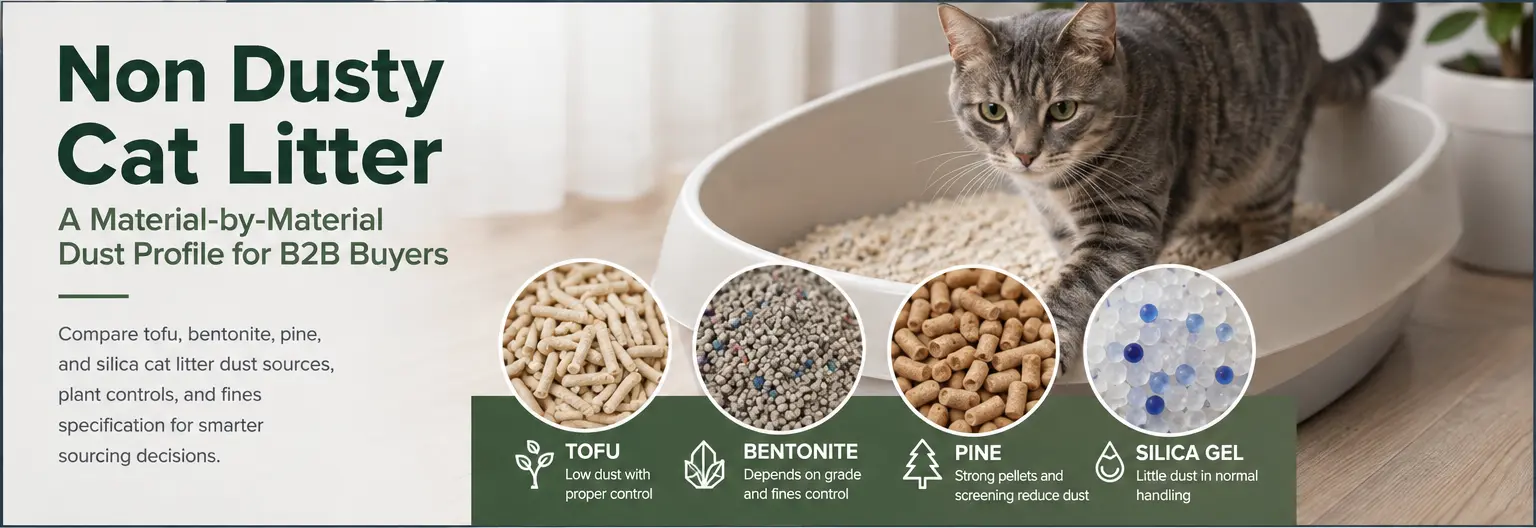
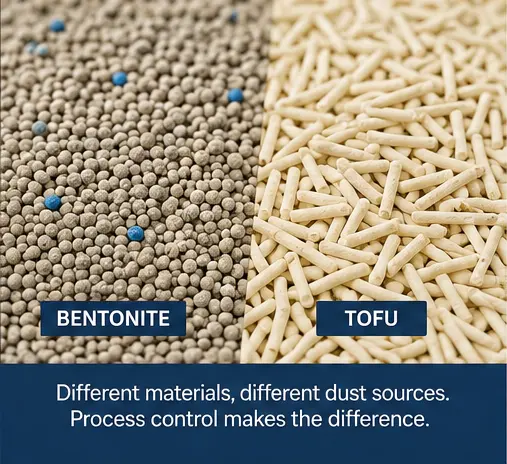
Bentonite and tofu are common bases for clumping litter, but their dust behavior comes from different material and process characteristics. Bentonite forms clumps primarily through the hydration and aggregation of clay particles, while tofu litter typically relies on processed plant-based material, formulation aids, and extrusion or pellet-forming processes to create scoopable clumps. Bentonite dust can be associated with mineral fines and abrasion, while tofu litter may generate fines when plant-based granules fracture or when moisture and processing conditions are not well controlled. Neither material is inherently low-dust; the result depends on particle structure, screening, dedusting, moisture control, formulation, and handling conditions.
Bentonite Clumping Litter Dust Profile
Bentonite clumping litter can be engineered for low dust, but clay is naturally dusty if milling and screening are not controlled. Well-formed granules with consistent compaction shed less powder during handling than loosely milled material. Buyers should compare bentonite samples under the same defined fines test rather than assume a clay base is automatically dusty.
Tofu Clumping Litter Dust Profile
Tofu clumping litter generates dust mainly when extruded granules fracture or when drying is uneven. A stable binder system and controlled moisture reduce friable fines. As with bentonite, the deciding factor is process control: a well-dried, well-screened tofu litter can be low-dust while a poorly processed one is not.
| Attribute | Bentonite clumping | Tofu clumping |
|---|---|---|
| Clump mechanism | Clay hydration and particle aggregation | Plant-fiber matrix, binder, and extrusion structure |
| Main dust source | Milling, screening fines, and granule abrasion | Granule friability, drying variation, and abrasion |
| Primary low-dust controls | Granulation, screening, dedusting, and handling control | Extrusion, moisture, binder, screening, and dedusting control |
| Procurement consideration | Evaluate mineral fines, granule integrity, screening, and abrasion under the agreed test | Evaluate granule friability, moisture stability, formulation, screening, and abrasion under the agreed test |
What Drives Dust in Clumping Litter
Dust in clumping litter generally comes from fine particles already present in the formulation or from granules that fracture and abrade during processing, packaging, transport, and handling. Particle-size distribution, granule strength, screening efficiency, moisture control, binder selection, dedusting, and packaging conditions can all influence the amount of loose powder reaching the customer.
Low Dust Does Not Mean Zero Fines
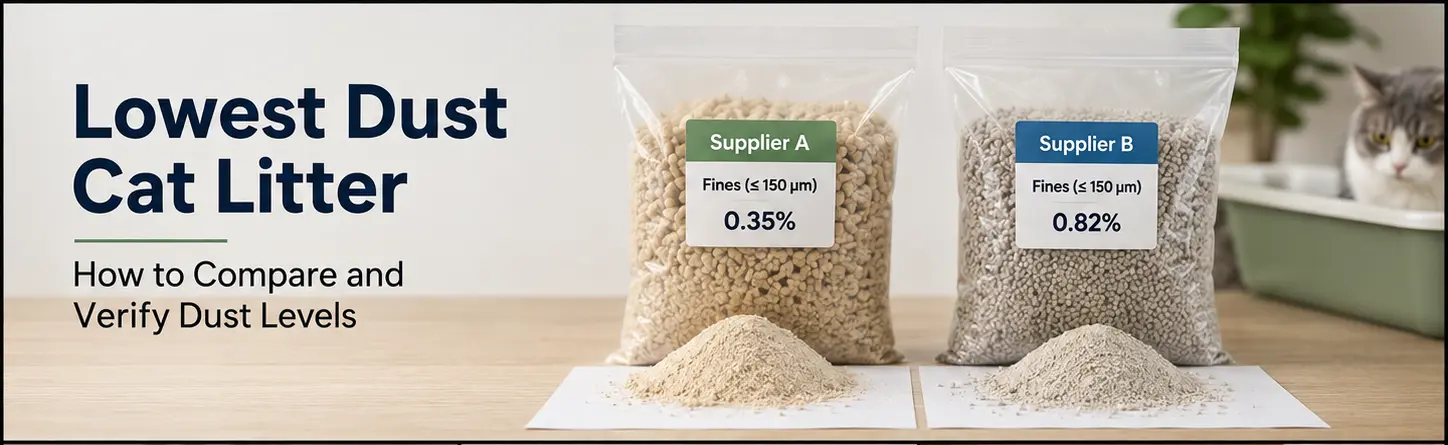
For B2B specifications, “low dust” should not be treated as a universal numerical standard. Buyers should distinguish between fines already present in the product and airborne dust generated during a defined handling test; airborne-particle frameworks from agencies such as the U.S. National Institute for Occupational Safety and Health address workplace exposure, not cat-litter product ratings. A practical specification can therefore set a maximum fines percentage using an agreed sieve method and, where airborne dust matters, add a standardized agitation or handling test with documented conditions. The key is to define the test method, sample preparation, reporting unit, and acceptance limit together rather than rely on the words “low dust” or “dust-free.”
How Clumping and Dust Control Interact
Clumping depends on the formulation, binder system, particle structure, and granule integrity, while dust control depends on the amount of loose fines and the product’s resistance to fracture and abrasion. The two performance goals can be achieved together, but they may require trade-offs during formulation and processing. For example, increasing binding or compaction may improve clump strength but can also change granule structure and handling behavior. A low-dust scoopable cat litter is therefore best developed by optimizing clumping and dust control as a combined specification rather than as separate targets.
| Control factor | Affects clumping | Affects dust |
|---|---|---|
| Granule integrity and compaction | Clump strength and speed | Less fracture, fewer fines |
| Screening and dedusting | Can affect effective particle-size distribution and clump consistency | Removes loose fines before bagging |
| Moisture and binder balance | Clump set and scoopability | Reduces friable surface powder |
| Packaging and handling | Reduces granule damage during transport | Limits abrasion and fines migration during transit |
Specifying Low Dust Clumping Litter for OEM and Bulk Orders
When you work with a cat litter manufacturer on OEM or bulk programs, translate “low dust clumping” into separate acceptance criteria for clumping and dust control. For example, a specification can define the required clump set time, minimum clump integrity or scoopability result, maximum fines percentage under an agreed sieve procedure, and, when required, a standardized handling or agitation test for airborne dust. The specification should also identify sample preparation, test conditions, sampling frequency, and batch acceptance limits. This prevents the supplier and buyer from interpreting “low dust” or “strong clumping” differently during production and reorders. Although some products are marketed as dust-free clumping cat litter, buyers should distinguish marketing terminology from a measurable low-dust requirement and state the actual acceptance limit in the specification.
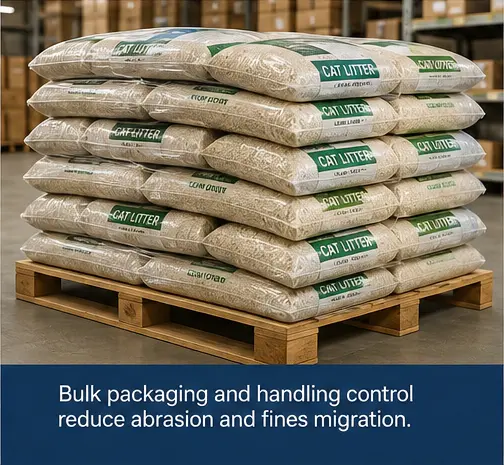
Packaging cannot replace product-level dust control, but it can help preserve the approved dust and fines performance during transport. For bulk clumping cat litter, packaging should therefore be evaluated for compression, abrasion, granule breakage, and fines migration under the intended logistics conditions.
| Spec item | Why it matters |
|---|---|
| Clump acceptance criterion | Defines speed, strength, and scoopability the buyer expects |
| Fines limit and, if required, airborne-dust test | Defines the maximum loose fines and, where airborne exposure matters, the conditions used to measure dust generated during handling |
| Particle-size distribution | Controls granule consistency and helps limit excessive fines |
| Test method and conditions | Ensures supplier and buyer measure both attributes the same way |
| Sampling procedure | Makes batch results comparable across reorders |
| Batch test report | Documents actual clump and dust results against the spec |
| Packaging dust control | Reduces in-transit powder migration for bulk formats |
Buyer Pre-Shipment Checklist
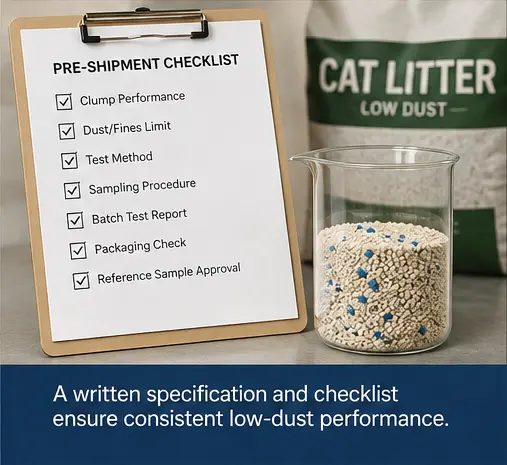
Before confirming a production run, buyers can use a short checklist to verify both attributes: (1) confirm that the clump acceptance criterion is written into the product specification; (2) confirm the fines limit and any required airborne-dust test method; (3) approve a reference or golden sample for production comparison; (4) request a batch test report covering both clumping and dust-control results; (5) verify that the selected packaging format limits compression, abrasion, and fines migration during the intended transport cycle; and (6) validate the specification with a trial shipment before scaling to full-container orders.
Conclusion
Low-dust clumping performance is a manufacturing and specification outcome, not a single material category. Buyers can achieve more consistent results by defining clump performance and a measurable dust or fines requirement, approving a reference sample, using an agreed test method, and requiring batch QC before shipment. For OEM and bulk programs, combining formulation controls, granulation, screening, dedusting, packaging, and documented acceptance criteria turns a general “low dust” expectation into a repeatable commercial specification.
Frequently Asked Questions
Yes. A low dust clumping cat litter is a common private label and OEM format because it serves both the end user and the handler. The key is to write the clump criterion and dust limit into the contract rather than assume the product name guarantees them, then verify both through batch testing.
They can differ in dust behavior, but there is no universal ranking that makes bentonite or tofu automatically lower-dust. Bentonite performance is influenced by mineral fines, granule integrity, screening, and abrasion, while tofu performance is influenced by formulation, extrusion or forming conditions, moisture control, granule friability, and screening. Compare both materials using the same agreed fines or dust-control test rather than judging dust level from the raw material name alone.
No. “Low dust” is a product-performance claim rather than a single universal numerical standard for cat litter. For B2B purchasing, the buyer and supplier should define the relevant fines or airborne-dust measurement, test conditions, sampling procedure, and acceptance limit in the product specification. This makes the claim measurable and repeatable across production batches.
Clumping does not automatically prevent dust. Fine particles can remain after granulation and screening, while granules can also create additional fines through fracture and abrasion during processing, packaging, transport, and use. Low-dust performance therefore depends on both the initial fines level and the granules’ resistance to handling damage.
The main source controls are granule integrity and compaction, mechanical screening and dedusting, moisture and binder balance, and packaging that limits abrasion. Controlling these together reduces loose fines before bagging and during transit, independent of the clumping base material.
Run the clump test and the agreed fines or dust-control test on samples from the same production batch, using documented conditions and acceptance criteria. Record both results in the batch report and compare them with the approved specification. The important point is consistency: the buyer and supplier should use the same sampling and test procedure for production approval and subsequent reorders.
Not exactly. “Scoopable” describes the user outcome of removing waste without emptying the tray, which clumping enables, but the term is sometimes used loosely for non-clumping absorbent litters. For B2B specs, define the actual clump acceptance criterion rather than relying on the scoopable label alone.
For bulk clumping litter, define a maximum dust or fines level using a specified product test method, together with the clump acceptance criterion, sampling procedure, and batch acceptance record. Longer transport, repeated handling, and compression can increase granule abrasion and fines migration, so packaging dust control should also be specified and validated.
Often yes, but the two targets may require formulation and process trade-offs. Good granule integrity can support clump strength while reducing fracture and loose fines, while appropriate moisture and binder control can improve both scoopability and surface stability. The key is to optimize clumping and dust control together and verify both against defined acceptance criteria.