



Plant-Based Cat Litter Aflatoxin Risk: Mold and Mycotoxin Red Lines for Buyers
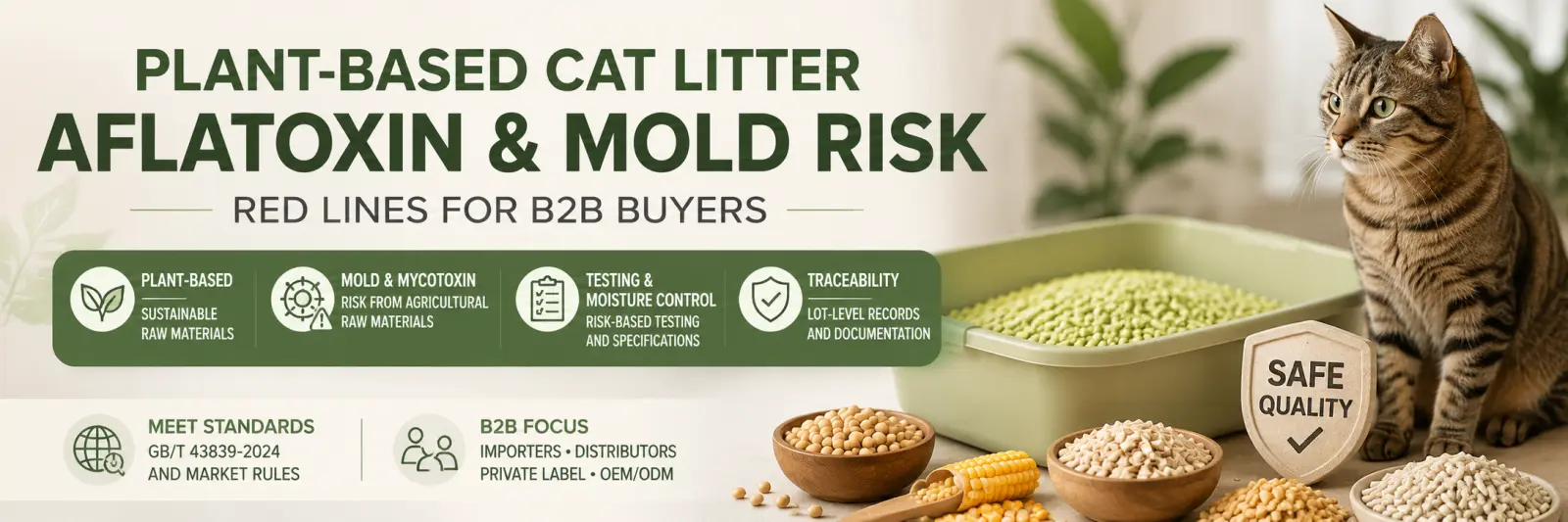
For importers, distributors, and private-label buyers, plant-based cat litter—tofu (soy), corn, cassava, wheat, and pea formulas—offers a sustainability and renewable-material positioning that mineral litters generally do not. It also introduces a distinct raw-material risk: agricultural ingredients can carry mold and mycotoxins such as aflatoxin B1 if they are contaminated in the field or poorly stored before processing. This guide explains the procurement and manufacturing red lines buyers can use to control that risk, and where the Chinese national standard GB/T 43839-2024 fits without overstating what it requires.
Quick answer: Plant-based cat litter has a distinct mold and mycotoxin exposure pathway because agricultural raw materials such as soybean, corn, cassava, wheat, and pea can become contaminated before processing. For B2B procurement, practical red lines include supplier-controlled raw-material screening, a documented moisture specification, risk-based finished-product testing for relevant mycotoxins and microbiological indicators, and lot-level documentation. GB/T 43839-2024 is a recommended Chinese national standard covering safety requirements for companion-animal products, but buyers should not treat it as a universal global mycotoxin limit; the applicable requirements depend on the product, market, and current standard or regulation in force.
Why Plant-Based Litters Carry a Different Risk Than Mineral Litters
Bentonite and silica litters are geologically stable materials with little biological content, so their contamination profile is dominated by mining and processing hygiene. Plant-based litters start as agricultural commodities—soybean, corn, cassava, wheat, pea—that are exposed to field, storage, and fungal risk before they ever reach a litter line. That single difference is why mold and mycotoxin belong on a plant-based buyer’s checklist from day one.
A plant-based base material is not automatically a safety guarantee. Terms such as “natural” or “plant-based” describe material positioning, not the absence of contamination risk. Product safety depends on raw-material sourcing, storage, processing, testing, and quality controls.
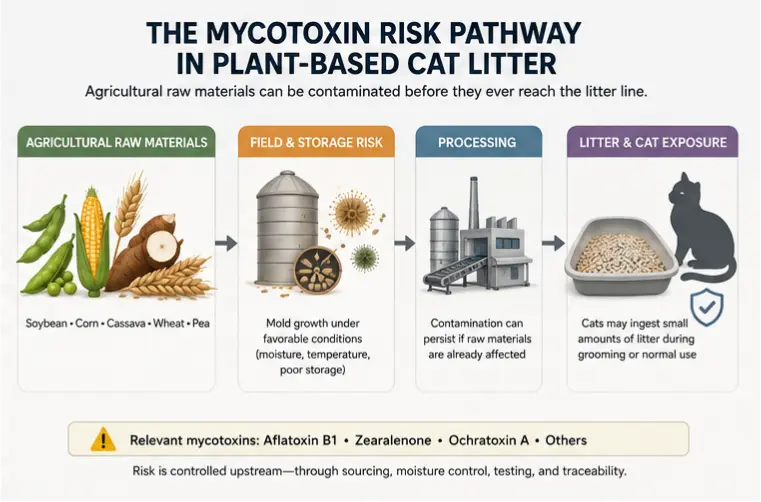
The Core Hazard — Aflatoxin B1 and Other Mycotoxins
Aflatoxin B1 is among the most important mycotoxins to consider because certain agricultural raw materials can become contaminated by Aspergillus molds under favorable conditions. It is not the only relevant mycotoxin:
- Aflatoxin B1 — an important mycotoxin to screen for in susceptible agricultural raw materials, including some grain and plant-based inputs.
- Zearalenone — a mycotoxin associated with corn and other cereals; comparative testing has reported it in some plant-based cat-litter samples containing corn.
- Ochratoxin A — relevant where storage conditions allow broader fungal growth.
Cats can ingest small amounts of litter during grooming or normal litter-box use, so contamination is a product-safety and quality concern for both the animal and the brand. The practical response is upstream raw-material control, moisture management, appropriate testing, and traceable documentation—not a fragrance or a marketing claim.
GB/T 43839-2024 — Where the Standard Fits
GB/T 43839-2024, titled “Safety technical requirements for companion animal (pet) products,” was published on 2024-03-15 and implemented on 2024-10-01. It was proposed by the Ministry of Agriculture and Rural Affairs (MARA) and is administered under SAC/TC 541 (the National Technical Committee for Companion Animal (Pet) Products), with publication by the Standardization Administration of China (SAC) jointly with the State Administration for Market Regulation (SAMR). It is a recommended national standard rather than a mandatory national standard; the “T” in GB/T identifies it as a recommended standard. The standard establishes safety-related requirements and test methods for products within its stated scope. For cat-litter buyers, the important point is to verify the applicable product category, test items, and limits in the current standard text rather than assume that every requirement applies identically to every litter formula or every export market.
For litter buyers, the practical reading is:
- Scope verification — Confirm that the specific cat-litter product and formula fall within the applicable scope of the current GB/T 43839-2024 requirements before using the standard as a procurement specification.
- Test-item verification — Use the current standard text to identify the applicable safety and microbiological test items and acceptance criteria, then add destination-market requirements and buyer specifications where needed.
- For export, the destination market’s rules may differ, and pet-litter mycotoxin limits are not always harmonized with food or feed limits, so market-specific advice should be obtained before setting specifications.
Our cat litter quality standard guide covers the product-side parameters in more detail; this article focuses on the mycotoxin-specific red lines.
Procurement Red Lines — What to Require From a Supplier
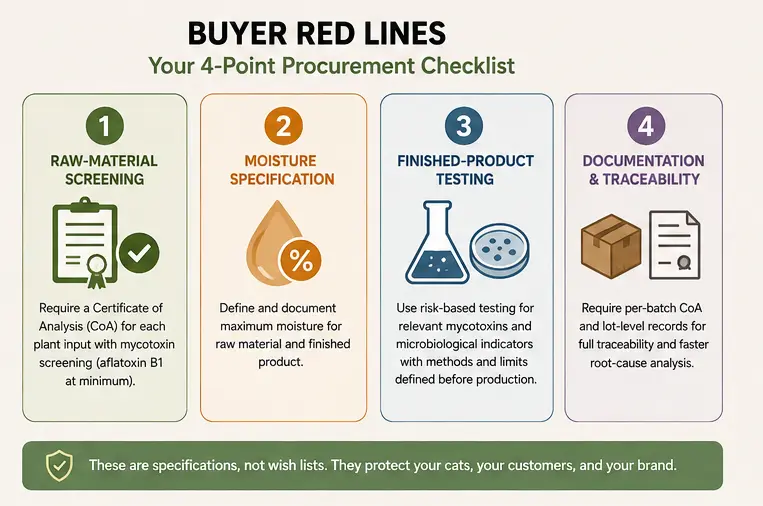
Treat the following as a procurement specification, not a wish list. Each item addresses a practical contamination or quality-control risk in plant-based litter sourcing.
| Red line | What to require | Why it matters |
|---|---|---|
| Raw-material control | Certificate of Analysis for each plant input, with mycotoxin screening (aflatoxin B1 at minimum) | Contamination can enter with agricultural raw materials, especially when sourcing, storage, or supplier controls are inadequate. |
| Moisture specification | A documented maximum moisture for raw material and finished product | Moisture availability and storage conditions influence fungal growth; a defined moisture specification provides a measurable control point. |
| Finished-product testing | Risk-based testing for relevant mycotoxins and microbiological indicators, with methods and acceptance criteria defined before production | Confirms the finished SKU meets the agreed specification rather than relying only on raw-material documentation |
| Documentation and traceability | Per-batch CoA and lot-level records | Enables recall and root-cause analysis if a finding occurs |
The table reflects common procurement practice for plant-based litter and is not a substitute for the requirements of GB/T 43839-2024 or the destination market’s rules.
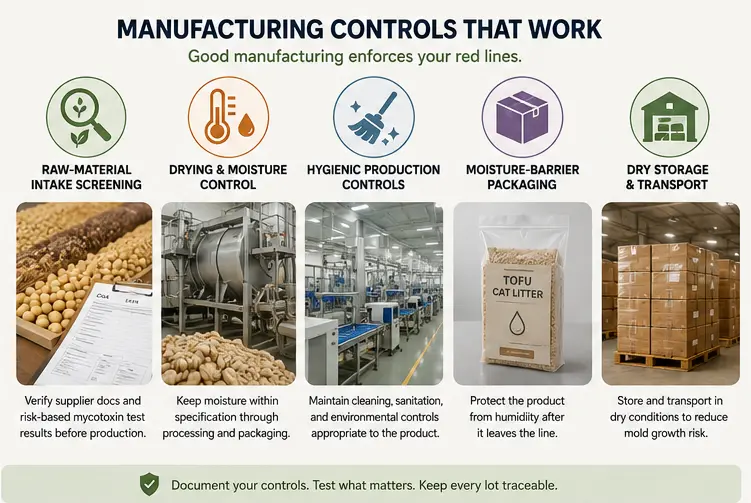
Manufacturing Controls That Prevent Mold and Mycotoxin
Good manufacturing is where the red lines are enforced. A capable plant-based line should demonstrate:
- Raw-material intake screening — Verify supplier documentation and risk-based mycotoxin test results for plant inputs before releasing materials into production.
- Drying and moisture control — keep moisture within the documented specification through processing and packaging.
- Hygienic production controls — Maintain documented cleaning, sanitation, and environmental controls appropriate to the product and manufacturing process.
- Moisture-barrier packaging and dry storage — protect the product from humidity after it leaves the line.
These are process controls rather than marketing claims. For a private-label or OEM program, buyers should ask suppliers to document how raw materials are approved, how moisture is controlled, which finished-product tests are performed, and how batch records are maintained. See our OEM cat litter capability overview for supplier qualification considerations, and our tofu cat litter page for a soybean-based formula example.
Independent Testing Evidence
The risk is not purely theoretical. A 2023 comparative test reported by China National Radio (CNR), involving multiple cat-litter samples, identified mycotoxin findings including zearalenone in some plant-based products containing corn and reported differences in microbial counts between product samples. The results were sample-specific and should not be interpreted as proof that all plant-based litters are contaminated. For buyers, the practical lesson is to request current, product-specific test reports rather than rely on category assumptions. (CNR / Shanghai consumer council cat litter comparison)
Common Mistakes That Let Contamination Through
- Buying on price alone without verifying raw-material sourcing, storage conditions, testing, and supplier traceability.
- Accepting a product with no raw-material CoA or no mycotoxin screening.
- Omitting a documented moisture specification, then discovering mold after humid storage.
- Testing only the raw material and never the finished product.
- Treating “natural” as a safety claim rather than a supply-chain responsibility.
Conclusion
Plant-based cat litter is not inherently unsafe, but its agricultural raw materials create a distinct exposure pathway for mold and mycotoxins such as aflatoxin B1. For buyers, the practical controls are clear: verify raw-material sourcing and testing, define moisture requirements, use risk-based finished-product testing, maintain batch-level documentation, and align specifications with the applicable Chinese standard and destination-market rules. For private-label and OEM programs, supplier verification should focus on documented controls rather than broad claims such as “natural” or “safe.”us on documented controls rather than broad claims such as “natural” or “safe.”
Frequently Asked Questions
Yes, plant-based cat litter can have aflatoxin and other mycotoxin exposure because agricultural raw materials such as soybean, corn, cassava, wheat, and pea can become contaminated before processing. This is a raw-material and supply-chain risk, not proof that a particular plant-based litter is contaminated. Effective supplier controls and appropriate testing are therefore important.
Aflatoxin B1 is a potent mycotoxin produced by Aspergillus molds that can contaminate improperly stored grain and plant material. Because cats may ingest small amounts of litter, contamination is a product-safety and quality concern, which is why aflatoxin B1 is among the most important mycotoxins to consider for plant-based litter.
GB/T 43839-2024 provides safety-related requirements and test methods for companion-animal products within its stated scope and is a recommended national standard in China. Buyers should verify the current standard text to determine the applicable test items and acceptance criteria for a specific cat-litter product. It should not be treated as a universal global aflatoxin limit for exported cat litter, because destination-market requirements may differ.
For B2B procurement, consider risk-based testing of relevant plant inputs and finished products for mycotoxins and microbiological indicators, together with a documented moisture specification and lot-level records. Aflatoxin B1 may be an important screening target for susceptible raw materials, while the final test panel and acceptance criteria should follow the applicable standard, destination-market requirements, and the buyer’s product specification.
Mold growth is influenced by moisture and storage conditions. A documented maximum moisture for raw materials and finished product, combined with moisture-barrier packaging and dry storage, helps reduce the risk of fungal growth after the product leaves the line.
They have a different mycotoxin exposure pathway rather than being inherently unsafe. Tofu and corn litters use agricultural raw materials that can carry fungal contamination before processing, whereas bentonite is a mineral material and does not have the same agricultural raw-material pathway. The appropriate response is stronger raw-material verification and risk-based finished-product testing, not a blanket assumption that one litter category is unsafe.
A capable contract manufacturer can, by screening raw-material intake, controlling moisture through drying and packaging, maintaining a clean environment, and issuing per-batch Certificates of Analysis. The buyer should still verify which tests the supplier actually performs and at what limits.
Confirm that it identifies the specific plant input or finished product, lists the relevant mycotoxin and microbiological tests, includes the moisture result where specified, states the test methods and acceptance criteria, and identifies the applicable lot or batch. The document should correspond to the actual product and shipment rather than serve as a generic certificate.