




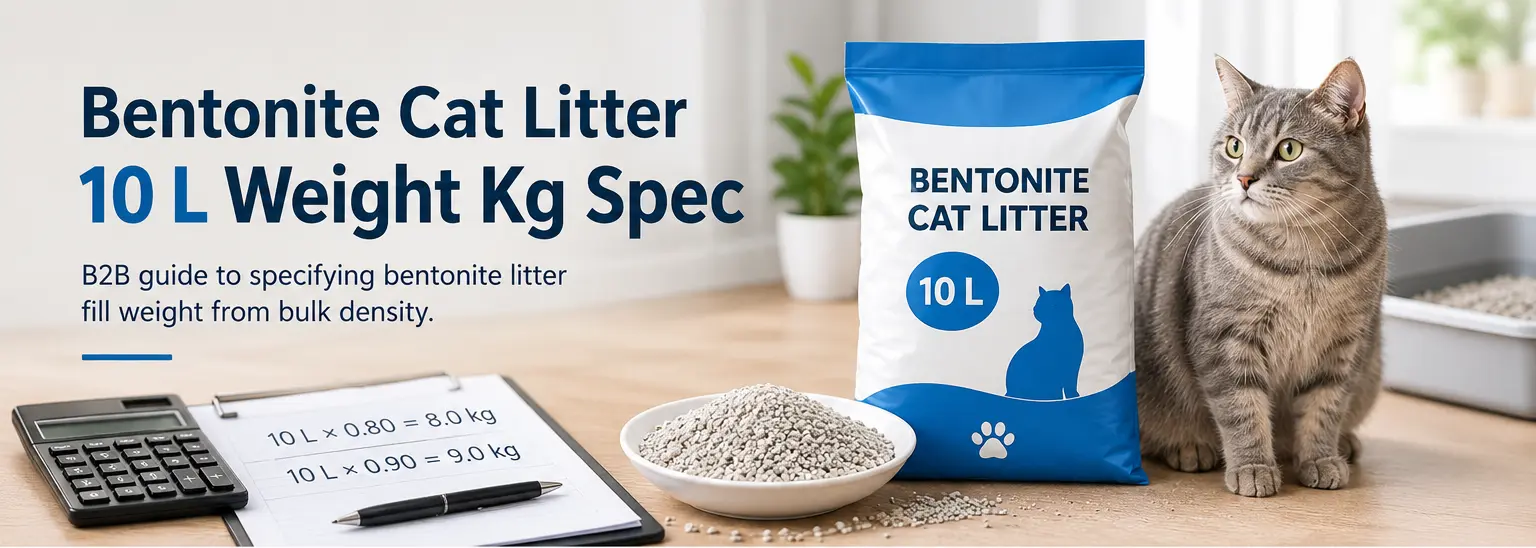
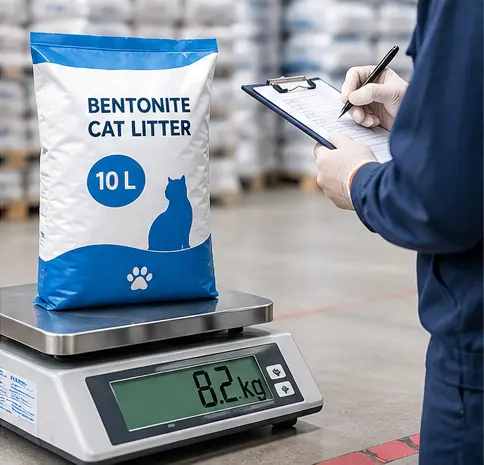
Buyers searching for bentonite cat litter 10 l weight kg usually want to know how many kilograms of litter fit into a 10 L bag. The answer depends on bulk density: multiply 10 L by the product’s bulk density in kg/L to estimate fill weight. As a calculation example, 0.80 kg/L gives 8.0 kg and 0.90 kg/L gives 9.0 kg. For importers and private label buyers, the purchase specification should state the target density range and fill-weight tolerance so volume, weight, and freight calculations remain consistent. Buyers planning volume programs can also review our bentonite cat litter wholesale guide for freight and purchasing considerations.
Quick Answer: A 10 L bag of bentonite cat litter does not have one universal weight because fill weight depends on bulk density. The calculation is 10 L × bulk density (kg/L) = fill weight (kg). As a calculation example, 0.80 kg/L gives 8.0 kg and 0.90 kg/L gives 9.0 kg. These are examples, not universal bentonite specifications. For B2B supply, specify the actual SKU bulk-density range, fill-weight tolerance, and measurement procedure.
What Bulk Density Means for Cat Litter
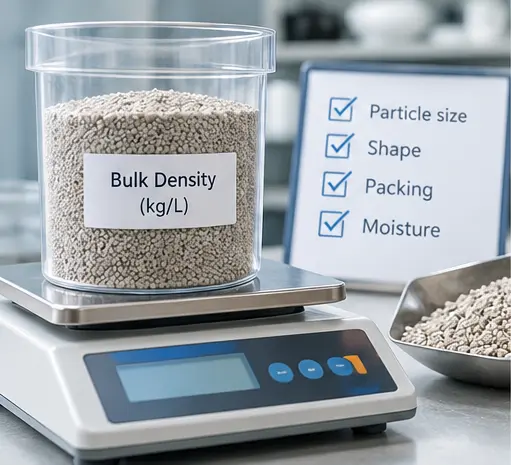
Bulk density is the mass of a material divided by the total volume it occupies, including the air spaces between granules. Cat litter bulk density is commonly expressed in grams per cubic centimetre (g/cm³) or kilograms per litre (kg/L); these units are numerically equivalent. The measured value depends on factors such as particle-size distribution, particle shape, packing arrangement, compaction, and moisture. As these factors change, the same nominal 10 L volume can correspond to different fill weights.
Bentonite cat litter is a mineral-based product, but its measured bulk density is still formulation-specific. Particle size distribution, granule shape, packing, processing, and moisture can all affect the value. For B2B purchasing, it is therefore safer to compare the supplier’s measured bulk-density specification rather than assume a density from the litter material alone.
From Bulk Density to Bag Fill Weight
The relationship is straightforward:
Fill weight = declared product volume × bulk density
For a 10 L product-volume claim, the theoretical fill weight is calculated from the measured bulk density: fill weight (kg) = 10 L × bulk density (kg/L). This calculation assumes that the stated 10 L refers to the volume of litter in the finished package. If a supplier uses a different packaging convention, the volume basis should be defined in the purchase specification. The actual accepted fill weight should then be controlled within the agreed tolerance.
The following table shows mathematical examples across different assumed bulk densities; it is not a typical or recommended bentonite cat litter density range.
| Bulk density (kg/L) | Theoretical weight for 10 L (calculation example) |
|---|---|
| 0.70 kg/L | 7.0 kg |
| 0.75 kg/L | 7.5 kg |
| 0.80 kg/L | 8.0 kg |
| 0.85 kg/L | 8.5 kg |
| 0.90 kg/L | 9.0 kg |
| 0.95 kg/L | 9.5 kg |
| 1.00 kg/L | 10.0 kg |
| Specification input | What the buyer controls | Why it matters |
|---|---|---|
| Declared product volume (L) | Product and packaging specification | Defines the volume represented by the 10 L claim |
| Bulk density band (kg/L) | Granule spec | Determines actual fill weight |
| Fill-weight tolerance | Acceptance limit | Provides an objective basis for over/under-fill inspection |
| Moisture range | Production and test condition | Controls variation in measured weight, density, and clumping |
For purchasing control, define one repeatable bulk-density measurement procedure rather than relying on the name of a standards organization. The specification should state the sample condition, container volume, filling or compaction procedure, number of measurements, calculation method, and acceptance range. If a recognized standard such as an ASTM International method is selected, identify the exact standard and confirm that its scope and test conditions are appropriate for the bentonite cat litter being measured.
Why Buyers Should Specify a Band, Not a Single Number
Particle-size distribution, granule shape, packing conditions, and moisture can cause bulk density to vary within a formulation-specific range. A supplier that controls an agreed range across batches is more useful than one that targets a single number without defined test conditions. The written specification should therefore define:
- the target bulk-density band (kg/L),
- the permitted fill-weight tolerance for the declared product volume,
- the moisture range used for production and testing, and
- the defined measurement procedure, sample condition, and sample size.
Treating the number as a defined range protects both sides: the supplier has a measurable production target, while the buyer has an objective acceptance criterion for incoming inspection rather than relying on visual assessment.
Bulk Density, Freight, and Palletization
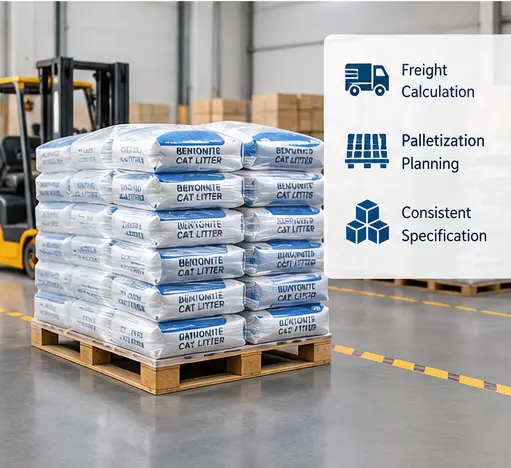
Bentonite’s bulk density affects the amount of product weight carried per bag and therefore influences pallet and container planning. For OEM programs, buyers can use the specified density range and fill-weight tolerance to estimate total shipment weight before finalizing bag size, pallet configuration, and freight calculations. The density target should be agreed together with the formula and packaging specification so the finished SKU remains consistent across production batches.
The density band also affects how a bag feels and how much product a customer perceives they receive. Buyers building a custom formula can start from our OEM cat litter program overview to scope granule and fill targets together.
Common Specification Mistakes
Buyers sometimes state only “10 L” and assume weight follows. Without a bulk-density band, two suppliers can ship very different weights under the same volume claim. Others fix one weight number and reject normal batch variation, creating avoidable disputes. The cleaner approach is a stated volume, a density band, and a fill-weight tolerance tied to a defined measurement method.
Conclusion
For bentonite cat litter 10 l weight kg, a 10 L fill does not correspond to one universal weight. Calculate it as 10 L × bulk density (kg/L); as a calculation example, 0.80 kg/L gives 8.0 kg and 0.90 kg/L gives 9.0 kg. For B2B supply, specify the product volume, bulk-density range, fill-weight tolerance, and measurement procedure together. This gives importers and private label buyers a more reliable basis for freight planning, palletization, and incoming quality control.
Frequently Asked Questions
It depends on bulk density. The calculation is fill weight (kg) = 10 L × bulk density (kg/L). As a calculation example, 0.80 kg/L gives about 8.0 kg and 0.90 kg/L gives about 9.0 kg; these are examples, not a universal bentonite specification. For B2B supply, specify the actual SKU bulk-density range, fill-weight tolerance, and measurement procedure so the accepted weight is defined rather than assumed.
Bentonite is a mineral-based litter, so its measured bulk density is formulation-specific rather than fixed by material type. Define the target density band with your supplier and tie it to a stated measurement procedure and fill-weight tolerance.
Particle-size distribution, granule shape, packing, and moisture shift bulk density naturally. A band lets the supplier hold consistent performance across batches and gives you an objective acceptance test.
Yes. Higher bulk density means more weight per bag, so weight-based freight rises with bag size. Density helps you model container weight before committing.
Yes. Moisture can affect measured weight, bulk density, and clumping behavior. A formulation-specific moisture range helps control variation between batches and makes bulk-density and fill-weight measurements more comparable.
No. Bulk density includes the air between granules; particle density is the solid material alone. For bag fill and freight, bulk density is the relevant figure.
Use a documented, repeatable procedure agreed with the supplier. If a recognized standard such as a specific ASTM method is selected, identify the exact standard and confirm its scope and test conditions fit bentonite cat litter measurement. The specification should state the sample condition, container volume, filling or compaction procedure, number of measurements, calculation method, and acceptance range.
It can. At the same declared volume, a higher bulk density generally means a heavier filled bag, which can affect how substantial the product feels to the customer. Particle shape, granule size, packaging, and fill level can also affect the overall product experience, so density should be considered together with the finished SKU specification.