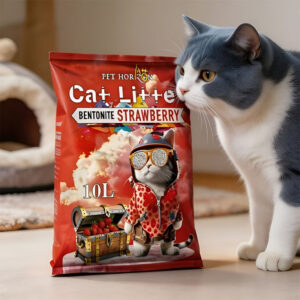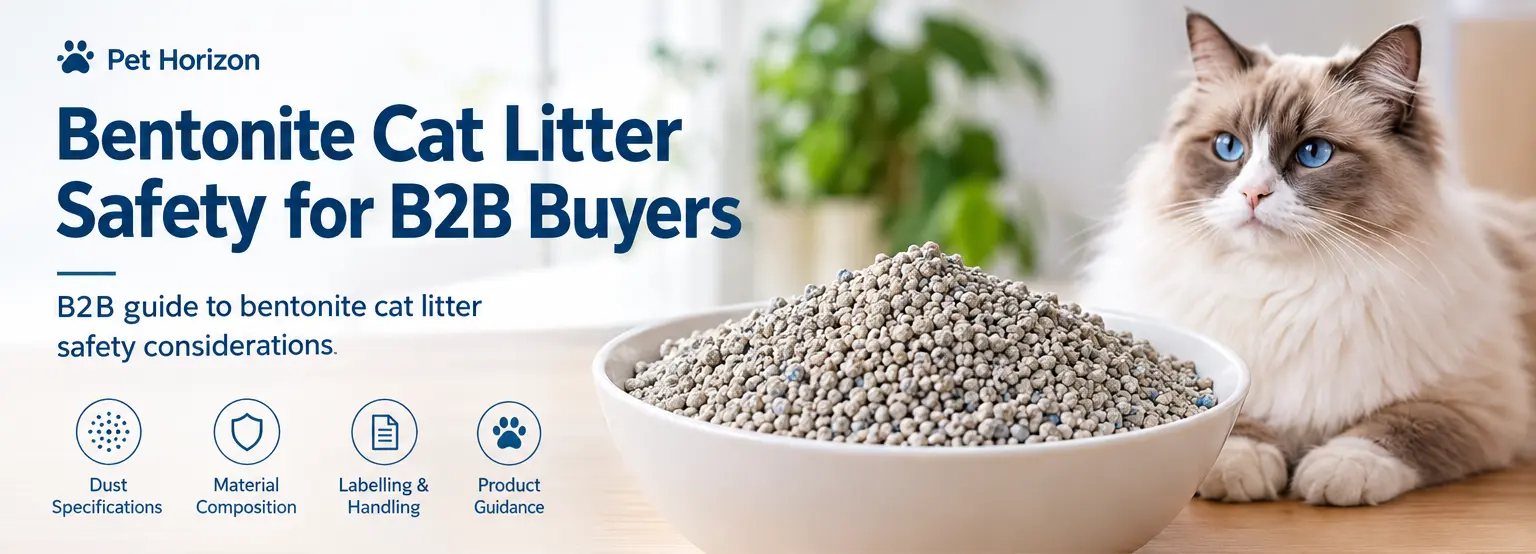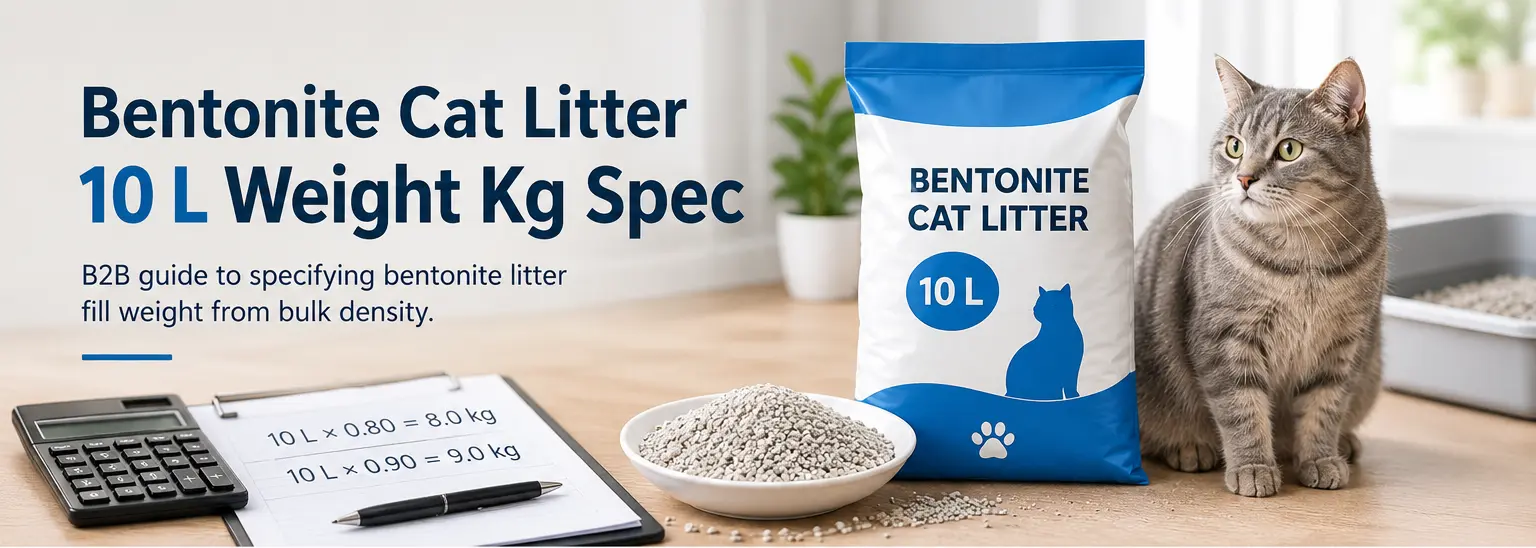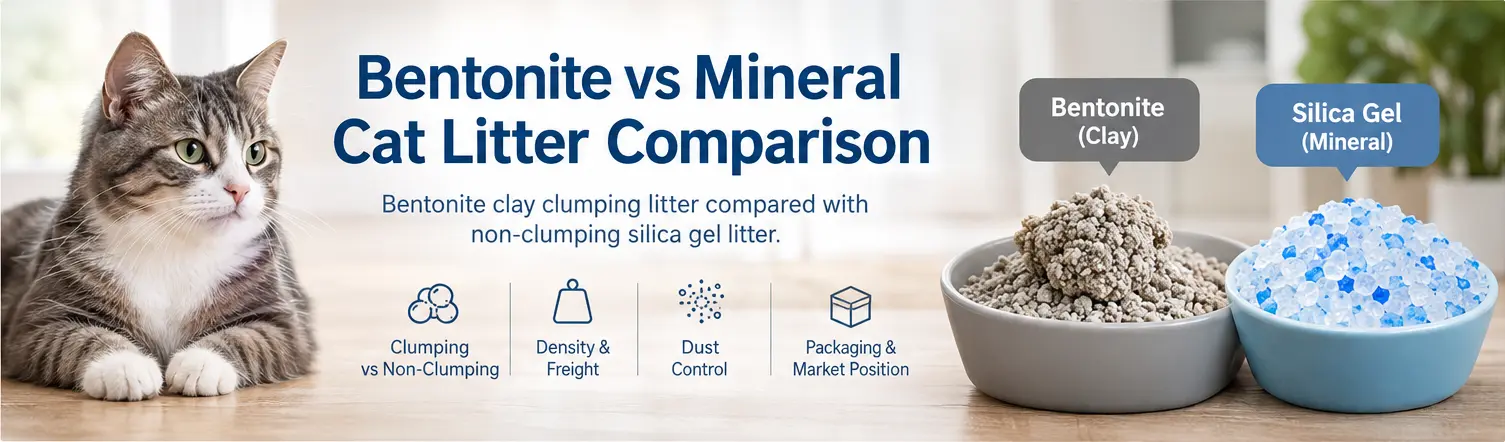




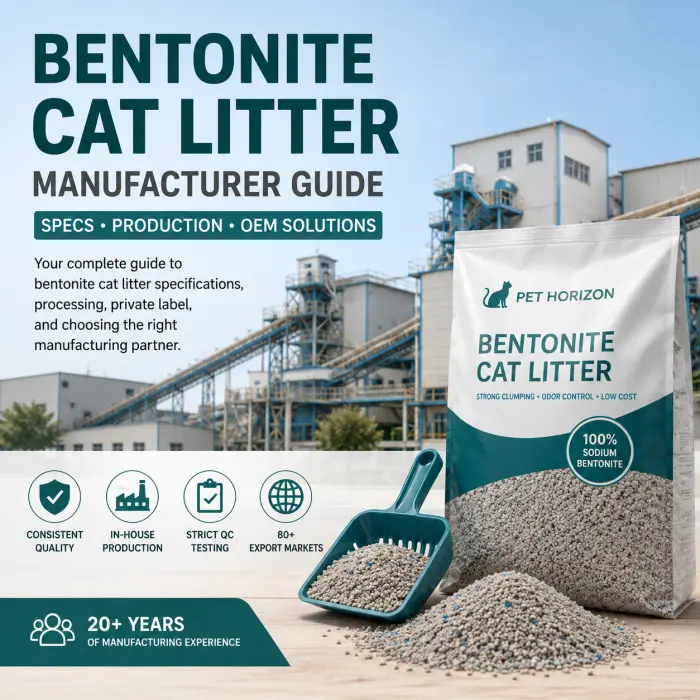
Bentonite cat litter — built on sodium montmorillonite clay — is the volume workhorse of the global cat-litter category. It clumps harder than any plant-based alternative, locks odor effectively, and moves through distributors and private-label programs at scale. This guide covers what bentonite litter is, the specs that separate a good batch from a poor one, how it is processed, and how to run an OEM or private-label program with confidence.
Quick Answer
Bentonite cat litter is a sodium-based clumping litter made from natural bentonite clay. It offers strong clumping performance, excellent odor control, and low cost, making it one of the world’s most widely used cat litters. B2B buyers should specify sodium content, dust (<1% for premium), clump hardness, and granule size (1–4 mm), then confirm mining source and in-house processing. It is not flushable and generates more dust than tofu or pine — choose it for value and performance, not eco-positioning. For private-label programs, partner with a manufacturer that offers 10+ years of OEM/ODM experience and can supply specification sheets, batch QC reports, and compliant packaging from the first run.
What Is Bentonite Cat Litter?
Bentonite is a natural clay dominated by montmorillonite minerals. When sodium-activated, it swells and binds liquid into a tight, scoopable clump — the property that made clumping litter mainstream. Most commercial bentonite litter is the sodium variety (Na-bentonite) rather than calcium, because sodium swells far more effectively.
| Attribute | Typical Spec | Why It Matters for B2B |
|---|---|---|
| Clay type | Sodium bentonite (Na) | Hard clump, strong swell — the performance baseline |
| Form | Granule | Uniform granules = less breakdown in transit |
| Granule size | 1–4 mm | Affects tracking, scoop feel, and pour behavior |
| Color | Grey / beige | Natural; pearl or white grades available at premium |
| Additives | Activated carbon, scent | Odor-control and branding options |
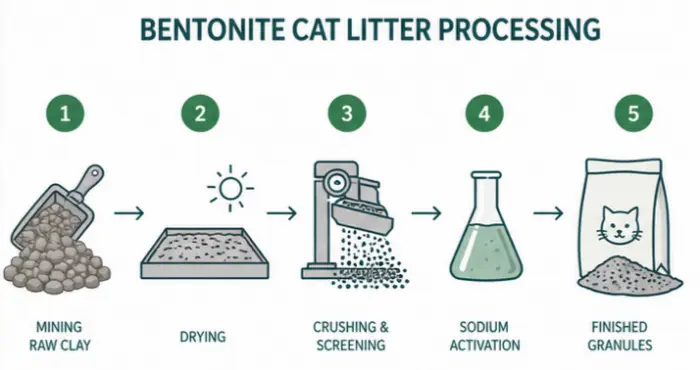
How Bentonite Cat Litter Is Processed
Quality starts at the mine and ends at the bagging line:
- Mining & drying: crude bentonite is extracted and sun- or kiln-dried to a target moisture.
- Crushing & screening: the clay is crushed and screened to a consistent granule size.
- Sodium activation: where natural sodium content is low, the clay is treated to maximize swell.
- Blending: carbon or fragrance is mixed in by batch.
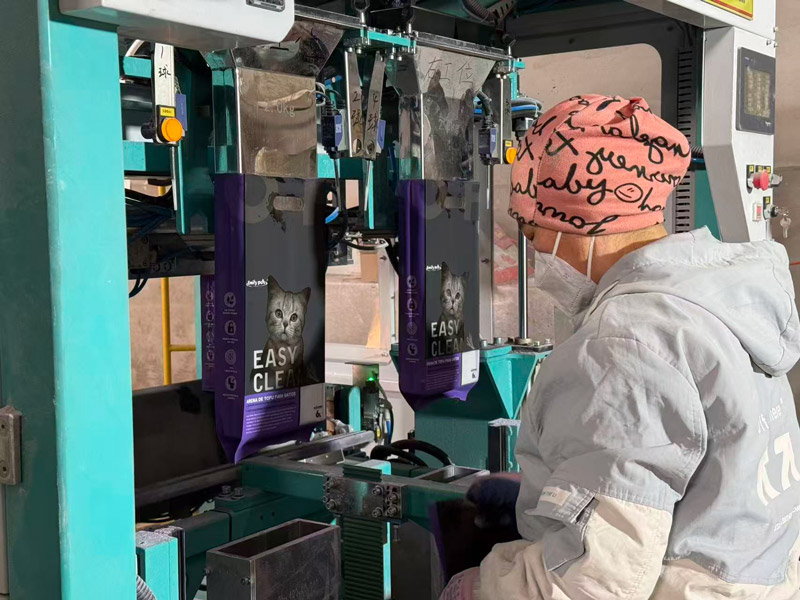
- QC: dust, clump, moisture, and swell are tested per batch before bagging.
A supplier that controls mining and processing in-house can hold tighter specs than a trader who resells third-party clay. Verify the source and the supplier’s production control before committing volume.
Key Specs B2B Buyers Should Specify
| Spec | Target | Note |
|---|---|---|
| Sodium content | High (Na-dominant) | Drives swell and clump hardness |
| Dust | < 1% (premium) | Standard grades run higher; specify for EU shelves |
| Clump hardness | Very hard | The core performance claim |
| Moisture | < 12% | High moisture softens clumps |
| Granule size | 1–4 mm | Match to your scoop and bag format |
Bentonite vs Tofu: What B2B Buyers Should Know
Bentonite is the value-and-performance option; tofu is the eco-and-low-dust option. Many brands bridge them with a mixed tofu + bentonite formula.
| Factor | Bentonite | Tofu |
|---|---|---|
| Clump hardness | Very hard | Medium |
| Dust | Moderate–high | Very low |
| Flushable | No | Partially (market-dependent) |
| Price point | Economy–mid | Premium |
| Best for | Value, max odor lock | Eco, low tracking |
OEM & Private Label Considerations
Bentonite is the easiest litter to run at volume and the most cost-efficient for private label. Scent, carbon content, granule grade, and bag design are all adjustable. Confirm the manufacturer’s minimum run, lead time, and whether they hold certifications (ISO 9001, BSCI, SGS, REACH where applicable). Pair your program with a clear comparison of litter types so retail buyers understand the trade-offs.
How to Choose a Bentonite Cat Litter Manufacturer
Specifying the product is only half the job — the manufacturer determines whether your SKU stays consistent across reorders. Vet suppliers against these six points:
- Track record: ask for 10+ years of OEM/ODM experience and references from comparable private-label programs.
- Certifications: request ISO 9001, BSCI, SGS, and REACH documentation plus recent audit reports.
- In-house control: confirm owned mines, sodium-activation, and screening lines — this is what keeps clump hardness and dust stable.
- QC transparency: the supplier should hand over a full specification sheet and per-batch QC reports without pushback.
- Export readiness: check they can produce destination-market labeling and customs paperwork for your target regions.
- Commercial terms: clarify MOQ, lead time, and private-label packaging support before you sign.
A manufacturer that controls the mine, sodium activation, and processing in-house is generally more capable of delivering consistent clump hardness and dust levels over long-term OEM cooperation.
Red Flags When Evaluating Suppliers
- Cannot provide batch QC reports
- No mine ownership or long-term raw material source
- Only trading company
- No export references
- MOQ changes frequently
- Cannot customize specifications
Typical OEM Ordering Process
A standard private-label program runs in eight steps:
- Brief: submit your spec — sodium content, dust level, granule size, packaging.
- Quote: the manufacturer returns pricing and the minimum order quantity (MOQ).
- Contract: sign the agreement and confirm artwork and NDA terms.
- Sample: a pre-production batch is processed and tested against your spec.
- Approval: you sign off the sample; bulk production is scheduled.
- Production QC: in-process checks and a final batch inspection are recorded.
- Documentation: packing, palletizing, and export papers (SDS, CO) are prepared.
- Shipment: container loading and delivery to your nominated port.
Compliance Notes for Importers
Bentonite itself is a natural mineral with few formulation restrictions, but packaging is regulated in the EU under the PPWR (from August 2026). Specify PPWR-aligned bags from the start, and keep dust-control claims truthful — overstating “low dust” on a standard grade invites complaints and returns. Also request the supplier’s SDS (formerly MSDS) together with the product specification sheet and any other export documents your destination market requires — most importers need it for customs clearance and downstream safety compliance.
Why Partner With Pet Horizon
Pet Horizon has specialized in cat litter manufacturing for more than 20 years and has supported OEM and private-label programs for over 10 years, serving distributors, importers, and retail brands across 80+ international markets.
During OEM production, our engineering team evaluates every batch for moisture, dust percentage, clump strength, and particle size before shipment. These data are recorded for traceability and are available to customers upon request.
Conclusion
Bentonite cat litter remains the volume engine of the category: hardest clump, strongest odor lock, lowest cost. Specify sodium content, dust, clump hardness, and granule size, verify in-house mining and processing, and align packaging with PPWR before import. For brands wanting both performance and an eco story, a mixed formula is the pragmatic bridge. For importers and private-label brands, choosing a manufacturer with stable production, transparent QC, and export experience is often more important than choosing the lowest price.
Frequently Asked Questions
Sodium montmorillonite swells many times more than calcium varieties, producing the hard, scoopable clump that defines clumping litter. Calcium bentonite is used mainly for its absorbency in non-clumping roles.
No. It does not break down in water and will clog plumbing. Never advertise bentonite as flushable.
For premium and EU retail, target under 1% dust. Standard economy grades run higher; be explicit on the spec sheet so your bags match the claim on the box.
It is the most cost-efficient litter by weight — ideal for value lines, distributors, and high-volume private label. Its trade-off is dust and eco-story versus tofu or pine.
Look for ISO 9001, BSCI, and SGS testing; REACH compliance matters for the EU market. Request current audit reports rather than just certificate scans, since dates and scope affect importers.
Our standard minimum order quantity starts from one 20ft container, and the exact volume is negotiable depending on bag format and formulation. Confirm the MOQ and lead time during the brief stage so it fits your launch plan.
Small amounts are typically non-toxic, but it is not food and can cause gastrointestinal blockage if consumed in quantity. Standard pet-safety caution applies, and documentation should be kept on file.
Keep it in a dry warehouse below 12% ambient moisture; bentonite is hygroscopic and will soften or clump prematurely if exposed to humidity. Use palletized, sealed bags and avoid outdoor storage before distribution.
Depends on the number of cats, but high-quality sodium bentonite generally lasts longer because only clumped material is removed during scooping.
Yes. Many manufacturers now produce mixed formulas combining bentonite’s clumping performance with tofu’s low dust and biodegradability.