




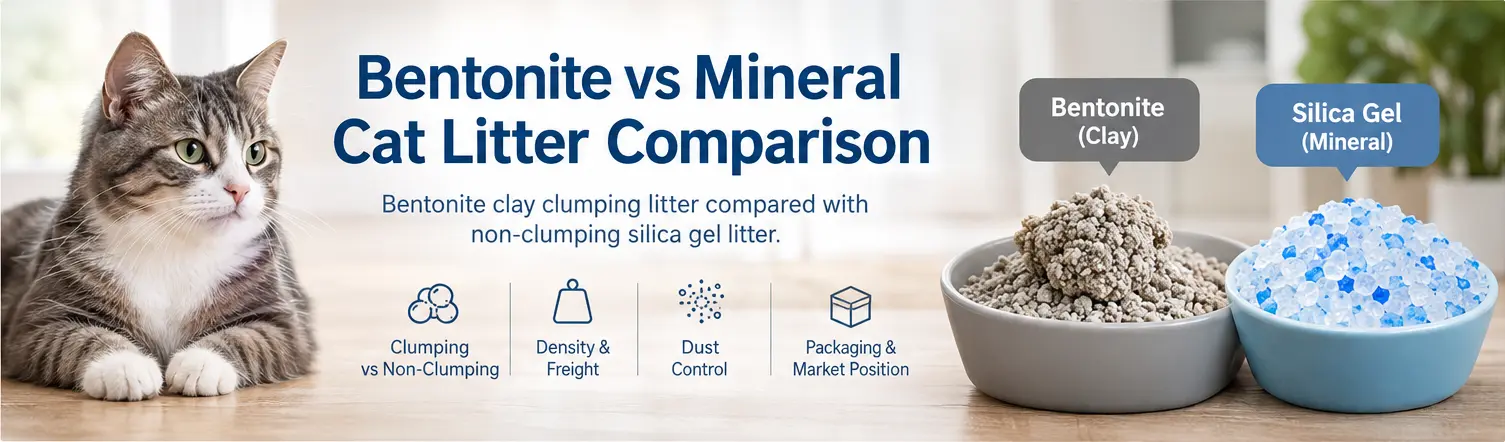
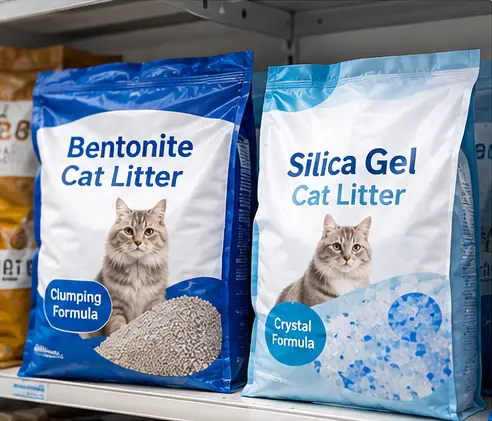
Buyers comparing bentonite vs mineral cat litter are often comparing sodium bentonite clay litter with silica-gel (crystal) litter, although “mineral cat litter” is a broader category that can include both clay and silica-based products. Sodium bentonite clumps by swelling when wet, while silica-gel litter adsorbs and retains moisture within its porous structure without forming a scoopable clump. For importers and distributors, the practical comparison is therefore clumping, density, freight, dust, packaging, and market positioning rather than a simple “better” claim. Buyers who want the bentonite production side can read our bentonite cat litter manufacturing process guide.
Quick Answer: Bentonite and silica-gel litter are both mineral-based cat litter materials, but they behave differently. Sodium bentonite swells and forms scoopable clumps, while silica gel adsorbs and retains moisture within porous particles without conventional clumping. For B2B buyers, the better fit depends on clumping requirements, finished-SKU specifications, freight economics, dust requirements, packaging, and the target market rather than a universal performance ranking.
What Each Material Actually Is
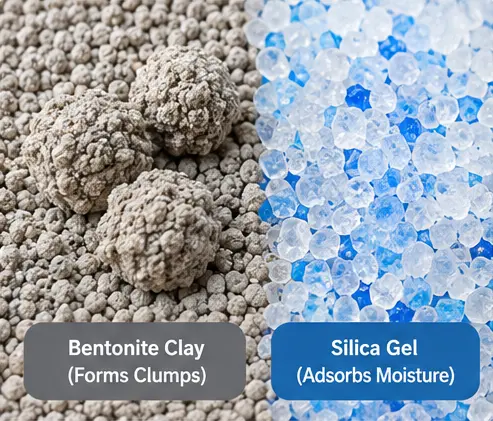
Bentonite cat litter is made from sodium bentonite clay that swells and forms a solid clump when wet. Silica gel cat litter, also called crystal litter, uses porous silica particles to adsorb and retain moisture rather than forming a conventional scoopable clump. The two are sometimes confused because both are mineral-based materials, but their performance characteristics and supply chains are distinct.
Definition: Mineral cat litter is a broad category that can include clay-based materials such as bentonite as well as silica-based materials such as silica gel. In this comparison, bentonite refers to sodium-bentonite clay litter that forms clumps, while silica-gel litter refers to porous crystal litter that adsorbs and retains moisture without conventional scoopable clumping.
Note on product scope: this guide compares materials for buyer education. Silica-gel litter is outside our own production lines, so the comparison is presented neutrally rather than as a recommendation to switch.
Performance Comparison for B2B Buyers
For buyers evaluating clumping vs non-clumping litter, the primary functional difference is how the two materials manage urine. Sodium bentonite typically swells and forms a removable clump, while silica-gel litter retains moisture within porous particles without conventional scoopable clumping. Other purchasing differences include density, dust, packaging, freight, and market positioning.
| Factor | Bentonite clay litter | Silica-gel mineral litter |
|---|---|---|
| Clumping | Forms scoopable clumps via swelling | Non-clumping; adsorbs and retains moisture in porous particles |
| Density and freight | Bulk density varies by grade and particle size; finished-SKU weight and container utilization should be verified | Bulk density varies by crystal grade and particle structure; finished-SKU weight and container utilization should be verified |
| Odor control | Depends on absorbency, clump removal, formulation, and any odor-control additives | Moisture is retained within porous particles; odor performance depends on particle structure, formulation, and usage conditions |
| Handling dust | Fines depend on particle size distribution, screening, processing, and dedusting | Fines depend on crystal grade, particle size distribution, processing, and handling; low-dust performance should be verified by test |
| Market positioning | Commonly positioned as a clumping clay litter category | Commonly positioned as crystal or silica-gel litter; market penetration varies by country and channel |
For particulate and indoor-air context, agencies such as the U.S. EPA publish material on indoor air and particulates that buyers can use when framing dust expectations, though those references are general and not litter-specific.
Density, Freight, and Shelf Footprint
Bentonite and silica-gel products can differ substantially in bulk density, but freight should be evaluated from the finished SKU rather than material type alone. Fill weight, bag dimensions, palletization, container utilization, and transport mode all affect landed cost. For private label programs, the material choice can also change shelf footprint, package size, and how the product is positioned against competing SKUs.
Private label buyers can review our private label cat litter program for how formulation and format are scoped under a custom brand.
Clumping and Moisture: What the Spec Should Capture
If clumping is required, bentonite is generally the more direct fit because its swelling behavior supports scoopable clumps. If a non-clumping mineral format is required, silica gel may be evaluated instead. Buyer specifications should define the actual performance metric, test procedure, sample conditions, and acceptance limit. For example, a bentonite specification can define clump formation time, clump integrity, and fines, while a silica-gel specification can define moisture adsorption or retention under a stated test procedure. A recognized laboratory method can be used where an appropriate standard exists, but the method and SKU-level acceptance criteria should be stated rather than citing a standards body generically.
Safety and Handling Notes
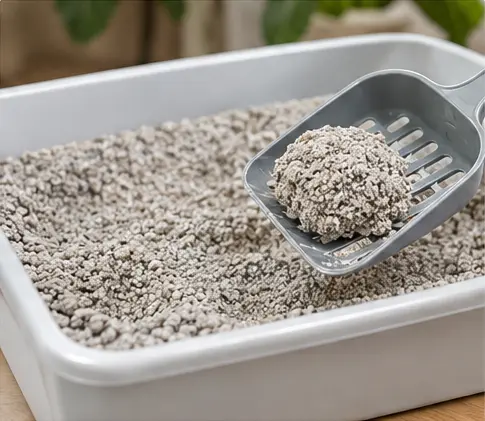
Both materials can generate fine particulate during manufacturing, packaging, transport, and handling, so dust performance should be specified using a defined test method and acceptance limit where appropriate. For clay-based products, any potential respirable crystalline silica concern should be assessed from the actual raw material and finished-product composition, together with applicable workplace-safety requirements in the destination market. Buyers should therefore define measurable fines or dust requirements and request relevant composition or safety documentation when required.
Which Should a Buyer Stock?
Choose bentonite when the target channel expects conventional clumping clay litter and easy clump removal. Evaluate silica gel when the target segment is built around crystal, non-clumping litter. If both segments have sufficient demand, carrying both can broaden the range, but buyers should compare target price, fill weight, packaging format, freight, dust specification, shelf space, and repeat-purchase potential at SKU level before adding a new product.
Conclusion
Bentonite vs mineral cat litter is best understood as a comparison between bentonite clay litter and silica-gel litter within the broader mineral-based cat litter category. Bentonite suits clumping programs, while silica-gel litter suits non-clumping crystal segments. Specify performance with defined test methods and SKU-level acceptance criteria, and choose based on your channel, packaging, and freight model rather than a universal “better” claim.
Frequently Asked Questions
Neither is universally better. In this comparison, bentonite is a clumping clay litter, while silica-gel litter is a non-clumping crystal format. The right choice depends on clumping requirements, finished-SKU specifications, freight economics, packaging, and the target market rather than a universal performance ranking.
Both are mineral-based cat litter materials, but they are different product families. Bentonite is a clay-based litter that uses sodium bentonite’s swelling behavior to form scoopable clumps; silica-gel (crystal) litter uses porous silica particles to adsorb and retain moisture without conventional clumping. “Mineral cat litter” is a broad category that can include both, so the specific formulation should always be checked rather than assumed from the material name.
Neither material is automatically cheaper to ship. Silica-gel products may have a different bulk density and fill-weight profile from bentonite, but actual freight depends on bag weight, package dimensions, palletization, container utilization, and transport mode. Compare landed cost using the finished SKU rather than material type alone.
Typically no. Silica-gel litter adsorbs and retains moisture within porous particles rather than forming a conventional scoopable clump. However, “mineral cat litter” is a broad category and can include other mineral-based materials, so the specific product formulation should always be checked.
Dust depends on grade and processing for both. Specify a measured fines limit with a stated method rather than assuming one material is always lower dust.
Private label is possible for both, but supply comes from different production lines. Silica-gel litter is outside many bentonite manufacturers’ own lines, so sourcing and QC must be scoped separately.
Both materials can generate fine particulate during manufacturing, packaging, and handling. Buyers should specify applicable dust or fines requirements using a defined method and acceptance limit, and review the raw-material and finished-product composition for any relevant workplace hazards. Safety should be evaluated from the actual SKU and manufacturing process rather than assumed from the material category alone.
Define each performance metric separately with its test procedure, sample preparation, measurement conditions, and SKU-level acceptance limit. For bentonite, specifications may cover clump formation and clump integrity; for silica gel, they may cover moisture adsorption or retention. Dust or fines should have their own defined method and acceptance threshold where required.