




“Is bentonite cat litter safe?” Bentonite clay is widely used as a material for clumping cat litter, and finished products should be properly specified, manufactured, labelled, and handled. The main practical considerations are dust generated during handling and accidental ingestion of clumping litter. For B2B buyers, the better approach is to define measurable product specifications and clear handling guidance rather than make an absolute “safe” claim. Buyers looking for product and sourcing information can also review our bentonite cat litter manufacturer and OEM guide.
Quick Answer: Bentonite cat litter is widely used, but “safe” should not be treated as an absolute product claim. Buyers should define a measurable fines specification and, where airborne dust performance is claimed, use an appropriate dust-test method and acceptance limit, address relevant material hazards through supplier documentation and workplace controls, and provide practical guidance for accidental ingestion. Pet-health concerns should be referred to a veterinarian rather than addressed through product-level medical claims.
Key Safety Considerations for Bentonite Cat Litter
For B2B buyers, “safe” is not a single test result. It is an assessment based on material composition, product dust characteristics, applicable hazard documentation, manufacturing controls, packaging, labelling, and normal-use guidance.
For B2B buyers, the main safety considerations are dust generated during handling, accidental ingestion of clumping litter, and the mineral composition of the supplied clay. These considerations should be addressed separately in product specifications, supplier documentation, and customer-facing guidance.
Dust: Specify a Measured Property
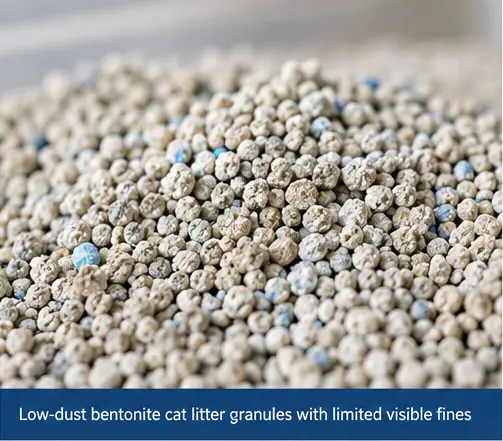
“Low dust” should not be treated as a standalone technical specification. Buyers should define the exact measurable property being controlled, such as fines below a stated particle-size threshold, and specify the test method, sampling procedure, acceptance limit, and batch-release requirement. If airborne dust performance is claimed separately, it should be supported by an appropriate dust-test method rather than inferred from particle-size screening alone. This distinction prevents a fines specification from being presented as proof of a particular airborne exposure level.
Lower-dust grades can reduce the amount of fine particulate released during filling, pouring, and scooping. Buyers can use a defined low-dust specification where reduced visible or airborne particulate is an important product requirement, while avoiding claims that the litter prevents, treats, or is specifically suitable for a medical condition.
| Consideration | Buyer action | Why it matters |
|---|---|---|
| Product fines | Specify particle-size threshold, test method, and acceptance limit | Controls the amount of fine material in the finished litter |
| Airborne dust | Use an appropriate dust-test method when making a dust-performance claim | Fines content and airborne dust are related but different measurements |
| Mineral composition | Review supplier material documentation and relevant test data | Determines whether specific material hazards require additional controls |
| Accidental ingestion | Provide practical product guidance and veterinarian referral advice | Avoids unsupported medical or toxicity claims |
Crystalline Silica and Mineral Composition
Crystalline silica should be evaluated according to the actual mineral composition of the supplied clay and the applicable workplace requirements. Buyers should use supplier material documentation and, where relevant, test data to determine whether respirable crystalline silica requires specific controls. This issue should be kept distinct from the general dust or fines specification: total fines indicate a physical product characteristic, while crystalline silica is a specific material hazard that requires separate assessment.
Accidental Ingestion and Product Guidance
Clumping bentonite litter forms a solid clump when exposed to liquid, which is the intended functional property of the product. If a cat or other pet accidentally ingests litter, the appropriate product guidance is to prevent access to litter outside normal use and advise the owner to contact a veterinarian if ingestion is suspected and the animal shows symptoms. A B2B buyer should communicate this practical guidance without claiming that bentonite litter is inherently toxic or making unsupported medical statements.
What Buyers Should Put on a Product Page
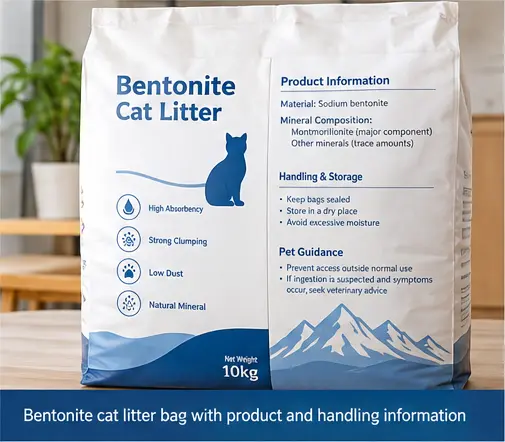
Rather than claiming “safe,” a defensible product page states what the product is, the dust grade, and practical handling guidance. For private label programs, this content is part of the specification. Buyers building a custom range can review our private label cat litter program for how guidance text is aligned with the final product specification and applicable market requirements.
- Material: specify the bentonite type and relevant mineral composition.
- Dust or fines specification: define the measured property, test method, sampling procedure, and acceptance limit.
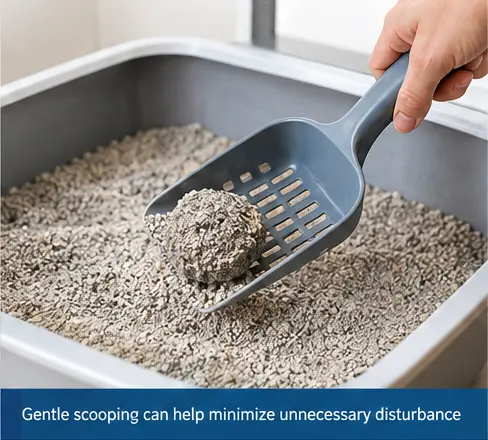
- Handling: provide practical instructions for filling, pouring, scooping, and storage according to the packaging format.
- Pet guidance: include practical advice for accidental ingestion and recommend veterinary advice for health concerns.
Common Misconceptions
One misconception is that “natural” means zero risk. Bentonite is a natural mineral, but natural does not remove the need for dust control and handling practice. Another is that a single “safe” label replaces a specification. For B2B supply, the measured dust or fines limit and clear guidance do more than a marketing word.
B2B Buyer Decision Framework
The following framework turns the safety discussion into a specification checklist:
| Buyer question | What to verify |
|---|---|
| How is low dust defined? | Defined fines or airborne-dust property, test method, sampling procedure, and acceptance limit |
| Does the product contain relevant mineral hazards? | Material composition, supplier documentation, and applicable testing |
| What happens if a cat ingests it? | Product-use guidance and veterinarian referral |
| Can the product be marketed as safe? | Evidence supporting the specific claim and applicable market requirements |
Conclusion
Is bentonite cat litter safe? It should not be described as universally “safe” or “unsafe.” Its suitability depends on the material composition, product dust characteristics, manufacturing controls, packaging, labelling, and normal use. For B2B buyers, the most defensible approach is to specify measurable dust or fines requirements, assess relevant material hazards separately, and provide clear handling and pet-use guidance without unsupported medical claims.
Frequently Asked Questions
Bentonite cat litter should not be described as universally “safe” or “unsafe.” For normal household use, buyers should focus on product composition, dust characteristics, clear handling instructions, and appropriate pet-use guidance. If ingestion is suspected and the animal shows symptoms, the owner should seek veterinary advice.
Define the exact measurable property, such as fines below a stated particle-size threshold, and state the test method, sampling procedure, acceptance limit, and batch-release requirement. If airborne dust performance is claimed, support it with an appropriate dust-test method rather than inferring it from screening alone.
No. “Low dust” does not mean zero airborne particulate. Buyers should define the specific property being controlled, such as a fines limit or an airborne-dust measurement, together with the applicable test method and acceptance limit. A fines specification should not be presented as proof of zero or near-zero airborne dust.
Crystalline silica should be assessed from the actual mineral composition of the supplied clay and the applicable workplace requirements, using supplier documentation and relevant test data where needed. It is a specific material hazard kept separate from the general fines or dust specification.
Bentonite clumps when exposed to liquid, which is its intended function. The product guidance should be to prevent access outside normal use and contact a veterinarian if ingestion is suspected and the animal shows symptoms. Avoid unsupported toxicity or medical claims about the product.
State the material and relevant mineral composition, the dust or fines specification with test method and acceptance limit, practical handling and storage instructions, and veterinarian referral advice for health concerns. Align this text with the final product specification and applicable market requirements.
Safety and health claims should not be made as broad, unsupported statements. Product pages should distinguish measurable product characteristics from medical or therapeutic claims and substantiate any specific safety-related claim with appropriate evidence and applicable market requirements.