

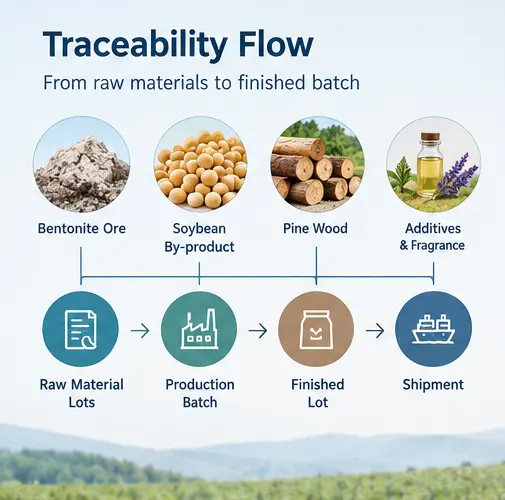
Cat litter raw material traceability is the ability to trace each production batch back to its inputs, whether that is bentonite ore, soybean or cassava by-products, or pine. As retailers and regulators ask for proof of origin, buyers need a practical method to request, check, and verify the documents a manufacturer supplies. This guide explains what to ask for, how to verify it, and the red flags that mean a claim is not yet backed by evidence.
Cat litter raw material traceability is the ability to trace each production batch back to its inputs, such as bentonite ore, soybean or cassava by-products, or pine. Buyers verify origin by requesting source declarations and batch-linked documents, then checking them against the actual lot. Good traceability supports retailer and regulatory requirements, including deforestation-related rules for wood and soy-based inputs, and shortens any future recall or claim.
Why Raw Material Traceability Matters Now
Retailer requirements, supply-chain due diligence, and changing import rules make raw material traceability increasingly important for cat litter buyers. A useful system connects each finished-product lot to its approved formula, raw-material batches, supplier declarations, and production records. For wood- or soy-derived inputs, buyers supplying the EU should assess whether the relevant product and transaction fall within the scope of the EU Deforestation Regulation (EUDR). Applicability depends on the product classification and applicable legal requirements, not simply on whether a formula contains wood or soy. Check the latest European Commission guidance and confirm your company’s obligations with a qualified trade adviser before relying on a supplier’s compliance statement. Clear batch records also help buyers investigate quality issues and respond to traceability requests.
What to Ask the Manufacturer
| Input | Document to request | What good evidence looks like |
|---|---|---|
| Bentonite | Mine or quarry source declaration, not just country of production | Named source region and a declaration linked to the lot |
| Soybean, pea, or cassava by-product | Origin country and supplier declaration, non-GMO statement if claimed | By-product stream identified and lot-linked |
| Pine or wood material | Timber legality and, where claimed, FSC or PEFC chain-of-custody | Chain-of-custody certificate with valid scope |
| Additives and fragrance | Supplier declaration for the additive | Named supplier and intended use |
The key is to request documents that name the source and link to the batch, rather than generic statements such as “sourced from China.” A country is not a mine, and a brand claim is not a certificate.
How to Verify, Not Just Collect
Collecting documents is only half the work. Verification means checking that the paperwork describes the lot you actually received.

Build one traceability packet per finished lot
Use the finished-goods lot number as the file name and include the formula revision, raw-material lot references, source declarations, supplier names, receiving dates, production date, packaging record, and any certificate scope check. Pet Horizon can assemble this packet for the materials and claims agreed in the purchase order; buyers should define the required evidence before production, not after a retailer asks for it.
Match documents to the actual batch
Ask for lot or production-date linkage on every declaration so the certificate in your file corresponds to the container on your dock. Without that link, a valid document may still say nothing about your goods.
Run a three-way batch check
Cross-check the source declaration, production records, and finished-goods or shipment records. The source declaration should identify the claimed origin and relevant supplier or raw-material reference. Production records should show which raw-material lots were used, while finished-goods and shipment records should connect the resulting batch to the goods delivered. If the references do not align, ask the manufacturer to explain the discrepancy before approving the shipment. Matching records support batch traceability, but they do not independently prove geographic origin; additional supplier verification or independent checks may be needed for higher-risk claims.
Use independent or third-party verification
For high-value or regulated inputs, a third-party audit or laboratory check adds weight. The exact auditor is a commercial choice; what matters is that the verification is independent of the supplier’s own statement.
Watch for red flags
- Origin given only as a country, with no named source or lot link.
- Documents that cannot be tied to a specific production batch.
- Certificates whose scope does not cover the material in your formula.
- Inconsistent supplier names across declarations and invoices.

Chain of Custody Versus Origin Claim
Chain-of-custody certification and raw material origin declarations serve different purposes. An origin declaration identifies the source claimed by a supplier, while a chain-of-custody system documents the handling of eligible material through the certified supply chain under the applicable scheme. For wood-based cat litter, buyers requiring FSC or PEFC evidence should check the certificate holder, validity, product scope, and relevant transaction records. Neither certification should be treated as proof of the finished litter’s dust level, clumping performance, safety, or overall regulatory compliance. If certified material is a purchase requirement, confirm that the specific material and supply chain can support the claim.
Key Takeaway: Traceability is only as strong as the batch link. A certificate that cannot be tied to your specific lot is a decoration, not evidence. Ask for named sources, lot linkage, and independent checks, and treat vague origin statements as a gap to close before the order.
What Traceability Can—and Cannot—Prove
Traceability proves linkage: that a finished lot connects to the declared origin and the documents supplied for it. It does not by itself prove product safety, dust performance, or clumping quality, and it does not replace your own product specification or testing. A clean chain of custody tells you where the material came from; it does not tell you the litter will perform in your boxes. Keep traceability as one part of due diligence, alongside performance testing and a written acceptance standard.
Tracing by Litter Type
Bentonite litter starts at a quarry, so the traceability question is which mine or region supplied the ore. Plant-based litters built on soybean, pea, or cassava by-products need the by-product stream and its origin identified. Pine and wood litters raise timber-legality questions, and the wood supply chain is covered in more detail in the EUDR cat litter wood supply chain guide. Each material needs its own evidence set, so build the checklist per formula rather than once.
For OEM and private label orders, traceability requirements should be agreed before production begins. Depending on the approved formula, available supplier documentation, and destination-market requirements, Pet Horizon can work with buyers to define the relevant source declarations, raw-material lot references, production records, and finished-goods batch information required for review. These records support supplier due diligence but should not be presented as a blanket certification of origin or regulatory compliance. Buyers should confirm the required evidence and any independent verification in writing before production.
Conclusion
A bentonite cat litter sourcing program earns retailer and regulatory trust when origin is documented at the batch level. Request named sources, link every declaration to the lot, and confirm the evidence with an independent check where it matters. Pair that with the cat litter manufacturing overview so the traceability story and the production story agree.
Frequently Asked Questions
It is batch-level linkage between a finished cat litter lot and the declared origin of its inputs, such as bentonite ore, plant-based by-products, or pine. It is a due-diligence method, not a performance claim.
A named source declaration for each input, a country of origin where relevant, supplier declarations for additives, and any chain-of-custody certificate, all linked to the specific production lot.
No. FSC and PEFC are chain-of-custody systems for wood fiber. They track responsible sourcing but are not a safety, dust, or performance certificate for the finished litter, so confirm the certificate scope covers your wood input.
Match each document to the actual batch, use an independent or third-party check for regulated inputs, and watch for red flags such as vague origin, missing lot links, or inconsistent supplier names.
Not automatically. EUDR applies to specified commodities and derived products within the regulation’s scope. Whether a particular cat litter product or transaction is covered depends on the relevant product classification and the parties’ legal roles. Buyers sourcing wood- or soy-derived materials for the EU market should check the latest European Commission guidance and obtain advice on their specific product rather than relying on a generic supplier declaration.
Bentonite is quarried, so ask for a mine or region declaration linked to the lot rather than a bare country of production. A country is not a mine, and the link to your batch is what gives the statement meaning.