




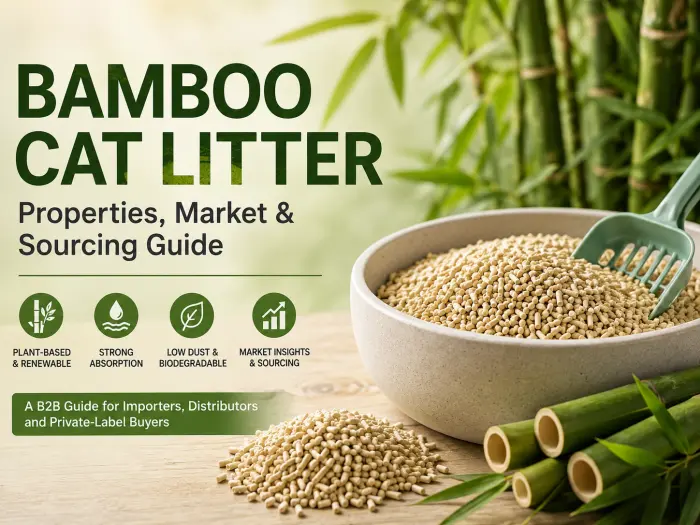
Bamboo cat litter is a plant-based litter made from bamboo fibre, sawdust or processing residues. It is increasingly considered as an alternative to clay and other plant-based substrates, particularly where buyers prioritize renewability, low dust and a differentiated natural-material story. For importers, distributors and private-label buyers, the key questions are how bamboo litter is made, what its performance claims actually mean, how large the market is, and whether the supply base is reliable enough for repeat orders.
This guide examines bamboo cat litter from a manufacturing and sourcing perspective, including its raw materials, production process, reported properties, market data, sustainability claims and direct comparison with tofu cat litter.
Quick Answer: Is Bamboo Cat Litter Good for Cats?
Bamboo cat litter can be a good plant-based option for cats when the finished formulation is low-dust, free of problematic additives and tested for its intended use.
Bamboo cat litter is made from bamboo fibre, sawdust or processing residues and is commonly sold as pellets, granules or clumping blends. It is generally positioned around renewability, low dust and biodegradability, but clumping strength, odour control and safety depend on the finished formula rather than bamboo alone. For buyers, the key checks are binder, additives, dust performance and lot consistency.
Key takeaway: bamboo is a credible plant-based substrate, but it is better treated as a formulation category than as a single standardized litter type.
What Bamboo Cat Litter Is and How It Is Made
Bamboo is a fast-growing grass, not a hardwood. Litter-grade bamboo is almost never grown for litter; it arrives as a residue stream from industries that already process the culm for higher-value products. That single fact explains both the material’s environmental positioning and its supply behaviour.
Raw Material Streams
- Processing residues. Offcuts, trimmings and shavings from bamboo flooring, board, furniture and utensil manufacturing.
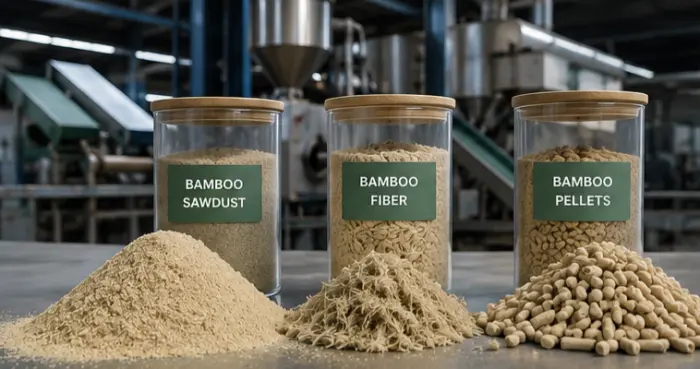
- Bamboo sawdust. The fine fraction generated during sawing and sanding, which is the most common litter feedstock because it is already reduced in size.
- Bamboo fibre. Coarser lignocellulosic fibre recovered from culm processing, used where a firmer pellet is required.
- Bamboo charcoal. Carbonised bamboo added in small proportions and marketed as an odour-adsorption component rather than as the base substrate.
Typical Production Sequence
- Incoming residue is cleaned and screened to remove bark, grit and oversize fragments.
- Material is milled and classified to a target particle size distribution.
- Moisture is reduced by drying to a level that supports absorbency and storage stability.
- For non-clumping grades the material is pelletised or compressed directly; for clumping grades a plant-derived binder is blended in before extrusion or granulation.
- The finished granule is dried again, dedusted, screened and packed.
The clumping mechanism therefore sits in the same family as tofu litter: an absorbent plant substrate plus a starch or gum binder that forms a liftable mass on contact with liquid. Non-clumping bamboo pellets work in the opposite way, absorbing and then disintegrating into sawdust, which suits sifting trays but not the scoopable format most Western retail buyers specify.
Why Formulation Disclosure Matters
A significant share of products marketed as bamboo litter are blends. Bamboo charcoal may be added at a low percentage to a tofu, paper or wood base, and the pack will still carry bamboo as the lead descriptor. Before a buyer commits to a listing, the specification should state the bamboo content as a percentage of the formula, identify the binder, and confirm whether the remaining substrate is starch, wood fibre or recycled paper. Without that, two shipments described identically can behave differently in the tray and in a consumer complaint file.
Reported Properties: Separating Evidence From Claim
In short: bamboo cat litter can offer good absorption and low dust, but clumping strength, odour control and antibacterial performance depend on the finished formulation and should be verified by test method and lot-level documentation.
Most performance statements circulating in this sub-category originate from supplier literature and market reports rather than from independent laboratory programmes. They are useful as directional guidance and unusable as packaging copy without documentation.
Absorption and Clumping
Bamboo’s porous lignocellulosic structure gives it genuine liquid uptake, which is why the material was used as animal bedding long before it was granulated for cats. Clump integrity, however, is a formulation outcome rather than a property of bamboo itself. Buyers evaluating a clumping bamboo grade should run drop and crumble tests on retained samples from the actual production lot, because binder loading and particle size distribution vary considerably between mills.
Odour Control and the Antibacterial Attribution
Market reports and supplier documentation commonly attribute natural antibacterial or bacteriostatic behaviour to bamboo, and bamboo charcoal is widely described as an odour adsorbent. Both statements should be handled as source-attributed claims. Neither is a Pet Horizon technology and neither should be reproduced on a retail pack without a third-party antibacterial or odour-reduction test report covering the finished product, not the raw material. Regulators in several destination markets treat unsupported functional claims the same way they treat unsupported environmental ones.
Dust, Tracking and Freight Weight
Post-dedusting bamboo grades are commonly reported as low dust, which is consistent with the behaviour of other lignocellulosic substrates. As with hemp or pine, there is no single global dust standard cited in this category, so a supplier who can state the measurement method is in a stronger position than one who only repeats a percentage. Low bulk density is the more reliable commercial advantage: plant-based litters are considerably lighter than clay per litre, so containers tend to cube out before they weigh out and landed cost per litre is driven by volume rather than tonnage.
Important note: absorption, dust and antibacterial figures for bamboo litter are supplier-claimed or source-attributed. Documentation should be requested per lot before any of it reaches packaging.
Bamboo Cat Litter Market Data: Three Sources, Three Base Years
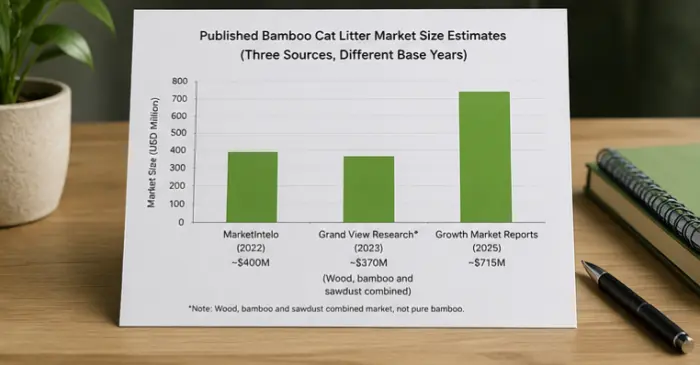
Public data on bamboo litter is fragmented, and the three most cited estimates disagree substantially. They use different base years, different scope definitions and different forecast horizons, so the honest approach is to present a range rather than a single headline number.
The most detailed bamboo-specific dataset comes from MarketIntelo, which uses a 2025 base year. A second bamboo-specific estimate from Growth Market Reports uses a 2024 base year and a materially higher growth rate. The third widely quoted figure, published by Grand View Research, is not a pure bamboo figure at all: it covers wood, bamboo and sawdust raw materials combined, on a 2022 base year.
| Source and base year | Scope covered | Base-year value | Forecast value | Stated CAGR |
|---|---|---|---|---|
| MarketIntelo, base 2025 | Bamboo cat litter only | US$400 million (2025) | US$800 million (2034) | 7.8 percent |
| Growth Market Reports, base 2024 | Bamboo cat litter only | US$245 million (2024) | US$715 million (2033) | 12.7 percent |
| Grand View Research, base 2022 | Wood, bamboo and sawdust combined | US$471 million (2022) | US$885.5 million (2030) | 8.2 percent |
How to Read the Spread
- Size. Bamboo-specific estimates for the mid-2020s sit in a range of roughly US$245 million to US$400 million, depending on source and base year. The gap is too wide to treat either figure as settled.
- Growth. Reported CAGRs for bamboo-specific data range from about 7.8 percent to 12.7 percent. The combined wood, bamboo and sawdust series sits between them at 8.2 percent.
- Scope discipline. The Grand View series must not be quoted as a pure bamboo market. Wood and sawdust litter volumes are far larger than bamboo, so using that number as a bamboo figure overstates the sub-category considerably.
- Direction. The cited estimates all point to continued growth in bamboo-related cat litter, although their different scopes and methodologies mean the growth rates should not be treated as directly comparable with one another or with the overall cat litter market.
Regional Demand Split, Approximate and Single-Source
The regional breakdown below comes from a single source on a 2025 base year and should be read as approximate rather than as a reconciled market consensus.
- Asia Pacific: approximately US$142 million, about 35.4 percent of the total.
- North America: approximately US$105 million, about 26.3 percent.
- Europe: approximately US$89 million, about 22.3 percent.
- Urban household penetration: reported at 14 to 16 percent in North America, and 12 to 13 percent in the Nordic countries and Germany.
For a European or North American buyer the practical reading is that bamboo has established a real premium niche in exactly the markets where environmental claims carry pricing power, while the bulk of production capacity sits elsewhere.
Bamboo Cat Litter vs Tofu Cat Litter
For most buyers the real decision is not bamboo against clay, but bamboo against the plant-based substrate that already dominates OEM production volume. The comparison below is written from a sourcing perspective rather than a consumer one.
| Criterion | Bamboo litter | Tofu litter | Buyer note |
|---|---|---|---|
| Base raw material | Bamboo sawdust, fibre or charcoal from processing residues | Pea and soybean fibre with plant starch, largely from food-processing residues | Both are renewable by-product streams |
| Standard format | Non-clumping pellets, granules, or clumping blends with added binder | Extruded clumping granules as the default format | Most Western retail listings assume clumping |
| Clumping performance | Formulation dependent; many grades absorb and disintegrate | Tight liftable clumps are the core product property | Tofu is the lower-risk specification when the pack claims clumping |
| Odour control | Sources attribute natural bacteriostatic and adsorption properties; evidence required | Rapid liquid capture, with optional scented or unscented systems | Request finished-product test reports in both cases |
| Dust | Reported low after dedusting | Reported low after dedusting | Verify by method, not by marketing percentage |
| Weight and freight | Light relative to clay; volume-driven container economics | Light relative to clay; volume-driven container economics | Both improve landed cost per litre against mineral litter |
| Flushability positioning | Marketed as flushable by some brands | Marketed as flushable by some brands | Governed by destination wastewater rules, never by material alone |
| Supply base | Concentrated in a small number of Asian processing regions | Broad, mature manufacturing base with multiple qualified plants | Dual sourcing is materially easier for tofu |
| OEM and private-label readiness | Fewer OEM partners, narrower specification flexibility | Established OEM and ODM programmes with wide packaging options | Directly affects time to shelf |
| Pet Horizon plant-based program | Enquire about substrate coverage | Produced under OEM, ODM and private label | Pine and mixed formulations are also produced |
Bottom line: choose bamboo when raw-material differentiation and a premium sustainability story matter most; choose tofu when clumping performance, repeatability and supply depth are the priority.
The pattern is consistent. Bamboo competes on raw-material narrative; tofu competes on delivered performance and supply reliability. Where a programme needs a scalable clumping plant-based line that can absorb promotional demand without a supply scare, tofu cat litter remains the substrate that carries the volume, with bamboo positioned as a premium halo listing if the marketing case justifies it.
What This Means in a Line Review
A buyer presenting bamboo to a category team should expect three questions: can the supplier hold specification across repeat orders, can the environmental claims be evidenced, and what happens to the listing if the mill reallocates capacity. A mixed assortment answers all three, using a plant-based volume line as the commercial base and bamboo as a deliberate niche SKU rather than the platform.
Biodegradable Cat Litter Types and Where Bamboo Fits
Bamboo belongs to a broader family of plant-based substrates that share a biodegradability story but differ sharply in performance and supply depth. Bamboo belongs to the plant-based biodegradable cat litter category, alongside tofu, pine, paper, corn and wheat. The main difference is not the biodegradable label but the substrate, clumping mechanism, dust profile and supply base.
- Tofu. Pea and soybean fibre with starch binder; the volume leader in plant-based clumping litter.
- Pine and other wood. Softwood fibre in pellet or clumping form, with a distinctive natural scent profile.
- Bamboo. Grass-derived sawdust, fibre or charcoal, usually a processing residue.
- Paper. Recycled cellulose, valued for softness and low dust in post-surgical use.
- Corn and wheat. Starch-rich agricultural substrates with clumping capability and crop-linked price exposure.
Positioning within this family matters more than the biodegradable label itself, because buyers and regulators increasingly ask which substrate performs which job. A structured overview of the substrate landscape and the trade-offs between them is set out in our guide to the types of cat litter.
Sustainability and Compostability Claims Need Documentation
Bamboo’s environmental narrative is the main reason the sub-category grows faster than the market average, and it is also the main compliance exposure. European rules on consumer-facing environmental claims, including the Empowering Consumers Directive and the proposed Green Claims framework, require that environmental statements be substantiated, specific and verifiable. Generic wording is precisely what is being targeted.
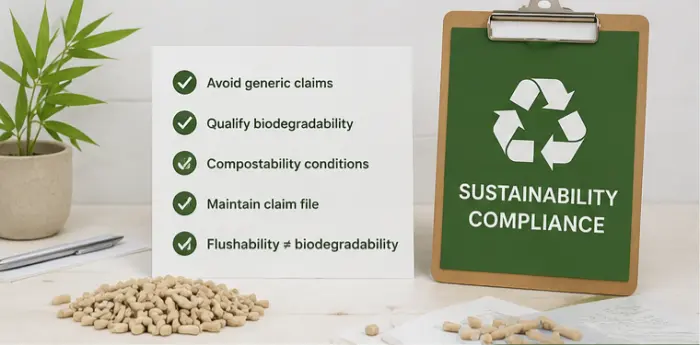
- Avoid unqualified generic claims. Terms such as eco-friendly, green or climate-neutral used without supporting evidence are the clearest regulatory risk.
- Qualify biodegradability. A biodegradable claim should state the conditions, the timeframe and whether it applies to the finished product or only to the raw material.
- Treat compostability as a certified outcome. Home and industrial composting are different disposal routes with different evidence requirements, and a claim on pack needs a test report covering the product as sold.
- Keep the claim file with the SKU. Where a private-label buyer owns the brand, the buyer usually owns the substantiation obligation, not the factory.
- Do not infer flushability from biodegradability. They are unrelated, and several jurisdictions restrict the disposal of cat waste through wastewater systems.
Key takeaway: the sustainability story sells the product, but the documentation is what keeps the listing on shelf. Both should be built at the specification stage, not after the first market challenge.
Supply Concentration and the OEM Implication
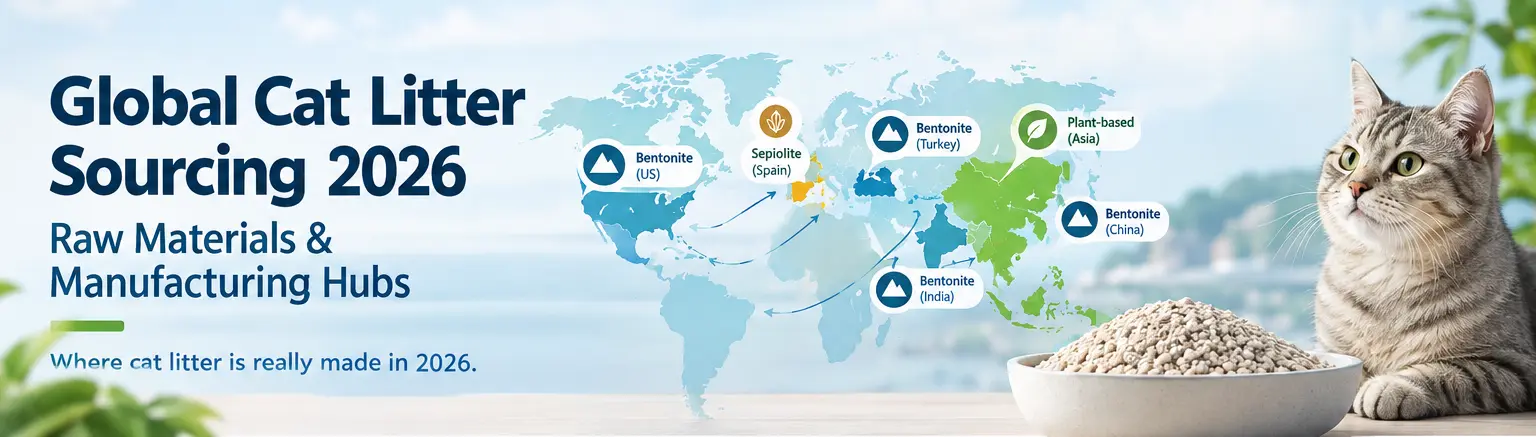
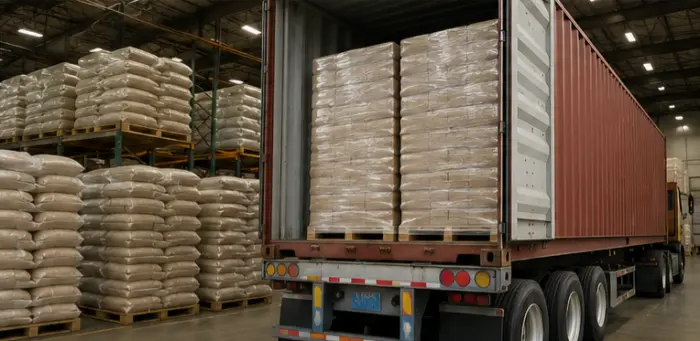
Bamboo litter processing is geographically concentrated. Capacity across the main Asia Pacific producing countries, principally China, Vietnam and Indonesia, was reported at roughly 145,000 tonnes as of mid-2025, equivalent to approximately 68 percent of global supply. That figure comes from a single source on a 2025 base year and should be treated as an approximation, but the direction is not seriously disputed. For wholesale and distribution buyers, that concentration is the most important structural fact in the sub-category.
Sourcing Consequences
- Fewer qualified partners. A narrow mill base lengthens supplier qualification and reduces the number of realistic dual-sourcing options.
- Feedstock competition. Litter competes for bamboo residue with board, flooring, charcoal and horticultural users, so litter-grade availability is not fully within any mill’s control.
- Price exposure. Concentrated supply transmits upstream cost movements quickly and gives buyers limited leverage during tight periods.
- Specification drift. Where capacity is scarce, blends change quietly. Locking bamboo content, binder identity and particle size in the specification protects the listing.
- Programme design. The workable structure is a small bamboo listing supported by a plant-based volume line that can absorb promotional peaks.
Buyers who want a woody, natural-fibre profile with a broader and more mature supply base frequently qualify pine cat litter alongside or instead of bamboo, since it delivers a comparable plant-based positioning without the single-substrate concentration risk.
Pet Horizon’s Plant-Based OEM Program
Our plant-based OEM and ODM program covers tofu, pine and mixed clumping litter. These formats address the same plant-based, low-dust and biodegradable brief that brings many buyers to bamboo, while offering established production and export support.
OEM and Private-Label Scope
- Company background. More than 20 years in the cat litter industry, more than 10 years of OEM and ODM production since establishing our own factory, and exports to more than 80 countries.
- Location and logistics. The plant is located near Dalian port, which shortens inland haulage and simplifies container scheduling for European, North American and Asian destinations.
- Order structure. MOQ is one 20ft container, negotiable for trial and market-test programmes.
- Customisation. Formulation, particle size, scented and unscented variants, packaging formats and full private-label artwork.
- Where to meet us. We exhibit at CIPS, which is a practical setting for sample review and specification discussion before a first order.
Where a buyer’s brief centres on bamboo, we discuss how it compares with our tofu, pine and mixed programs and supply the comparative data needed to defend the substrate choice. When the underlying requirement is a credible plant-based litter with documented dust control, consistent clumping and reliable container supply, those substrates usually meet it.
Conclusion
Bamboo cat litter is a legitimate plant-based substrate with a coherent technical story: a porous grass-derived material, low dust after dedusting, light weight in freight, and an environmental narrative that resonates in premium Western retail. Published estimates place the bamboo-specific market somewhere between roughly US$245 million and US$400 million in the mid-2020s, growing at between about 7.8 percent and 12.7 percent depending on the source, with all series agreeing that it outpaces the overall cat litter market.
The constraints are equally clear. Performance and antibacterial properties are source-attributed rather than independently verified, environmental claims now require finished-product evidence in major destination markets, and roughly two-thirds of processing capacity sits in a small group of Asian countries. For buyers, that combination argues for bamboo as a deliberate premium listing rather than a volume platform, with a scalable plant-based clumping litter such as tofu carrying the core of the assortment.
Frequently Asked Questions
Bamboo cat litter can be a safe option for cats when the finished formulation is low-dust and free from problematic additives. Safety depends on the complete product rather than bamboo alone, so buyers should confirm the binder, fragrance or other additives and relevant finished-product test results before listing.
It is better on renewability, weight and dust, and generally weaker on clump strength and price stability. Clay remains cheaper per litre in most markets and delivers predictable clumping. Bamboo wins where the retail proposition is environmental and the shopper accepts a premium; clay wins where cost per use governs.
Bamboo litter uses sawdust, fibre or charcoal from bamboo processing residues, while tofu litter uses pea and soybean fibre with a starch binder. Tofu is clumping by default and has a far broader OEM supply base; bamboo clumping performance depends entirely on formulation. For volume programmes tofu is the lower-risk specification.
Bamboo is a lignocellulosic material that will biodegrade, and suppliers describe finished litter accordingly. That is a material-level statement. A biodegradable or compostable claim on retail packaging in the European Union or United Kingdom requires qualified wording, stated conditions and finished-product evidence retained by the brand owner.
Not as a general rule. Some brands position bamboo litter as flushable, but biodegradability does not imply flushability. Local wastewater regulations, plumbing capacity and veterinary guidance on parasite transmission all apply, and several jurisdictions restrict flushing cat waste outright. Confirm against destination-market rules before printing any flush claim.
It is commonly reported as low dust, which is consistent with other plant-based substrates that are dedusted before packing. There is no single global dust standard cited in this category, so a percentage on a datasheet means little without the test method. Request the method and a particulate report per production lot.
Production is concentrated in Asia Pacific, principally China, Vietnam and Indonesia. Capacity across those countries was reported at approximately 145,000 tonnes as of mid-2025, around 68 percent of global supply on a single-source estimate. Buyers outside the region should plan qualification lead times and freight scheduling accordingly.
Pet Horizon currently manufactures plant-based clumping litter in tofu, pine and mixed formats on an OEM, ODM and private-label basis. For a bamboo-specific programme, buyers can discuss substrate coverage with our team and compare bamboo with the plant-based formats already covered by our production programme.