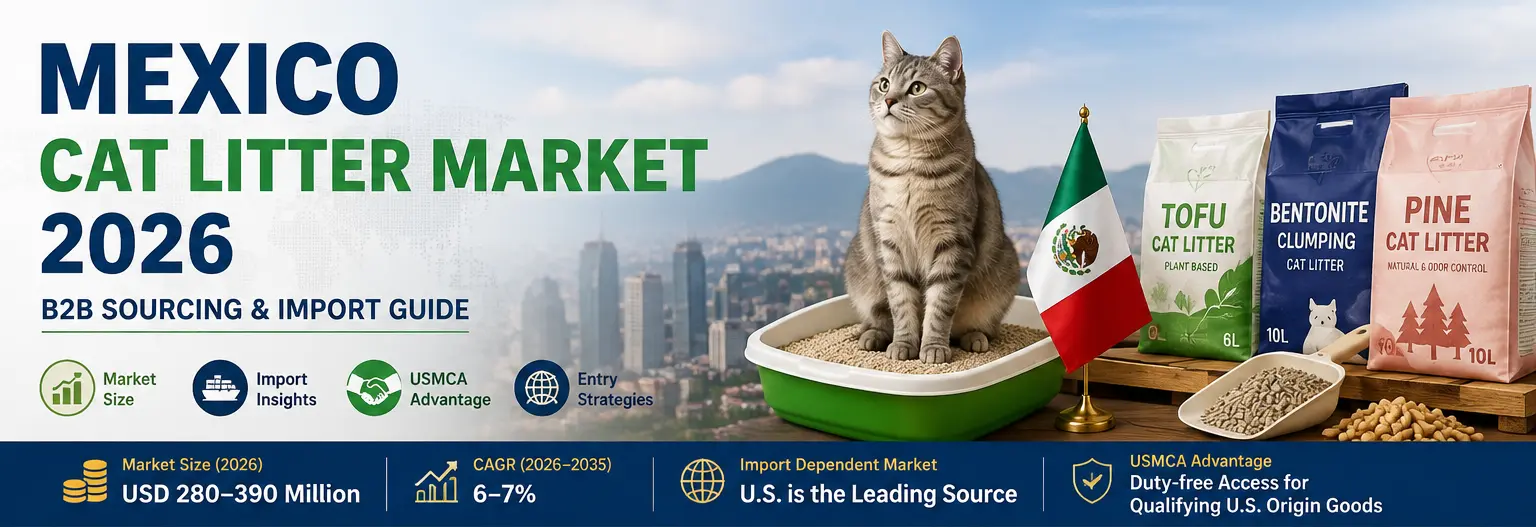



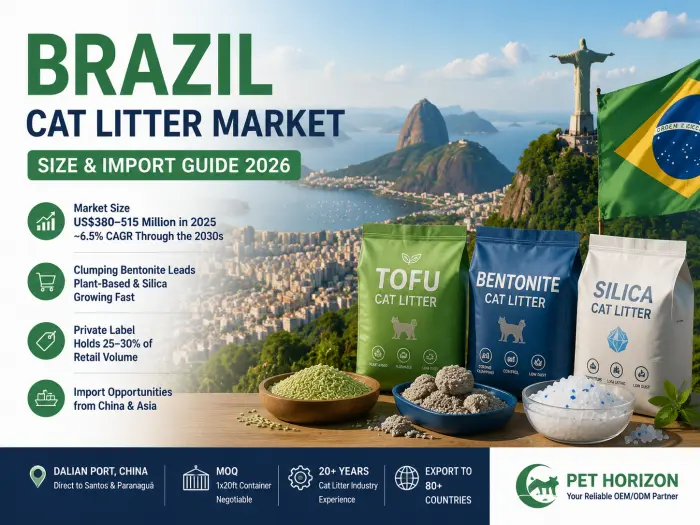
Brazil is the largest pet cat market in Latin America and one of the fastest-growing cat litter regions in the world. For importers, brand owners, and private-label buyers, the country offers a rare combination of scale, rising per-cat consumption, and a still-fragmented supply base that leaves room for new OEM and ODM partners.
Quick Answer: Is the Brazil Cat Litter Market Worth Entering?
Yes. Available industry estimates place Brazil’s cat litter market at approximately US$380–515 million in 2025, depending on research methodology, with forecasts indicating steady growth through the 2030s — faster than the global average. Clumping bentonite dominates volume, but plant-based and silica segments are expanding quickly, and private label already holds an estimated 25–30% of retail volume.
For a manufacturer, that means a large, growing, and still contestable import opportunity. For overseas suppliers and private-label brands, Brazil represents an attractive sourcing opportunity due to growing demand for clumping, plant-based, and premium cat litter formats.

Brazil Cat Litter Market Size and Growth
Published estimates vary by methodology, so the safest planning range is an approximate US$380–515 million market in 2025, expanding toward US$670–845 million by the early-to-mid 2030s. Three independent research houses frame the opportunity:
- Grand View Research sizes Brazil at US$515.4 million in 2025, reaching US$844.6 million by 2033 at a 6.4% CAGR; Brazil accounted for about 3.0% of the global cat litter products market in 2025.
- MarkWide Research reports US$385.4 million in 2026, growing to US$696.7 million by 2035 at a 6.8% CAGR.
- Deep Market Insights estimates US$377.1 million in 2025, rising to US$668.5 million by 2034 at a 6.56% CAGR.
Treat the spread as a planning buffer rather than a contradiction: all three agree on the direction (steady, above-global growth) and on clumping litter being both the largest and fastest-growing format.
Why the Brazilian Market Keeps Expanding
Several structural drivers support multi-year demand:
- Cat population scale. Brazil has the second-largest pet cat population in the Americas after the United States, with cat ownership projected to grow roughly 2.5–3.5% per year through 2035.
- Urbanization and apartment living. Dense city housing raises the value of odor control, low tracking, and easy scooping — all clumping-litter benefits.
- Pet humanization. Brazilian owners increasingly treat cats as family members, upgrading from basic clay to premium, low-dust, and scented formats.
- E-commerce acceleration. Subscription and auto-replenishment models are disintermediating supermarket bulk buying in São Paulo, Rio de Janeiro, and Brasília.
Product Mix: What Brazilian Buyers Actually Purchase
The category is still clay-led, but the edges are moving:
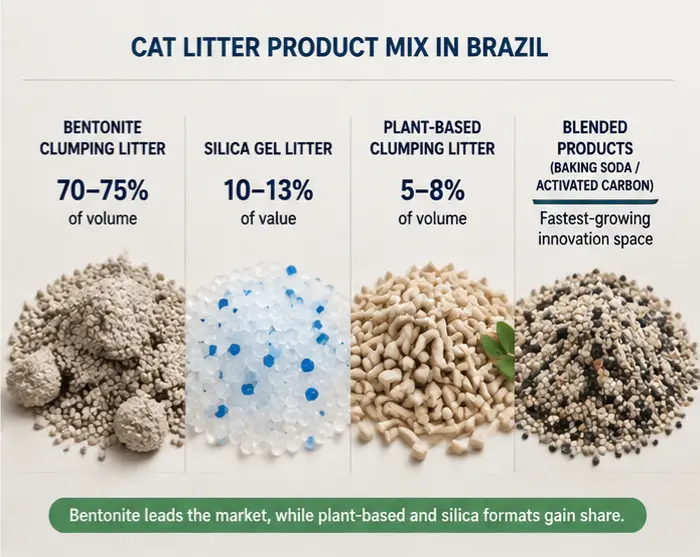
- Bentonite clumping litter dominates at an estimated 70–75% of volume, favored for strong clumping and low price.
- Silica gel (crystal) litter holds about 10–13% by value and grows at 12–16% annually on low-dust, long-lasting performance.
- Plant-based clumping litters (corn, wheat, pine, walnut) are small at 5–8% of volume but expanding fast from a low base among eco-conscious buyers.
- Blended products (bentonite with baking soda or activated carbon) are the fastest-growing innovation space within the clay segment.
For new entrants, the largest opportunity is not replacing low-cost bentonite volume, but introducing differentiated products: low-dust bentonite, odor-control blends, and sustainable plant-based litters positioned for premium urban consumers.
Private Label and Retail Dynamics
Unlike many CPG categories where private label trails branded goods, private-label clumping litter already holds an estimated 25–30% of Brazilian retail volume. This reflects the commodity-like nature of the core product and the price sensitivity of a large buyer segment. For an OEM/ODM manufacturer, that is a direct opening: Brazilian retailers and e-commerce brands need reliable, cost-competitive supply — exactly what an experienced plant-based and bentonite producer can provide.
International brands are also intensifying competition. Certain brands have been expanding their operations in Latin America (including Brazil), indicating that global companies view this market as a strategic priority. That raises the bar on quality and consistency — but it also validates long-term demand and creates white-space for differentiated private-label and imported premium SKUs.
Importing Cat Litter to Brazil: Sourcing From China and Asia
Brazil produces bentonite domestically, yet premium silica, plant-based, and differentiated clumping formats still rely partly on imports. For Asian manufacturers, the logistics are workable:
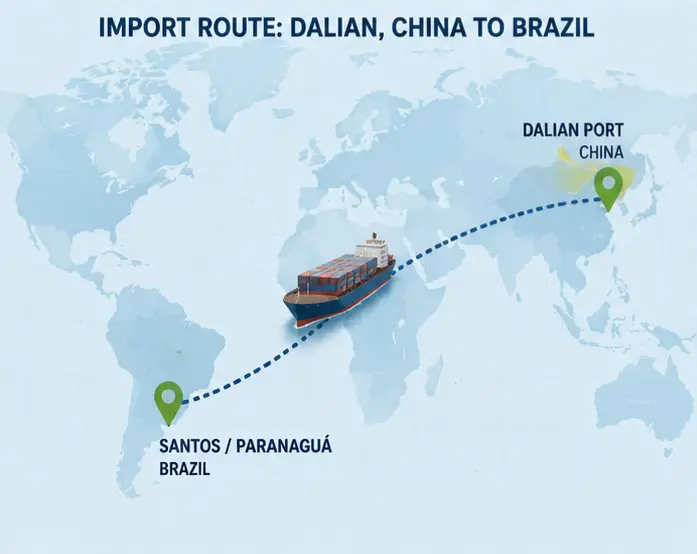
- Route: A mill in Dalian (northern China) ships through Dalian Port to major Brazilian gateways such as Santos and Paranaguá — a mature container lane.
- MOQ: Typical OEM orders move in 1×20ft container loads, negotiable, which keeps entry volume manageable for a first private-label program.
- Cost levers: Bulk containers and bag formats compress per-kilogram logistics in Brazil’s fragmented distribution geography.
Where Pet Horizon Fits as an OEM/ODM Partner
Pet Horizon is a cat litter manufacturer and OEM/ODM supplier based in Dalian, China, within reach of Dalian Port — a practical advantage for Brazilian importers. Our credentials:
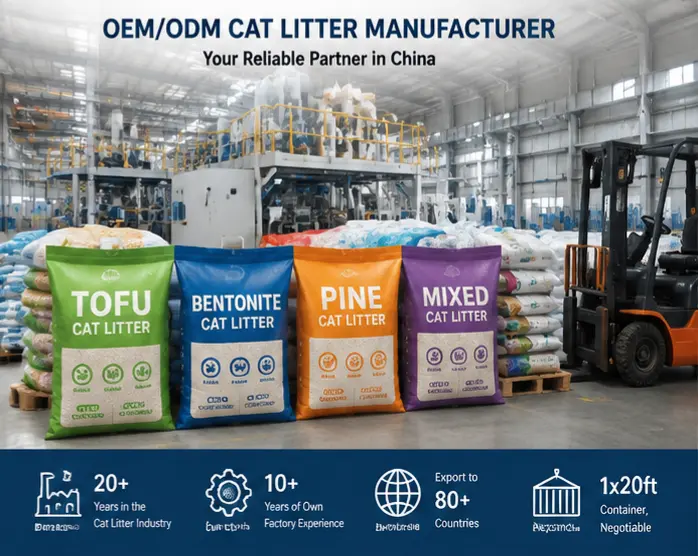
- 20+ years in the cat litter industry, with 10+ years operating our own OEM/ODM factory.
- Export experience across 80+ country markets.
- Real production across tofu (plant-based), bentonite, pine, and mixed litter formats — covering the exact segments growing in Brazil.
- OEM programs built around private label, custom clumping profiles, low-dust formulas, and flexible MOQs.
For a Brazilian brand or retailer evaluating a supplier, the combination of a plant-based and bentonite production base plus a Dalian Port shipping position shortens lead times and lowers landed cost versus purely domestic or distant-source supply.
Conclusion
Brazil is a large, above-global-growth cat litter market with a clay-led but rapidly diversifying mix and an unusually strong private-label base. For importers and brand owners, the window is open: pair a reliable OEM/ODM partner with a Dalian Port shipping position, and the landed-cost and lead-time math works. Explore our Germany cat litter market analysis for a comparison of European demand, or our tofu cat litter page for the plant-based formats gaining share in Brazil.
Frequently Asked Questions
Brazil’s cat litter market was approximately US$380–515 million in 2025 and is forecast to reach roughly US$670–845 million by the mid-2030s, at a 6.4–6.8% CAGR depending on the research source.
Clumping litter is both the largest and fastest-growing format. Within it, silica gel and plant-based clumping litters are expanding quickest, while blended bentonite (with odor additives) is the fastest-moving innovation space.
Bentonite clay clumping litter leads with an estimated 70–75% of volume. Silica gel holds about 10–13% by value, and plant-based litters (corn, wheat, pine, walnut) are 5–8% but rising fast.
Yes. Private-label clumping litter already accounts for an estimated 25–30% of Brazilian retail volume — unusually high for a pet category — making the market attractive for OEM and ODM supply.
Yes. Premium silica, plant-based, and differentiated clumping formats are partly import-sourced. A Dalian-based supplier can ship via Dalian Port to Santos or Paranaguá on an established container lane.
OEM orders typically start at 1×20ft container loads, negotiable, which lets a Brazilian brand launch a private-label program without committing to very large volume.
Verify production formats (bentonite, plant-based, mixed), dust and clumping performance, private-label and packaging capability, MOQ flexibility, and shipping position relative to Brazilian ports. See our cat litter export compliance guide for documentation basics.
The strongest opportunities in Brazil are not only in replacing low-cost bentonite volume, but in supplying differentiated products that meet changing consumer expectations. Premium low-dust bentonite, odor-control clumping blends, silica gel litter, and plant-based tofu cat litter are gaining attention among urban cat owners who value convenience, cleanliness, and sustainability.
For private-label brands and retailers, products with clear selling points — such as stronger clumping, lower dust, natural ingredients, and customized packaging — offer better opportunities than competing only on price.
Import transit time depends on the departure port, shipping schedule, destination port, customs clearance process, and local logistics arrangements. Buyers should evaluate the supplier’s export experience, container planning capability, and documentation support before placing an order.
For Brazilian importers, working with a supplier familiar with international cat litter shipments can help reduce delays, improve container utilization, and simplify the sourcing process from China.
Market figures cited from Grand View Research (Brazil cat litter products outlook, 2025–2033), MarkWide Research (Brazil cat litter market, 2026–2036), and IndexBox (Brazil clumping cat litter set analysis). Estimates vary by methodology; treat ranges as planning assumptions, not guarantees.