




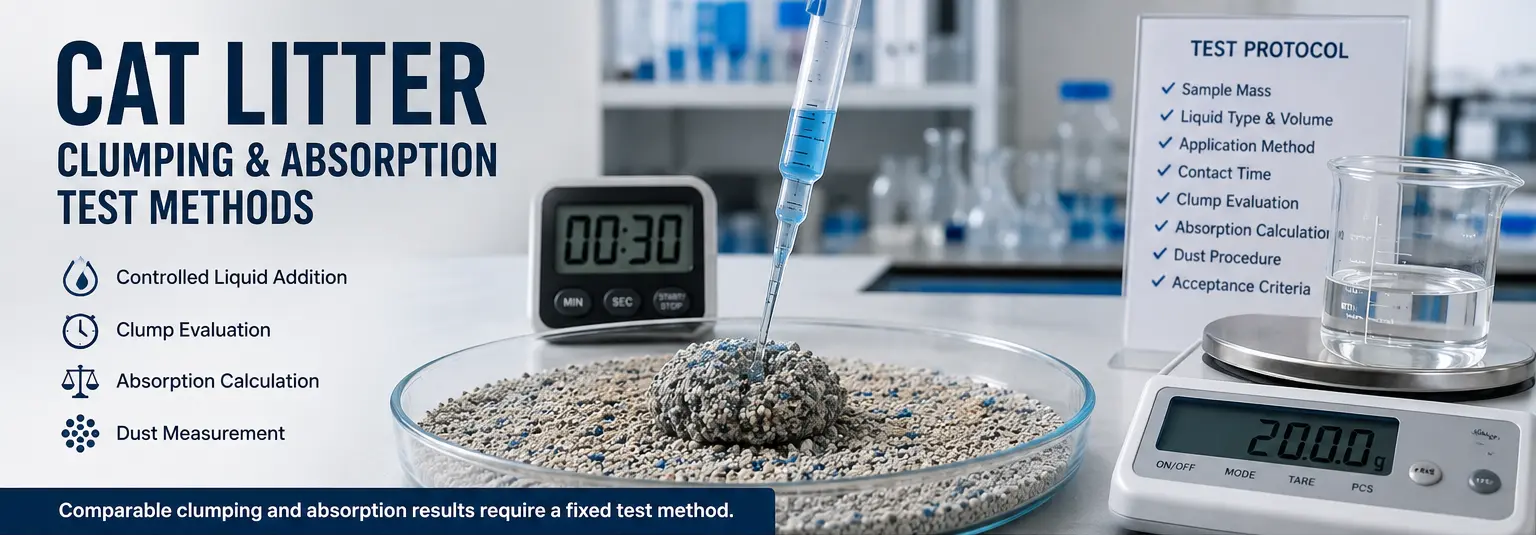
A cat litter clumping test and absorption test are usually controlled through buyer-supplier test protocols rather than one universal international cat litter standard. A comparable specification should define the liquid type and volume, application method, contact or rest time, clump evaluation method, absorption calculation, and dust procedure where relevant. Buyers can reference applicable ASTM, ISO, EN, or GB methods when a method fits the material, but the exact test conditions and acceptance criteria should be written into the purchase specification.
Quick Answer
There is no single universal international standard for cat litter clumping and absorption. For B2B purchasing, buyers should define one repeatable test protocol and use it consistently across suppliers and batches. The specification should state the sample mass, liquid type and volume, application method, contact time, clump evaluation, absorption calculation, and SKU-level acceptance criterion. A published ASTM, ISO, EN, or GB method may be referenced when its scope is applicable. The cat litter dust testing standards guide covers the dust side separately.
What Clumping Tests Measure
A buyer-defined clumping test should fix the sample mass, liquid type and volume, liquid addition rate or placement pattern, waiting time, and evaluation method before testing. Clump performance can then be recorded using a defined hardness, integrity, or breakage procedure. Terms such as “fast clumping” or “strong clumping” should not be accepted as standalone specifications; the purchase specification should state the test conditions and the pass/fail criterion used for the finished SKU.
A cat litter clump strength test should use a defined mechanical or breakage procedure rather than a subjective visual score.
Cat Litter Absorption Test and Calculation
For procurement testing, absorption can be expressed as the mass of liquid retained relative to the dry mass of litter, provided the calculation and test conditions are defined in advance. The specification should state the liquid used, sample mass, liquid-to-sample ratio, contact time, drainage or separation procedure, and calculation formula. Absorption capacity should also be kept separate from clumping performance because a litter can retain liquid effectively without forming a mechanically strong clump. Absorption performance depends on the litter material, particle structure, moisture condition, formulation, and manufacturing controls. The cat litter manufacturing process can influence these properties, but batch consistency should be demonstrated through a defined test method and SKU-level acceptance range rather than assumed from the manufacturing process alone.
Dust Testing as a Separate QC Parameter
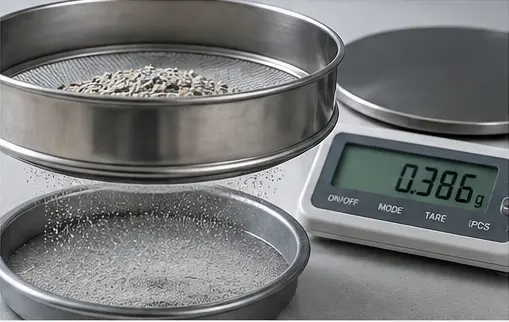
Dust should normally be specified as a separate QC parameter rather than combined with clumping or absorption. The result depends on the defined particle-size fraction, sample preparation, agitation procedure, collection method, and reporting basis. The cat litter dust control guide explains how manufacturing controls can reduce dust before the finished product is tested.
How Standards Bodies Apply
Standards organizations can provide useful reference methods, but the individual document must be checked for material scope and test purpose before it is used for cat litter. Buyers should cite the specific standard number rather than simply naming ASTM, ISO, EN, or GB. For example, ASTM E1521 addresses liquid holding capacity for specified granular carriers, while ISO 62 addresses water absorption of plastics and is not a general method for granular cat litter. If no applicable published method exists, the buyer and supplier should document an agreed internal procedure and acceptance criterion.
How Importers Should Specify Cat Litter QC
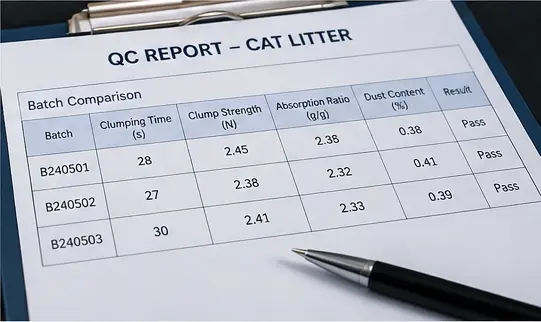
Importers should separate the test method from the acceptance criterion in the purchase specification. The method should define the sample preparation, liquid type and volume, addition procedure, rest time, measurement equipment, calculation, and reporting format. The acceptance criterion should then state the permitted result or range for the specific SKU, together with any batch-to-batch tolerance. This prevents a supplier from changing the test procedure while still reporting a seemingly compliant result.
Conclusion
Cat litter clumping and absorption claims become useful for procurement only when the measurement method and acceptance criterion are fixed. Buyers should define the sample, liquid conditions, test procedure, calculation, reporting format, and SKU-level acceptance range, then reference an applicable published method where one exists. This creates a repeatable QC basis for comparing batches, suppliers, and factories without treating a generic “ISO,” “ASTM,” or “GB” label as a certification claim.
Frequently Asked Questions
A clumping test evaluates how quickly litter forms a usable clump and how well that clump retains its integrity after a defined waiting period. Depending on the agreed protocol, the result may include clumping time, hardness, breakage, or an integrity score. The test conditions must remain fixed for results to be comparable.
For procurement testing, absorption can be expressed as the mass of liquid retained relative to the dry mass of litter. The buyer and supplier should define the liquid, sample mass, contact time, drainage procedure, and calculation formula before testing so that reported values can be compared.
Dust results can change with particle-size fraction, sample preparation, agitation procedure, collection method, and reporting basis. Without fixed conditions, two laboratories can produce different dust values from comparable litter samples.
If a published method is applicable to the litter material and test objective, cite the specific standard number and relevant procedure rather than only naming ISO or ASTM. If no suitable published method exists, the buyer and supplier can define an agreed internal test procedure with fixed conditions, calculation rules, and acceptance criteria.
State the liquid volume and rate, rest time, hardness scoring, absorption definition, dust sieve and agitation, and acceptable batch variance.
Do not assume that an EN designation means there is a universal European test for cat litter clumping. Buyers should identify a specific applicable EN standard, confirm its scope, and state the complete test procedure in the purchase specification. If no applicable standard exists, an agreed buyer-supplier method can be used.
A test standard can provide a repeatable measurement method without making the product “certified.” For purchasing, the important point is to use an applicable method, document the test conditions, and define the SKU-level acceptance criterion. Certification should not be implied unless a separate certification requirement actually applies.
Yes. The same litter can produce different reported values when liquid type, sample preparation, contact time, drainage, particle size, or calculation method differs. Buyers should therefore compare results only when the test conditions and calculation method are the same.