




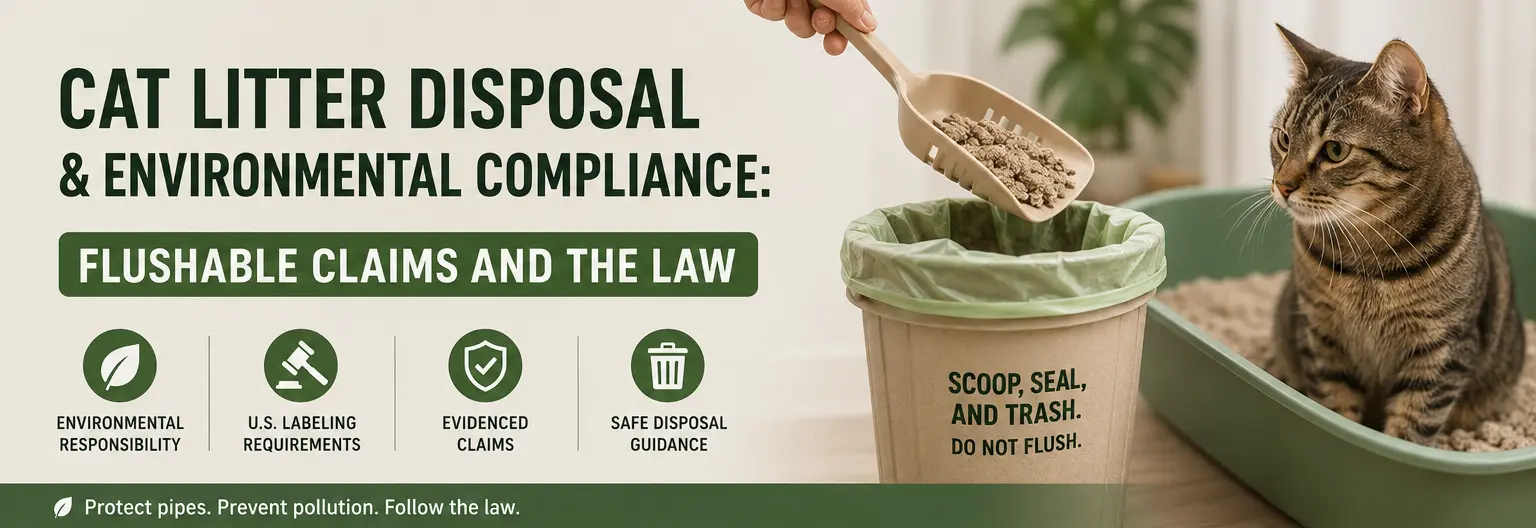
“Flushable” is one of the most sensitive environmental claims in the cat litter category. The key issue is not simply whether a litter can pass through a toilet, but whether its disposal claim is supported for the relevant plumbing and wastewater conditions and complies with local requirements. For brands, importers, and OEM suppliers, the practical priority is clear: separate biodegradability from flushability, substantiate any environmental claim, and provide disposal instructions that match the destination market. This guide explains the environmental risks, U.S. labeling requirements, the difference between “biodegradable” and “flushable,” and how suppliers can manage disposal claims more defensibly.
Quick Answer
Is cat litter flushable? Not by default. Cat litter should not be treated as toilet-safe simply because it is plant-based, biodegradable, or marketed as flushable. Flushability claims require evidence for the conditions they describe, while local wastewater and disposal rules still apply. In California, cat litter sold in the state must carry a statement discouraging flushing and disposal in gutters or storm drains under Fish & Game Code § 4501. For environmental marketing claims, the FTC expects competent and reliable scientific evidence and clear qualification where needed.
The Parasite Problem: Toxoplasma gondii
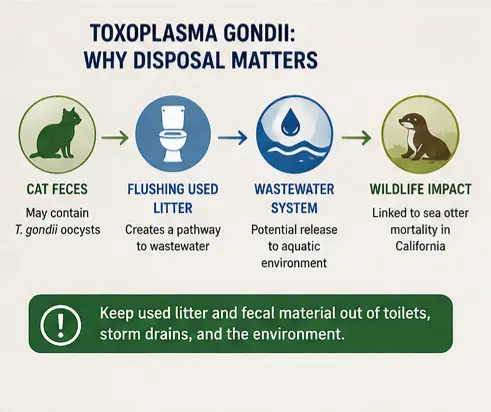
Cat feces can contain Toxoplasma gondii oocysts, and California legislation specifically identifies the link between cat feces, T. gondii, and sea otter mortality as a reason to reduce the flushing of cat litter and cat feces. The practical disposal concern is that flushing used litter can create a pathway from household waste into wastewater and potentially into the wider aquatic environment. For this reason, disposal guidance should address the used litter and fecal material rather than treating the litter substrate alone as the source of the parasite.
California’s Do-Not-Flush Labeling Law
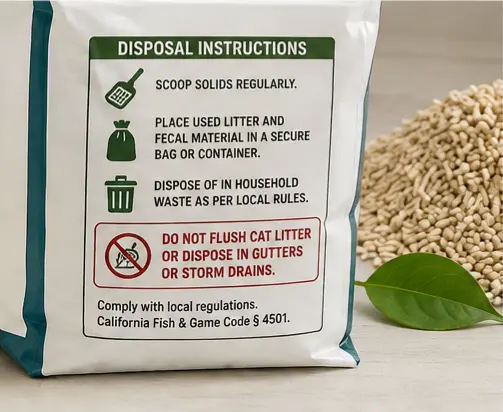
California Fish & Game Code § 4501, added by AB 2485 in 2006, requires cat litter offered for sale in the state to carry one of two specified types of disposal statements. One option explicitly tells consumers not to flush cat litter in toilets or dispose of it outdoors in gutters or storm drains; the other generally encourages disposal of cat feces in the trash and discourages flushing or disposal in drains. The requirement applies to cat litter offered for sale in California, including plant-based products, so suppliers selling into the state should review the pack wording before production.
The FTC and Environmental Claims
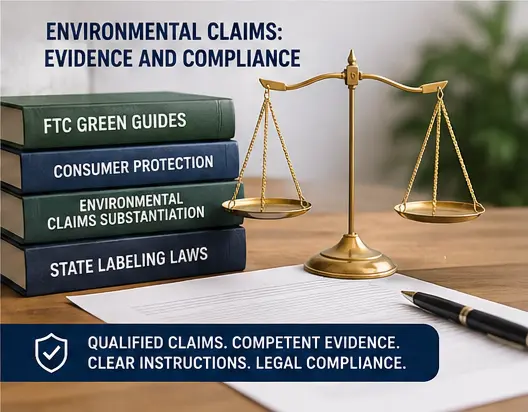
The U.S. Federal Trade Commission‘s Green Guides apply general truth-in-advertising principles to environmental marketing claims. Marketers should have competent and reliable scientific evidence to support the environmental benefits they communicate, and qualifications should be clear enough to prevent consumers from taking a broader meaning from the claim than the evidence supports. For cat litter, this distinction matters when terms such as “flushable,” “biodegradable,” or “compostable” could imply disposal or environmental benefits beyond what the product has actually been tested to demonstrate. For suppliers, the practical lesson is that an environmental claim can create exposure beyond the product’s tested performance, so any such claim should be supported by product-specific evidence and reviewed against destination-market requirements.
Why “Biodegradable” Is Not “Toilet-Safe”
Two claims are frequently conflated:
- Biodegradable. The material can break down under certain conditions — often industrial composting, not a sewer.
- Flushable / toilet-safe. Implies safe passage through and breakdown in the wastewater system.
A plant-based litter may be biodegradable in a compost setting yet still clog pipes. Used litter can contain cat fecal material and therefore may present a Toxoplasma gondii pathway, so the litter substrate alone should not be treated as the source of the parasite. Unqualified “flushable” labeling therefore exposes brands to both regulatory and litigation risk, and the two concepts should never be used interchangeably on a pack.
Best-Practice Disposal Guidance
For general consumer guidance, the safest default is to keep used litter out of toilets and storm drains and follow the waste-disposal rules of the local authority:
- Scoop solids regularly.
- Place used litter and fecal material in a securely closed waste bag or container.
- Dispose of used litter through the household or municipal waste route permitted in the local area.
- Do not flush used litter unless the product labeling and applicable local wastewater rules specifically permit the claimed disposal route.
- Keep cat feces and used litter out of gutters and storm drains.
- Only compost clean, unused litter where the product is specifically suitable for that composting system and the local program accepts it; never use used cat litter or fecal material in food gardens.
For a product marketed with any flushability-related language, the claim should be reviewed separately from the general disposal recommendation. Packaging should clearly state the conditions and limitations supported by testing and should include any destination-market warning or disposal statement that is legally required. Where local rules prohibit or discourage flushing cat litter, the packaging should not imply that a general “flushable” claim overrides those requirements.
Labeling Discipline for Suppliers
An OEM supplying flushable or plant-based litters should:
- Avoid unqualified “flushable” claims; use qualified language tied to testing.
- Align copy with the FTC Green Guides and state labeling laws.
- Include a clear do-not-flush warning where required (California).
- Provide disposal guidance on-pack and in supporting materials.
The cat litter types and disposal guide helps buyers understand which materials carry which disposal considerations, and the cat litter export compliance hub consolidates U.S. and EU labeling rules so disposal claims are handled alongside the rest of the compliance stack.
What Importers Should Tell Retailers
Importers, distributors, retailers, and brand owners should keep the disposal message consistent across packaging, product listings, retailer training materials, and customer-service responses. A simple instruction such as “Scoop, seal, and dispose of used litter as household waste; do not flush” can reduce ambiguity and keep the consumer-facing message aligned with the product’s compliance file. Where a market requires specific disposal wording, the statutory or approved wording should take priority over generic marketing copy.
International Angles
Disposal and environmental-claim requirements vary by market. In the United Kingdom, water utilities have long promoted anti-flush messaging for products that can cause sewer blockages, while the EU is strengthening rules on environmental claims through Directive (EU) 2024/825 on empowering consumers for the green transition, which applies from 27 September 2026. For a global brand, the better approach is therefore not to use one universal legal claim, but to maintain market-specific disposal wording, claim substantiation, and packaging requirements.
Disposal by Litter Type
Although flushing is not recommended for any litter, disposal guidance varies slightly by base material:
| Litter type | General septic-system guidance | Composting guidance | Default disposal |
|---|---|---|---|
| Clay / bentonite | Do not flush; follow local septic guidance | Do not assume compostability; follow the finished-product instructions | Seal and dispose of as household waste |
| Tofu / plant-based | Do not assume septic compatibility from plant-based composition | Only where the finished product and composting system permit | Seal and dispose of as household waste |
| Pine / wood | Do not assume septic compatibility from wood composition | Only where the finished product and composting system permit | Seal and dispose of as household waste |
| Silica crystals | Do not flush; follow local septic guidance | Do not assume compostability; follow the finished-product instructions | Seal and dispose of as household waste |
A Claim-Compliance Checklist
Before printing any environmental language, run this list:
- Is the claim qualified (e.g., “biodegradable in industrial compost,” not “flushable”)?
- Is there credible scientific evidence on file for the specific SKU?
- Does the pack carry a do-not-flush warning where required (California)?
- Does the wording align with the FTC Green Guides and the environmental-claim requirements applicable in the destination market?
- Are disposal instructions present and unambiguous?
Conclusion
Cat litter should not be treated as toilet-safe simply because it is plant-based, biodegradable, or marketed as flushable. The potential Toxoplasma pathway, plumbing and wastewater concerns, and legal exposure around environmental claims make labeling discipline essential. Suppliers of plant-based and flushable-positioned litters should use qualified, evidence-based claims, include any mandatory disposal warning or instruction required by the market, and provide clear disposal guidance that matches the product’s tested performance and destination-market requirements.
Frequently Asked Questions
Do not assume that cat litter is toilet-safe because it is plant-based, biodegradable, or marketed as flushable. Flushability depends on the specific product, test conditions, plumbing and wastewater requirements, and local rules. In California, cat litter sold in the state must carry a disposal statement discouraging flushing under Fish & Game Code § 4501.
Used cat litter can contain fecal material and may introduce Toxoplasma gondii into the wastewater pathway. Litter can also contribute to plumbing or wastewater-management problems. Disposal should therefore follow the product instructions and applicable local requirements.
California Fish & Game Code § 4501 requires cat litter offered for sale in the state to contain one of two specified types of disposal statements. One specifically tells consumers not to flush cat litter or dispose of it in gutters or storm drains.
The FTC’s Green Guides state that environmental marketing claims should be supported by competent and reliable scientific evidence. Claims and qualifications should also be presented clearly enough to avoid communicating environmental benefits broader than the evidence supports.
No. Biodegradability describes breakdown under particular conditions; it does not by itself establish that a product is suitable for toilets, sewer systems, septic systems, or local wastewater infrastructure.
Scoop solids regularly, place used litter and fecal material in a securely closed waste bag or container, and dispose of it through the household or municipal waste route permitted locally; do not flush or use storm drains.
Only clean, unused litter where the product is specifically suitable for that composting system and the local program accepts it; do not use used cat litter or fecal material in food gardens.
Do not rely on a material-level claim such as “biodegradable” as proof of flushability. Keep product-specific test evidence with the SKU compliance file, qualify the claim according to the conditions tested, review destination-market requirements, and include any mandatory disposal warning or instruction required by the market.
The export compliance hub and cat litter types guide cover U.S. and EU labeling requirements.