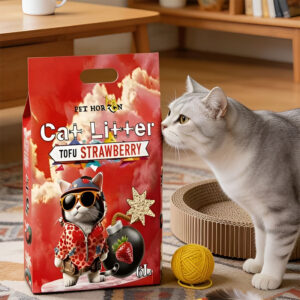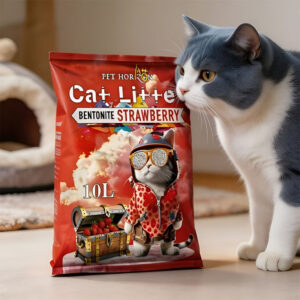





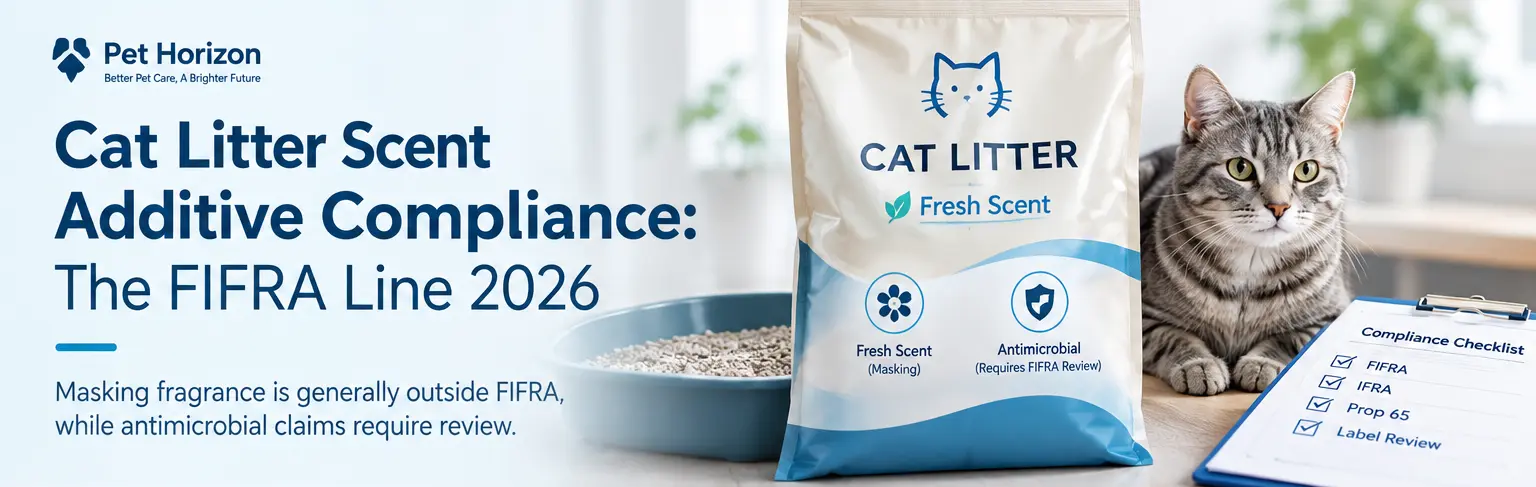
Cat litter scent additive compliance is a key issue for US-bound private-label and OEM programs before the formula and artwork are finalized. A fragrance claim that only describes scent or odor masking is generally outside FIFRA, while claims that state or imply control of microorganisms can bring the product within EPA pesticide requirements. Depending on the product, claim, and applicable exemption, the compliance path may involve EPA registration or a specific FIFRA exemption. Buyers should resolve that classification with the supplier before launch to avoid artwork changes, reformulation, or regulatory delays.
Quick Answer
A scented cat litter does not automatically require EPA registration simply because it contains a fragrance. The key issue is the product’s claims and how the additive is used. A claim limited to scent or odor masking is generally non-pesticidal, while claims that state or imply control of microorganisms can make the product subject to FIFRA. Registration may be required unless a specific exemption applies, so buyers should confirm the regulatory status and permitted claims with the supplier before finalizing the US label.
Fragrance vs Antimicrobial: The FIFRA Divide
The Federal Insecticide, Fungicide, and Rodenticide Act (FIFRA) regulates products that make pesticidal claims. A scent claim that only describes fragrance or odor masking is generally non-pesticidal. By contrast, a claim that the litter kills, controls, or inhibits microorganisms can be treated as a pesticidal claim, with the applicable requirements depending on the claim, intended use, product formulation, and available FIFRA exemption. Buyers should not assume that every antimicrobial claim follows the same registration pathway.
EPA’s PR Notice 2000-1 explains how the treated-articles exemption under 40 CFR 152.25(a) applies to antimicrobial pesticide claims and distinguishes article-protection claims from public-health claims.
The Treated-Articles Exemption
Under 40 CFR 152.25(a), the treated-articles exemption can apply when an article or substance is treated with, or contains, a pesticide that is registered for that use and the treatment is intended to protect the treated article or substance itself. EPA’s PR Notice 2000-1 distinguishes these non-public-health uses from claims that imply protection against harmful microorganisms or other public-health benefits. For cat litter, buyers should therefore separate a simple fragrance or odor-masking claim from an antimicrobial treatment claim and verify the exact formulation, pesticide status, intended use, and label wording before relying on the exemption.
Scent Claims Generally Outside FIFRA
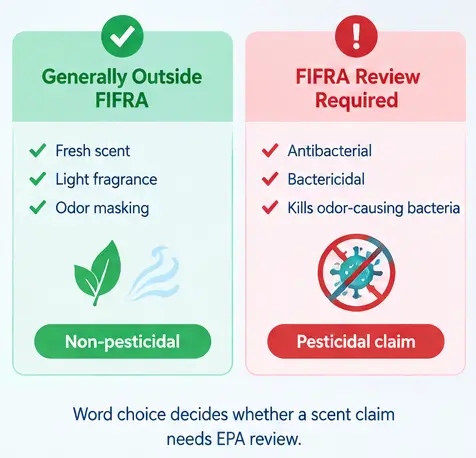
Claims such as “fresh scent,” “light fragrance,” or “odor-masking” describe a sensory effect and are generally non-pesticidal. They should not imply control of bacteria or other organisms. Our odor-control technology explainer shows how physical and mineral mechanisms manage odor without a pesticidal claim.
When a Scent Claim Triggers FIFRA Review
If pack copy says “antibacterial,” “bactericidal,” “kills odor-causing bacteria,” or makes similar microorganism-control claims, the product should be reviewed as a potential pesticide claim rather than treated as a simple fragrance claim. EPA’s treatment of the claim depends on the intended use, formulation, target microorganisms, label context, and whether a FIFRA exemption applies. PR Notice 2000-1 is particularly important for treated articles because some odor- and microorganism-related claims can fall outside the exemption even when the treatment is intended for odor control. Our antimicrobial claims EPA/FIFRA guide explains the claim categories and compliance review process.
Use this table to triage a scent claim before finalizing pack copy:
| Claim or positioning | Initial compliance direction |
|---|---|
| Fresh scent | Generally non-pesticidal |
| Fragrance or odor masking | Generally non-pesticidal if no microorganism-control implication |
| Controls odor-causing bacteria | FIFRA review required |
| Kills odor-causing bacteria | FIFRA review required |
| Antibacterial or germ-killing | FIFRA review required |
| Protects the litter itself from microbial deterioration | Evaluate treated-articles eligibility and applicable pesticide requirements |
IFRA and Disclosure Discipline
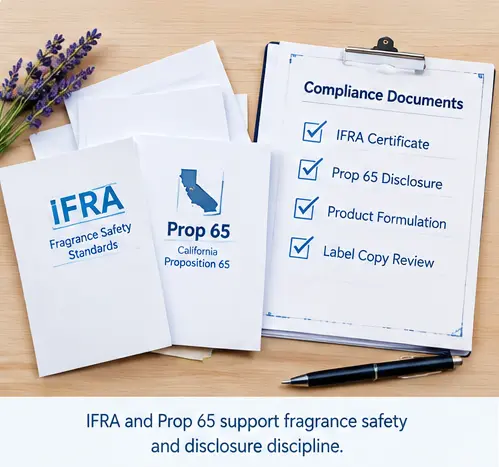
Even when a fragrance is not a pesticide claim, buyers should review fragrance safety documentation separately from FIFRA status. IFRA Standards provide an industry framework for the safe use of fragrance ingredients, while California Proposition 65 may create additional disclosure obligations for certain substances and exposures. Ask the fragrance supplier for applicable IFRA conformity documentation and Prop 65 information rather than treating either document as a substitute for the product’s FIFRA assessment. See the IFRA standards for the fragrance safety framework.
Briefing a Supplier on Compliant Scent Claims
A practical supplier brief:
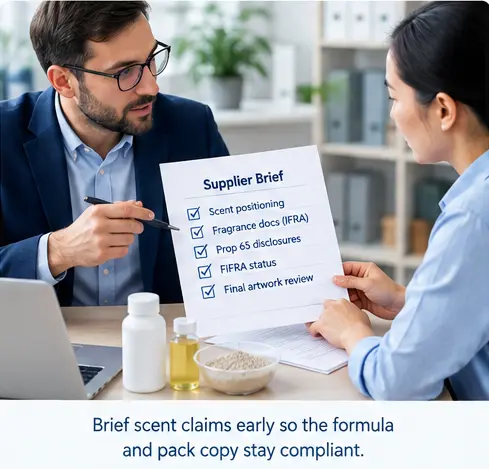
- State the intended scent effect as masking, not antimicrobial.
- Do not use “antibacterial,” “bactericidal,” “germicidal,” or similar microorganism-control wording unless the supplier has confirmed the applicable FIFRA status and approved label language.
- Ask for IFRA-conformant fragrance documentation and any Prop 65 disclosures.
- Confirm the regulatory status of any antimicrobial additive, including its EPA registration status or applicable FIFRA exemption.
- Review final artwork against the FIFRA claim line before approval.
Export Compliance Context
The FIFRA rule is US-specific; the EU and other markets have their own claims frameworks. Our cat litter export compliance guide summarizes how to position a global SKU per market so a scent claim cleared for one region does not breach another.
Conclusion
Cat litter scent additive compliance comes down to one line: a fragrance claim that only masks odor is generally non-pesticidal, while a claim that kills, controls, or inhibits microorganisms can bring the product within FIFRA. The applicable compliance path may involve EPA registration or a specific exemption, depending on the formulation, intended use, and label claims. Decide the scent positioning and claim wording during formula development, confirm the regulatory status with the supplier, and review final artwork before launch.
Frequently Asked Questions
Not necessarily. A fragrance-only or odor-masking claim is generally non-pesticidal, while claims to kill, control, or inhibit microorganisms can bring the product within FIFRA. Whether EPA registration is required depends on the product and claim, including whether a specific FIFRA exemption applies.
Usually no. A scent that masks odor is a sensory effect. The claim becomes pesticidal only when it states or implies control of microorganisms.
Under 40 CFR 152.25(a), the treated-articles exemption may apply when a registered pesticide is used to protect the treated article or substance itself. Claims that imply public-health protection or microorganism control may fall outside the exemption, so the exact formulation, intended use, and label wording should be reviewed before relying on it.
Generally, yes, when “fresh scent” or “odor-masking” only describes a sensory effect and does not state or imply control of bacteria or other microorganisms. The complete label and marketing context should still be reviewed before approval.
IFRA standards guide safe fragrance use, and California Prop 65 may require disclosures for certain substances.
A scent claim can trigger FIFRA review when the wording states or implies that the product kills, controls, or inhibits microorganisms. Whether that claim requires EPA registration depends on the product, intended use, formulation, label wording, and any applicable FIFRA exemption.
FIFRA is a US federal pesticide law and does not govern products sold solely outside the United States. Other markets have their own rules for pesticide, biocidal, fragrance, and product claims.
State the intended scent effect clearly, avoid microorganism-control wording unless its FIFRA status and label language have been confirmed, request applicable fragrance and Prop 65 documentation, and review the final artwork before approval.