




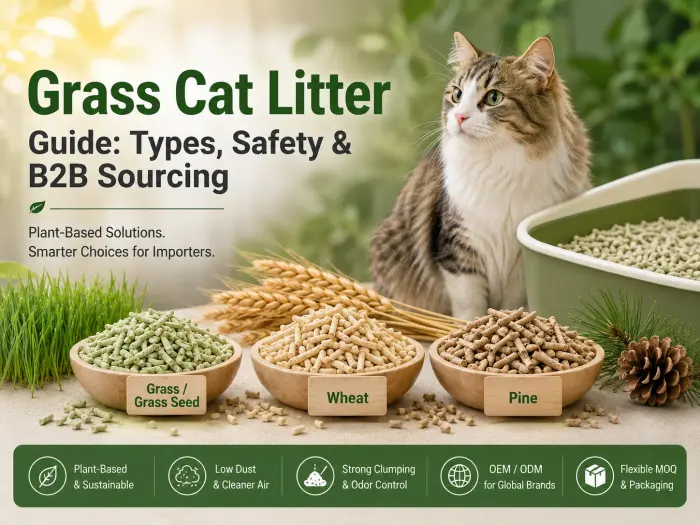
Grass cat litter is a plant-based litter made primarily from grass or grass seed, while wheat and pine are separate plant-based litter categories. For B2B buyers, understanding these differences helps when comparing clumping, dust, odor control, supply stability, and OEM options.
Quick Answer
Grass cat litter is a plant-based litter made from grass or grass seed, while wheat and pine are separate plant-based litter types. Grass-based formulas are typically lightweight and can offer low dust and strong clumping, depending on the formulation. For B2B buyers, the key sourcing factors are raw-material consistency, clumping performance, dust control, humidity stability, packaging, and OEM flexibility.
What Is Grass Cat Litter?
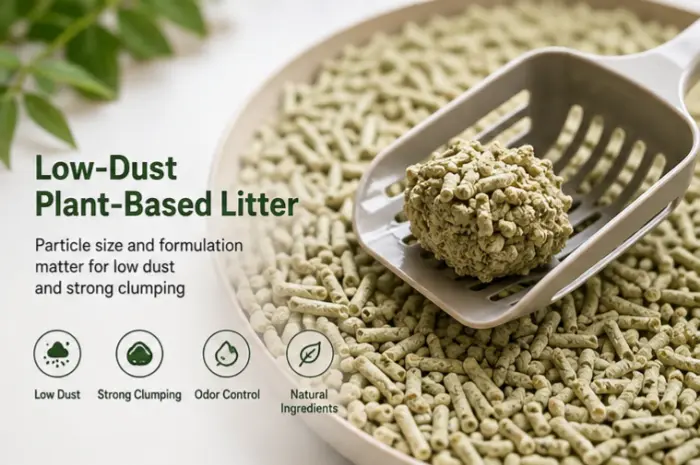
Grass cat litter is cat litter made primarily from grass or grass seed rather than mined clay or mineral-based materials. Depending on the product, the raw material may be processed into fine granules or other lightweight forms and combined with natural or formulated clumping agents.
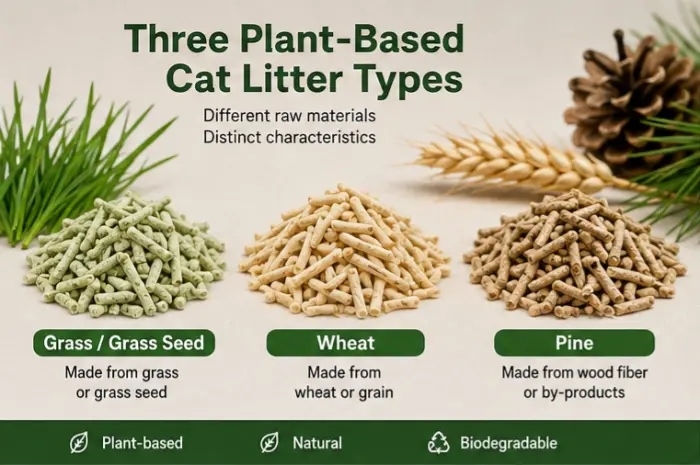
Grass litter should be distinguished from other plant-based categories. Wheat litter is grain-based, while pine litter is wood-based. All three can be positioned as plant-based alternatives to clay, but their raw materials, texture, clumping behavior, and supply chains are different.
Grass Cat Litter vs. Other Plant-Based Litters
Grass cat litter is made from grass or grass seed, while wheat litter uses grain-based raw materials and pine litter uses wood fibers or wood by-products. These categories share a plant-based positioning, but they should not be treated as the same product type. Their clumping behavior, particle structure, odor control, dust level, and supply requirements can differ significantly.
What Is the Difference Between Grass and Grass Seed Cat Litter?
Grass cat litter may be made from grass material or grass seed, depending on the product. Grass-seed formulas can be processed into lightweight granules, while clumping performance depends on the raw material, particle structure, binders, and overall formulation. Buyers should confirm the exact raw material and particle structure with the manufacturer rather than relying only on the product name.
How Grass Cat Litter Is Made
Production typically involves drying and milling the plant material, then either pelleting it or combining it with a natural clumping agent. Some formulas add baking soda or plant extracts for odor control. Because the inputs are agricultural, batch consistency depends on crop quality and drying control — a key point for OEM buyers.
Grass Cat Litter Market Size and Growth
Third-party market research provides one indication of the segment’s growth potential. According to Marketintelo’s market forecast, the global grass cat litter market is projected to increase from about USD 0.4 billion in 2025 to USD 0.8 billion by 2034, representing a reported CAGR of 7.2%.
| Metric | Value |
|---|---|
| Global market (2025) | USD 0.4 billion |
| Global market (2034 forecast) | USD 0.8 billion |
| Reported CAGR (2025–2034) | 7.2% |
Key takeaway: the cited forecast indicates continued growth in the grass cat litter segment through 2034, giving B2B buyers another plant-based category to evaluate alongside wheat, pine, and other alternatives.
Grass Cat Litter vs. Wheat and Pine Cat Litter
| Type | Main Material | Typical Clumping | Dust Profile | Supply Basis |
|---|---|---|---|---|
| Grass | Grass or grass seed | Varies by formula | Depends on particle size and processing | Agricultural crops |
| Wheat | Wheat / grain | Strong in many clumping formulas | Depends on processing and formulation | Grain agriculture |
| Pine | Wood fiber / by-products | Varies by formula | Depends on particle size and processing | Timber / wood processing |
For buyers comparing grass vs. wheat cat litter, the key distinction is the raw material: grass-based litter uses grass or grass seed, while wheat litter relies on grain-based materials. Performance depends heavily on particle structure, binders, processing, and formulation, so buyers should request clumping, dust, moisture, and odor-control specifications rather than judging by raw material alone.
Is Grass Cat Litter Safe?
Grass cat litter is generally marketed as a plant-based alternative to conventional clay litter, with some products emphasizing low-dust performance. However, dust levels and ingredients vary by product. Buyers should review the actual formulation, particle size, additives, and dust-control specifications rather than assuming every grass-based litter has the same safety profile.
Grass Cat Litter and Respiratory Sensitivity
Low-dust litter can be preferable in households concerned about airborne particles, but grass cat litter should not be described as a treatment or medically proven solution for feline asthma. For cats with respiratory conditions, product selection should follow veterinary advice and consider the individual cat’s sensitivity to dust, fragrance, and other ingredients.
Buyers searching for low-dust litter for asthma-related households should compare dust levels, fragrance, particle size, and formulation across products rather than relying on the material name alone. The same approach applies when comparing grass-based litter options for households concerned about feline respiratory sensitivity.
For the Environment
Many grass-based litters are made from biodegradable plant materials, but the actual disposal properties depend on the formulation and additives. Biodegradable does not automatically mean compostable or flushable, so buyers should verify the manufacturer’s disposal documentation and local waste rules. Broader plant-based category research also highlights environmental considerations in markets such as Europe and Asia-Pacific. For B2B buyers, these preferences can be relevant when positioning private-label plant-based litter lines.
Sourcing and OEM Considerations for Importers
Humidity and Regional Formulation
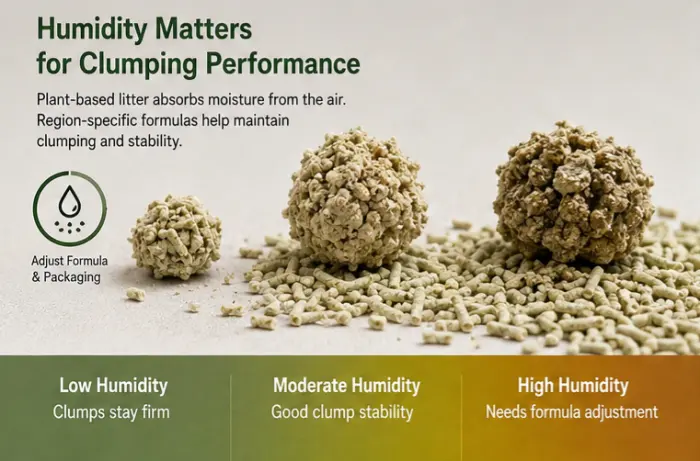
Plant-based litters can be sensitive to ambient moisture, so tropical and coastal markets may require formulation or packaging adjustments to maintain clumping and product stability. An OEM partner should offer region-specific tuning rather than a single global SKU.
What to Require from a Plant-Based OEM
- Raw-material specifications and batch consistency data.
- Particle-size distribution and granule consistency.
- Moisture content, absorption, and clump-strength specifications.
- Odor-control formulation details and additive disclosures.
- Biodegradability or compostability documentation where claimed.
- Private-label packaging, carton configuration, and MOQ options.
Common Mistakes When Sourcing Plant-Based Litter
- Assuming all “grass” litters clump the same — grass, wheat, and pine differ sharply.
- Ignoring humidity stability in tropical import markets.
- Conflating grass with wheat or pine, which use different raw materials and supply chains.
- Overlooking OEM formulation flexibility and MOQ structure.
Pet Horizon’s Plant-Based OEM Capabilities
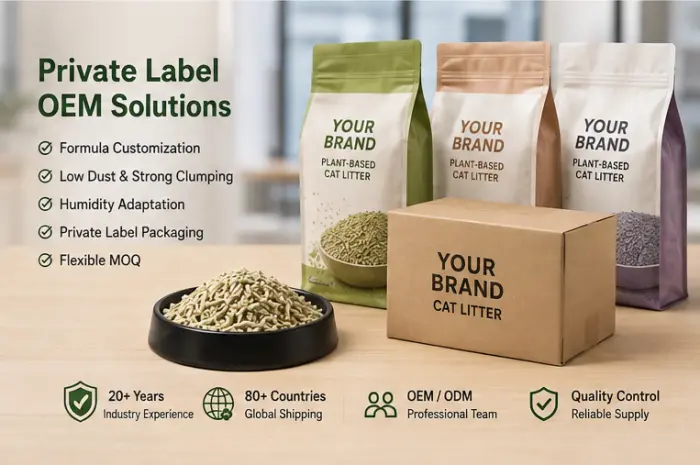
Pet Horizon has more than 20 years in the cat litter industry and over 10 years of OEM and ODM experience, shipping to more than 80 countries. Our plant-based OEM program covers tofu, pine, and mixed clumping litters, with formulas tuned for regional humidity and low-dust performance, and we continue to expand the plant-based range as importer demand evolves. Importers exploring the category can start with our pine cat litter or tofu cat litter lines, and review the full range in our cat litter types overview. MOQ starts at one 20-foot container and is negotiable.
Conclusion
Grass cat litter is a distinct plant-based category made from grass or grass seed, while wheat and pine belong to separate plant-based litter categories. For importers, the most important sourcing factors are raw-material consistency, clumping performance, dust control, humidity stability, packaging, and formulation flexibility. Comparing these specifications with an experienced OEM partner can help buyers select the right plant-based litter format for their target market.
Frequently Asked Questions
Grass cat litter is typically made from processed grass or grass seed, although the exact raw material and formulation vary by manufacturer. It should be distinguished from wheat-based and pine-based cat litter, which use different plant materials.
Grass cat litter is generally used as a plant-based alternative to mineral litter, but safety and dust performance depend on the specific formulation, additives, and manufacturing quality. Buyers should check the product specifications and consult a veterinarian for cats with specific health concerns.
Low-dust litter can be a suitable choice for households concerned about airborne particles, but grass cat litter is not a medically proven treatment for feline asthma. Product selection for cats with respiratory conditions should follow veterinary advice and account for the individual cat’s sensitivity to dust, fragrance, and other ingredients.
The key distinction is the raw material: grass-based litter uses grass or grass seed, while wheat litter relies on grain-based materials. Performance depends on particle structure, binders, and processing, so buyers should request clumping, dust, and moisture specifications rather than judging by raw material alone.
No. Pine is wood-based, while grass litter is made from grass or grass seed. Both are plant-based alternatives to clay but use different raw materials, particle structures, and supply chains.
Many grass-based formulas clump, especially grass-seed varieties with natural starch, but clumping performance varies by formulation. Confirm clumping strength and moisture behavior with the supplier before ordering.
Many grass-based litters are made from biodegradable plant materials, but the actual disposal properties depend on the formulation and additives. Biodegradable does not automatically mean compostable or flushable, so buyers should verify the manufacturer’s disposal documentation and local waste rules.
Yes. OEM programs covering tofu, pine, and mixed formats typically start at one 20-foot container MOQ and are negotiable, with private-label packaging and regional formulation support.