




If you’re a first-time cat owner, few purchases will trip you up quite like cat litter. After years of research and evaluation in the cat care industry — and conversations with tens of thousands of cat owners — the pattern is consistent: cat litter has the highest pitfall rate of any consumable for new cat parents.
Most new cat owners make their first litter purchase based purely on personal preference — the packaging looks nice, the fragrance smells pleasant, or the price seems right. What they overlook are a cat’s physiological habits, the impact of the home environment, and the practical logic behind different litter materials. The result? Excessive dust, persistent odors, or a cat that flat-out refuses the litter box and starts eliminating on the sofa.
A bag of cat litter looks simple. But it hides layers of industry nuance that brands rarely explain — and sometimes deliberately obscure. In this guide, we’ve compiled the eight most common cat litter mistakes new owners make, along with the practical knowledge to help you avoid every one of them. Master these new cat owner tips, and you’ll sidestep the most expensive and frustrating detours in your cat-raising journey.
Mistake 1: Blindly Choosing Scented Litter
The first instinct for most new cat owners is to pick a litter that smells nice. Peach, white tea, lavender — the options are endless and deliberately appealing. The logic seems sound: a pleasant fragrance should mask the smell of cat waste and keep your home fresh.
Here’s the industry reality: the vast majority of scented cat litters on the market are made from ordinary raw materials, then soaked or sprayed with synthetic chemical fragrances to cover up those deficiencies. In an enclosed home, these fragrances don’t dissipate naturally — they accumulate in the air and combine with the smell of waste to create a stuffy, compound odor that’s worse than either scent alone.
More importantly, cats’ sense of smell is dozens of times more sensitive than ours. Strong artificial fragrances continuously irritate a cat’s nasal mucosa. Long-term exposure can lead to chronic sneezing, nasal inflammation, and degraded sense of smell. Sensitive cats may also develop increased tear stains, lethargy, and reduced appetite.
Truly high-quality cat litter never relies on heavy fragrance. It uses the material’s own microporous structure to physically neutralize odors — a method that’s gentler and longer lasting. Experienced cat owners almost universally avoid scented litter. Rejecting artificial fragrance is the most basic common sense in responsible cat care.
Mistake 2: Chasing the Lowest Price
Early in the cat-owning journey, the temptation to cut costs is understandable. Budget-priced bulk litters with no proper packaging, no process labeling, and no quality controls are everywhere — and their low unit price makes them look like a bargain.
They’re not. Low-quality litter is loaded with impurities: cheap bentonite mixed with excess soil and gravel, tofu litter padded with waste starch residue. These products generate excessive dust, clump poorly, and break down within three to four days. Once the litter absorbs enough moisture to start smelling, the entire box needs replacing. Over a month, the cumulative cost is often far higher than mid-range litter that lasts twice as long.
The safety risks are real, too. Unscreened raw materials can contain sharp gravel that scratches a cat’s sensitive paw pads. Low-quality plant-based litters may contain unknown binding agents that, if ingested, can cause vomiting, loose stools, or intestinal blockages.
You don’t need to buy the most expensive litter on the market. But you should never buy unprocessed, low-grade raw material dressed up in a bag. In cat supplies, quality and price are genuinely correlated — and nowhere is this more costly to ignore than with litter.
Mistake 3: Not Knowing the Right Litter Depth
Surveys consistently show that over 60% of new cat owners don’t fill the litter box to the correct depth. A thin layer — just enough to cover the bottom — seems sufficient. In practice, it’s one of the most common cat litter mistakes that leads to litter sticking to the box floor, urine seeping through to the bottom, and persistent sour odors building up over time.
Each litter type has a different physical structure, and the ideal depth varies accordingly:
- Tofu litter (loose plant fibers, fast water absorption): 7–10 cm
- Bentonite/clumping clay (high density, quick clumping): ~6 cm
- Crystal litter (stable structure): ~5 cm
- Mixed litter (complex composite structure): 7 cm or more
When the litter layer is too thin, cats touch the bottom while digging, urine reaches the base without being fully absorbed, and moisture accumulates. Bacteria multiply, and the box begins to smell sour. Many owners blame the product — but the real culprit is incorrect usage. Brands rarely publish the recommended depth on the packaging, because thinner litter means faster consumption and more repeat purchases. Now you know better.
Mistake 4: Switching Litter Types Too Frequently
New cat owners are naturally curious and enjoy trying new things — including different litters. It’s easy to rotate through tofu litter, bentonite, and crystal litter within the same week. For humans, litter is just a product. For cats, it’s something far more important: the familiar, scent-defined surface that signals safety and signals where it’s appropriate to eliminate.
Cats can detect even subtle differences in the odor molecules of different litters. Their paw pads are sensitive to changes in texture, temperature, and firmness. A sudden switch — new smell, unfamiliar texture — disrupts a cat’s established urination memory. The result is anxiety, litter box avoidance, or inappropriate elimination on furniture or floors.
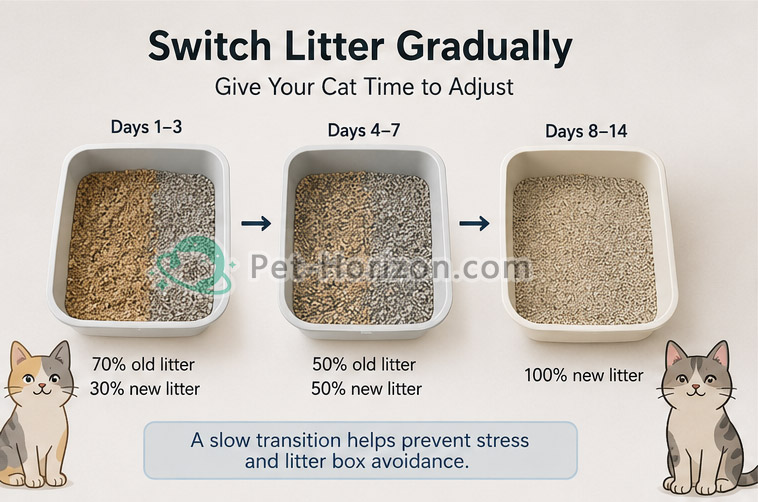
Cat brands constantly launch new products to drive sales, but they rarely mention the stress risks of abrupt changes. The correct approach is a gradual transition: start with 70% old litter and 30% new, move to a 50/50 mix, then complete the shift over one to two weeks — always leaving some residual scent from the old litter present throughout.
Stability is what cats need most. Once you find a litter that works, stick with it.
Mistake 5: Ignoring the Dust Problem
This is one of the most underestimated cat litter mistakes. Dust is invisible at a glance — but during pouring, when your cat digs, and as it moves around the box, fine particles become airborne and circulate indoors. Both cats and humans inhale this dust continuously.
For cats, litter dust adheres to the nose, trachea, and fur. Over time it can trigger chronic sneezing, coughing, and respiratory inflammation. For owners — especially those with rhinitis or sensitive airways — it means nasal congestion, itchy throats, and frequent sneezing.
This is why low dust cat litter should be a baseline requirement, not a premium option. Quality litters undergo multiple processing steps before leaving the factory — washing, air-drying, and vibration-screening — so particles are clean and dry with minimal airborne powder. Low-quality litters skip these steps; you can visibly see a cloud of dust when pouring.
For cats with sensitive constitutions or any respiratory condition, choosing a low dust cat litter isn’t optional — it’s essential. Don’t trade your cat’s long-term respiratory health for a lower price tag.
Mistake 6: Neglecting Daily Litter Box Maintenance
Many new owners assume cat litter is low-maintenance: scoop the waste clumps periodically and the box takes care of itself. This misunderstanding leads to moisture accumulation at the base of the box, bacterial growth, and the gradual development of a persistent sour smell — even with a quality litter.
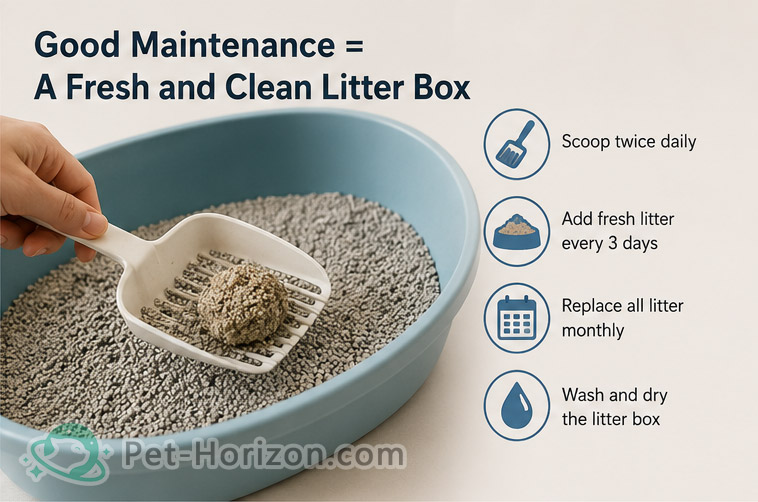
A simple, sustainable maintenance routine makes an enormous difference:
- Twice daily: Scoop feces and urine clumps at consistent morning and evening times
- Every 3 days: Add fresh litter to refill depressions on the surface
- Monthly: Do a complete litter change — empty the box entirely and start fresh
- Periodically: Wash the litter box with hot water and let it dry in direct sunlight to kill bacteria
This basic routine keeps the litter box genuinely fresh, slows bacterial growth, and dramatically extends the usable life of each bag of litter. Cat litter companies rarely emphasize these maintenance steps for an obvious reason: proper care means less frequent purchasing. Build these habits early and you’ll spend less and deal with fewer odor problems.
Mistake 7: Blindly Buying Pre-Mixed Litter
Mixed litter has been heavily marketed in recent years, and the appeal is intuitive: multiple materials working together must outperform any single type, right? Not necessarily.
The majority of commercially pre-mixed litters on the market are random blends — particles of incompatible sizes and densities mixed together without a scientific ratio. Bentonite, broken tofu pellets, and crystal fragments don’t naturally complement each other when poorly combined. Rather than balancing their properties, they often amplify each type’s weaknesses.
Well-designed mixed litter requires a layered approach: dense, heavy material at the bottom for moisture control and odor blocking, softer particles on the surface for paw comfort and dust reduction. This kind of intentional ratio produces real benefits. But it’s very difficult to achieve in mass-produced pre-mixed products.
If you want to try mixed litter, manually blending two compatible types — and layering them thoughtfully — will almost always outperform a pre-mixed commercial product at a lower cost.
Mistake 8: Ignoring Your Cat’s Individual Needs
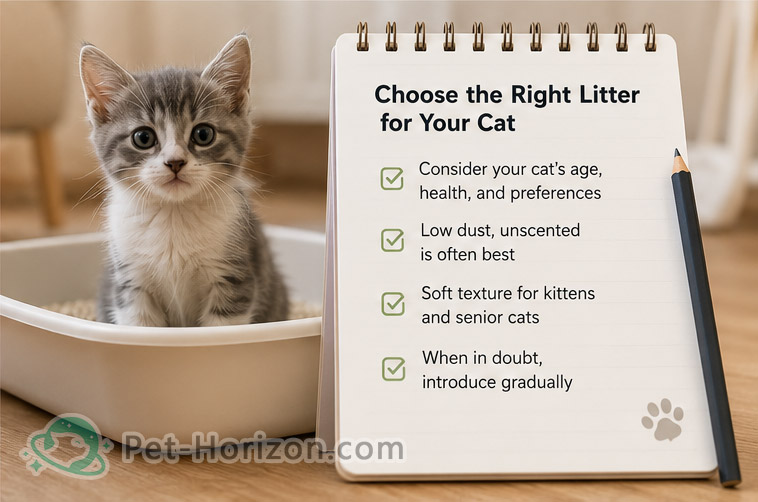
There is no universally perfect cat litter — only litter that’s right for your cat. Kittens, adult cats, senior cats, and cats recovering from surgery or illness have meaningfully different needs, paw sensitivities, and physiological tolerances. One of the most common cat litter mistakes is copying another owner’s recommendation without considering whether it actually fits your specific cat.
- Kittens are curious and prone to tasting their litter — hard mineral clay litters pose an ingestion risk and should be avoided
- Post-surgery or medically sensitive cats need litters that are fragrance-free, zero-dust, and gentle in composition
- Senior cats have aging joints and more sensitive paw pads — soft, fine-grain litters with low hardness are most appropriate
Choose litter that aligns with your cat’s age, health status, and temperament. The best-reviewed litter in the world means nothing if your cat rejects it or if it irritates their system.
Final Thoughts: Smarter Cat Litter Choices Start Here
The essence of responsible cat ownership is following your cat’s nature and meeting their actual needs — not marketing trends. Choosing the right cat litter doesn’t require advanced expertise. It requires avoiding manipulation, understanding what materials actually do, and respecting your cat’s instincts and sensitivities.
Most of the cat litter mistakes covered in this guide don’t stem from bad products — they stem from insufficient information and incorrect usage. By keeping these eight pitfalls in mind, you can filter out the majority of low-quality and overpriced options flooding the market. The litter that genuinely works for everyday home use is usually simple, unscented, well-processed, and chosen with your specific cat in mind.
Experienced cat owners rarely follow trends. They know that raising a healthy cat isn’t about buying the most expensive supplies or chasing the newest product launch. It’s about applying careful, patient, and well-informed care — starting with something as foundational as the right bag of litter. Choose wisely, maintain consistently, and both you and your cat will benefit.
FAQ
Why does my cat suddenly stop using the litter box?
Sudden litter changes, strong fragrances, dirty litter boxes, stress, or uncomfortable litter textures can all cause litter box avoidance.
What is the best cat litter for beginners?
Low dust, unscented cat litter with strong clumping ability is usually the safest and easiest option for first-time cat owners.
Is tofu cat litter better than bentonite litter?
Tofu cat litter is lightweight and low dust, while bentonite litter usually provides faster clumping and stronger odor control. The better choice depends on your cat’s needs and preferences.