




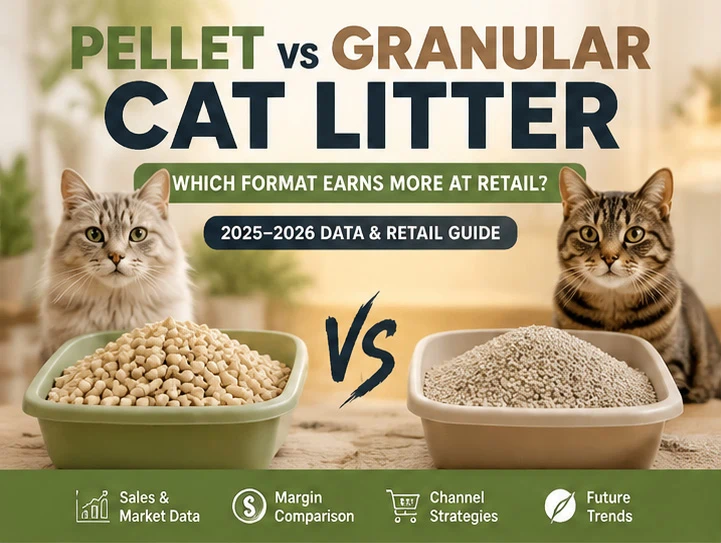
Most retailers stock whichever format they used personally or inherited from their first supplier. That’s a mistake that quietly costs 15–20 points of gross margin every month. Pellet vs granular cat litter is not a personal preference question — it’s a channel strategy question, and the answer is different depending on whether you’re running a rural pet shop, an urban boutique, a TikTok storefront, or a cross-border Amazon listing. This analysis draws on the 2025 Global Retail Report of Pet Consumables and covers every dimension that actually matters at the retail level: sales velocity by channel, cat acceptance rates, logistics cost, gross margin structure, and after-sales risk.
The short version: Granular leads on volume (62% global share). Pellets lead on margin (38–52% vs 18–25%) and are the faster-growing format for the second consecutive year. Both belong in a well-run store — the question is the ratio.
Key Facts: Pellet vs Granular Cat Litter at a Glance
What is pellet cat litter?
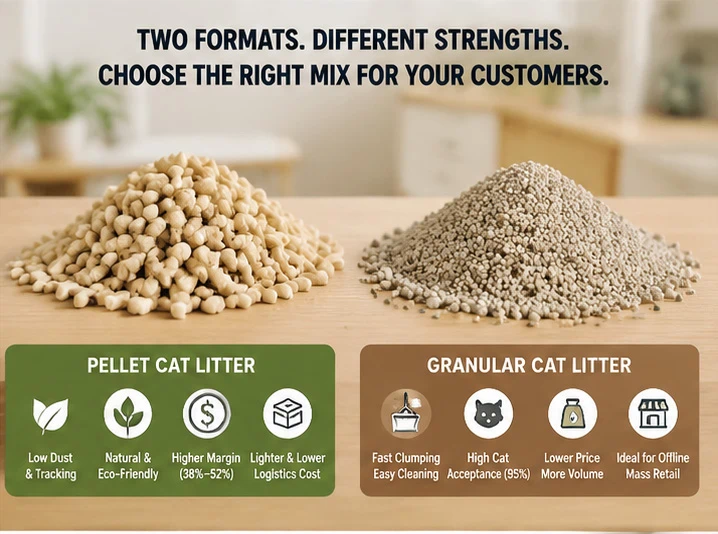
Pellet cat litter consists of extruded cylindrical particles (2–4 mm diameter, 6–12 mm length) made from plant-based materials such as tofu fiber, pine wood, or corn starch. It absorbs urine and disintegrates rather than clumping, generates near-zero dust, and is widely marketed as an eco-friendly, flushable cat litter option. Global retail share: 38% (2025), growing.
What is granular cat litter?
Granular cat litter consists of fine, round or irregular particles (0.8–3 mm) made from bentonite, mineral blends, or broken tofu sand. It clumps tightly on contact with urine for easy scooping, has a ~95% global cat acceptance rate, and leads retail volume at 62% of total global cat litter sales (2025).
Which sells better — pellet or granular cat litter?
Granular cat litter outsells pellet cat litter by total volume (62% vs 38% globally). However, pellets have grown faster for two consecutive years, earn 38–52% gross margins vs 18–25% for granular, and are gaining share rapidly in online, premium, and cross-border export channels. The right choice depends on your retail channel, customer base, and margin strategy.
Table of Contents
- Defining the Two Formats: Pellet vs Granular Cat Litter
- Core Performance Benchmarks: What Drives Repurchase and Reviews
- Global Retail Sales Data: Online vs Offline
- Side-by-Side Comparison Table
- Retail Operations: Gross Profit, Inventory, and After-Sales Risk
- Stocking Strategy by Store Type
- 2026–2027 Market Trend Forecast
- Conclusion
1. Defining the Two Formats: Pellet vs Granular Cat Litter
1.1 Pellet Cat Litter (Strip-Shaped / Columnar Particles)
Pellet cat litter — strip sand or column sand in trade shorthand — is an extruded cylindrical product: 2–4 mm in diameter, 6–12 mm long, high-temperature cured into dense rods that don’t break down under normal handling. Mainstream materials are tofu/soy fiber, pine wood, corn starch, and blended plant composites.
It doesn’t clump. Instead, pellets absorb urine and gradually disintegrate, with the spent material sinking to the bottom while the upper layer stays dry. Near-zero dust. Minimal tracking — the particles are simply too large to lodge between cat toes. Flushable in most tofu-fiber varieties. This is the format that apartment dwellers, allergy sufferers, and clean-home buyers are actively seeking out online. Browse our pellet cat litter range →
1.2 Granular Cat Litter (Fine Round or Irregular Particles)
Granular cat litter is the format most cats have used their entire lives: fine, round or irregular particles, 0.8–3 mm, loose and soft underfoot. Bentonite ore dominates production globally; broken tofu sand, crystal sand, and blended mineral formulas round out the category. The production process is simpler — grinding, screening, crushing — which keeps costs low and supply abundant.
On contact with urine it clumps fast and tight. That single behavior — easy to scoop, intuitive to use, instantly familiar to cats — is why granular formats have held 60%+ of global retail for decades and why they’re still the default choice for offline mass retail and multi-cat households. Shop our granular cat litter range →
2. Pellet vs Granular Cat Litter: Core Performance Benchmarks That Drive Repurchase
2.1 Cat Acceptance: The Metric That Drives Returns
Cats default to soft, sandy substrate. Granular formats replicate it. The global cat acceptance rate for fine-particle litter sits at roughly 95% — including elderly cats, kittens, and flat-faced breeds that are notoriously picky. No transition protocol required. Cats that resist one granular brand rarely resist switching to another.
Pellets are a harder sell — literally. The particles are firmer underfoot and feel nothing like natural sand. Some cats adapt within a week; others refuse the box entirely and start urinating elsewhere. That refusal pattern is why pellet return rates due to non-use run 3.2 times higher than granular. It doesn’t mean pellets are a bad product — it means they require pre-sale education, and stores that skip that step pay for it in returns.
2.2 Dust and Tracking: Where Pellets Win Decisively
Pellets generate almost no dust. The extruded structure doesn’t shed, doesn’t float, and doesn’t stick to paw fur. For households where someone has rhinitis or asthma, or where the litter box is in a bedroom, pellets are essentially the only viable option. Tracking — litter carried out of the box — is minimal because the particles are simply too large to wedge between cat toes.
Granular litter’s tracking problem is inherent. Fine particles follow cats out of the box and across floors, landing under furniture and in corners. Low-grade mineral sand also generates real dust during pouring and scooping. Anti-splash boxes help but don’t solve it. Every negative review about “sand everywhere” is format-inherent — you can’t educate your way out of it, only choose your customer base accordingly.
2.3 Clumping, Odor, and Cost-Per-Use
Clumping: Granular wins here, clearly. Tight discrete clumps, easy to scoop, rest of the litter bed stays intact. The catch: urine eventually seeps to the pan base, and after extended use you’re scrubbing hardened buildup. Pellets absorb and disintegrate instead — the upper layer stays dry, but you can’t spot-clean a clump. Full-layer sifting or periodic replacement is the routine. Tofu-fiber pellets are a partial exception; they clump mildly.
Odor: Pine and plant-fiber pellets suppress odor naturally, through adsorption and mild antimicrobial action. No added fragrance needed, and performance holds in warm weather. Most granular mineral sand depends on synthetic deodorizers that work fine until they don’t — high temperatures accelerate off-gassing, and summer complaints about odor reversal track almost entirely to low-cost bentonite SKUs.
Cost-per-use: Pellets are lighter and bulkier per bag. A single-cat household goes through roughly 20% more granular litter by weight each month than the equivalent pellet usage. Over a year, that difference is meaningful — both for the consumer’s wallet and for how often they need to reorder. Pellet customers reorder less frequently but are more loyal when they do.
3. Pellet Cat Litter vs Granular Cat Litter: Global Retail Sales by Channel
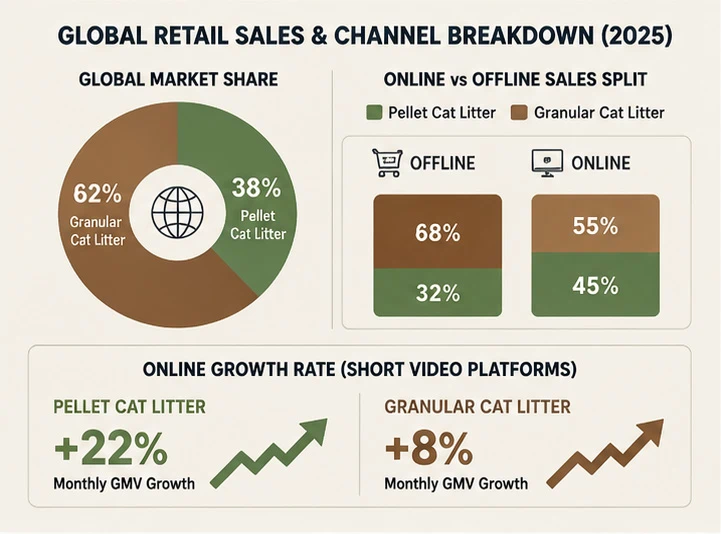
The overall 62/38 split between granular and pellet cat litter tells you less than the channel-level breakdown does. The gap is massive offline and nearly closed online — which means your optimal mix depends entirely on where you’re selling.
3.1 Offline: Granular’s Home Territory
Across independent pet stores, community supermarkets, township convenience shops, and breeder supply channels, granular accounts for roughly 68% of offline volume. The buyer profile is largely first-time owners, middle-aged consumers, and commercial breeders — people who prioritize clumping speed, high volume per bag, and low per-unit price. Bentonite and blended mineral SKUs move fastest. Deep inventory is the right call.
In rural and lower-tier markets, the ratio swings to 4:1 in granular’s favor. Price sensitivity is the dominant factor; dust and tracking don’t register as problems. In Tier 1–2 city boutiques, though, pellet allocation runs as high as 45% — because those customers are specifically seeking out the format for its dust-free and trackless performance.
3.2 Online and Cross-Border: Where Pellets Are Taking Share
Online the gap narrows sharply: roughly 55% granular, 45% pellet across Taobao, Douyin/TikTok, Pinduoduo, and Amazon cross-border. Over 80% of online cat litter buyers are under 35 — apartment dwellers, high-floor residents, people with dust sensitivities. They research before buying and convert strongly on short-video content showing dust-free pours or toilet-flush demos.
Pellet GMV on short-video platforms is growing at roughly 22% per month. Granular is at 8%. The content gap is structural: it’s simply easier to make a compelling 30-second video about pellets than about clumping sand. Cross-border is an even starker story — EU and North American sustainability regulations are actively restricting clay-based cat litter imports, and degradable plant-fiber pellet formats are the direct beneficiary. Overseas pellet sales have grown year-over-year for multiple consecutive years.
3.3 Repurchase Behavior
Granular buyers reorder frequently, with minimal brand loyalty. Budget households, multi-cat operations, and rural buyers run through stock fast and buy on price. The category is self-selling — no content required, no community needed. Reliable volume, thin margin.
Pellet buyers reorder less often but almost never churn. Once a cat adapts to the format, the owner rarely switches back — the cleaner home experience is too obvious to give up. These customers also respond well to cross-sells: pellet litter pairs naturally with sifting boxes, odor accessories, and premium food. For stores building a content-driven customer base, pellet buyers are the ones worth acquiring.
4. Pellet vs Granular Cat Litter: Side-by-Side Comparison
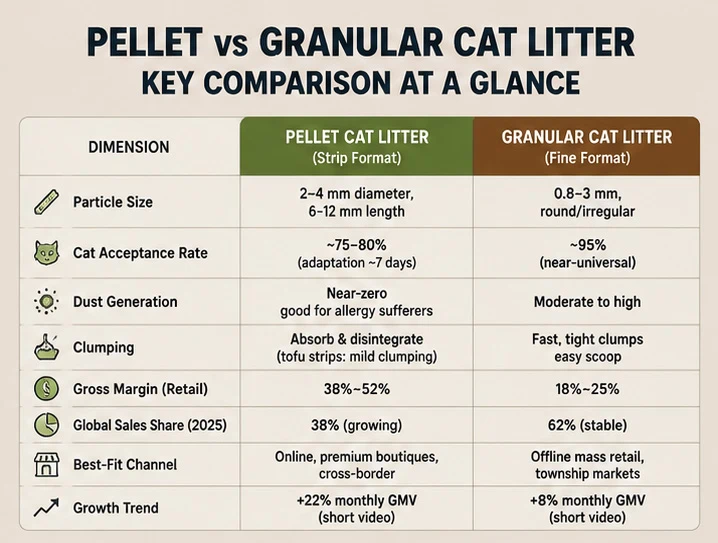
The table below summarizes the key retail dimensions across both formats to support stocking and ranging decisions.
| Dimension | Pellet Cat Litter (Strip Format) | Granular Cat Litter (Fine Format) |
|---|---|---|
| Particle Size | 2–4 mm diameter, 6–12 mm length | 0.8–3 mm, round/irregular |
| Main Materials | Tofu/soy fiber, pine wood, corn starch, blended plant composites | Bentonite ore, broken tofu sand, crystal sand, blended mineral sand |
| Cat Acceptance Rate | ~75–80% (adaptation period ~7 days) | ~95% (near-universal, no adaptation needed) |
| Return Rate (litter refusal) | 3.2× higher than granular | Baseline (lowest return rate) |
| Dust Generation | Near-zero; suitable for allergy sufferers | Moderate to high, especially low-cost mineral grades |
| Tracking (carry-out) | Minimal — particles too large to lodge in paw fur | High — fine particles spread across floors |
| Clumping | Most formats: absorb and disintegrate, no discrete clumps. Tofu strips: mild clumping. | Fast, tight clumps; easy scoop-and-discard cleaning |
| Odor Control | Natural antibacterial (pine/plant); stable in heat | Synthetic deodorizer; may off-gas in summer |
| Monthly Consumption (single cat) | Lower (higher bulk, slower depletion) | ~20% higher than pellets by weight |
| Retail Price Range | ¥25–58 / bag (online & offline) | ¥12–28 / bag (offline bulk) |
| Single-Product Gross Margin | 38%–52% | 18%–25% |
| Transport Loss Rate | <2% | 7%–11% |
| After-Sales Complaint Type | Cat adaptation (manageable via pre-sale education) | Dust, tracking, odor, sticky pan base (format-inherent) |
| Global Sales Share (2025) | 38% — growing | 62% — stable |
| Online Growth Rate (Short Video) | +22% monthly GMV | +8% monthly GMV |
| Cross-Border Overseas Trend | Rising strongly (EU/NA eco-policy tailwind) | Slowing in developed markets; strong in emerging markets |
| Best-Fit Channel | Online e-commerce, premium pet boutiques, cross-border | Offline mass retail, township markets, multi-cat breeders |
Bottom Line: Pellet vs Granular Cat Litter
- Volume leader: Granular — 62% of global retail, dominant offline and in price-sensitive markets.
- Margin leader: Pellet — 38–52% gross margin vs 18–25% for granular; 30% higher retail price at lower logistics cost.
- Growth leader: Pellet — +22% monthly GMV on short-video platforms vs +8% for granular; projected to reach 45% global share by end of 2027.
- Cat acceptance: Granular wins — 95% acceptance rate vs ~75–80% for pellets (7-day adaptation required).
- Best channel fit: Granular for offline mass retail and rural markets; pellet for online, premium boutiques, and cross-border export.
5. Retail Operations: Gross Profit, Inventory, and After-Sales Risk — Pellet vs Granular
The performance data above tells you what each format does. This section tells you what each format costs you — in margin, in logistics risk, and in post-sale labor. For most retailers, this is where the format decision actually gets made.
5.1 Margin Structure
Granular is a volume game. Raw materials are cheap and abundant; production is straightforward; offline bulk pricing runs ¥12–28 per bag. Gross margin lands at 18–25%. The hidden cost is freight: dense, heavy bags eat into margin on every long-distance shipment.
Pellets are a margin game. Same-weight bags price roughly 30% higher — ¥25–58 retail — and gross margins run 38–52%. The logistics math also flips: pellets are light for their volume, so the same fulfillment cost moves significantly more units. For e-commerce and cross-border operators, this is not a minor advantage. It compounds with every order.
5.2 Storage and Logistics Risk
Granular litter is fragile in transit. Fine particles break at the corners under stacking pressure, vibration during shipping, and repeated handling. Loss rates of 7–11% are common. The format is also hygroscopic — ambient humidity triggers premature clumping in storage, shortening usable shelf life. Heavy weight limits how much you can store per square meter.
Pellets are nearly the opposite. The extruded structure holds up under stacking; transit loss runs below 2%. Plant-fiber pellets resist moisture well and store reliably at ambient temperature for extended periods. The low bulk density means higher unit counts per shelf bay, which matters for stores managing e-commerce fulfillment in-house.
5.3 After-Sales Cost
After-sales isn’t just refunds — it’s review score management, repeat customer outreach, and staff time on complaint resolution. The two formats generate very different after-sales profiles.
Granular produces a steady stream: dust aggravating rhinitis, sand tracked across floors, synthetic odor turning in summer heat, buildup welded to the pan base. None of these complaints are resolvable through better product advice. They’re format-inherent. Each one needs individual handling, and at scale the labor cost is real.
Pellets produce one complaint type: cat adaptation failure. The difference is that this one is manageable. Stores that walk customers through a 7-day blended transition protocol — mixing pellets gradually into the existing granular litter — see adaptation-related returns drop dramatically. After the transition window closes, product quality complaints are rare. The long-run after-sales cost of a pellet-heavy range is significantly lower than granular, which is easy to miss when you’re only looking at the return rate on a per-unit basis.
6. Stocking Strategy: How to Range Pellet and Granular Cat Litter by Store Type
6.1 Which Format Fits Which Customer
Granular is the right call for: cats with established preferences or litter box anxiety; elderly or mobility-impaired cats; multi-cat households where budget and clumping convenience dominate; and buyers in humid climates where pellet disintegration is inconsistent. Don’t try to convert these customers to pellets — sell them the best granular SKU for their situation.
Pellets suit: high-floor apartment residents, small enclosed spaces where tracking creates outsized problems, anyone with respiratory sensitivities, buyers who want flushable or biodegradable litter, and households willing to spend a week on transition in exchange for a permanently cleaner home. These customers often self-identify online before they even reach your store. They’re already sold on the format — you just need to stock it.
6.2 Stocking Ratio by Retail Format
Township and rural community stores: 75% granular / 25% pellet. Volume and price dominate here. Stock deep on low-cost bentonite and blended mineral SKUs. Keep a small pellet selection for the occasional premium buyer, but don’t over-index — slow-moving pellet inventory in a price-sensitive market is dead capital.
Urban boutique pet stores (Tier 1–2 cities): 40% granular / 60% pellet formats. The customer base skews toward affluent, health-conscious buyers willing to pay a premium for clean-home performance. A 60% pellet allocation lifts average basket size and store gross margin while reinforcing a premium brand positioning that differentiates from mass-market chain competitors.
Online e-commerce and live-commerce channels: 50% blended-format granular SKUs / 50% viral pellet SKUs. Balance traffic-driving volume sellers (large-bag clumping granular) with high-margin content-driven pellet lines (tofu fiber, pine, charcoal). Short video content drives pellet conversion at significantly lower CPM than granular formats — use platform content tools to maximize this asymmetry.
Cross-border export storefronts: 30% fine mineral sand / 70% degradable plant-fiber pellet formats. Environmental regulations in the EU and North America are actively restricting clay-based cat litter on import sustainability grounds. Plant-based pellet formats clear these regulatory hurdles and command premium pricing in overseas markets. This ratio positions the store for both current revenue and regulatory compliance. Looking to source at scale? Learn about our OEM and bulk wholesale programs →
7. 2026–2027 Market Trend Forecast
The pellet vs granular cat litter share split is moving — slowly but consistently — toward parity. Granular won’t be displaced in the next two years, but every structural trend in the market favors pellet formats: environmental regulation, content commerce, urban premiumization, and an industry actively engineering away the one weakness that holds pellets back (particle hardness). Here’s the channel-level picture through 2027.
Over the next two years, granular fine particle cat litter will retain its position as the global sales volume leader. Its grip on offline mass retail, township markets, and multi-cat breeding supply chains is structural and will not be displaced in this timeframe. Blended granular formats — combining mineral base with low-dust additives or plant-fiber particles — are emerging as the next mainstream sub-segment, capturing buyers who want clumping performance with reduced tracking and dust.
The more dynamic growth story belongs to pellet cat litter. Market-share projections suggest the pellet segment will reach 45% of global retail sales by end of 2027, up from 38% today. Three forces are driving this convergence: the global policy trend toward plastic-free and biodegradable pet products (which systematically disadvantages clay mineral sand in export markets); the continued growth of content-commerce and short-video retail (where pellet formats have a structural content advantage); and the ongoing premiumization of the pet care category, with consumers in developing urban markets beginning to replicate the preferences of buyers in first-tier cities.
On the product side, the industry is actively working to address pellet cat litter’s primary weakness: particle hardness and cat foot sensitivity. Manufacturers are developing softened extrusion processes that reduce particle firmness while maintaining structural integrity — closing the adaptation gap that currently drives the higher return rate for pellet formats. Once a softer-format pellet achieves mainstream availability, the primary objection to pellet adoption (cat refusal) will diminish substantially.
The retail market is also moving toward product segmentation by cat type. Miniature pellet formats designed for flat-faced breeds, short-legged cats, and kittens are in development. Large-particle high-adhesion granular formats for multi-cat households (reducing the need for frequent full-box changes) are being introduced to address the clumping format’s pan-buildup weakness. The long-term trend is not winner-takes-all between formats — it is co-existence through sub-segmentation.
For retail operators, the future opportunity lies in bundled selling: transitional combination packs that pair “granular for immediate acceptance” with “pellet for long-term maintenance” reduce the stress of the sand-transition period, increase average order value, and give merchants a structured reason to reactivate customers at multiple points in the repurchase cycle. Stores that invest now in content ecosystems supporting pellet adoption will build a customer base that generates high-margin, high-loyalty repurchase for years.
Conclusion: Pellet vs Granular Cat Litter — Which Should You Sell?
One-sentence answer: Sell both — granular cat litter for volume and cat acceptance, pellet cat litter for margin and growth; the optimal ratio depends on your channel, with online and cross-border stores running 50–70% pellet and offline mass-market stores running 70–75% granular.
Sell both. That’s the actual answer. The pellet vs granular cat litter question isn’t a product debate — it’s a portfolio question, and the retailers who treat it that way are the ones running 40%+ blended gross margins while everyone else fights over bentonite pricing.
Granular is your volume foundation. It moves in every channel, needs no education, and serves the customers who will never switch formats. Accept the thinner margins and the occasional tracking complaint, and stock it deep wherever foot traffic or price sensitivity is high.
Pellets are your growth lever. Faster-growing, higher-margin, lighter to ship, easier to store, and they build a customer base that almost never churns. The investment is pre-sale: teach the transition, explain the 7-day adaptation window, and most of the after-sales cost disappears.
The most effective move right now is the bundle: a combination pack that pairs a granular starter with a pellet maintenance option, sold as a transition kit. It raises average order value, smooths the adaptation curve, and gives you a reason to reactivate customers at multiple touchpoints. That’s where the retail cat litter market is heading — not one format winning, but both formats working together, matched to the right customer at the right moment.
FAQ
Which sells better overall — pellet or granular cat litter?
Granular leads on volume at 62% of global retail. Pellets hold 38% but are growing faster for two consecutive years and generate 38–52% gross margins vs 18–25% for granular. Granular wins on quantity; pellets win on profit. Most successful retailers stock both and optimize the ratio by channel.
Which cat litter format has higher gross margin for retailers?
Pellet cat litter earns significantly more per unit: 38–52% gross margin vs 18–25% for granular. Same-weight pellet bags retail 30% higher, and pellets are lighter to ship, cutting logistics cost further. For online and cross-border sellers, the combined margin advantage is substantial.
Do cats prefer pellet or granular cat litter?
Granular, by a wide margin. Its fine texture mimics natural sand, giving it a ~95% global cat acceptance rate with no transition needed. Pellets have a harder texture that some cats reject initially; a 7-day blended transition protocol is recommended. Pellet return rates from cat refusal run 3.2× higher than granular.
Which format is better for controlling dust and litter tracking?
Pellets are decisively better on both. The extruded structure generates near-zero dust and doesn’t lodge between cat toes, so tracking is minimal. Granular litter — especially low-cost bentonite — produces measurable dust during use and spreads across floors when cats exit the box. For allergy sufferers or small apartments, pellets are the only practical option.
Which cat litter format sells better online vs offline?
Offline, granular dominates at ~68% of volume. Online, the gap nearly closes: ~55% granular vs ~45% pellet. Online buyers skew younger and prioritize dust-free, eco-friendly, and flushable attributes — exactly where pellet formats excel. On short-video platforms, pellet GMV is growing at 22% monthly vs 8% for granular.
What is the recommended stocking ratio for a pet store?
It depends on your channel. Rural and township stores: 75% granular / 25% pellet. Urban boutique stores: 40% granular / 60% pellet. Online e-commerce: 50/50. Cross-border export storefronts: 30% granular / 70% degradable plant-fiber pellet to meet EU and North American environmental import standards.
Is pellet cat litter harder to manage after-sales than granular?
No — it’s easier long-term. Granular generates persistent complaints about dust, tracking, odor, and pan buildup that are format-inherent and unresolvable. Pellet after-sales concentrates on one issue: cat adaptation. That’s manageable with pre-sale education. Stores that walk customers through a 7-day transition protocol see adaptation-related returns drop substantially.
Will pellet cat litter overtake granular in market share by 2027?
Not fully, but the gap is closing. Pellets are projected to reach 45% of global retail by end of 2027, up from 38% today. Three forces drive this: biodegradable product regulations tightening in the EU and North America, short-video commerce growth favoring pellet content, and ongoing softening of pellet particle texture to reduce cat rejection.