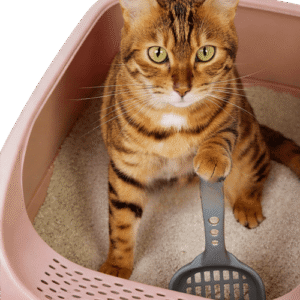





Cat owners with respiratory-sensitive cats likely share a common frustration: You feed them the best food and keep up with deworming, yet your cat still sneezes frequently, rubs their eyes, or makes occasional “wheezing” sounds. Many of these cases are not caused by illness but by environmental triggers such as dust-free litter that is not truly safe for long-term use. In fact, using the wrong low dust cat litter or low-quality litter for sensitive cats can significantly worsen respiratory symptoms. They seem lethargic, too. At first, you might suspect a cold, but a trip to the vet reveals no infection. The vet’s verdict: “It’s likely environmental irritation. Start by checking your cat litter.”This guide focuses on how to choose the best low dust cat litter for sensitive cats that suffer from respiratory issues.
As a long-time professional in the pet supply industry, we consult with many cat owners facing this exact issue. What many people don’t realize is that for sensitive cats, fine litter dust is a persistent, often-overlooked respiratory irritant. A cat’s respiratory system is far more fragile than a human’s, and their sense of smell is considerably more acute. Microscopic dust enters their nasal passages and trachea, even reaching deep into the lungs. Over time, this doesn’t just cause sneezing; it can trigger feline wheezing, chronic bronchitis, or, in some cases, longer-term respiratory sensitivity.
Today, in collaboration with our partner cat litter manufacturers, we want to have an honest, science-based conversation: How should owners of sensitive cats choose the right litter? What health crises are hidden behind ignored dust hazards? Drawing on R&D data, testing experience, and feedback from thousands of owners, we’ll help you avoid the “dust traps” and find the best low dust cat litter that allows sensitive cats to breathe more comfortably. For cats prone to respiratory irritation, choosing a truly low dust cat litter or reliable no dust cat litter option is often the first and most important step toward improving their daily quality of life.
To be perfectly honest: For a respiratory-sensitive cat, choosing the right litter is more important than choosing the right food. Poor food might cause an upset stomach, but poor litter can contribute to longer-term respiratory tract irritation that is easy to overlook until symptoms become established. Our veterinary consultants emphasize one core rule: Keep away from dust. Any high-quality low dust cat litter must meet strict low-dust standards while remaining safe and non-irritating for long-term daily use.
Field observations from our partner manufacturers and specialized pet respiratory hospitals suggest a large share of comfort issues in sensitive cats — often the majority — are linked to litter dust. Many owners also unknowingly use litter with excessive dust levels, leading to recurring issues that cause both physical pain for the cat and added veterinary costs for the owner. In reality, simply switching to a low dust cat litter and using it correctly can significantly alleviate most respiratory discomfort.
Quick Answer
Respiratory-sensitive cats react strongly to fine airborne litter dust. The practical fix is a genuinely low-dust formula (dust rate below about 1%, validated by testing) made from natural, non-irritating materials, used with good ventilation and regular litter-box cleaning. Low-dust litter reduces inhaled particles and supports comfort, but it is not a substitute for veterinary care when symptoms persist.
Why Low Dust Cat Litter Matters for Sensitive Cats with Respiratory Issues
Many owners wonder: how can tiny particles we can barely see cause so much damage? It comes down to feline physiology. A cat’s airway is extremely narrow and their mucous membranes are incredibly fragile. Their throat area is packed with cough receptors that are hypersensitive to both mechanical and chemical irritation. Even a tiny amount of dust can trigger a violent reaction.This is why cat litter for asthma-prone cats must be carefully selected to avoid respiratory triggers.
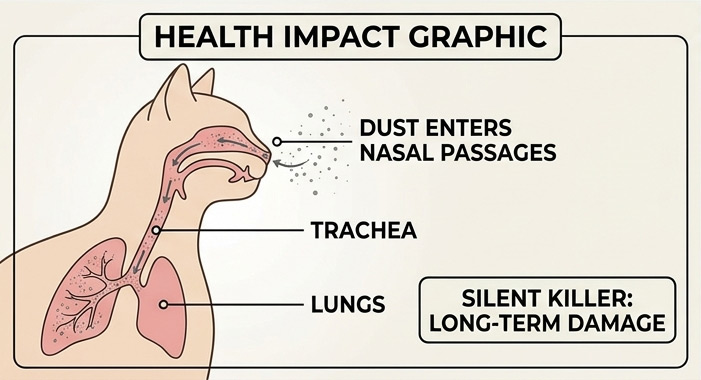
R&D researchers at litter companies have found through professional testing that dust particles in ordinary litter typically range from 0.1 to 10 microns in diameter. A cat’s respiratory system can only filter out particles larger than 10 microns. Those finer particles bypass natural defenses, entering the trachea and bronchi, and even settling deep in the lungs. Over time, this buildup irritates the lining of the airway, leading to congestion, edema (swelling), and chronic inflammation.Only a true respiratory-safe cat litter can effectively minimize the risk of these fine particles entering the lungs.
Even more concerning is a cat’s grooming habit. After using the litter box, dust inevitably clings to their paws. When they lick themselves clean, they ingest this dust, which irritates the digestive tract and can pass through the throat to irritate the airway again—a “double whammy” of harm. Brachycephalic (flat-faced) breeds, such as Persians and Exotic Shorthairs, are at even higher risk; their naturally narrower airways make them hypersensitive to even minimal dust, which can quickly lead to severe wheezing.
We once encountered a case involving a 2-year-old British Shorthair with sensitive airways. The owner was using a standard bentonite clay litter. The cat sneezed and rubbed its eyes constantly, suffered from bouts of dry coughing, and would eventually stretch its neck out to breathe through its mouth, becoming increasingly lethargic. At the hospital, the vet diagnosed “feline wheezing” (asthma) triggered by long-term dust inhalation. Once the owner switched to the best low dust cat litter made from natural plant-based ingredients(natural cat litter), the sneezing and coughing subsided within a week, and the cat regained its playful energy.
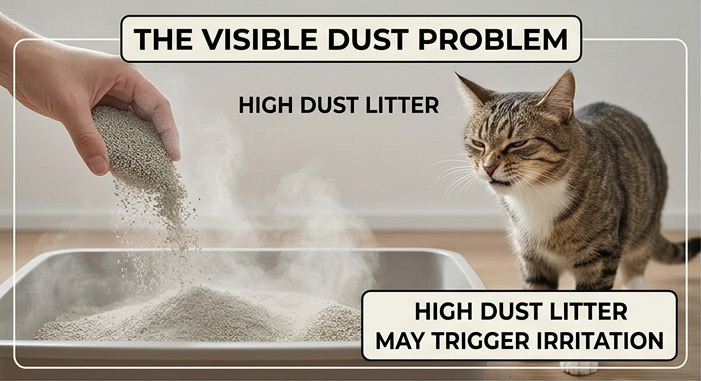
Beyond the cat, litter dust contaminates the entire home. When a cat digs, fine particles drift onto sofas, window sills, and cat trees. This doesn’t just soil furniture; it’s inhaled by everyone in the house. For households with seniors, children, or humans with respiratory sensitivities, this is a real health concern. Many owners report coughing while pouring litter—a clear red flag of excessive dust. If it makes you cough, imagine the impact on a cat who puts its face right in it every day.
Testing data shows that for high-quality low dust cat litter, the dust rate must be controlled below 0.80%, with a friability rate (tendency to crumble into dust) of ≤1.00%. This is the only way to minimize irritation. In contrast, low-quality litters can have dust rates exceeding 3%, contributing to ongoing respiratory irritation in cats with sensitive systems.
4 Principles for Choosing the Best Low Dust Cat Litter
Based on years of R&D data from litter manufacturers and our own industry observations, we have summarized four core principles. By following these rules, you can more easily identify a low dust cat litter that truly protects your cat’s respiratory health. These principles are the same rigorous standards used by professionals when developing specialized formulas for sensitive cats.
Principle 1: Low Dust is Non-Negotiable; Real-World Testing is Key
For cats with respiratory sensitivities, the amount of dust is the number one priority—period. No matter how well a litter absorbs moisture or clumps, if it fails the dust test, it’s a hard “no.” Don’t be misled by “99% Dust-Free” labels on the packaging. Many dust-free litter products on the market fail real-world testing despite marketing claims.True low dust cat litter or no dust cat litter products must be verified through actual testing and meet strict industry standards.
Reputable manufacturers use at least three professional de-dusting stages. Some even employ proprietary “Clean-Dust” or “Micro-Dust” technologies to eliminate fine particles, ensuring that pouring the litter or a cat’s digging won’t create a cloud. For example:
- Premium Natural Plant Litters: Undergo washing, drying, grinding, and multiple de-dusting cycles to keep the dust rate strictly below 0.80%.
- Low-Dust Bentonite: Uses purification and electrostatic de-dusting to remove impurities and fine raw material particles.
To help beginners avoid “dust traps,” here are two internal testing methods used by litter professionals:
Method 1: The Water Bottle Test
Fill a clear, empty water bottle halfway with litter. Cap it and shake vigorously for 10 seconds, then let it sit for 30 seconds. Look at the inside walls of the bottle. If there is only a faint film of dust, it’s safe for sensitive cats using a low dust clumping litter formula. If the walls are coated in a thick layer of powder or you saw a visible cloud while shaking, it’s a “dust bomb”—do not buy it.
Method 2: The Palm Friction Test
Take a handful of litter in your palm and rub your hands together gently for 30 seconds. Toss the litter and look at your palm. If there is minimal residue and no irritating smell, the dust level is acceptable. If your palm looks grey or feels “muddy,” or if you felt a puff of dust while rubbing, the litter is unsuitable for sensitive cats.
A Final Warning: Many low-end, cheap litters skip the de-dusting process to save costs. While they are budget-friendly, the long-term cost to your cat’s health is far higher. We always tell our customers: when it comes to a sensitive cat, investing in the best low dust cat litter is worth it.
Principle 2: Natural, Non-Irritating Ingredients; Zero Chemical Additives
Beyond dust, the raw materials and additives in cat litter can also irritate a cat’s respiratory tract. Sensitive cats are hypersensitive to chemical and pungent odors. Unfortunately, many low-quality litters use industrial glues, bleachers, and artificial fragrances to cut costs or create “selling points.” These substances emit sharp smells that not only irritate the respiratory system but can also trigger skin allergies and digestive issues.
R&D experts from litter manufacturers state that for sensitive cats, Natural cat litter is generally safer for long-term respiratory health. ingredients must be natural, non-irritating, and free from harmful chemicals—ideally meeting pet-safe or even food-grade standards. The most common high-quality low dust cat litter products generally fall into two categories:
- Natural Plant-Based Ingredients: These include pea/soy fiber, corn starch, and cassava starch. These materials are inherently non-toxic and carry only a faint, natural scent rather than a chemical one. They are gentle on the respiratory tract, produce minimal dust, and are safe even if small amounts are accidentally ingested.
- Natural Mineral Ingredients: This primarily refers to high-purity bentonite clay. Once purified and de-dusted, it offers excellent clumping and absorption with controlled dust levels. This is a great option for sensitive cats that love to dig or have a high urine volume. However, ensure it is specifically labeled as “low-dust” or “professional-grade de-dusted” bentonite, as standard clay litter is often a major dust offender.
Pro Tips for Choosing No Dust Cat Litter
- Check the Ingredient List: Reputable brands clearly list their components, such as “soy fiber, corn starch” or “high-purity natural bentonite.” Avoid products with vague terms like “composite materials,” “other ingredients,” or those mentioning industrial adhesives, preservatives, or artificial perfumes.
- The Scent Test: High-quality no dust cat litter should only smell like its raw materials. If you open the bag and are hit by an overwhelming floral scent or sharp chemical odor, it likely contains artificial fragrances that may irritate your cat’s nose and lungs.
Principle 3: Smooth Texture with No Sharp Edges; Gentle on Paws and Lungs
Cats with respiratory sensitivities are not only sensitive to dust but also very picky about texture. If the litter particles are coarse or have sharp angles, they don’t just scratch the cat’s delicate paw pads; the friction between these jagged grains generates even more dust during digging, further irritating the airway. Furthermore, rough particles are more likely to get stuck between the toes, spreading dust throughout the home.
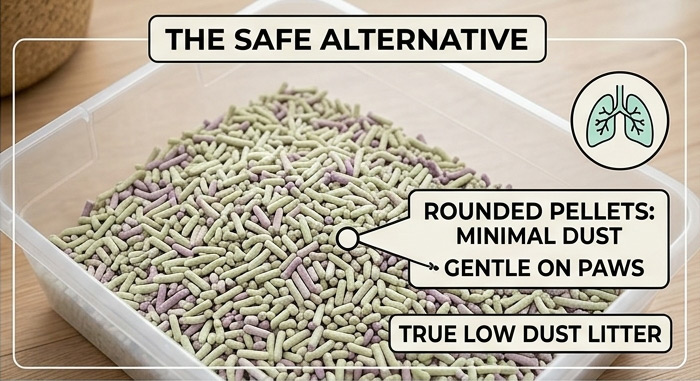
Through thousands of tests, manufacturers have found that the ideal low dust cat litter for sensitive cats must have uniform particles—typically between 2–4 mm in diameter. The texture should be refined yet maintain a certain hardness, having undergone a polishing process to remove sharp edges.They also help create a low tracking litter effect, reducing dust spread outside the box.
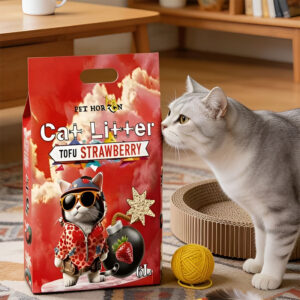
- Natural Tofu Litter: Features rounded, smooth pellets with a soft touch. It produces minimal dust and is very gentle on paws.
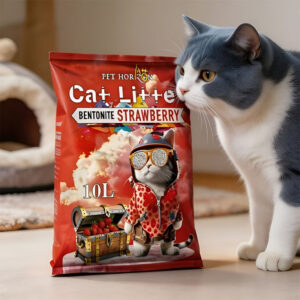
- Low-Dust Bentonite: High-quality versions are polished until the grains are smooth and spherical. This satisfies a cat’s instinct to dig while significantly reducing dust production.
In contrast, low-quality litters often have uneven sizes and sharp edges, making them very unfriendly to sensitive cats.
Pro Tip: The Palm Rub Test
Take a handful of litter and rub it gently against your palm. If you feel sharpness or rough edges, the texture is substandard and likely to irritate your cat. Smooth, uniform particles are safer and more comfortable.
Keep an Eye on the Friability Rate
Litter with a high friability rate breaks down quickly during use, creating excessive fine powder. This not only increases dust hazards but also turns the litter box into a mess. According to industry standards, premium low dust cat litter should maintain a friability rate of ≤1.00%.
Principle 4: Superior Absorbency and Clumping Reduce Odor and Dust Spread
You might wonder: “What do absorbency and clumping have to do with respiratory sensitivity?” While they don’t directly determine the initial dust level, they play a major role in preventing secondary dust spread and odor irritation.
If litter has poor absorbency, urine stays on the surface longer. This allows ammonia odors to spread rapidly, and strong odors are a major trigger for respiratory-sensitive cats. Weak clumps also break apart when scooped, producing additional fine particles that increase overall dust exposure.This is why respiratory-safe cat litter must control both odor and secondary dust generation.
According to professional manufacturing standards, high-quality low dust clumping litter should meet these benchmarks:
- Absorbency Rate: No less than 25.0%
- Absorption Speed: Fully locks in liquid within 3–5 seconds
- Clumping Strength: ≥80.0%, forming solid clumps that stay intact during scooping
Pro Tip: The 10ml Test
Place a small amount of litter in a container and pour 10ml of water onto it. If the liquid is absorbed within seconds and forms a firm clump that does not crumble, the litter performs well.
3 Types of Cat Litter Sensitive Cats Should Avoid
Drawing from professional testing and industry observation, we’ve identified three types of litter that are absolute “no-gos” for respiratory-sensitive cats.
1. High-Dust Litter Without Proper De-Dusting
These products often come from low-end workshops that skip professional de-dusting. Opening or pouring the bag releases visible dust clouds into the air. This kind of litter is the opposite of true no dust cat litter and should be avoided completely.
2. Litters with Artificial Fragrances and Chemical Additives
To cheaply mask odors, some litters are loaded with strong artificial perfumes, industrial glues, or bleaching agents. These chemicals can irritate sensitive cats and may even cause litter box avoidance.
3. Coarse Litter with High Friability
Sharp, fragile litter particles break down rapidly during digging, producing continuous fine dust that spreads throughout the home and constantly irritates the respiratory tract.
How to Use Low Dust Cat Litter Correctly
Choosing the best low dust cat litter is only the first step. Correct daily usage also plays a major role in minimizing dust exposure.
Maintain the Ideal Depth: 5–8 cm
Keeping the litter depth between 5–8 cm helps prevent urine from sticking to the bottom while avoiding unnecessary dust caused by excessive digging.
Pour Slowly and Gently
Many owners pour litter too quickly, creating airborne dust clouds. Instead, pour slowly along the edge of the litter box and allow particles to settle before your cat enters.
Choose the Right Location
Place the litter box in a dry, ventilated area away from food and water bowls. Avoid strong airflow directly hitting the box, as this may spread fine dust around the room.
Clean Regularly
Scoop waste at least once or twice daily. Replace old litter frequently to prevent moisture buildup, odor concentration, and dust accumulation.
Transition Gradually
Sensitive cats often dislike sudden changes. Mix the new low dust cat litter gradually with the old litter over several days to help your cat adapt comfortably.
Final Thoughts: Protecting Sensitive Cats Starts with the Right Low Dust Cat Litter
Cats with respiratory sensitivities are like little angels who require extra-delicate care. Their airways are so fragile that even a tiny amount of dust can cause immense suffering. As an everyday necessity, the dust level of your cat litter directly dictates your cat’s respiratory health and the overall air quality of your home.
As pet professionals, we have seen far too many cases where the wrong litter caused recurring pain for sensitive cats. Conversely, we’ve seen countless cats regain their energy and breathe freely again simply by switching to a high-quality low dust cat litter option. We firmly believe that a “good” litter must do more than just absorb and clump; its ultimate mission is to safeguard health. For sensitive cats, “low-dust” and “natural” are the priorities we recommend weighing most heavily.
The original mission of our partner manufacturers is to provide a safer, more comfortable bathroom experience for every cat, especially those struggling with respiratory issues. Every bag of low dust cat litter from a reputable company undergoes thousands of tests and optimizations—from raw material screening to production—all to minimize dust and protect those tiny lungs.
We hope this guide empowers every owner of a sensitive cat to understand the keys to choosing litter and avoid the “dust traps.” Living with a cat is a healing journey. Since we have chosen to share our lives with these small beings, we owe it to them to care for every detail. Choosing the right best low dust cat litter is the vital first step.
May every sensitive cat enjoy a dust-free environment where they can breathe easily, free from the constant annoyance of sneezing and coughing. And may every owner find relief from dust-related stress, finding only happiness and comfort in their cat’s company. Let your home be a place of gentle purrs and fresh air, where every breath is a breath of peace.
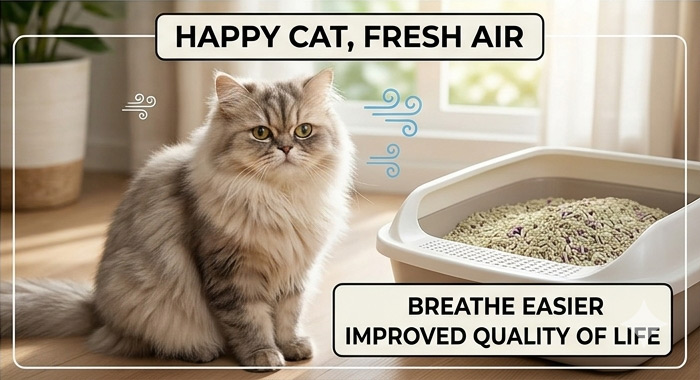
One final reminder: When choosing litter for a sensitive cat, don’t just follow the crowd or chase the highest price tag. Focus on the dust rate, ingredients, texture, and clumping performance. Observe your cat’s reaction closely. That is the secret to finding the perfect dust-free cat litter for your cat’s needs. Whether you prefer natural tofu litter or purified bentonite, choosing a truly low dust cat litter, especially a natural cat litter or no dust cat litter option, ensures long-term respiratory safety for sensitive cats. That is the core message we and our manufacturing partners want to share with every cat owner.
FAQ
What is the best low dust cat litter for sensitive cats?
The best low dust cat litter for sensitive cats is one that combines low dust production, natural materials, and strong clumping ability to protect respiratory health.
Is dust-free litter safe for cats with asthma?
Dust-free litter can help reduce irritation, but cat litter for asthma must also be free from chemicals, fragrances, and fine particles. Persistent symptoms should be reviewed by a veterinarian.
What is the difference between low dust cat litter and regular litter?
Low dust cat litter undergoes de-dusting processes to reduce airborne particles, while regular litter often contains high dust levels that may trigger respiratory issues.
How can I tell if a cat litter is truly low dust?
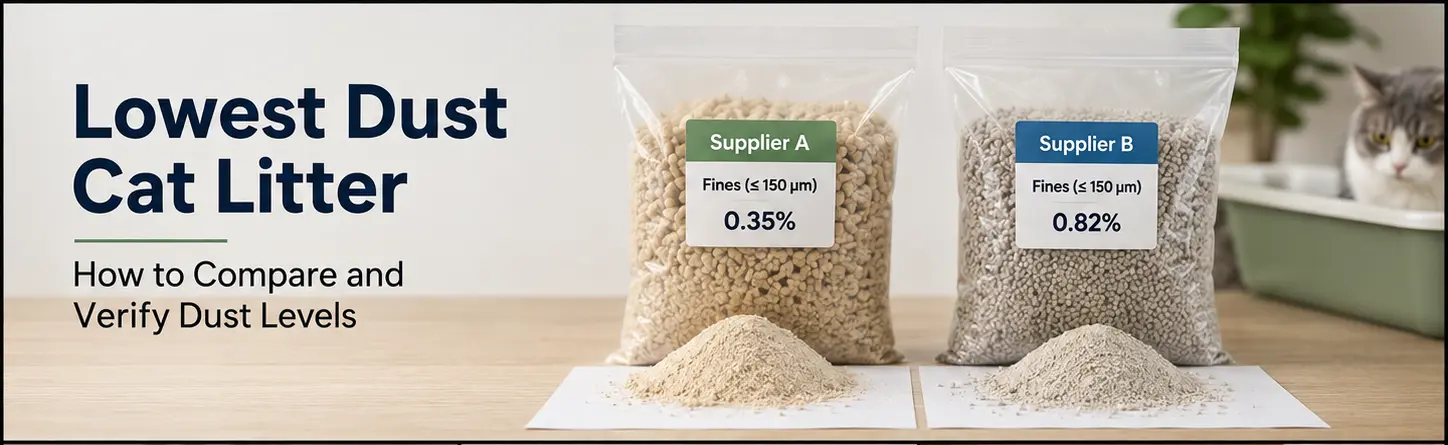
Ask the supplier for a dust test report (static dust rate, particle-size distribution, inhalable fraction). Genuinely low-dust products typically measure below about 1% total dust; claims without a test report are hard to verify.
What dust rate should low dust cat litter meet?
Many buyers treat a total dust rate below 1% as a procurement benchmark, with some specifications targeting below 0.80%. These are commercial conventions rather than a single mandated standard, so always request the supplier’s own test data.
Does low dust litter still clump and control odor?
Yes. A well-formulated low dust litter can deliver fast clumping and odor control while keeping airborne particles low. Clumping performance and dust control are independent properties addressed separately during manufacturing.
Can kittens use low dust cat litter?
Low dust formulas are generally suitable for kittens, whose respiratory systems are still developing. Choose a soft, natural, unscented option and keep the litter box clean and well ventilated.
Where can I buy low dust cat litter in bulk or private label?
For distributors and brands, OEM cat litter production and private label packaging are available with customized formulas, fragrances, and bag design. MOQ is 1×20ft container.