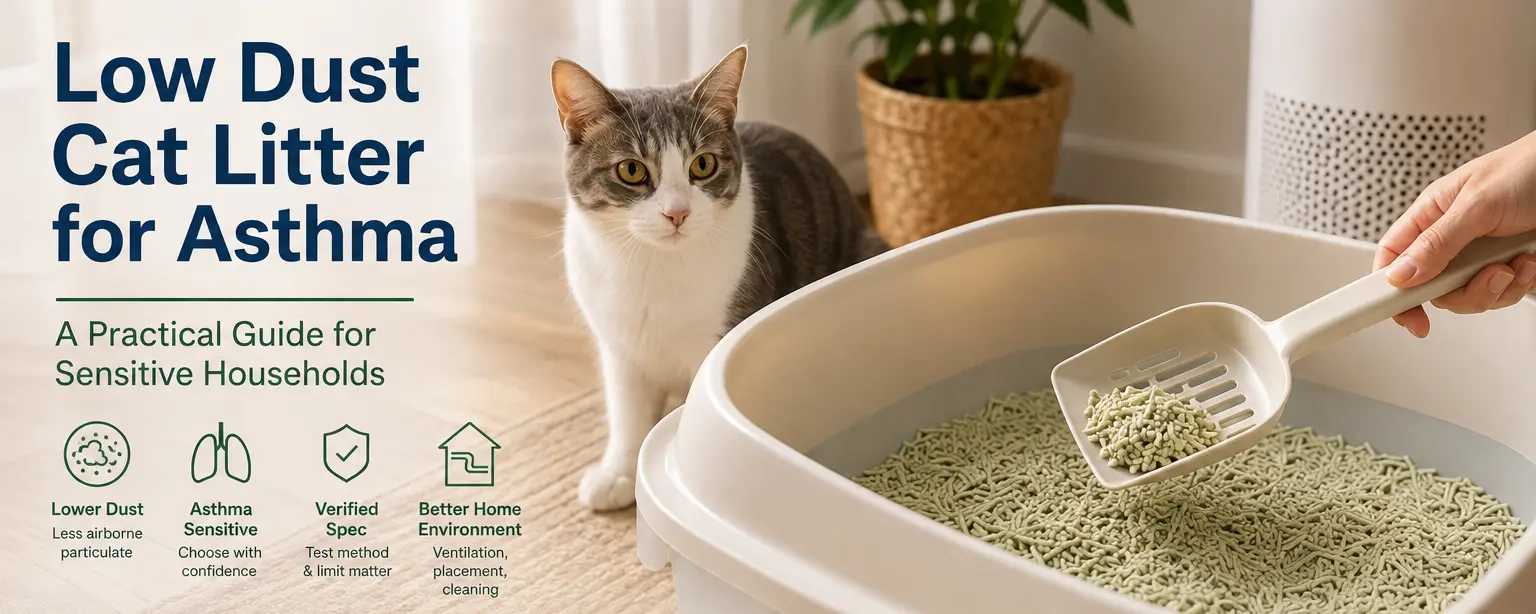





Buyers searching for no dust cat litter are usually solving a practical problem: loose powder that clouds the air when a bag is opened, a tray is filled, or clumps are scooped. For distributors, shelters, and private label brands, dust is also a returns and complaint driver. Buyers serving allergy-prone households may also review our low dust cat litter for sensitive cats guide for the household side of the same issue.
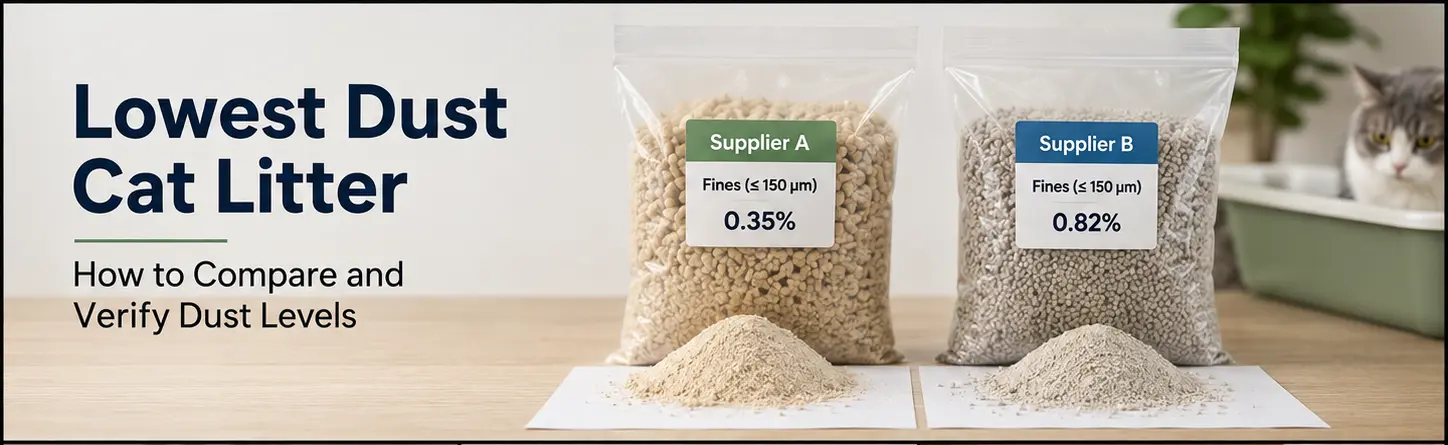
“No dust cat litter” is generally a marketing or procurement term rather than a universal technical standard. The practical B2B approach is to define a measurable dust or fines limit using a specified test method, then verify that limit through supplier QC and batch testing. Manufacturers typically reduce dust through controlled granulation, mechanical dedusting, screening, and moisture management, but the test conditions must be written into the OEM or private label specification rather than assumed. Respirability is a separate exposure-related characteristic and should not be treated as interchangeable with a general product dust rating.
Quick Answer: For OEM and private label buyers, “no dust” should be treated as a measurable product specification rather than a literal zero-dust claim. Define the test method, maximum dust or fines level, sampling procedure, and batch acceptance criteria before production.
What “No Dust” Means as a Cat Litter Specification
Buyers may describe the requirement as “no dust cat litter,” “cat litter without dust,” or “dust-free cat litter.” These phrases generally describe the same commercial goal: minimizing loose fines and airborne particles during normal handling. Because none of these terms defines a universal test limit, the purchasing specification should state the measurement method, test conditions, and acceptance threshold rather than assume that “no dust” means zero particles.
Treating “no dust” as a measurable spec protects both sides of a supply agreement. A supplier knows exactly what to test for, and a buyer has an objective basis to accept or reject a batch instead of relying on a visual impression at the warehouse.
How Manufacturers Reduce Dust
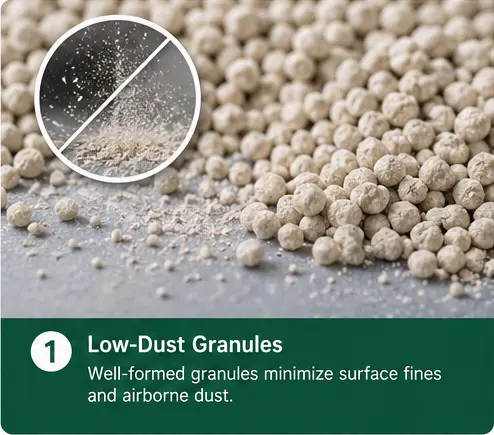
Cat litter dust generally consists of fine particles that are already present in the formulation or are generated when granules fracture and abrade during processing, packaging, transport, and handling. Particle-size distribution, granule strength, screening efficiency, and packaging conditions all influence the amount of loose powder that reaches the customer. Several manufacturing controls can reduce dust at different stages of production. The main controls discussed below are granulation and pelletizing, mechanical dedusting and screening, and formulation-specific moisture and binder control.
Granulation and Pelletizing
Well-formed extruded or pelleted granules can provide better particle-size control and resistance to abrasion than poorly consolidated material. However, granule shape alone does not determine dust performance; formulation, compaction, drying, screening, and handling conditions also affect the amount of fines generated. For dust control, a well-formed clumping litter with good granule integrity is generally easier to manage than material with a high proportion of loose or friable fines.
Mechanical Dedusting and Screening
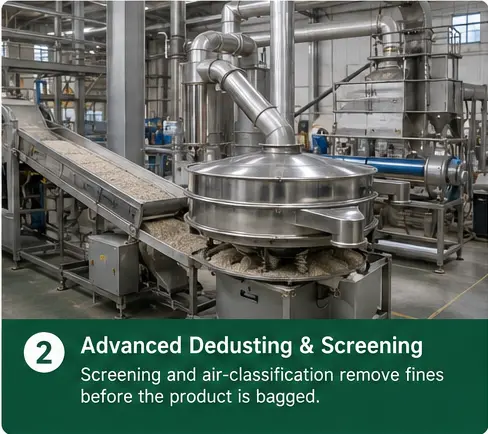
After forming, batches pass through screening and air-classification steps that pull fine powder out of the stream. Screening, air classification, and other dedusting systems can separate undersized particles and loose fines before bagging. Dedusting and screening can substantially reduce loose fines before packaging, but final dust performance depends on both the raw material and the complete manufacturing process, including granulation, drying, screening, and handling.
Moisture and Binder Control
Moisture must be controlled within a formulation-specific range. Excessively low or high moisture can affect granule strength, clumping, drying stability, or storage performance, so OEM specifications should define the acceptable moisture range for the specific litter formulation rather than apply one universal target. Binder selection also affects how well particles hold together, so process control holds moisture inside the range defined for that product.
How Dust Levels Are Measured
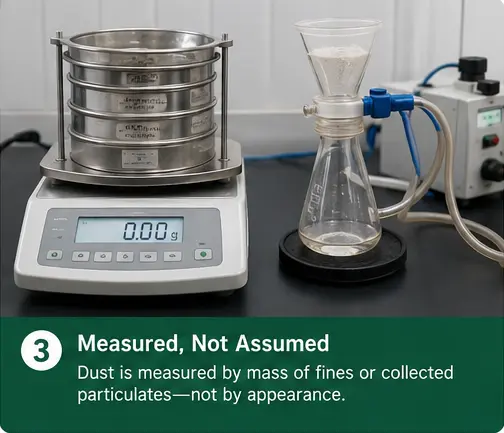
Product dust testing and occupational exposure assessment are related but different. A cat litter QC program may measure loose fines or airborne particulate generated under a defined handling test, while workplace assessments use exposure-based methods appropriate to the work environment. For clay- or mineral-based litters, respirable crystalline silica is a specific material hazard addressed by agencies such as the U.S. Occupational Safety and Health Administration, and should not be used as a general synonym for cat litter dust. PM10 and PM2.5 describe airborne particle-size fractions, as classified by agencies such as the U.S. Environmental Protection Agency; they are not a cat-litter product dust rating.
| Measurement approach | What it captures | Typical B2B use |
|---|---|---|
| Sieve shake test | Mass of fines passing a defined mesh | Incoming QC, supplier comparison |
| Gravimetric collection | Particulate captured on a filter during pouring | Batch release specification |
| PM fraction / airborne particle testing | Airborne particle concentration within a defined test environment | Exposure assessment or specialized product-performance studies |
What to Specify in OEM and Private Label Orders
When you source private label cat litter or run an OEM cat litter program, translate “no dust” into contract language. A vague request invites inconsistent shipments; a written spec protects the brand on every reorder.
| Spec item | Why it matters |
|---|---|
| Test method and conditions | Ensures supplier and buyer measure dust the same way |
| Maximum dust or fines limit | Defines the acceptance threshold |
| Sampling procedure | Makes batch results comparable |
| Batch test report and acceptance record | Documents actual results against the agreed specification |
| Packaging dust control | Reduces in-transit powder migration |
| Respirable or inhalable particle assessment, where relevant | Supports additional occupational or exposure evaluation when required |
What a Good OEM Dust Specification Looks Like
A useful OEM dust specification should state five things: the test method, sample preparation, test conditions, maximum acceptable dust or fines level, and batch acceptance procedure. “Dust-free” by itself is not a sufficient technical specification because the supplier and buyer may interpret the term differently.
Material Considerations
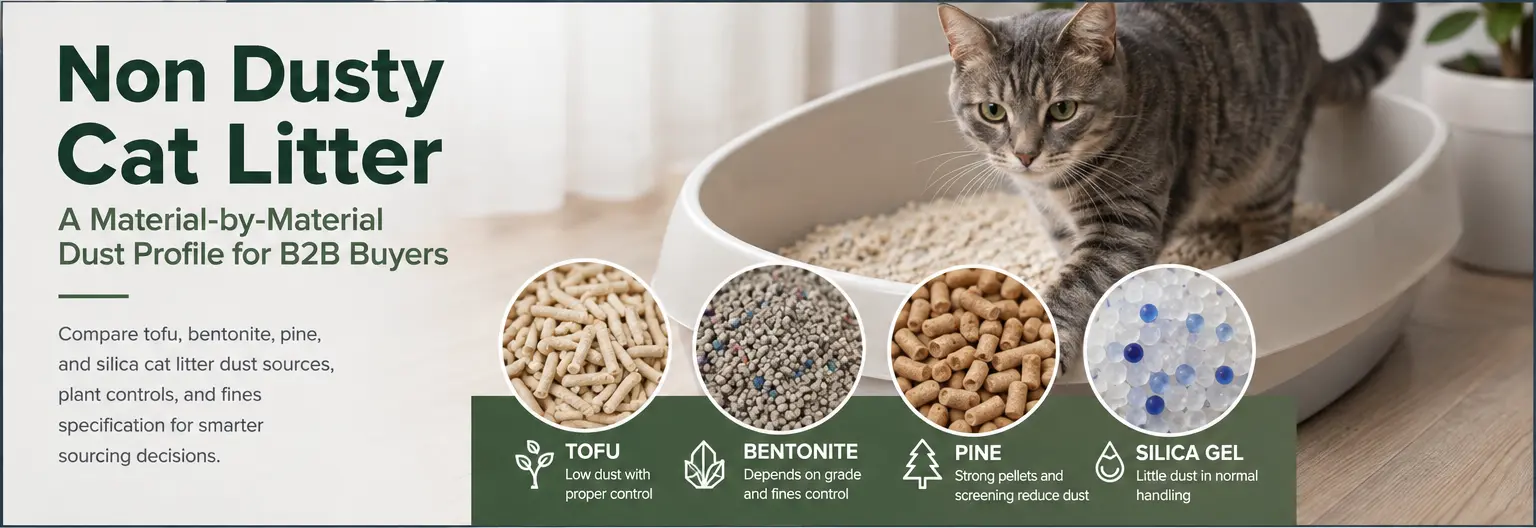
Dust performance varies substantially within every litter material category. Tofu, wood, bentonite, mineral, and other formulations can all be engineered for low-dust performance, while poorly processed products can generate excessive fines regardless of the raw material. For OEM sourcing, compare products using the same defined test method rather than ranking materials by name alone. A dust-free clumping cat litter built on a well-granulated base is a common low-dust commercial format for private label programs.
Conclusion
Low-dust performance is a manufacturing and procurement outcome, not a single product category. Buyers get the most reliable result by specifying measurable dust limits, requiring batch test reports, and working with a supplier that controls dust at granulation, dedusting, and moisture stages. For private label and OEM programs, written specs turn a fuzzy expectation into a repeatable, shippable standard.
Frequently Asked Questions
No product is truly zero-dust. Granular litters can release some fine particles during handling, even when they are engineered for very low dust. The practical goal is a measured dust level low enough for normal use, defined in a contract rather than claimed on a label.
Cat litter dust generally consists of fine particles already present in the formulation or generated when granules fracture and abrade during processing, packaging, transport, and handling. Particle-size distribution, granule strength, screening efficiency, and packaging conditions all influence how much loose powder reaches the customer.
Common product methods are the sieve shake test (mass of fines through a mesh) and gravimetric collection (particulate caught on a filter during pouring). Airborne-particle or PM-fraction testing in a defined environment is used for exposure assessment or specialized product-performance studies, not as a routine product dust rating. Batch test reports should state which method was used.
No single cat litter material is inherently the lowest-dust option across all products. Tofu, wood, bentonite, and other formulations can achieve low-dust performance when granulation, drying, screening, and packaging are well controlled. Buyers should compare supplier test results under the same defined method.
For most private label programs, define a maximum dust or fines level using a specified product test method, together with sampling and acceptance criteria. Add airborne or respirable-particle testing only when it is relevant to the intended use, regulatory requirements, or workplace exposure assessment.
Not necessarily. Clumping depends on the binder system and granule integrity, while dust depends on fines control. A well-granulated, properly bound litter can be both low-dust and fast-clumping.
Specify packaging that limits abrasion, powder migration, and seal failure during transport. Depending on the product and pack format, this may include appropriately selected paper bags, PE-lined woven PP bags, or other barrier packaging. The packaging specification should be validated through transport and handling tests rather than assumed to be universal.
Yes. OEM and private label suppliers can often develop or select a formulation and manufacturing process to meet a defined dust target. Depending on the product, improvements may involve formulation, granulation, screening, dedusting, drying, or packaging. Buyers should provide the target test method and acceptance limit before production qualification.