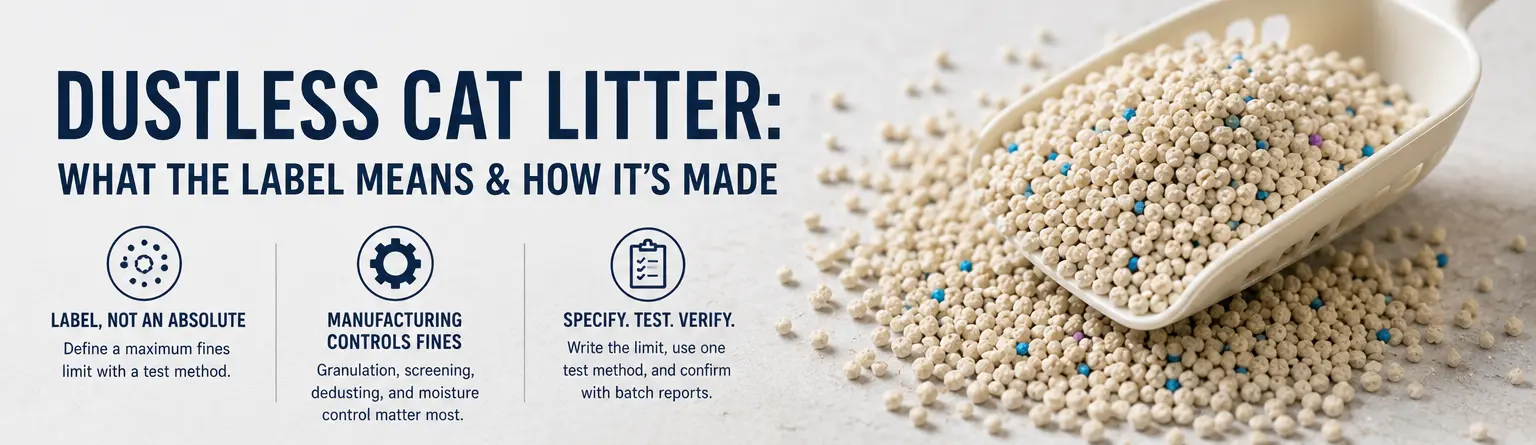





Buyers comparing a “lowest dust” claim rarely have a shared yardstick to rank one supplier’s bag against another. The phrase is a marketing label, not a certified grade, so the practical task is to ask how each product’s dust is defined, sampled, and reported. Our dustless cat litter guide explains what “dustless” means on the production side; this article covers how a purchaser can compare and verify those claims across materials and suppliers.
Quick Answer
“Lowest dust” is a comparative marketing claim, not a universal product grade or certification. To compare cat litter suppliers, ask each supplier to define the measured dust or fines fraction, specify the test method and sample basis, and provide a numerical acceptance limit. Compare products only when the measurement basis is consistent, then verify the result through batch records or independent incoming inspection. Material type matters, but processing and product consistency can materially change the result.
What “Lowest Dust” Actually Means
On a spec sheet, “low dust” and “lowest dust” are marketing descriptions rather than standardized grades. Depending on the supplier’s method, the reported result may describe loose fines, particles generated during handling, or airborne dust collected under controlled conditions. These measurements are related but not interchangeable, so buyers should compare products only when the test method, sample preparation, particle-size basis, and reported limit are clearly defined.
In practice the claim behaves like a procurement benchmark. A distributor or shelter buyer is not really asking “is this literally the lowest-dust litter ever made” — they are asking “is the airborne fine fraction low enough for my setting, and can the supplier prove it consistently?” Framing the question that way turns a vague label into a measurable specification.
How Dust Levels Are Measured
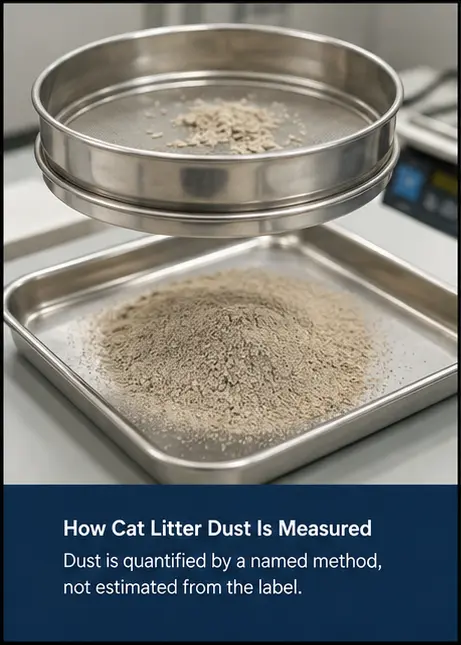
Dust can be assessed in several different ways, but the result depends on what the test is designed to measure. Sieve analysis can quantify the proportion of particles below a specified screen size and is useful for comparing loose fines. Other controlled tests can measure particles released into the air during handling or the amount of dust collected over a defined period. Because these approaches measure different fractions, a buyer should record the test method, sample preparation, particle-size or collection basis, and reporting unit before comparing results between suppliers.
Workplace dust science provides useful examples of why a measurement needs a defined sampling method and reporting basis. The U.S. National Institute for Occupational Safety and Health publishes methods for sampling airborne particulates, while the U.S. Occupational Safety and Health Administration sets exposure limits for specific workplace hazards such as respirable crystalline silica. These occupational methods and limits are not product standards for consumer cat litter. For procurement, their relevance is mainly methodological: buyers should ask suppliers to identify exactly what is measured, how the sample is collected, and what numerical acceptance limit applies to the litter specification.
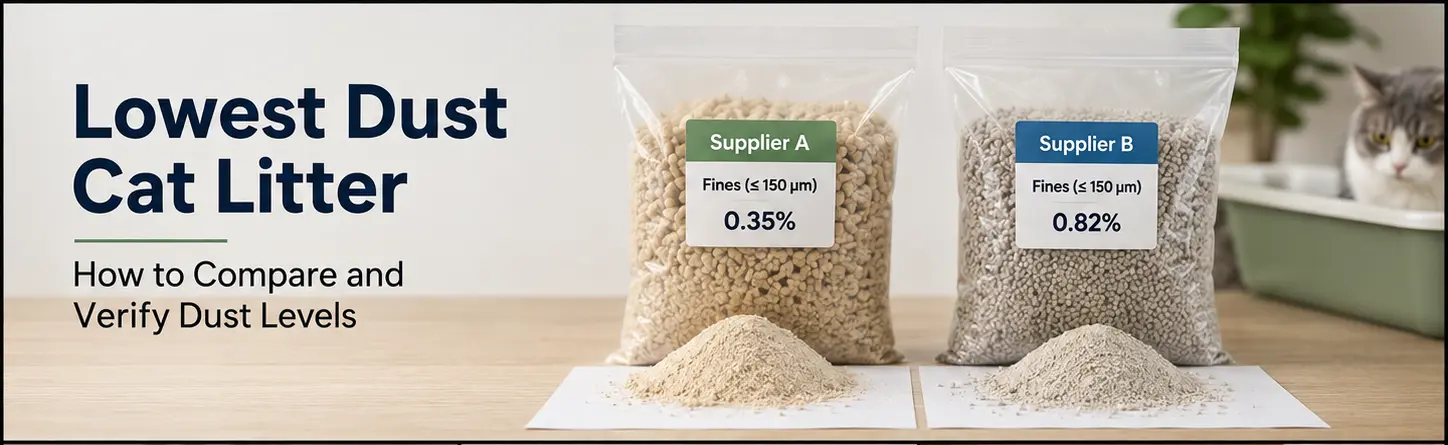
A result from one test cannot be ranked directly against a result from a different method. A 0.5% fines figure from one sieve cutoff is not automatically “lower dust” than a 0.8% figure generated with a different particle-size basis or sampling procedure. Buyers should compare numbers only when the measured fraction, screen size or collection method, sample preparation, and reporting unit are the same.
How to Compare Dust Claims Between Suppliers
The practical way to rank “lowest dust” claims is to standardize the comparison before reading the numbers:
- Define the measured fraction — loose fines, handling dust, or airborne dust.
- Standardize the test method, including screen size or collection procedure and sample preparation.
- Compare the numerical limit only when the measurement basis matches across suppliers.
- Verify batch consistency through records or independent incoming inspection.
When the basis differs, ask each supplier to restate the result on the same method rather than comparing labels or unrelated figures.
Material Dust Profiles Compared
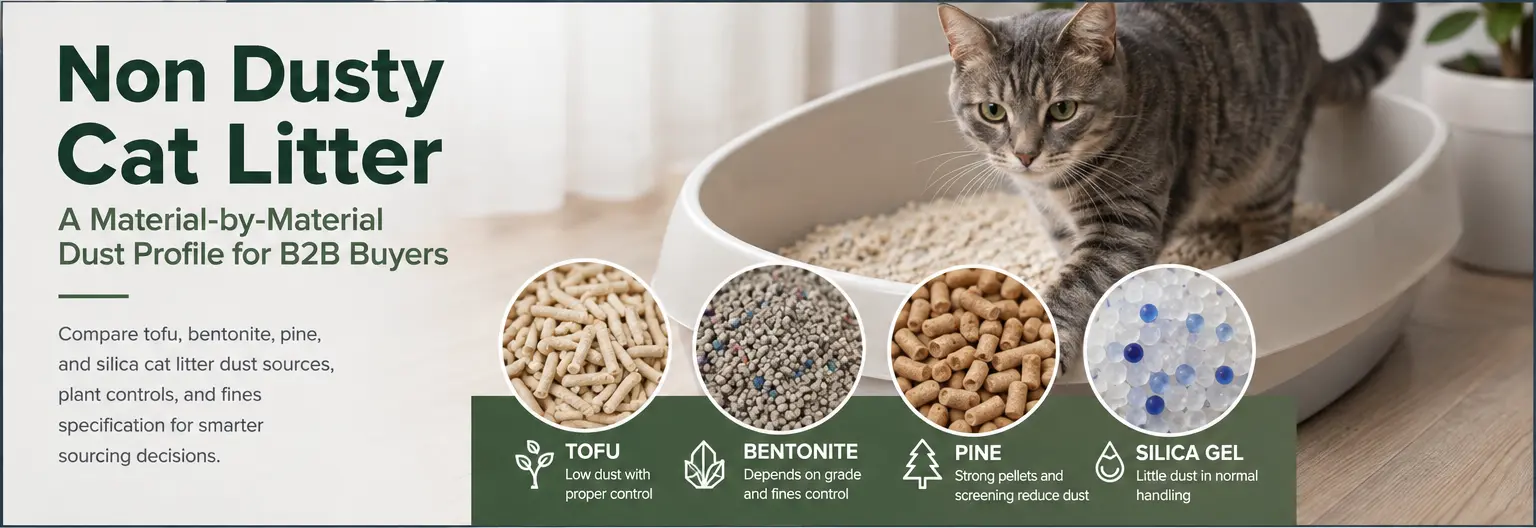
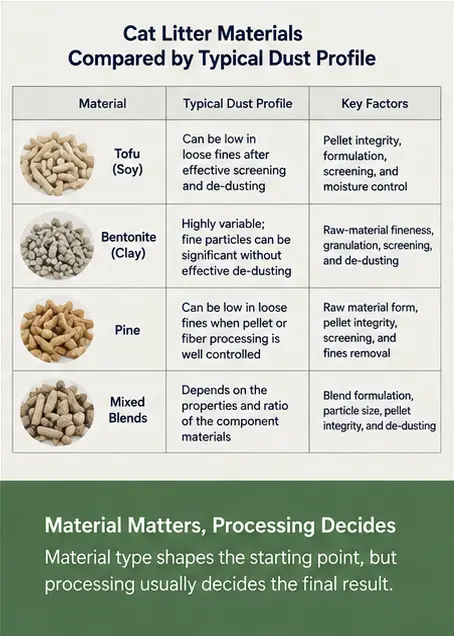
Material type shapes the starting point, but processing usually decides the outcome. The table below is a general buyer’s view; exact rankings shift with how thoroughly each plant de-dusts its product.
| Material | Typical dust profile | What usually drives it |
|---|---|---|
| Tofu (soy) | Can be low in loose fines after effective screening and de-dusting | Pellet integrity, formulation, screening, and moisture control |
| Bentonite (clay) | Highly variable; fine particles can be significant without effective de-dusting | Raw-material fineness, granulation, screening, and de-dusting |
| Pine | Can be low in loose fines when pellet or fiber processing is well controlled | Raw material form, pellet integrity, screening, and fines removal |
| Mixed blends | Depends on the properties and ratio of the component materials | Blend formulation, particle size, pellet integrity, and de-dusting |
Material type shapes the starting point, but material class alone does not establish a product’s dust performance. Screening, pellet or granule integrity, moisture control, de-dusting, and packaging can all change the amount of loose or airborne particulate released during handling. We produce tofu, bentonite, pine, and mixed formats; we do not manufacture corn, wheat, walnut, paper, or hemp litters, so those materials are mentioned only as comparison context rather than as products we supply.
A dust-free clumping cat litter is one commercial example built around a reduced loose-fine specification, but the same comparison logic applies to any format a buyer evaluates.
A Buyer’s Verification Checklist
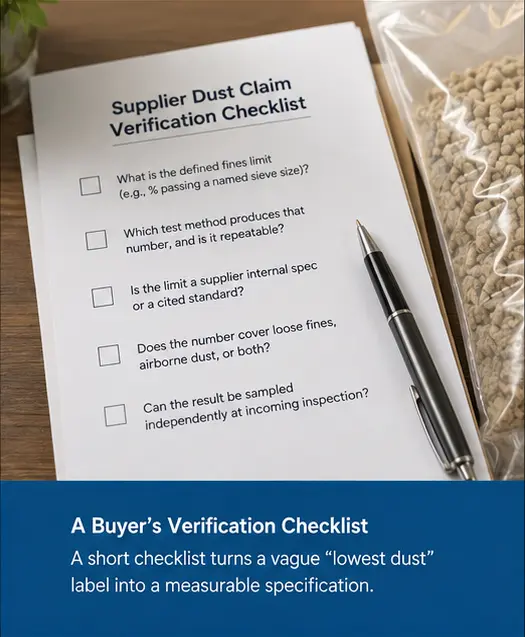
When a supplier says “lowest dust,” the response should be a short list of questions rather than acceptance of the label:
- What is the defined fines limit (for example, percent passing a named sieve size)?
- Which test method produces that number, and is it repeatable batch to batch?
- Is the limit a supplier internal spec or a cited standard?
- Does the number cover loose fines, airborne dust, or both?
- Can the result be sampled independently at incoming inspection?
A stronger supplier response identifies the measured fraction, test method, reporting basis, and numerical limit. A statement such as “our litter is virtually dust-free” provides little basis for comparing suppliers unless those details are also available.
Working With a Supplier on Dust Specs
For bulk or private-label programs, a cat litter manufacturer can incorporate a defined fines limit and test method into the purchase specification or quality agreement. The specification can also identify the sampling procedure, acceptance criteria, and batch documentation required for incoming inspection. This makes “lowest dust” a measurable procurement requirement rather than a marketing description and gives both buyer and supplier the same basis for evaluating consistency.
Conclusion
“Lowest dust cat litter” is best treated as a comparison exercise, not a title anyone can claim by default. Rank candidates by their stated fines limit and named test method, weigh the material against how it is processed, and put the number in writing for any volume program. The label starts the conversation; the measurement is what closes it.
Frequently Asked Questions
It is a relative marketing claim describing a very low share of loose, airborne fines. Because no single standard fixes the word to a number, the meaning depends on each supplier’s defined limit and test method.
Common methods include sieve analysis of loose fines, settled-dust collection in a chamber, and gravimetric sampling of airborne particles. Each captures a different fraction, so the named method determines what the reported number actually represents.
There is no universally lowest-dust cat litter material because dust performance depends on particle size, formulation, pellet or granule integrity, screening, de-dusting, moisture control, and handling conditions. A properly processed product in one material category can outperform a poorly processed product in another. Buyers should therefore compare suppliers using the same defined test method and acceptance limit rather than ranking materials by category alone.
No. “No dust” and “lowest dust” are marketing descriptions unless they are tied to a defined measurement and acceptance limit. “No dust” does not by itself establish a zero-particle condition, while “lowest dust” is inherently comparative. In either case, buyers should ask what fraction is being measured, which test method is used, and what numerical limit supports the claim.
Not as a standalone claim. A label with no stated fines limit or test method is a marketing phrase. Request the underlying number and the method that produces it before treating the claim as verified.
Ask for the defined fines limit, the named test method, whether the limit is internal or cited, and whether it covers loose fines, airborne dust, or both. A concrete answer is a stronger signal than an absolute adjective.
Yes, indirectly. Clumping formats still release fines from loose particles, so the de-dusting step matters as much as the clumping agent. A well-processed clumping litter can be low dust, while a poorly de-dusted one can be dusty regardless of format.
Put the dust or fines limit and test method into the purchase specification, define the sampling procedure for incoming inspection, and retain an approved reference sample where appropriate. For ongoing programs, the manufacturer should document the acceptance criterion and batch results so each shipment is evaluated against the same specification rather than against the marketing label.