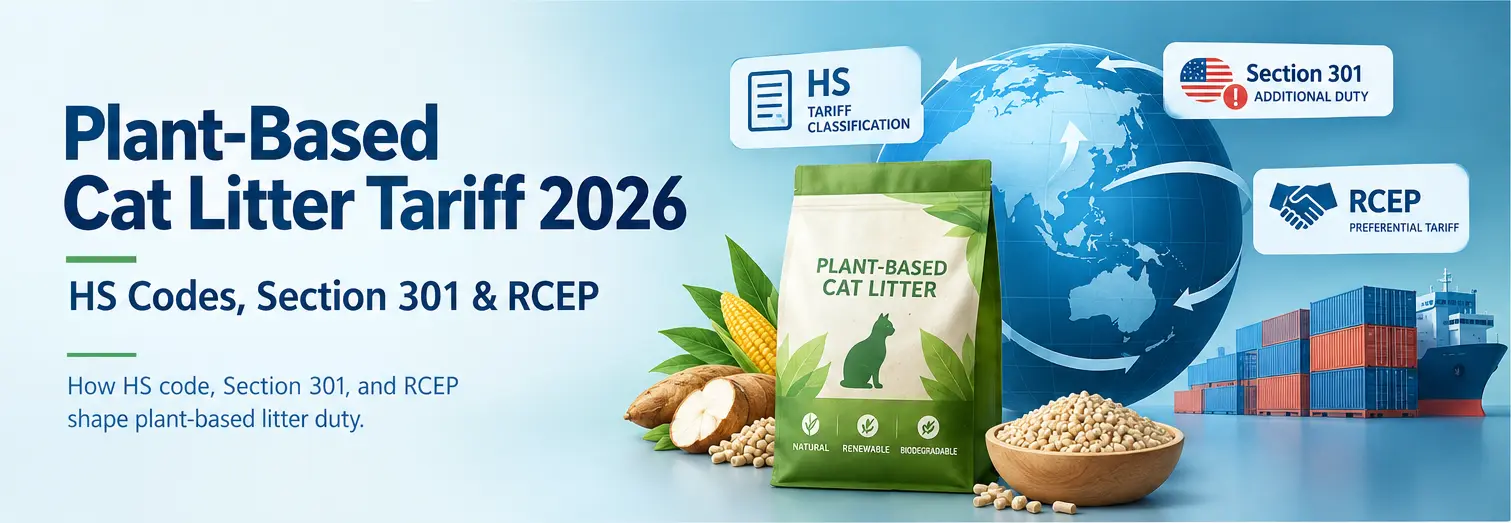





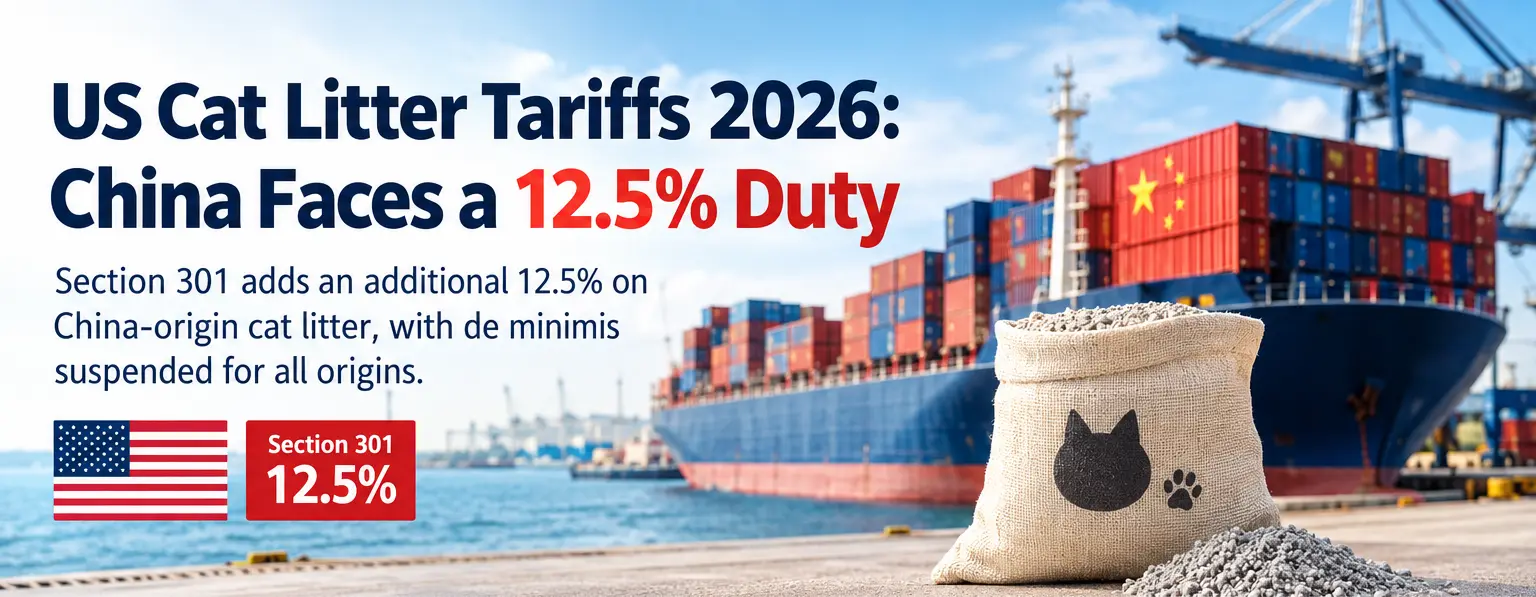
US cat litter tariffs in 2026 changed materially for shipments from China. On 23 July 2026, the Office of the US Trade Representative announced final Section 301 action covering 60 economies, with the additional tariffs generally applying to covered goods entered for consumption on or after 24 July 2026. China-origin goods are subject to an additional 12.5% Section 301 duty unless specifically exempted. The duty should be included in landed-cost calculations alongside the applicable HTS classification and other import charges. Exporters should review our cat litter export compliance guide for market context.
Quick Answer
From 24 July 2026, covered China-origin cat litter is generally subject to an additional 12.5% Section 301 duty unless a product-specific exemption applies. The underlying MFN rate depends on the correct HTS classification. Duty-free de minimis treatment for low-value shipments had already been suspended for all countries from 29 August 2025, so importers should calculate applicable duties and fees based on the shipment’s classification, origin, value, and entry method.
What the 2026 US Section 301 Action Covers
The USTR action responds to the failure of listed economies to impose and enforce a prohibition on imports of goods made with forced labor. Economies that enacted such bans received a 10% rate; China and Hong Kong are among the “all other investigated economies” subject to 12.5%. The official USTR press release details the rates and product exemptions.
For a China-origin cat litter product that is correctly classified under an MFN-free HTS provision and is not covered by a Section 301 exemption, the 12.5% Section 301 duty is generally the principal tariff surcharge created by this 2026 action. The importer should still verify the exact HTS classification, country of origin, and any applicable exemption before calculating the final duty.
Buyers should reconcile this with our cat litter HS code reference when calculating landed cost.
How the Duty Applies to Cat Litter
HTS Classification and MFN Treatment
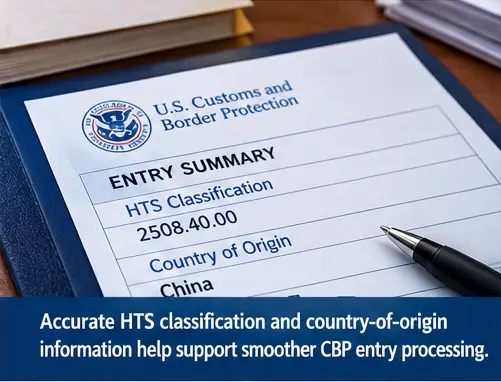
Cat litter does not have a single HTS classification based only on its retail name or intended use. For example, bentonite is listed under HTS 2508.10.00, while other clays are covered under HTS 2508.40.01, with a general MFN rate of Free in the applicable HTS schedule. Plant-based and mixed-material litters may require different classifications. Because the Section 301 duty is tied to the product’s HTS classification and country of origin, importers should confirm the correct code before calculating the total landed cost.
De Minimis Suspension
Duty-free de minimis treatment for qualifying low-value shipments from all countries was suspended effective 29 August 2025, so small direct-mail and sample shipments are no longer automatically exempt from applicable duties, taxes, and fees. For China-origin cat litter, importers should separately determine whether the shipment is subject to the 12.5% Section 301 duty based on its HTS classification, origin, and any applicable exemption.
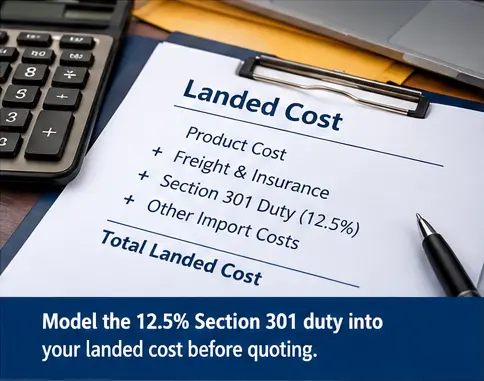
Calculating Landed Cost After the 2026 Tariff
A simple planning model for a China-origin order:
- Commercial transaction value and other amounts relevant to customs valuation.
- International freight, insurance, brokerage, port, and other logistics costs that apply to the shipment.
- 12.5% Section 301 duty calculated on the applicable customs value when the product is covered and not exempted.
- Any additional federal, state, local, handling, storage, brokerage, and last-mile costs that apply.
For an actual entry, the importer or customs broker should determine the customs value and applicable duty treatment under current CBP rules rather than treating FOB plus freight as a universal calculation formula. Use our cat litter tariff guide for the broader entry checklist.
Options for Exporters and Importers
FOB With Buyer-Managed Tariff
A China factory can quote FOB while the US buyer arranges import clearance and pays applicable duties as the importer of record. The sales contract can allocate the economic cost of the Section 301 duty between the parties, but Incoterms do not by themselves change the importer of record’s customs obligations to CBP.
Third-Country or Alternative Sourcing
Some buyers may evaluate sourcing from countries subject to different US tariff treatment. However, simply routing China-origin goods through a third country does not normally change their country of origin. Any alternative-sourcing strategy should be based on qualifying production or substantial transformation under applicable US origin rules, with the resulting origin documented for customs purposes.
Tariff Escalation Clauses
OEM and distributor contracts should name the duty-bearing party and include a price-adjustment mechanism so a future rate change does not erase margin.
Compliance Notes for Private Label and OEM
USMCA preferences apply only to qualifying goods from Canada or Mexico under specific rules; they do not neutralize the China-origin Section 301 duty. CBP entry records should reflect the correct HTS and country of origin.
Conclusion
US cat litter tariffs in 2026 add a 12.5% Section 301 duty to covered China-origin goods unless an applicable exemption applies, while duty-free de minimis treatment is no longer generally available. Exporters and importers should verify the HTS classification and origin, model the additional duty using the applicable customs value, and define tariff responsibility in OEM and distribution contracts. Plan the applicable 2026 duty into every US quote rather than treating the tariff as a fixed percentage of total landed cost.
Frequently Asked Questions
Covered China-origin goods are generally subject to an additional 12.5% Section 301 duty from 24 July 2026 unless a product-specific exemption applies. The underlying MFN rate depends on the correct HTS classification; for example, bentonite is listed under HTS 2508.10.00 and other clays under HTS 2508.40.01 with a general MFN rate of Free. Plant-based cat litter may require a different classification.
USTR announced the final Section 301 action on 23 July 2026. The additional duties generally apply to covered goods entered for consumption, or withdrawn from warehouse for consumption, on or after 12:01 a.m. Eastern Time on 24 July 2026, subject to the transition rules and product exemptions specified in the official notice.
Duty-free de minimis treatment for qualifying low-value shipments from all countries has been suspended since 29 August 2025, subject to specified exceptions. China-origin cat litter therefore does not receive the former blanket de minimis exemption, but the applicable duties and fees still depend on the product’s classification, origin, value, entry method, and any applicable exemption.
No. USMCA preferences cover qualifying Canadian and Mexican goods under specific rules and do not offset a China-origin Section 301 duty.
There is no single HTS code for all cat litter. For example, bentonite is listed under HTS 2508.10.00, while other clays are covered under HTS 2508.40.01. Plant-based, mixed-material, and other formulations may fall under different provisions. Importers should confirm the classification with CBP or a customs broker before using it for tariff calculations.
Country-of-origin rules prevent simple transshipment; substantive transformation or qualifying production may change origin but must meet CBP criteria.
The US importer of record pays it at entry, but contracts can allocate the risk through Incoterms and tariff clauses.
Yes. A tariff escalation clause naming the duty-bearing party protects both sides if the rate changes.