





The U.S. lickable cat treats market is a growing subsegment of the broader Northern America category. IndexBox estimates Northern America retail sales for lickable cat treats at USD 800 million to 1.2 billion in 2026, with annual growth of 8 to 12 percent, while its U.S. market analysis describes the U.S. category as a mid-hundreds-of-millions-dollar market and estimates that imported finished lickable treats account for 30 to 45 percent of U.S. volume. For overseas OEM suppliers, the combination of established demand, imported supply, and specialized high-moisture processing creates a relevant sourcing opportunity.
What “Lickable” Means
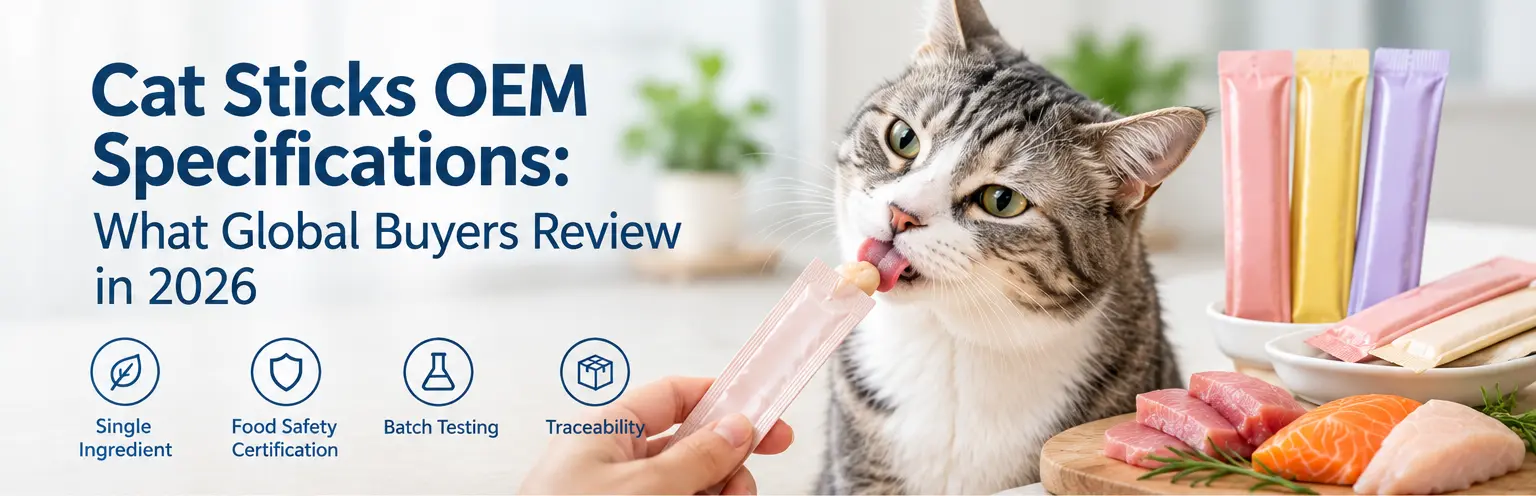
Lickable cat treats are semi-liquid formats — pastes, gels, mousses, and purees — packaged in single-serve tubes, sachets, or multi-pack dispensers and squeezed onto a surface, bowl, or finger for direct consumption.
Unlike crunchy biscuits, lickable formats emphasize interaction, palatability, and functional delivery. They sit between a reward product and a supplement vehicle, which is why they over-index on bonding and hydration occasions rather than simple calories.
U.S. Market Size and Growth
IndexBox estimates Northern America lickable cat treat retail sales at USD 800 million to 1.2 billion in 2026, with annual growth of 8 to 12 percent. Its separate U.S. analysis describes the domestic category as a mid-hundreds-of-millions-dollar market and projects 8 to 11 percent CAGR from 2026 to 2035. For broader category context, Strategic Market Research estimates the global cat treats market at USD 12.65 billion in 2025 with a 10.5 percent CAGR and reports that lickable and creamy treats account for about USD 1.71 billion, or 5 percent of the wider pet-treat market, with a 13.6 percent CAGR. These figures provide global category context rather than a direct estimate of U.S. lickable cat treat sales. Key demand drivers identified across these sources include pet humanization, palatability, hydration-oriented use cases, and functional positioning.
| Metric | Value / rate | Geographic scope |
|---|---|---|
| Lickable cat treat retail sales | USD 800M to 1.2B (2026) | Northern America |
| Annual lickable category growth | 8 to 12 percent | Northern America |
| U.S. market growth forecast | 8 to 11 percent CAGR, 2026 to 2035 | United States |
| Global cat treats market | USD 12.65B (2025), 10.5 percent CAGR | Global |
| Lickable and creamy treat growth | 13.6 percent CAGR | Global pet-treat market |
| E-commerce penetration | 25 to 35 percent of value | Northern America |
Data scope: U.S.-specific figures are used where available; Northern America figures are clearly identified as regional estimates, while global cat-treat data is included only for category context.
For context on the wider category, our U.S. cat treat market guide covers the total segment and its purchase channels.
Format and Functional Split
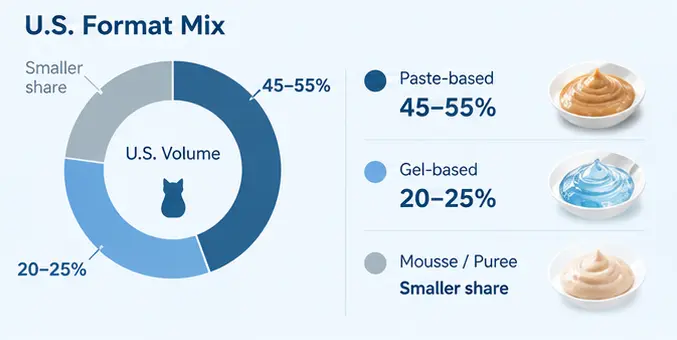
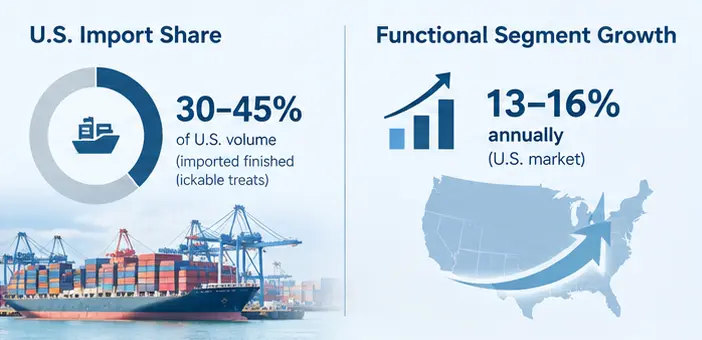
In the U.S. market, paste-based lickable formulations account for roughly 45 to 55 percent of volume, while gel-based hydration-focused treats represent about 20 to 25 percent and are among the fastest-growing formats. Mousse and puree formats serve smaller but distinct use cases, including senior cats, single-protein positioning, and palatability enhancement. Functional positioning is also becoming more important: IndexBox estimates a 13 to 16 percent annual growth rate for the U.S. functional segment, while its Northern America analysis identifies a 12 to 16 percent growth premium for functional lickable formats, an angle we cover in our functional cat treats guide. For OEM buyers, this makes texture stability, portion control, formulation flexibility, and claim substantiation important product-development considerations.
U.S. Import Dependence and the OEM Opportunity
Import dependence is an important feature of the U.S. lickable cat treat market. IndexBox estimates that imported finished lickable treats account for roughly 30 to 45 percent of U.S. volume, while Northern America overall also relies substantially on imports from Asia-Pacific production bases. The category requires specialized high-moisture processing, texture control, and filling capabilities, which can limit readily available co-packing capacity. For overseas OEM suppliers, the opportunity is therefore less about generic manufacturing capacity and more about demonstrating stable processing, food-safety controls, documentation, and scalable private-label production.
Pricing and Cost Structure
U.S. lickable cat treat pricing varies substantially by channel and positioning. IndexBox reports mass-market private-label and entry-level products at about USD 0.35 to 0.50 per single-serve unit, while specialty and veterinary-channel products commonly reach USD 0.65 to 0.75 or more per unit. Multi-pack pricing varies by brand, count, and formulation, with larger multipacks increasingly important in retail and e-commerce. For OEM buyers, major cost drivers include protein inputs, specialized high-moisture processing, filling equipment, packaging materials, and stability requirements. These variables should be evaluated at SKU level rather than treated as fixed category-wide percentages.
What This Means for Cat Treat OEM Buyers
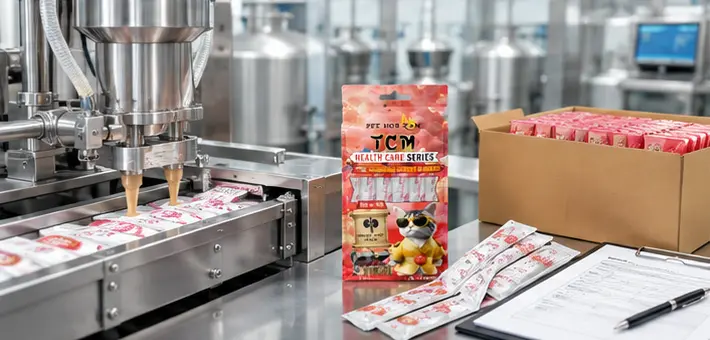
The growth-and-import profile makes lickable treats a relevant OEM category for U.S. brands and retailers. A capable overseas manufacturer needs more than a recipe: it needs documented food-safety controls, high-moisture processing capability, product specifications, and U.S. import documentation. Pet Horizon produces cat treats through its Dalian Aobang facility and maintains FDA food facility registration, ISO 22000, and HACCP certification. The company also participates in major industry trade fairs, including the Canton Fair, CIPS, and Pet Fair Asia. Its cat sticks and fish cubes product range provides a relevant reference point for portion-controlled, high-palatability cat treat formats and private-label development. Buyers should confirm the applicable documentation, specifications, MOQ, and compliance package for each individual lickable SKU before production.
Risks and Constraints
- Shelf-life and texture stability: lickable formats require tight control of moisture, texture, packaging, and preservation, which can complicate clean-label positioning and shelf-life validation.
- Co-packer capacity: specialized high-moisture mixing and filling equipment can constrain available capacity, particularly for new or small-batch programs.
- Import and regulatory requirements: U.S. programs may require facility registration, labeling compliance, Prior Notice, and importer-side FSVP responsibilities, while requirements can differ for Canada and Mexico.
Conclusion
The U.S. lickable cat treats market is a growing subsegment within the wider Northern America category. IndexBox estimates Northern America lickable cat treat retail sales at USD 800 million to 1.2 billion in 2026, while its U.S. analysis describes the domestic market as a mid-hundreds-of-millions-dollar category with 8 to 11 percent projected CAGR through 2035. With imported finished products accounting for an estimated 30 to 45 percent of U.S. volume, sourcing opportunities exist for OEM suppliers that can combine stable high-moisture processing with documented food-safety controls, product specifications, and U.S. import documentation.
Frequently Asked Questions
IndexBox describes the U.S. lickable cat treats market as a mid-hundreds-of-millions-dollar category in 2026. Its Northern America estimate is USD 800 million to 1.2 billion in 2026 retail sales, so the regional figure should not be treated as the U.S. market size.
IndexBox projects the U.S. lickable cat treats market to grow at approximately 8 to 11 percent CAGR from 2026 to 2035. Its Northern America analysis estimates annual growth of about 8 to 12 percent.
Paste-based formulations account for roughly 45 to 55 percent of U.S. volume. Gel-based hydration-focused treats represent about 20 to 25 percent and are among the fastest-growing formats, while mousse and puree products serve smaller, more specialized use cases.
Private label is an established part of the U.S. lickable cat treats market, particularly in mass-market retail. IndexBox identifies private label as a significant competitive segment, but exact market share should be treated cautiously because published estimates vary by product definition and channel.
IndexBox estimates that imported finished lickable cat treats account for approximately 30 to 45 percent of U.S. volume. This indicates a meaningful role for international suppliers, although import share can vary by product type, supplier origin, and channel.
The main considerations are shelf-life and texture stability, access to specialized high-moisture processing and filling capacity, product specifications, labeling and claim compliance, and U.S. import requirements such as facility registration, Prior Notice, and applicable importer responsibilities.
Functional positioning is an important growth driver in U.S. lickable cat treats. IndexBox projects the U.S. functional segment to grow at approximately 13 to 16 percent annually, supported by hydration-oriented products, joint and digestive positioning, and use cases such as medication disguise.
Buyers should require documented food-safety controls, applicable facility registration information, product specifications, compliant labeling support, traceability records, and export documentation. For U.S. imports, the importer should also confirm its applicable FSVP responsibilities and ensure Prior Notice is properly handled for each shipment.