




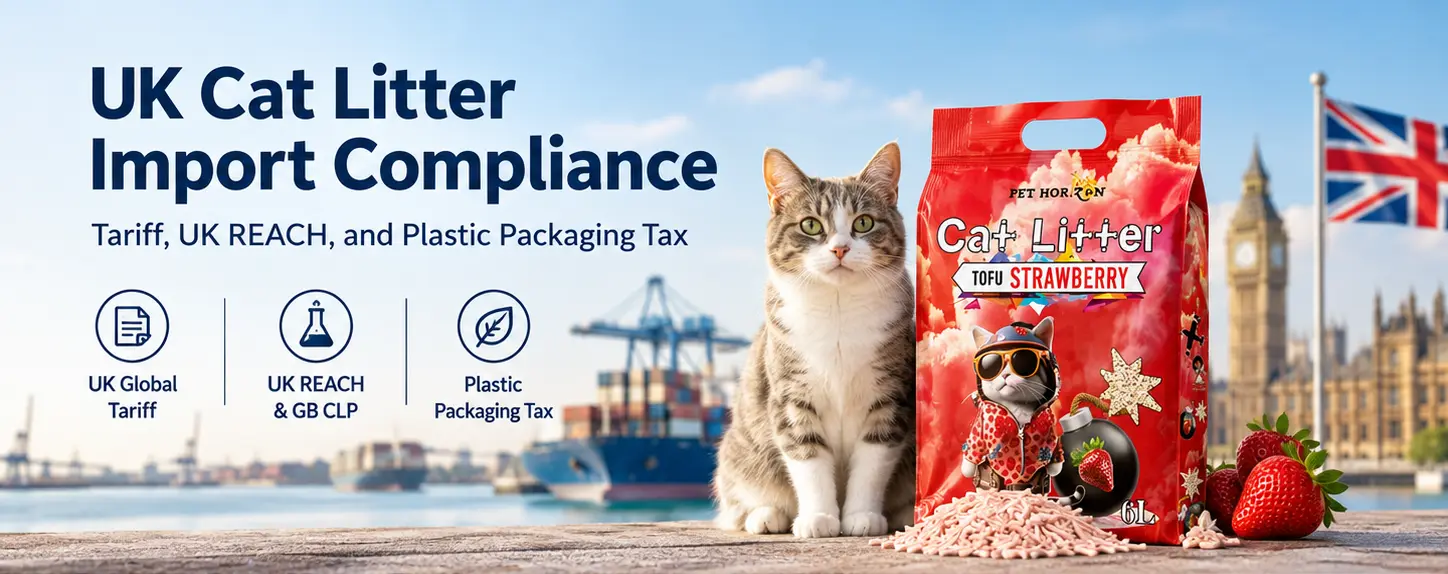
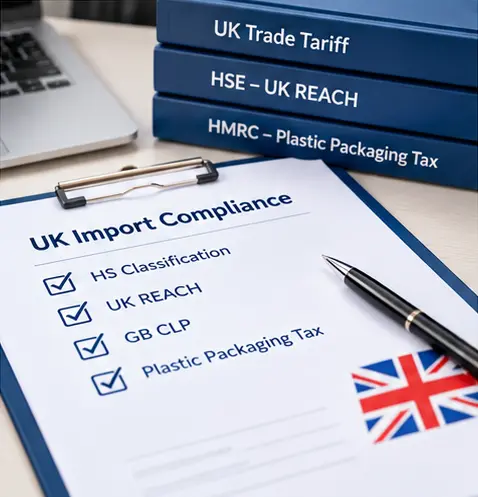
Importing cat litter to the UK is not the same as importing into the European Union. Since the end of the Brexit transition period, Great Britain runs its own tariff schedule, its own chemicals regime (UK REACH), and its own packaging tax. This guide sets out the three compliance pillars every cat litter manufacturer, OEM partner, and private label buyer must plan for before a UK cat litter import: the UK Global Tariff classification, UK REACH substance registration, and the Plastic Packaging Tax on low-recycled-content packaging.
Quick Answer
UK cat litter import requirements depend on the product’s composition, commodity code, origin, and destination. Certain clay-based products may qualify for zero customs duty, subject to verification in the UK Trade Tariff. Importers should also assess UK REACH and GB CLP obligations where applicable, and check whether plastic packaging is subject to Plastic Packaging Tax. From 1 April 2026, the PPT rate is £228.82 per tonne for chargeable plastic packaging components containing less than 30% recycled plastic. Registration thresholds and applicable exemptions should be checked against current HMRC guidance.
Scope and update note: This guide focuses on cat litter imports into Great Britain and highlights areas where Northern Ireland may require separate customs or regulatory treatment. Tariff rates, registration requirements, and tax rules can change. Confirm the applicable requirements against current official guidance before placing an order or shipping goods.
1. UK Global Tariff and HS Classification
The UK uses the UK Global Tariff (UKGT), a schedule separate from the EU TARIC. The commodity code you declare determines the duty rate, the need for any import licence, and how border officials treat the goods. Cat litter is not a single code: the rate depends on the material basis of the product. The official classification tool is the UK Trade Tariff.
| Material basis | UK Trade Tariff heading to investigate | Duty verification |
|---|---|---|
| Bentonite clay | Heading 2508.10 may be relevant | Verify the live commodity code and applicable rate |
| Other clay-based cat litter | Heading 2508.40 may be relevant, subject to the product’s characteristics | Verify the live commodity code and applicable rate |
| Silica gel | Review the relevant silica and chemical headings (e.g. 2811) | Confirm classification against composition and product form |
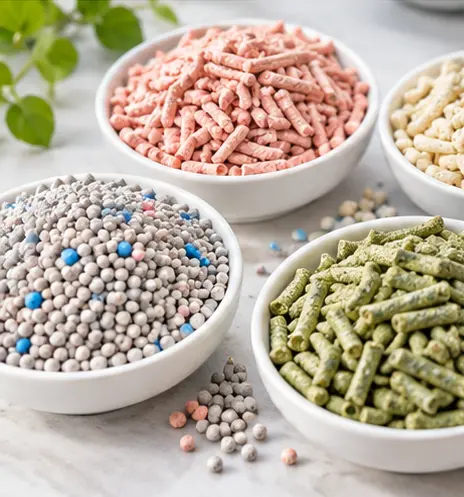
| Tofu, cassava, wood, paper, and other plant-based cat litter | Classification depends on the constituent materials and manufacturing process | Do not assume a single heading for all plant-based products |
| Blended or formulated cat litter | Assess the product as imported, including additives and processing | Obtain a classification decision where necessary |
The applicable customs duty depends on the full commodity code, the goods as imported, their country of origin, and any applicable preferential or other tariff measures. Headings 2508.10 and 2508.40 may be relevant to certain clay-based cat litters and, at the heading level, commonly carry a 0.00% third-country duty rate in the live UK Trade Tariff — but this must be verified against the corresponding full commodity code before shipment, because finished products with additives, blends, or non-clay bases require classification on their actual composition, processing, and form. Import VAT is separate from customs duty. The standard VAT rate is generally 20%, and eligible VAT-registered businesses may recover import VAT subject to the applicable conditions. Do not assume that the tariff treatment of a raw material automatically applies to every finished cat litter product. Always confirm the full commodity code and current tariff measures using the official UK Trade Tariff before lodging a declaration.
Trade agreements and the Developing Countries Trading Scheme (DCTS) can reduce or remove duty on goods from partner countries, but they do not change the underlying UKGT baseline. Northern Ireland requires separate consideration: under the Windsor Framework, the applicable tariff and customs procedures depend on the goods, their origin, and the circumstances of the movement. Importers should verify the correct treatment for their specific route rather than assume that every Northern Ireland shipment follows either the UK Global Tariff or EU TARIC without qualification. Our cat litter HS code guide explains how to map a product’s material basis to the correct code before you lodge a declaration.
2. UK REACH and GB CLP
UK REACH is the Great Britain chemicals regime, administered by the Health and Safety Executive (HSE), and is separate from EU REACH, which continues to apply in Northern Ireland. A GB-based business importing a substance on its own or in a mixture at or above 1 tonne per year may need to register that substance, unless an exemption or applicable transitional provision applies. The threshold relates to the relevant substance, not simply the total weight of the finished cat litter product. The official guidance is published by the HSE UK REACH service.
For cat litter importers, the assessment should begin with the identity and composition of each relevant substance, its annual import tonnage, and the importer’s legal role. Bentonite, silica-based materials, polymers, starches, and other ingredients should not automatically be treated as separate registration obligations without checking their substance identity and the applicable rules. Importers should confirm whether registration, an exemption, or a valid transitional arrangement applies to their specific circumstances.
Certain businesses eligible under the UK REACH transitional provisions may rely on recognised registrations or submit a Downstream User Import Notification (DUIN), subject to the applicable requirements. A DUIN is not itself a registration. Under the REACH (Amendment) (No. 2) Regulations 2026, the transitional dossier submission deadlines for eligible UK REACH registrations are 27 October 2029, 27 October 2030, and 27 October 2031, depending on the applicable tonnage band and hazard profile. These deadlines do not automatically exempt every importer from registration; businesses should confirm their eligibility for grandfathering or a valid Downstream User Import Notification (DUIN) arrangement and check the relevant HSE requirements before relying on transitional provisions. Great Britain also applies the GB Classification, Labelling and Packaging (GB CLP) regime from 1 January 2021; where a hazardous substance or mixture is supplied, the applicable classification, labelling, packaging, and Safety Data Sheet requirements must be assessed. These obligations do not automatically apply to every finished cat litter product simply because it contains a chemical ingredient. Northern Ireland has a different regulatory position, including the continued application of relevant EU chemicals rules. For a comparison of the regimes, see our EU cat litter compliance stack.
3. Plastic Packaging Tax
The UK Plastic Packaging Tax (PPT) applies to chargeable finished plastic packaging components containing less than 30% recycled plastic, subject to the relevant statutory conditions, exclusions, and reliefs. The tax took effect on 1 April 2022. From 1 April 2026 the rate is £228.82 per tonne of chargeable packaging components. The official detail is in the HMRC Plastic Packaging Tax guidance.
A business must register when it expects to import or manufacture at least 10 tonnes of finished plastic packaging components in the next 30 days, or has imported or manufactured at least 10 tonnes in the previous 12 months. The rules apply to qualifying packaging components, so cat litter importers should assess the packaging imported with their products and establish which business is responsible for the relevant PPT obligations. Plastic bags, pouches, and tubs used for cat litter may fall within scope where the statutory conditions are met and the recycled-plastic content is below 30%; assess the relevant component, its recycled content, its weight, and any applicable exclusion or relief rather than assuming every package is automatically chargeable. Maintain supporting evidence from packaging suppliers and review the tax treatment whenever packaging specifications change.
4. Northern Ireland: A Separate Customs and Chemicals Regime
A common failure point in UK cat litter import planning is assuming one rulebook covers the whole United Kingdom. Great Britain (England, Scotland, Wales) applies the UKGT, UK REACH, and GB CLP. Northern Ireland requires separate consideration under the Windsor Framework: the customs and regulatory treatment of a shipment depends on the goods, their origin, the route taken, and the applicable arrangements. Importers should verify the appropriate commodity code, tariff treatment, customs procedure, and any applicable EU regulatory requirements for the particular transaction.
This matters for substance registration too: a GB-based business registered under UK REACH should not assume this automatically satisfies EU REACH obligations for relevant goods placed on the Northern Ireland market. Importers supplying both Great Britain and Northern Ireland should map their supply chains and intended destinations, identify the responsible legal entities, and confirm the applicable customs and chemicals requirements before shipping.
5. Practical Checklist for Cat Litter Importers
- Obtain the appropriate EORI registration for the intended customs movements. A GB EORI is generally used for Great Britain imports; an XI EORI may be required for relevant Northern Ireland customs activities. Check the applicable requirements for your business and route.
- Confirm the full UK commodity code using the product’s actual composition, processing, and form. Verify the current duty rate and any applicable origin-based preference.
- Assess UK REACH obligations by relevant substance identity and annual tonnage. Confirm whether registration, an exemption, or a valid transitional provision applies.
- Review GB CLP requirements for relevant substances and mixtures, including classification, labelling, packaging, and Safety Data Sheets where required.
- Calculate the weight and recycled-plastic content of relevant finished packaging components. Check PPT registration thresholds, exclusions, reliefs, and the party responsible for compliance.
- Review applicable product safety, labelling, and importer-identification requirements for the product and intended market. Retain the commercial invoice, packing list, commodity classification evidence, customs declarations, and relevant regulatory documentation.
Most of these steps can be handled by a UK customs agent or freight forwarder, but their involvement does not automatically transfer every legal obligation away from the responsible importer or business. Our cat litter import guide explains the wider import process, from shipping documentation to customs clearance.
How UK Import Compliance Affects Cat Litter Landed Cost
For UK distributors and private label buyers, compliance costs should be assessed alongside the ex-works price, freight, insurance, customs duty, import VAT, and packaging specifications. Before approving a purchase order, confirm the commodity code and country of origin, identify any relevant UK REACH obligations, and establish whether the imported packaging is subject to Plastic Packaging Tax. Ask the supplier for a detailed product specification and packaging data so that the UK importer or its customs adviser can assess the shipment accurately. For OEM projects, packaging material and recycled content should be agreed before production, because changes to bag structure, packaging weight, or recycled-plastic content can affect compliance assessments and landed-cost calculations.
For example, if an importer brings in 1,000 kg of chargeable plastic packaging components containing less than 30% recycled plastic, the PPT at £228.82 per tonne would be £228.82, assuming the components are fully chargeable and no exclusion or relief applies. This example covers the packaging tax only, not customs duty, import VAT, freight, or other landed costs.
Frequently Asked Questions
The correct UK commodity code depends on the cat litter’s composition, processing, and form. Heading 2508.10 may be relevant to bentonite, while 2508.40 may be relevant to other clays, subject to the applicable classification rules. Silica-based and plant-based products require separate assessment; do not assume a single heading for all plant-based products. Confirm the full code and current duty rate using the UK Trade Tariff before importing.
The customs duty depends on the correct commodity code, country of origin, and applicable tariff treatment. Some clay-based cat litter may qualify for a zero standard third-country duty rate, but importers should verify the current UK Trade Tariff entry. Import VAT is a separate charge, and eligible VAT-registered businesses may be able to recover it subject to the applicable rules.
UK REACH is Great Britain’s chemicals regime, administered by the HSE. Registration may be required when a relevant substance is imported at or above 1 tonne per year, unless an exemption or applicable transitional provision applies. The threshold concerns the substance, not simply the total weight of finished cat litter. Northern Ireland requires a separate assessment under the relevant EU chemicals rules.
From 1 April 2026, the UK Plastic Packaging Tax rate is £228.82 per tonne of chargeable finished plastic packaging components containing less than 30% recycled plastic. Registration is generally required when a business expects to import or manufacture at least 10 tonnes in the next 30 days, or has imported or manufactured at least 10 tonnes in the previous 12 months, subject to the applicable rules.
Plastic bags, pouches, and tubs used for cat litter may be subject to Plastic Packaging Tax if they meet the definition of chargeable plastic packaging components and contain less than 30% recycled plastic. Importers should verify the component’s classification, recycled content, weight, applicable exclusions or reliefs, and which business is responsible for the tax.
Northern Ireland operates under the Windsor Framework, which preserves the application of relevant EU rules in specified areas. Customs and regulatory requirements depend on the product, origin, route, and applicable arrangements. Importers should confirm the correct tariff treatment and assess relevant EU chemicals obligations rather than assuming that GB compliance automatically covers Northern Ireland.
A suitable EORI number is generally required for customs declarations. Businesses importing into Great Britain normally use a GB EORI. An XI EORI is required for certain customs activities involving Northern Ireland, subject to the applicable rules and the business’s establishment. Confirm the correct registration for your route before shipping.
Common documents include a commercial invoice, packing list, correct commodity code, customs declaration, and transport documents. Depending on the product and importer, additional records may be required for origin preferences, UK REACH, GB CLP, product safety, and Plastic Packaging Tax. The exact requirements depend on the goods, route, and applicable obligations.
For cat litter manufacturers, OEM partners, and private label buyers planning UK imports in 2026, the key steps are to verify the commodity code and applicable tariff, assess UK REACH and GB CLP obligations, and determine whether imported packaging is subject to Plastic Packaging Tax. Businesses supplying both Great Britain and Northern Ireland should also confirm the customs and regulatory requirements for each intended destination before finalising product specifications, packaging, and shipping arrangements.