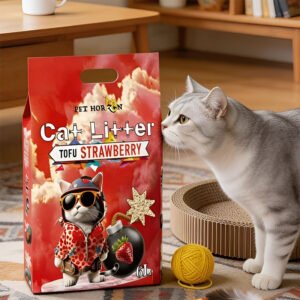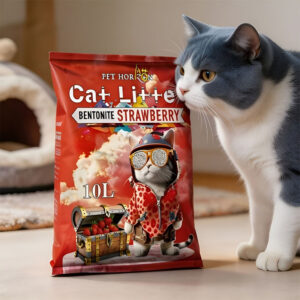


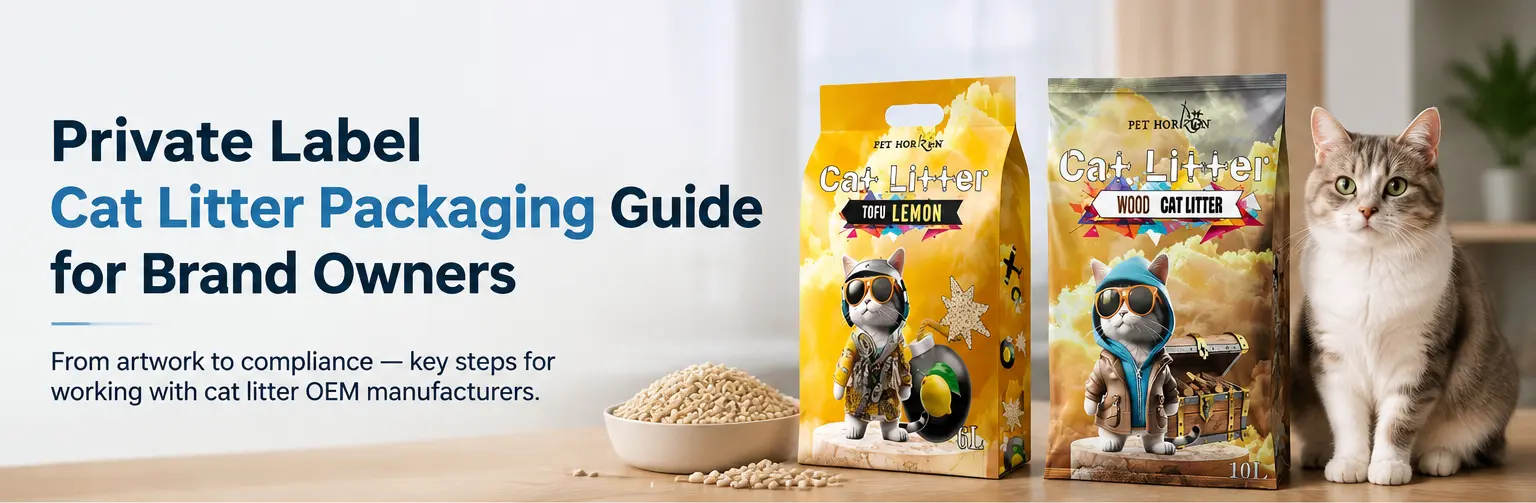
A private label cat litter packaging program allows brand owners, importers, and distributors to sell cat litter under their own brand while an OEM manufacturer manages production, filling, and packaging execution. The packaging stage involves more than printing a logo: bag structure, material selection, artwork approval, minimum order quantity, and destination-market labeling requirements must be confirmed before production starts.
Quick Answer: Private label cat litter packaging includes custom artwork, bag structure, packaging materials, MOQ, setup costs, and market-specific labeling requirements. A cat litter OEM manufacturer helps turn your packaging specification into a production-ready product, but the brand owner remains responsible for artwork approval, product claims, and destination-market compliance.
What Private Label Cat Litter Packaging Covers
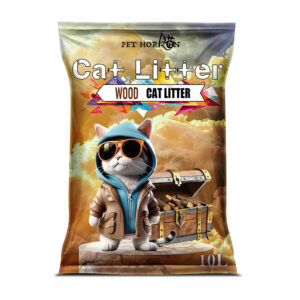
Private label cat litter packaging is more than applying a logo to a bag. Because cat litter is a heavy, moisture-sensitive product, the packaging specification must consider bag strength, sealing performance, filling process, storage conditions, and retail requirements in addition to brand design.
Private label cat litter packaging is the complete packaging specification a brand owner sets for a manufacturer to produce and fill, including print, materials, sizes, and compliant labeling.
Getting this specification right protects your brand at retail and prevents costly reprints or customs delays after the order ships.
Custom Print and Brand Assets
The most visible part of a private label program is the print. Buyers should prepare a complete artwork package rather than expecting the factory to design it.
- Vector logo and brand guidelines
- Pantone or CMYK color references for accurate reproduction
- Required legal text: net weight, material, country of origin, importer or distributor details
- Barcodes and any multilingual label text for the target market
- Batch and date coding position
A manufacturer can usually advise on print method and plate requirements, but the brand owner owns the artwork and the claims printed on the bag.
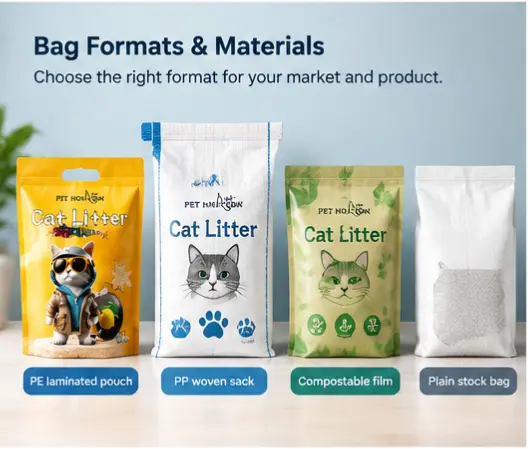
Bag Formats and Materials
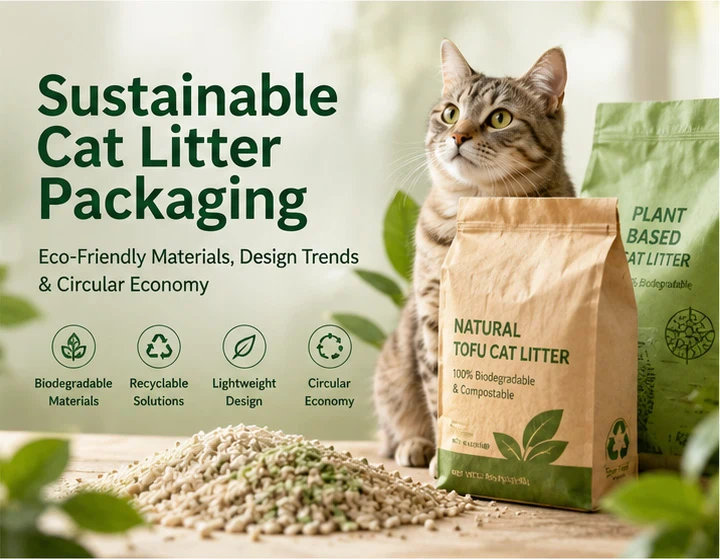
Bag format affects shelf appeal, protection, and compliance. The right choice depends on the litter type, the market, and the sustainability positioning.
| Format | Cat Litter Application | Buyer Consideration |
|---|---|---|
| PE laminated pouch | Premium tofu or bentonite cat litter retail | Barrier, sealing, shelf appearance |
| PP woven sack | Bulk bentonite or wholesale supply | Strength, cost efficiency |
| Compostable film | Eco-positioned cat litter product lines | Certification and claim verification |
| Plain stock bag, later-labeled | Fast launch, low MOQ | Limited brand control, manual labeling cost |
A “compostable” or “recyclable” claim is a substantiation obligation, not a free label. Confirm that the material and the destination market’s rules support the claim before printing it on the bag.
Private Label Cat Litter Packaging Process
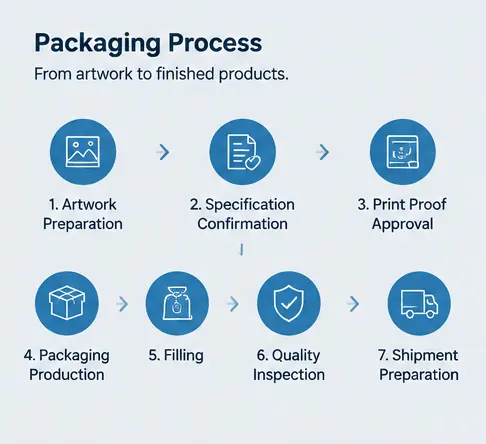
A typical private label packaging workflow includes artwork preparation, packaging specification confirmation, print proof approval, packaging production, filling, quality inspection, and shipment preparation.
- Confirm bag format, material, and packaging specifications
- Prepare and review artwork files
- Approve print proof and packaging samples
- Start packaging production and cat litter filling
- Complete inspection before shipment
Private Label Cat Litter Packaging Specification Checklist
Before starting production, buyers should confirm the following packaging specifications with their manufacturer:
- Bag type, size, and filling weight
- Packaging material structure and barrier requirements
- Printing method and artwork file format
- Seal type and handling requirements
- Labeling requirements for the destination market
- Packaging MOQ and production lead time
Minimum Order Quantity and Setup Costs
Custom print almost always raises the minimum order quantity above plain-stock bags, because the factory must prepare plates or cylinders and reserve a production slot for your design. The exact per-design minimum depends on bag size, material, and print method, so confirm it directly with your supplier.
Budget for one-time setup costs such as plate or cylinder charges, and for a pre-production proof. These fixed costs are amortized across the order, which is why larger first orders usually lower the per-unit packaging cost.
Compliance and Labeling by Market
Labeling and packaging waste rules are set by the destination market, not by the factory. In the European Union, the Packaging and Packaging Waste Regulation (PPWR, Regulation (EU) 2025/40) introduces new requirements for packaging design, recyclability, labeling, and waste management through phased implementation timelines. The United Kingdom and other markets operate separate packaging schemes, while the United States applies packaging obligations such as Extended Producer Responsibility (EPR) mainly through state-level regulations. A cat litter manufacturer can help select suitable packaging materials and provide technical information, but brand owners or importers remain responsible for meeting the labeling and packaging requirements of the markets where products are sold. Review the relevant cat litter packaging EPR rules early because compliance requirements can affect material selection and printed information.
Sample and Proofing Before Full Production
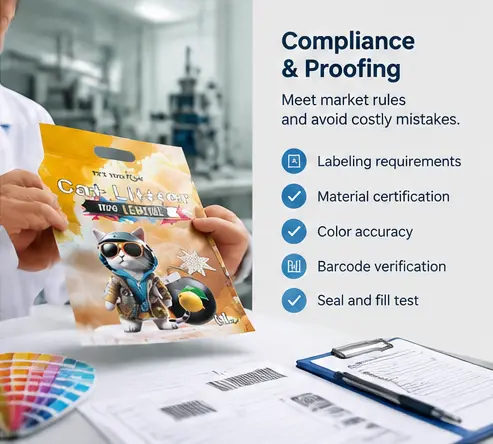
Never approve a full print run from artwork alone. A controlled proofing step prevents the most expensive private label mistakes.
- Request a pre-production print proof on the actual bag material
- Check color accuracy against your Pantone or CMYK reference
- Verify barcode scannability and legal text placement
- Confirm seal integrity and bag durability with a filled sample
Common Private Label Packaging Mistakes
- Starting artwork after production is booked, causing delays
- Printing an unsubstantiated environmental claim
- Underestimating custom-print MOQ and setup cost
- Omitting importer or origin details required by the destination market
- Skipping the print proof and discovering errors on arrival
Working With Your Manufacturer
A capable private label cat litter manufacturer can support packaging selection, artwork review, filling, and production coordination for different litter types, including tofu cat litter and other cat litter formulas. The buyer owns the brand identity, product claims, and market compliance, while the manufacturer manages production execution and quality control.
When selecting a cat litter bag manufacturer, buyers should evaluate not only printing capability but also packaging consistency, filling compatibility, quality control, and experience with export requirements for different markets.
Conclusion
A private label cat litter packaging program succeeds when the artwork, bag spec, minimum order quantity, and destination compliance are settled with the manufacturer before production, and when a pre-production proof is approved before the full run. Treat packaging as a specification, not an afterthought, and your launch will be faster and far less costly.
Frequently Asked Questions
It includes custom print and brand artwork, the bag format and material, sizes, minimum order quantity and setup costs, and the compliant labeling required for the destination market.
Yes. Many cat litter OEM manufacturers can coordinate litter production, filling, and customized packaging. Buyers should confirm whether the supplier supports complete private label production or only packaging supply.
Custom-print MOQ is higher than plain-stock MOQ and depends on bag size, material, and print method. Confirm the per-design minimum directly with your supplier, because it varies by factory and specification.
The factory can advise on technically compliant materials and print, but the brand owner or importer is responsible for meeting the labeling and packaging-waste rules of the market where the product is sold.
A compostable or recyclable claim is a substantiation obligation. Confirm that the material and the destination market’s rules support the claim, and keep the evidence on file, before printing it on the bag.
A proof on the actual bag material verifies color, barcode scannability, legal text, and seal integrity before you commit to a full container, avoiding expensive misprints.
Choose based on litter type, retail channel, budget, and sustainability positioning. A laminated pouch suits premium retail; a PP sack suits bulk value lines; compostable film suits an eco position but needs claim substantiation.
A private label partner can usually supply filled pre-production samples of your chosen formula in your custom packaging so you can verify print, seal, and product together before the full order.