



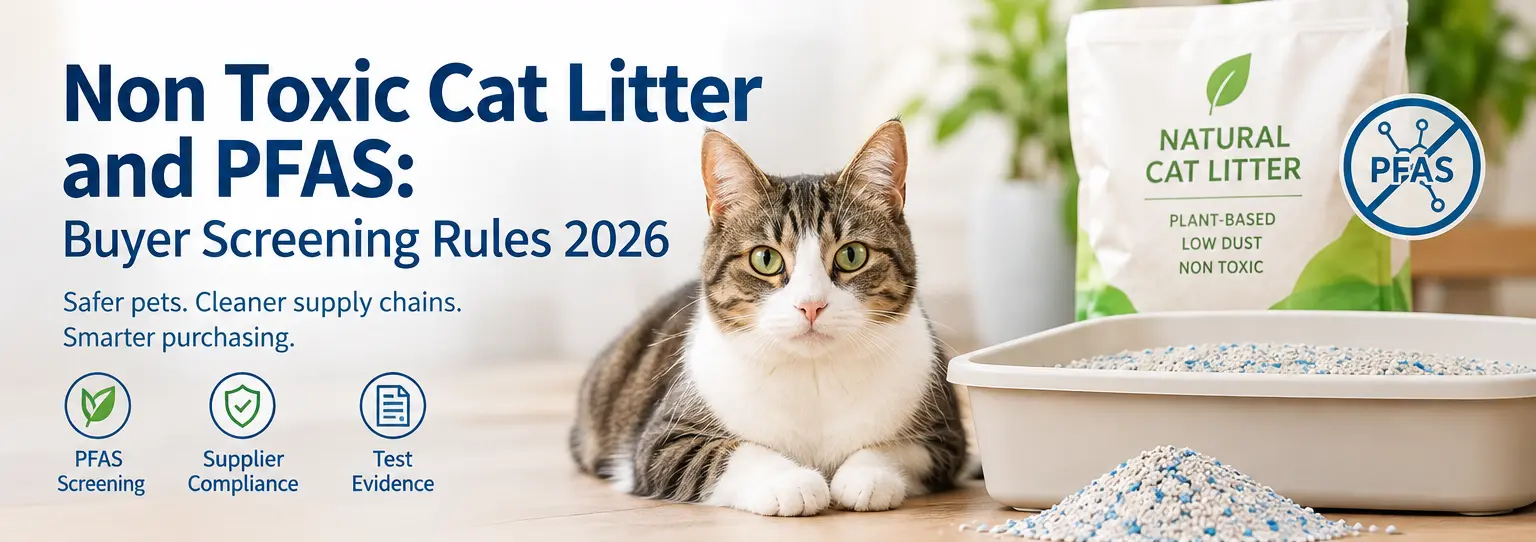
For cat litter buyers, “non toxic” is a broad marketing claim rather than a defined chemical standard. In 2026, PFAS screening is becoming a relevant part of chemical and supplier compliance programs, especially where buyers need documented controls for formulations, processing aids, and packaging materials.
Quick Answer
As of 2026, there is no EU-wide PFAS restriction specifically targeting cat litter, and no general US rule banning PFAS in all cat litter. However, the EU-wide PFAS restriction proposal remains under ECHA committee evaluation, while US states continue to introduce or implement PFAS restrictions for specific product categories. For buyers, the practical control is to define PFAS requirements for litter formulations, processing aids, and packaging rather than assume that “non toxic” or “PFAS-free” is self-proving. PFAS-free is a specific chemical claim; it is not equivalent to an overall “non toxic” certification.
What PFAS Are and Why They Matter
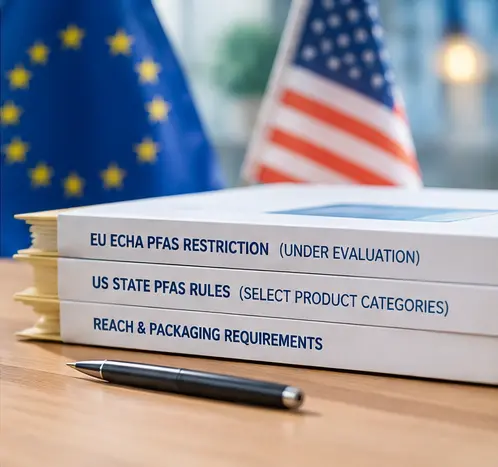
PFAS (per- and polyfluoroalkyl substances) are a large group of chemicals known for properties such as water, grease, and stain resistance. Their high persistence has led regulators to restrict or evaluate their use in different applications. For cat litter buyers, the relevant question is not whether a litter substrate is inherently associated with PFAS, but whether intentionally added PFAS are present in the formulation, processing inputs, treatments, or packaging. In the EU, Germany, Denmark, the Netherlands, Norway, and Sweden submitted a broad PFAS restriction proposal in 2023, and ECHA’s scientific committees are evaluating the proposal as part of the REACH restriction process.
Buyers can follow the ECHA PFAS regulatory page for the current status of the EU restriction process.
Where PFAS Risk Appears in Cat Litter
Processing Aids in Mineral and Bentonite Litter
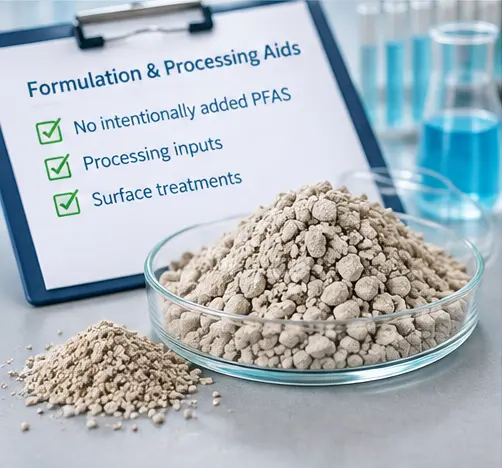
PFAS risk should be assessed based on the actual formulation and manufacturing inputs rather than the litter mineral itself. Buyers should ask suppliers whether any intentionally added fluorinated substances are used in processing aids, surface treatments, or other formulation components and request supporting documentation where relevant.
Packaging Coatings
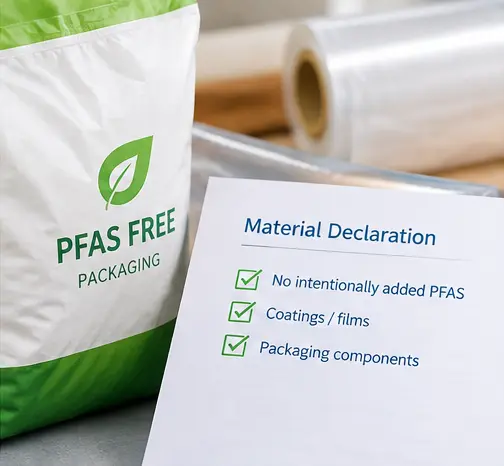
Packaging should be screened separately from the litter formulation. Where bags, coatings, films, or other packaging components use grease- or moisture-resistant treatments, buyers should obtain a material declaration from the packaging supplier confirming whether intentionally added PFAS are present.
How to Build a PFAS Screening Program
A practical buyer checklist:
- Request a supplier declaration covering intentionally added PFAS in litter formulations, processing aids, and packaging materials.
- Ask for third-party laboratory testing when the risk assessment, customer specification, or destination-market requirement calls for analytical verification, and require the laboratory to state the tested PFAS analytes, reporting limits, sample matrix, and analytical method.
- Define the restricted-substance requirement by destination market and product category rather than treating all US state PFAS laws as equivalent.
- Refresh supplier declarations and supporting evidence when formulations, raw materials, packaging, or applicable regulations change.
Non Toxic Claims and Substantiation
A “non toxic cat litter” claim should not be treated as proof of overall chemical safety. For a more defensible claim, buyers should define the substances and limits covered by the specification, document supplier controls, and retain relevant test reports or declarations for the finished product and applicable packaging materials. Our China cat litter quality standard guide covers heavy-metal and hazardous-substance limits that complement a PFAS screen.
Plant-Based Cat Litter and PFAS Screening
Plant-based litters such as tofu litter can have different formulation and processing profiles from mineral-based litters, but plant-based content alone does not establish that a product is PFAS-free or “non toxic.” Buyers should evaluate the finished formulation, additives, manufacturing inputs, and packaging using the same evidence-based screening approach. Review our tofu cat litter page for a plant-based alternative with documented specifications.
Compliance for Exporters
Exporters to the EU should track the ECHA restriction progress and align with cat litter export compliance requirements beyond PFAS, including REACH and packaging rules.
Conclusion
Non toxic cat litter is best evaluated through defined chemical requirements and documented evidence, not by a slogan alone. In 2026, buyers should treat PFAS screening as one part of a broader supplier compliance program covering formulations, processing inputs, packaging, and destination-market requirements. Require appropriate declarations and, where justified, laboratory evidence before approving a new product or formulation change.
Frequently Asked Questions
As of 2026, there is no EU-wide or US federal PFAS ban specifically targeting cat litter. However, the EU-wide PFAS restriction proposal remains under evaluation, and US states have adopted or proposed PFAS requirements for specific product categories.
It means treating PFAS screening as one part of supplier chemical compliance, covering relevant formulation components, processing inputs, surface treatments, and packaging materials.
Do not rely on the “non toxic” label alone. Define the substances and limits covered by the claim, obtain relevant supplier declarations, and use laboratory testing when the product specification, risk assessment, or destination-market requirement calls for analytical verification.
Not necessarily. PFAS risk should be assessed from the actual formulation, processing aids, surface treatments, and packaging rather than inferred from bentonite or another litter substrate alone.
Not necessarily. Plant-based litter may use a different formulation from mineral litter, but plant-based content does not by itself prove that the finished product or its packaging is PFAS-free. Buyers should verify the formulation, processing inputs, and packaging separately.
The European Chemicals Agency (ECHA) publishes the status of the EU PFAS restriction process and supports the REACH restriction procedure through its scientific committees.
Yes. An OEM specification can define the buyer’s PFAS requirement, including restrictions on intentionally added PFAS, applicable destination-market laws, supplier declarations, testing requirements where applicable, and change-control obligations. The specification should be updated as regulations move from proposals to final requirements.
On its own it is a loose adjective; pair it with a restricted-substance screen and test evidence for defensibility.