




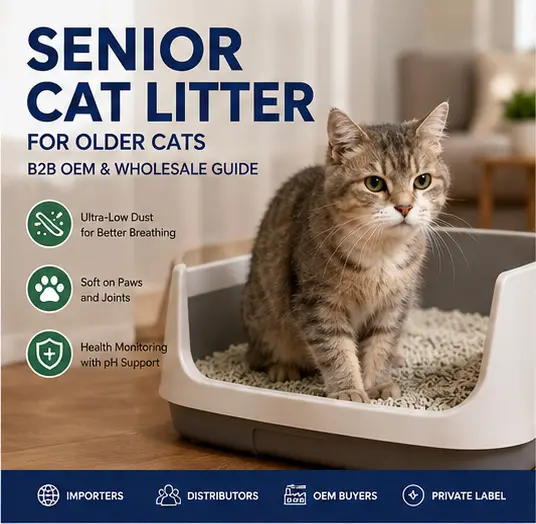
Cats are living longer, and the cat litter category is quietly splitting into a high-value segment that most suppliers still underserve: litter formulated specifically for senior cats and aging cats. For importers, distributors, OEM buyers, and private-label brands, “senior cat litter” is no longer a niche curiosity—it is one of the few cat litter segments where price competition is weak, repeat purchase is strong, and a clear health story supports premium positioning. As a cat litter manufacturer working daily with private-label and OEM buyers, we see this segment move from “interesting” to “core SKU” faster than almost any other.
This guide breaks down the market logic, the formulation specs that define a credible senior cat litter, how B2B buyers should choose and evaluate suppliers, and what we have learned producing these formulas for export markets.
Quick Answer
Senior cat litter is specially formulated cat litter designed for cats aged seven years and older. It is engineered with ultra-low dust, a soft and stable paw feel, and often health-monitoring features such as urine pH indicators. It typically commands premium pricing compared with standard clumping litter, grows faster than the mainstream clumping segment, and suits importers and OEM buyers looking for a differentiated, high-margin SKU with strong repeat-purchase behavior.
What Is Senior Cat Litter?
Senior cat litter is not a single material. It is a specification profile built around the way older cats use the litter box, and around the age-related conditions that make standard litter uncomfortable or even risky for them.
Senior cat litter is cat litter formulated to reduce the physical and respiratory strain of litter-box use for aging cats, while supporting health monitoring for age-related conditions such as kidney disease and arthritis.
Why Senior Cats Need a Different Litter
As cats age, three changes directly affect litter choice for senior felines:
- Mobility and joints. Osteoarthritis and cat arthritis are common in older cats. Hard, deep, or shifting substrates make squatting and digging painful, and can trigger litter-box avoidance that owners misread as a behavior problem.
- Respiratory sensitivity. Elderly cats react more strongly to inhaled dust and fragrance. Low-dust formulation is not a luxury feature; it is a baseline requirement for this segment.
- Kidneys and urination. Chronic kidney disease raises urination frequency. For households researching cat litter for senior cats with kidney issues, an unscented formula plus a pH indicator turns the litter box into an early-warning tool between veterinary visits. Owners of senior cats need to notice changes in urine volume and odor early, which argues for unscented formulas and, increasingly, pH-aware litter.
The Market Case: Why Senior Cat Litter Is Growing Fast
Aging Cat Populations Are Rising
Independent market research shows the share of cats aged seven and older climbing across major markets. In China, cats seven and up already represent a substantial and growing slice of the cat population, with several analyses placing the share around 30% and rising through the late 2020s. Industry analyses—including IndexBox regional reports on senior clumping litter—consistently indicate the Asia-Pacific senior segment continues to expand faster than the broader cat litter category, driven by population aging and premium pet-care demand. The same demographic driver appears in Europe and North America, where pet humanization and longer lifespans keep pushing demand for age-specific care products.
Premium Pricing Protects Margin
Senior formulas sell at a 30–60% premium over mainstream clumping litter. The premium is defensible: buyers pay for low-dust engineering, softer granules, and embedded health features—not for a renamed bag of the same product. For importers and distributors, that premium directly improves basket margin and weakens the race-to-the-bottom that defines commodity litter.
A Stable, Subscription-Friendly Consumable
Cat litter is a non-discretionary repeat purchase. Senior formulas pair naturally with auto-delivery, and the households driving premium demand—multi-cat homes and urban small apartments—are exactly the ones that value convenience and consistent supply. For OEM and private-label buyers, that makes senior litter a strong anchor for a recurring-revenue SKU.
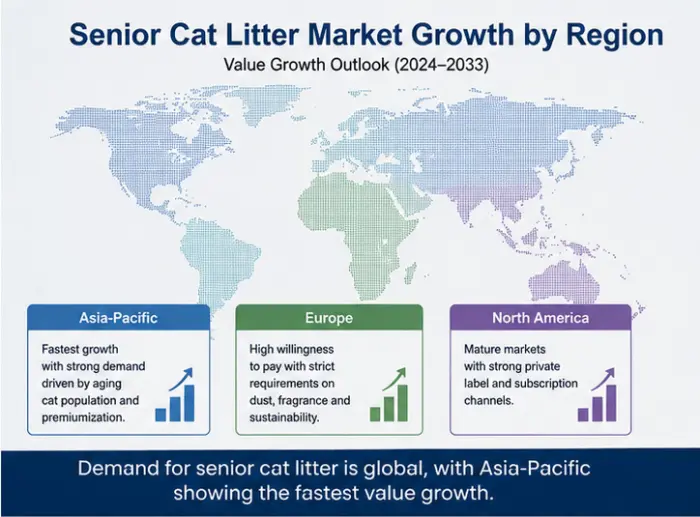
Regional Demand: Where the Senior Cat Opportunity Is Hottest
Asia-Pacific
Asia-Pacific leads on both volume and value growth. Urbanization, delayed family formation, and high cat-human bonding have produced large aging-cat populations in China, Japan, and South Korea. The region’s willingness to pay for health-oriented pet products makes it the first market importers should target for a senior SKU.
Europe
Europe combines high willingness to pay with strict expectations on dust, fragrance, and sustainability. Senior formulas here must clear low-dust and, where claimed, compostability standards (for example EN 13432). The premium is real, but so is the compliance bar.
North America
North America offers mature private-label and subscription channels and strong consumer education on senior pet care. Buyers can launch a white-label senior line quickly through existing DTC and retail-private-label pipelines, provided the low-dust claim is documented.
Senior Cat Litter Formulation Specs Buyers Want
A credible senior cat litter is defined by a short list of measurable specs. The table below maps each spec to the buyer rationale.
| Specification | Target | Why It Matters to Buyers |
|---|---|---|
| Respirable dust | <1% respirable silica; ultra-low total dust | Protects senior respiratory health; supports asthma and bronchitis claims |
| Paw feel | Soft but stable medium-fine granule | Reduces arthritis pain; prevents sinking or instability in the box |
| Urine monitoring | Optional pH / color-change indicator | Early signal of kidney or urinary tract issues |
| Odor control | Gentle, unscented or lightly scented | Seniors tolerate strong smells poorly; unscented aids health monitoring |
| Weight and tracking | Lightweight, low-tracking | Easier for elderly owners to carry and pour; cleaner homes |
| Ingestion safety | Food-grade plant base where used | Safe for cats that groom litter residue off paws |
Ultra-Low Dust Is the Non-Negotiable
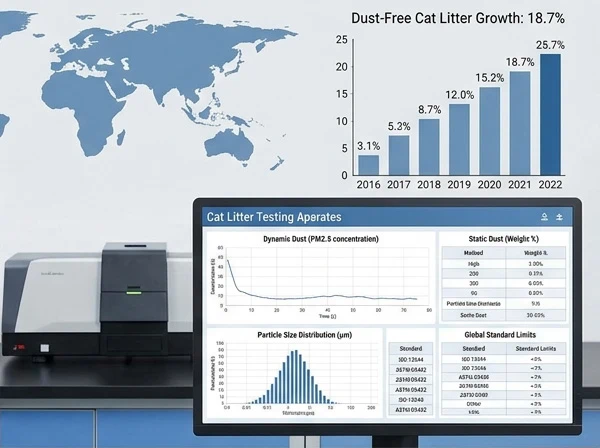
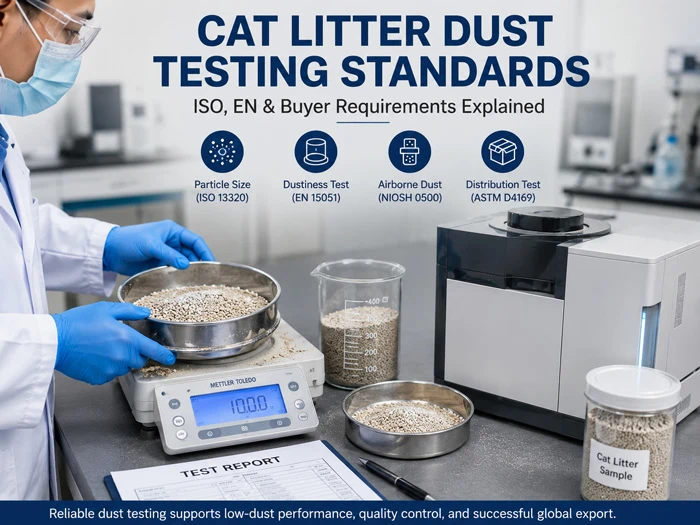
If a supplier can only improve one attribute, it should be dust. Ultra-low dust is the single most important spec for senior cats and the easiest one for buyers to verify; a low dust clumping cat litter that documents its respirable-silica result removes the biggest sourcing risk. In our OEM production experience, buyers from Japan, South Korea, and Germany usually require documented ultra-low-dust performance before they will even discuss packaging customization. Dust control is often evaluated first because it directly affects how a senior formula is positioned in premium export markets—and because it is the attribute regulators and retailers scrutinize most. Our guide to dust control in cat litter covers the engineering and testing methods behind a credible low-dust claim.
Soft, Stable Footing for Arthritic Paws
“Soft” and “stable” are not the same. Senior cats need a granule that yields under the paw but does not collapse or roll. During product testing, we found that overly light pellets tend to shift under the cat’s paws, while excessively dense granules increase joint pressure. A medium-fine particle size usually provides the best balance. Medium-fine plant-based granules and carefully graded low-dust bentonite both meet this need; loose pellets and deep litter beds do not.
Renal Monitoring via Urine pH Indicators
A growing number of senior formulas include a urine pH or color-change indicator that flags abnormal acidity. For brand owners, this is a powerful differentiation story: the litter box becomes a lightweight health-check point between veterinary visits. Buyers should request the indicator’s validated pH range and confirm it does not compromise clumping.
Odor Control Without Overwhelming Fragrance
Strong fragrance masks the very signals—urine odor changes—that alert owners to kidney or infection problems. Gentle, unscented or lightly scented odor control is the correct specification for this segment.

How to Choose Senior Cat Litter
Choosing the right senior cat litter starts with the cat, not the catalog. For aging cats, the non-negotiables are low dust, soft stable footing, and unscented or gently scented odor control. From there, buyers weigh material, monitoring features, and market positioning. The mini-matrix below turns those priorities into a practical specification checklist for importers and OEM buyers.
| If your priority is… | Specify… | Avoid… |
|---|---|---|
| Respiratory safety | <1% respirable dust with a documented test method | An unverified “low dust” label with no lot data |
| Arthritic comfort | Medium-fine, soft but stable granule | Loose pellets, deep beds, silica crystals |
| Kidney monitoring | Validated urine pH indicator | Strong fragrance that masks odor changes |
| Premium positioning | Plant base plus add-on health features | A plain relabel of standard litter |
| Private label speed | A flexible OEM base formula | A fixed single-SKU supplier with no formulation latitude |
Start with dust. A low dust clumping cat litter is the first filter for any senior formula. Request the respirable-dust figure and the test method; a credible supplier documents it lot by lot. If the number is missing, treat the claim as unverified. Next, judge paw feel—the best cat litter for older cats feels soft under the paw yet stays put when the cat squats or digs. Then consider monitoring: a pH indicator adds a health story that supports premium cat litter positioning and helps owners catch early signs of cat kidney disease. Material follows function, and the comparison below details each option. Finally, match the formula to the market: Western Europe emphasizes sustainability and fragrance restraint, East Asia prizes paw comfort and clump quality, and private label cat litter programs often start from a proven base formula and customize packaging and additives. Although priorities vary by market, buyers should always validate performance with documented test results rather than marketing claims. The right choice is the one a supplier can produce consistently, document fully, and ship to your destination market.
Material Options for Senior Cat Litter
Most senior formulas are built on one of five material bases. The table compares them on the attributes that matter most to aging cats.
| Material | Senior Fit | Notes for Buyers |
|---|---|---|
| Tofu / plant-based | Excellent | Soft, near-zero dust, food-grade, unscented; needs a clumping agent |
| Bentonite clumping | Strong | Proven clumping and firm footing; specify a low-dust grade |
| Mixed (tofu + bentonite) | Strong | Combines clump strength with plant softness; good balance SKU |
| Paper | Limited | Low dust and biodegradable, but weak clumping and unstable footing |
| Silica crystal | Poor | Hard, noisy, sharp pressure points; generally not recommended for seniors |
Tofu and other plant-based litters score highest on paw comfort and dust, while low-dust bentonite and mixed tofu-bentonite formulas add clumping strength that pure plant bases sometimes lack. Silica crystals and loose pellets are generally poor fits for seniors because of hardness, noise, and unstable footing.

What We See in OEM Production
Across export projects for senior and low-dust formulas, a few patterns repeat among B2B buyers, and they shape how we recommend specifying the product.
European Buyers
Many European buyers lead with dust documentation and fragrance restrictions, then ask about plant-base sustainability and compostability. They rarely accept a “low dust” claim without a test method and lot data, and they expect the PFAS-free declaration up front. The senior angle sells best there when it is paired with a credible environmental story.
Japanese Distributors
In our discussions with Japanese distributors, consistent particle-size grading is often one of the first quality-control requirements discussed. They run tight incoming-QC on every lot and notice small shifts in particle-size distribution that other markets would miss. For them, formulation stability lot after lot matters more than a long feature list.
Middle East Customers
Buyers in several Middle Eastern markets start from a price-sensitive bentonite base but upgrade to a mixed tofu-bentonite formula once they see the clump stability and lower tracking. Across regions, the buyers who succeed in the senior niche treat low dust as a tested specification rather than a label claim: they request the respirable-dust test method, lock granule size distribution into the QC plan, and validate the pH indicator’s range before launch.
The manufacturers who win these programs are not the cheapest—they are the ones who can adjust formulation, dust level, and packaging to match each destination market without a full production retool.
Why Work With an Experienced Manufacturer
An experienced manufacturer does more than fill a bag. It translates a regional brief—older-cat comfort, renal monitoring, low dust—into a repeatable production spec. Experienced manufacturers can adjust granule hardness, particle size distribution, dust level, fragrance intensity, and packaging specifications according to different regional markets, then hold those parameters lot after lot under documented QC. For the senior segment specifically, formulation flexibility is the difference between a one-off sample and a SKU that survives retail audit. Manufacturers with flexible OEM capabilities can support tofu, bentonite, and mixed formulations while providing documented dust testing, additive integration, and export-ready packaging. As a cat litter manufacturer focused on export, Pet Horizon follows this approach for OEM and private-label projects.

Private Label and OEM: Turning the Trend Into a Recurring SKU
Bundle With Subscription
Senior cat litter is a natural fit for auto-delivery. Owners of aging cats rarely switch brands once a formula agrees with their pet, so recurring revenue is higher than in commodity litter. Buyers should design smaller, lighter, easy-pour packs that suit elderly owners and reduce churn.
White-Label Differentiation
The health-monitoring angle—pH indicators, dust-free claims, soft-paw comfort—gives private-label brands a story that commodity litter cannot match. Buyers building a private-label senior line should evaluate OEM cat litter partners on formulation flexibility above all: can they add a pH indicator, adjust granule size, and switch plant base without a full production retool? White-label senior formulation plus custom packaging is the fastest route into the aging-cat segment.
How Buyers Should Evaluate Suppliers
Selecting a senior-cat-litter supplier is a procurement decision, not a catalog pick. Buyers should evaluate every candidate against a consistent set of criteria before committing volume:
- MOQ flexibility. Pilot runs to validate a new senior SKU before a volume commitment.
- Dust test report. Respirable-silica target, test method, and lot data—not marketing copy.
- QC system. Incoming raw-material checks, in-process granule grading, outgoing inspection.
- Container loading plan. Pack size, palletization, and mixed-SKU consolidation options.
- OEM experience. Existing senior or low-dust references by region and retail channel.
- Production capacity. Monthly tonnage and a peak-season buffer that protects lead time.
- Lead time. Production plus custom packaging and translation, locked into the contract.
- Packaging specifications. Easy-pour, lightweight, private-label artwork, and export carton strength.
- Export markets served. Certifications already held for your target regions.
- Certifications. MSDS, SGS, dust test, PFAS-free declaration, and food-grade base where claimed.
A B2B Sourcing Checklist for Senior Cat Litter
For Importers and Distributors
- Validate the low-dust claim with a test method and lot data, not marketing copy.
- Confirm the premium is defensible: documented specs, not a relabel.
- Plan for smaller, lighter, easy-pour packs suited to elderly owners and subscription.
- Check market-specific certifications before listing, especially for compostable or plant-based claims.
For OEM and Private-Label Buyers
- Request pilot MOQs to validate a new senior SKU before committing to volume.
- Confirm additive integration (pH indicator, deodorizer) is supported under documented QC.
- Lock custom packaging and translation lead times into the contract up front.
Manufacturing and QC Considerations
A credible senior program rests on manufacturing discipline. Partnering with an experienced cat litter manufacturing team lets buyers specify dust testing (<1% respirable), granule grading, and additive integration under documented QC. Buyers should also secure a PFAS-free declaration and, where relevant, compostability certification (for example EN 13432 in the EU) before launch.
Common Mistakes When Entering the Senior Niche
- Rebranding standard litter as “senior” without changing any spec.
- Over-fragrancing, which masks health signals and irritates senior respiratory systems.
- Treating low dust as unverified marketing rather than a tested attribute.
- Underestimating MOQ flexibility and certification lead time for a new SKU.
Senior Cat Litter at a Glance
A quick reference for buyers specifying or sourcing a senior formula:
| Factor | Recommendation |
|---|---|
| Dust | Ultra low (<1% respirable) |
| Material | Mixed or tofu / plant-based |
| Granule | Medium fine, soft but stable |
| Scent | Unscented or lightly scented |
| Tracking | Low |
| OEM | Flexible formulation and packaging |
| MOQ | Pilot runs available |
Why Buyers Choose Pet Horizon
For B2B buyers launching or expanding a senior cat litter program, the practical differentiators are consistency and flexibility, not slogans. Pet Horizon supports:
- OEM & private label — custom formulations and export-ready packaging.
- Flexible MOQ — pilot runs to validate a new SKU before volume commitment.
- Documented dust control — respirable-dust testing and lot-level reporting.
- SGS-tested quality — verified materials and additive integration under QC.
- Export experience — stable supply and global shipping to major destination markets.
Contact us to discuss a senior cat litter specification tailored to your region and channel.
Conclusion
Senior cat litter is a structural, long-cycle opportunity rather than a passing trend. Aging cat populations are rising across every major market, the segment commands a durable 30–60% premium, and its health-monitoring angle gives brand owners a story competitors cannot easily copy. For importers, distributors, and OEM buyers, the winning move is to specify the product properly—ultra-low dust, soft stable footing, and verified formulation—then build a recurring private-label or import program around it. For brands planning to launch premium senior cat litter, selecting an experienced OEM manufacturer is more important than choosing the lowest quotation. Verified dust control, formulation flexibility, and stable export quality ultimately determine long-term success.
Frequently Asked Questions
The defining specs are ultra-low dust, a soft but stable granule for arthritic paws, unscented or gently scented odor control, and often a urine pH indicator for kidney monitoring. The goal is to reduce physical and respiratory strain while supporting early health detection.
Yes. Senior cats are more sensitive to inhaled dust and fragrance, and veterinary literature consistently links airborne litter dust to respiratory irritation in aging cats. Low dust is the single most important and most verifiable spec in this segment.
Some senior formulas include a urine pH or color-change indicator that flags abnormal acidity, a potential early sign of kidney or urinary tract issues. It is a screening aid, not a diagnosis, and should complement—not replace—veterinary care.
For buyers comparing the best cat litter for older cats, tofu and other plant-based litters score highest on paw comfort and dust, while low-dust bentonite and mixed tofu-bentonite formulas add clumping strength. Silica crystals and loose pellets are generally poor fits for seniors.
Position it at a 30–60% premium over standard clumping litter, justified by documented low-dust and comfort specs. Avoid competing on the commodity price of regular litter; the segment rewards clear differentiation.
Expect suppliers to offer pilot MOQs for new SKU validation, then scale. The key question is formulation flexibility: can the manufacturer add a pH indicator, adjust granule size, and switch plant base without a full retool? That flexibility determines how fast a private-label senior line reaches shelf.
It is global but at different maturity levels. Asia-Pacific shows the fastest value growth and the largest aging-cat demographics, while Europe and North America offer high willingness to pay for premium, health-oriented pet care. All three are viable import and OEM targets.
Request the test method and lot data for respirable dust (target <1% respirable silica), ask for a PFAS-free declaration, and, for plant-based claims, confirm food-grade base material. Verified documentation beats marketing language when qualifying a supplier.
Yes. Senior formulas suit private label well because the differentiation—low dust, paw comfort, pH indicators—lives in the formulation and packaging, not in a brand name. An OEM partner should adjust granule size, dust level, fragrance intensity, and additive integration, then apply your private-label artwork and export-ready packaging. Request pilot MOQs to validate the SKU before committing to volume.
At minimum, request an MSDS and a Certificate of Analysis (COA), backed by a dust-test report. For plant-based or food-adjacent claims, ask for SGS testing and confirmation of food-grade base materials. A PFAS-free declaration is increasingly expected in the EU and North America. Where compostability is claimed, confirm the relevant standard (for example EN 13432 in Europe). Verify each certificate names the exact product and lot before launch.