




Odor control is one of the most heavily marketed benefits in cat litter, and it is also one of the easiest places for U.S. packaging copy to create a regulatory problem. Under the Federal Insecticide, Fungicide, and Rodenticide Act (FIFRA), cat litter marketed as killing or controlling bacteria may be subject to regulation as a pesticide product, which can affect registration status, permissible label claims, and supporting documentation. For OEM suppliers producing for the United States, the practical question is rarely whether an antimicrobial ingredient is present; it is what the finished product claims, what the intended use is, and whether an exemption applies to that claim. This guide sets out where the line sits, what the treated articles exemption actually requires, and how to review wording before artwork is approved.
Quick Answer
A cat litter claim about masking, absorbing, or neutralizing odor is generally not a pesticidal claim when it does not link the result to control of microorganisms. A claim that the litter kills, controls, or inhibits bacteria or other microorganisms can create a pesticidal claim under FIFRA. For treated articles, EPA separates non-public-health claims that protect the article or substance itself from public-health claims, and the split runs along specific wording: EPA lists “antibacterial,” “bactericidal,” and “germicidal” as public health claims that fall outside the treated articles exemption, while terms such as “antimicrobial,” “fungistatic,” and “preservative” may remain acceptable when they are properly and clearly qualified for a non-public-health purpose. The correct position depends on the exact wording, intended use, formulation, the registration status of the incorporated antimicrobial, and whether an exemption applies. Brand owners and OEM suppliers should review and approve the final packaging wording before artwork approval, because neither an antimicrobial ingredient nor an odor-control claim determines the regulatory result on its own.
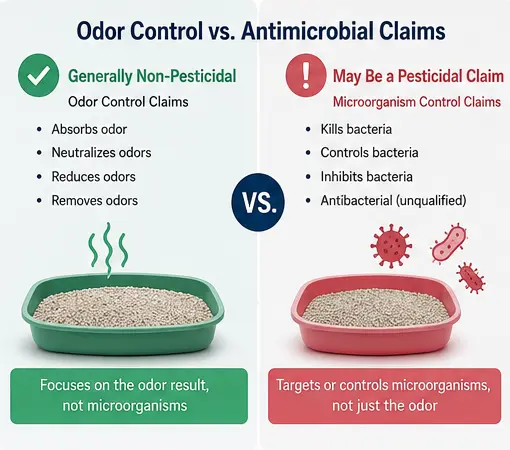
Odor Claims and Microorganism Claims at a Glance
| Claim type | Typical regulatory direction | Review point |
|---|---|---|
| Absorbs odor | Generally non-pesticidal | Does not link odor control to microorganisms |
| Neutralizes or removes odors | Generally non-pesticidal | Review surrounding claim and context for implied microbial control |
| Reduces odors from microorganisms | Potential non-public-health claim | May qualify only when properly qualified and the treated article meets the exemption conditions |
| Inhibits the growth of bacterial odors | Potential non-public-health claim | Must be properly qualified and limited to protecting the treated article or substance itself |
| Kills odor-causing bacteria | May be a pesticidal claim | Review the intended pesticidal purpose, registration status, and any applicable exemption |
| Antibacterial, bactericidal, germicidal | Listed as public health claims | EPA lists these terms as unacceptable for exempted treated articles, including references in any context to activity against germs |
| Protects the litter from microbial degradation | Potential treated-article exemption | Confirm that the antimicrobial is registered for the specific use and that the treatment protects the article itself |
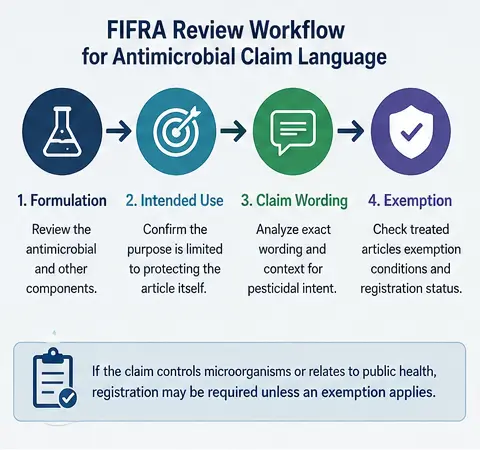
If the claim controls the microorganism, review the product as a potential pesticidal claim. If the claim only describes protection of the treated article, assess the treated articles exemption. If the claim concerns odor without a microorganism-control implication, it is generally outside FIFRA pesticide-claim territory.
What FIFRA Covers
FIFRA establishes the statutory pesticide framework; 40 CFR 152.25(a) provides the treated-articles exemption; and EPA PR Notice 2000-1 explains how antimicrobial claims on treated articles are evaluated under that exemption.
FIFRA provides the statutory framework. Section 2(t), 7 U.S.C. 136(t), defines “pest” to include bacteria and other micro-organisms, with an exception for viruses, bacteria, or other micro-organisms on or in living man or other living animals. That exception is why a claim about controlling bacteria in the litter box and a claim about treating an animal are assessed differently.
Two regulations do the detailed work. At 40 CFR 152.15, a substance is considered intended for a pesticidal purpose, and therefore a pesticide requiring registration, if the person who distributes or sells it claims, states, or implies by labeling or otherwise that it can or should be used as a pesticide. At 40 CFR 152.25(a), an article or substance treated with, or containing, a pesticide to protect the treated article or substance itself is exempt if the pesticide is registered for such use.
EPA policy adds the third layer. PR Notice 2000-1 gathers the agency’s guidance on which labeling statements it considers covered by the treated articles exemption and which it does not, and it sets out examples of claim wording drawn from enforcement proceedings.
EPA does not decide the question from the ingredient list alone. Pesticidal intent can be established through the label, the product name, advertising, or other statements made in connection with sale or distribution, and EPA has stated that it examines the product name, its context, the labeling claims, and other related elements on a case-by-case basis. The cat litter odor control technology explainer distinguishes physical and chemical approaches to odor management; for U.S. compliance, the wording used to describe the intended effect has to be reviewed separately from the underlying odor-control technology.
Odor Control vs Antimicrobial Claims Under EPA Policy
EPA’s PR Notice 2000-1 separates antimicrobial claims on treated articles into public health claims and non-public health claims. The distinction is worth understanding in EPA’s own terms, because the acceptable and unacceptable wording lists sit close together.
- Non-public health claims. EPA treats a claim as non-public health where it is limited to protecting the treated article or substance itself, including claims to inhibit offensive odors in the treated article or substance. Wording EPA has identified as acceptable for exempted treated articles includes “resists odors,” “inhibits the growth of bacterial odors,” “resists microbial odor development,” “guards against the growth of odors from microbial causes,” “reduces odors from microorganisms,” and “acts to mitigate the development of odors.” These examples do not by themselves establish an exemption; the claim must remain within the article-protection purpose and satisfy the other treated-articles conditions.
- Public health claims. EPA lists claims of “antibacterial,” “bactericidal,” or “germicidal” activity, including references in any context to activity against germs or human pathogenic organisms implying public health related protection, as public health claims. It also lists claims to control microorganisms infectious or pathogenic to humans, claims to be a sanitizer, disinfectant, sterilant, or virucide, and an unqualified claim of “antimicrobial” activity. Wording EPA has identified as unacceptable for exempted treated articles includes “antibacterial,” “kills pathogenic bacteria,” “provides a bacteria-resistant surface,” and “surface controls both gram positive and negative bacteria.”
Two groups of terms therefore behave differently, and mixing them up is a common review error. “Antibacterial,” “bactericidal,” and “germicidal” appear on EPA’s unacceptable list without a qualification route. By contrast, EPA considers terms such as “antimicrobial,” “fungistatic,” “mildew-resistant,” and “preservative” acceptable for exempted treated articles or substances provided that they are properly, and very clearly, qualified as to their intended non-public health use.
Cat litter is specifically discussed in EPA’s treated-articles guidance. EPA lists cat litter among consumer articles, alongside toothbrushes, cutting boards, sponges, and vacuum cleaner bags, for which products have in many cases made public health claims extending beyond protection of the article itself and therefore did not qualify for the treated articles exemption. For OEM programs, the practical lesson is that cat litter should not be treated as automatically exempt simply because the antimicrobial treatment is incorporated into the litter; the exact claim and intended purpose still need to be reviewed.
Terms such as “antimicrobial,” “fungistatic,” and “preservative” should not be evaluated in isolation. EPA’s treated-articles policy allows certain antimicrobial terminology when it is properly and clearly qualified for a non-public-health purpose, but an unqualified term, use of the term in the product name, or presentation in bolder text than the accompanying information can render the qualification inadequate. EPA’s policy also addresses presentation: all references to pesticidal properties and the required qualifying statements should be located together, printed in type of the same size, style, and color, and given equal prominence, and such references should not be given greater prominence than any other described product feature. For packaging review, assess the complete claim, its placement, and its surrounding text rather than approving or rejecting a single word on its own.
Treated Articles Exemption and When Registration Is Required
The treated articles exemption at 40 CFR 152.25(a) exempts an article or substance treated with, or containing, a pesticide to protect the treated article or substance itself, if the pesticide is registered for such use. Two conditions must both be met. First, the incorporated pesticide must be registered for use in or on that article or substance. Second, the sole purpose of the treatment must be to protect the article or substance itself.
EPA has interpreted the “registered for such use” condition narrowly. In PR Notice 2000-1, the agency states that the registration and labeling of an antimicrobial pesticide intended for incorporation into a treated article or substance needs to include specific listings of the articles or substances that may be treated, and that it has not permitted broad general use patterns such as the preservation of hard surfaces, plastics, adhesives, or coatings. The agency also states that it is not sufficient for the pesticidal substance in the treated article merely to resemble or have activity like a registered pesticide. OEM suppliers should therefore verify the actual registration and labeling of the antimicrobial rather than relying on a broad assumption that an ingredient is approved for all treated articles.
The exemption does not extend to implied or explicit public health claims. Where a cat litter bears a public health claim and does not otherwise qualify, EPA may treat it as a pesticide product subject to the applicable FIFRA requirements. Such a product generally may not be legally sold or distributed unless it is registered with EPA, or unless the claims are removed and the article otherwise qualifies for the exemption.
Other regulatory pathways have their own conditions and should not be assumed to apply. The minimum risk exemption under FIFRA section 25(b), for example, is limited to products meeting specific conditions on both active and inert ingredients, and it operates separately from the treated articles exemption. For OEM programs, the brand owner and a qualified regulatory adviser should review the formulation, the intended use, the exact claims, and any claimed exemption together before packaging is finalized. The EPA consumer products treated with pesticides page also notes a point worth repeating internally: the absence of an EPA registration number alone does not establish that a product is exempt, because an unregistered product that should have been registered would also lack an EPA registration number.
How Suppliers Should Qualify Claims
A practical compliance approach is to separate ordinary odor-control claims from microorganism-control claims and have the exact wording reviewed before packaging approval. OEM suppliers should ask the brand owner which claims are intended, request the regulatory basis for each one, and align pack copy with that status rather than adding antimicrobial language as a marketing enhancement. The cat litter export compliance hub consolidates labeling and documentation topics so antimicrobial and environmental claims are handled in the same compliance file. Where a program does want antimicrobial positioning, a documented cat litter supplier compliance process can hold the regulatory determination with the product specification from the first sample onward.
Documentation and Audit Readiness
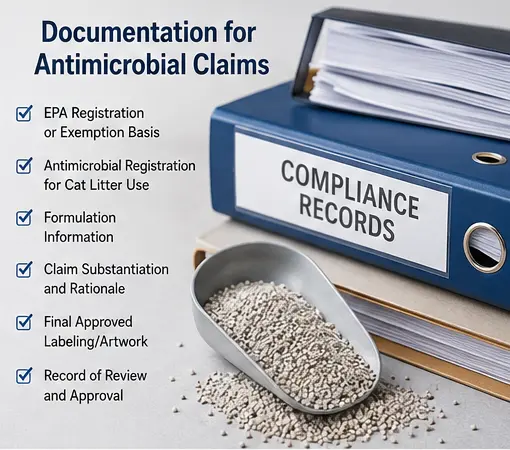
For any claim that could have pesticidal implications, keep a documented regulatory determination with the product specification. Depending on the applicable pathway, the file may include an EPA registration number and approved label, evidence supporting a claimed exemption, confirmation that the incorporated antimicrobial is registered for use in cat litter, formulation information, and claim substantiation. The wording that appears on the finished package should match the reviewed regulatory position exactly, and any required qualifying statement should be placed together with the pesticidal reference, printed in type of the same size, style, and color, and given equal prominence. Preparing this file before artwork approval makes it far easier to demonstrate why a claim was considered permissible if a commercial customer, importer, or regulator asks for supporting information.
Conclusion
Cat litter antimicrobial claims need more regulatory review than ordinary odor-control claims because the wording and intended purpose can determine whether a claim falls within or outside the treated articles exemption. The assessment should consider the formulation, the intended use, the exact wording, and the applicable exemption conditions before artwork is approved. For U.S. OEM programs, brands and suppliers should approve the final cat litter antimicrobial claims together, retain the regulatory determination with the product specification, and treat antimicrobial wording as a compliance decision rather than a copywriting option.
Frequently Asked Questions
The Federal Insecticide, Fungicide, and Rodenticide Act is the U.S. law under which EPA regulates products intended to prevent, destroy, repel, or mitigate pests. Section 2(t), 7 U.S.C. 136(t), defines pest to include bacteria and other micro-organisms on inanimate objects and surfaces, with an exception for organisms on or in living humans or animals. For cat litter, that definition matters because a claim about controlling bacteria in the litter can fall within FIFRA while a claim about treating an animal does not.
Not by itself. A claim about masking, absorbing, neutralizing, or removing odor is generally not a pesticidal claim when it does not link the result to control of microorganisms. The analysis changes when the wording states or implies that the litter kills, controls, or inhibits bacteria or other organisms.
No. The presence of an antimicrobial ingredient alone does not determine the regulatory status. EPA looks at the intended pesticidal purpose, the claims made on the label and in marketing, the use pattern, and whether an exemption applies. The formulation and the label should therefore be reviewed together.
EPA identifies unqualified claims such as “antibacterial,” “bactericidal,” and “germicidal,” as well as claims involving sanitizer, disinfectant, sterilant, or virucidal activity, as public-health claims that are outside the treated articles exemption. By contrast, EPA provides examples such as “reduces odors from microorganisms” and “inhibits the growth of bacterial odors” for non-public-health treated-article claims when the applicable conditions and qualifications are met. The complete wording, context, intended use, and exemption conditions should therefore be reviewed together.
It is the exemption at 40 CFR 152.25(a) for an article or substance treated with, or containing, a pesticide to protect the treated article or substance itself, if the pesticide is registered for such use. Both conditions must be met, and the exemption does not cover implied or explicit public health claims. EPA’s policy on how the exemption applies to antimicrobial claims, including examples of acceptable and unacceptable wording, is set out in PR Notice 2000-1, which is available from EPA as a PDF, and summarized for buyers and specifiers on EPA’s consumer products treated with pesticides page.
Not without first confirming the regulatory status of the exact claim. If the wording creates a pesticidal claim, the product must meet the applicable FIFRA registration requirements unless a valid exemption applies. OEM suppliers should have the brand owner or a qualified regulatory adviser approve antimicrobial wording before artwork, printing, or production rather than adding it as a marketing enhancement.
If a product is subject to FIFRA registration but is distributed with an unregistered pesticidal claim, the company may face regulatory enforcement and the product may be rejected by commercial customers. EPA has stated that it may take appropriate enforcement action where unregistered products make pesticidal claims, including Notices of Warning, Stop Sale, Use, or Removal Orders, and civil penalties. The claim should be reviewed before production and shipment.
Neither term should be treated as automatically safe. “Natural” raises a separate advertising and substantiation question, while terms such as “hygienic” or “sanitary” can become relevant to FIFRA when the surrounding label or marketing context implies antimicrobial or microorganism-control performance. Review the complete claim, supporting text, imagery, and intended use rather than assessing the word in isolation.
No. FIFRA is the U.S. framework, and other markets apply their own rules to biocidal, antimicrobial, and treated-product claims. An assessment made for the United States should not automatically be used for the EU or another destination market. For multi-market OEM packaging, review the exact claim against the requirements of each target market before using one artwork version across countries.