




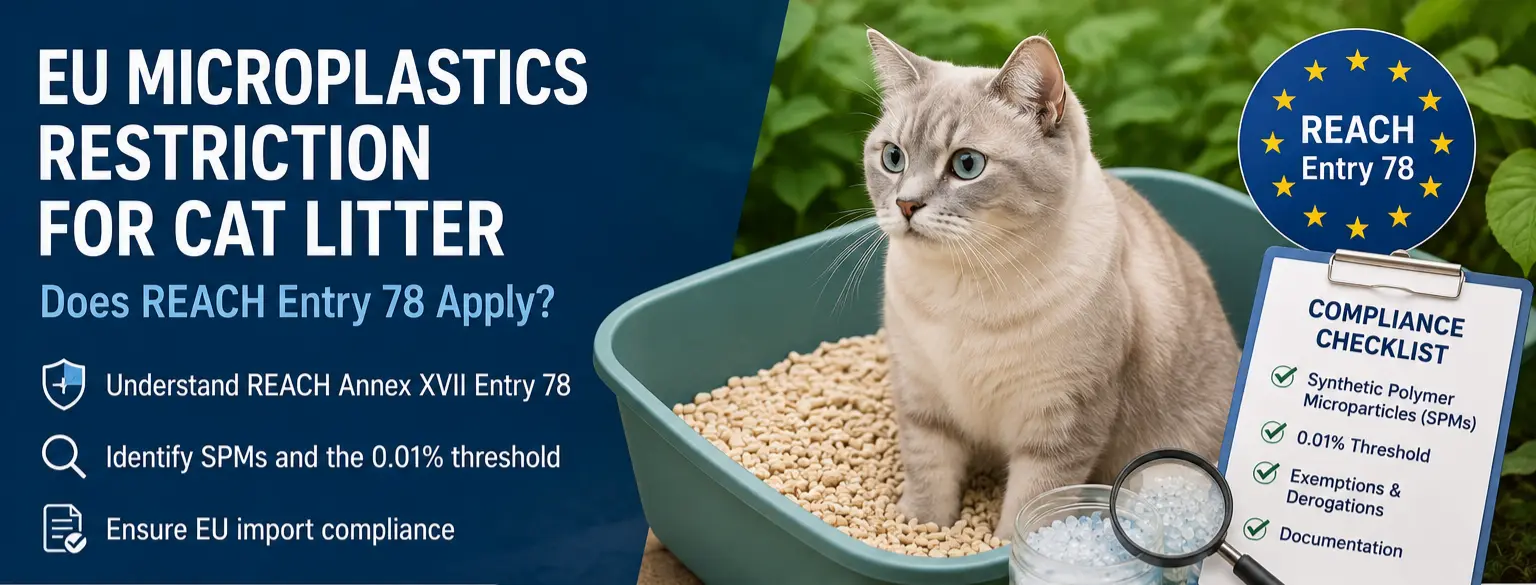
The EU’s restriction on intentionally added microplastics is one of the most misunderstood pieces of pet-product regulation. For cat litter importers and private-label brands selling into Europe, the question is practical: does my product fall inside the restriction, and what documentation do I need? Regulation (EU) 2023/2055 and REACH Annex XVII Entry 78 target intentionally added synthetic polymer microparticles (SPMs), not a cat litter material as such. The key question for a SKU is whether it contains SPMs that meet the Entry 78 definition, whether the concentration reaches 0.01% by weight, and whether an exemption or transitional arrangement applies. Standard bentonite, silica, tofu and pine base materials are usually not the issue; the additives — synthetic polymer microcapsules, coatings and other functional materials — are what need checking.
Quick Answer
REACH Entry 78 does not ban cat litter by “type.” Standard bentonite, silica, tofu and pine litters are based on materials that are generally not synthetic polymer microparticles, so the base material itself normally does not trigger Entry 78. If a formula also contains synthetic polymer microparticles that meet the definition — for example, certain synthetic polymer microcapsules, beads or coatings — the component must be assessed separately. For mixtures covered by paragraph 1 of Entry 78, intentionally added SPMs present to confer a sought-after characteristic at 0.01% by weight or more are generally restricted from being placed on the EU market unless a specific derogation or other applicable provision applies. EU-bound importers should obtain formulation information and an Entry 78 assessment from suppliers before ordering.
For EU Cat Litter Importers: What to Check
For a B2B buyer, the practical question is what to verify before a purchase order. A useful Entry 78 checklist is:
- Identify every intentionally added polymer-containing additive in the formula.
- Ask whether any polymer meets the Entry 78 SPM definition (particle size, solid polymer, concentration and coating conditions).
- Check the 0.01% by-weight threshold for qualifying SPMs present to confer a sought-after characteristic.
- Check whether an exclusion or derogation applies (naturally polymerised and non-modified polymer, degradability, solubility, industrial-site use, etc.).
- Obtain SKU-specific supplier documentation for the assessment.
- Keep formulation and batch records linked to the specific SKU placed on the EU market.
The Legal Backbone: REACH Annex XVII Entry 78
Regulation (EU) 2023/2055 added Entry 78 to REACH Annex XVII, restricting intentionally added synthetic polymer microparticles (SPM). It has been in force since 17 October 2023. The restriction bars placing on the market mixtures that contain SPM at 0.01% by weight or more where the SPM are present to confer a sought-after characteristic.
To clarify and refine Entry 78, Regulation (EU) 2026/1168 was published in the Official Journal on 2 June 2026 and entered into force on 22 June 2026. It expands the derogation for medicinal products, adds an exemption for product- and process-oriented research and development (PPORD) involving up to 1 tonne of synthetic polymer microparticles per year, and clarifies that the solid-matrix derogation covers intended end uses lasting one year or longer. The medicinal-product and PPORD amendments apply from 17 October 2023, while the amended solid-matrix provision applies from 22 June 2028. For ordinary cat litter products, these changes do not create a general exemption.
What Counts as a Synthetic Polymer Microparticle
Under REACH Annex XVII Entry 78, a synthetic polymer microparticle (SPM) is defined through several conditions rather than simply being any plastic particle smaller than 5 mm. The polymer must be solid and meet the regulation’s particle criteria, including particles where all dimensions are 5 mm or less, or elongated particles with a length of 15 mm or less and a length-to-diameter ratio above 3. The definition also excludes certain polymers that are naturally polymerised and not chemically modified, proven degradable, sufficiently soluble (solubility greater than 2 g/L), or do not contain carbon. Where the polymer is present in particles, additional regulatory conditions apply, including the polymer’s proportion within the particle or its presence as a continuous surface coating. These criteria should not be confused with the separate 0.01% by-weight threshold, which concerns the concentration of qualifying SPMs in the relevant mixture.
Which Cat Litter Materials Are Generally Outside Entry 78?
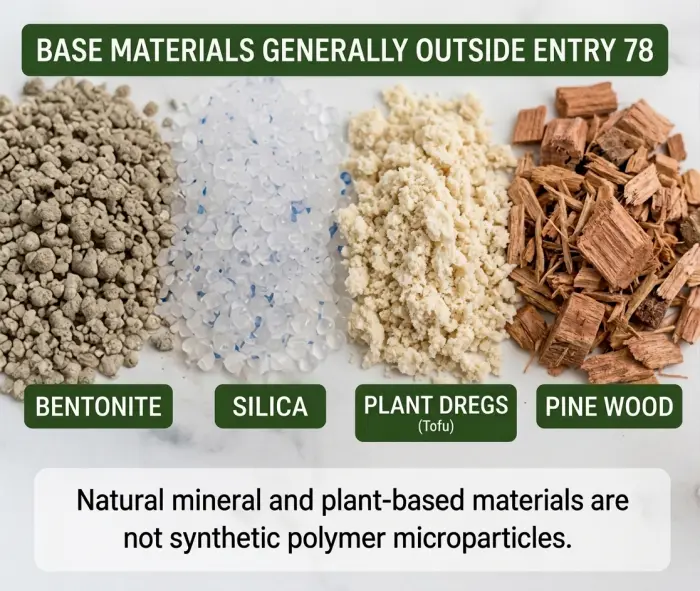
The main cat litter base materials used in standard formulas are generally not synthetic polymer microparticles. However, the assessment should be made at the SKU and formulation level because additives and surface treatments can change the compliance position.
- Mineral litters. Bentonite clay and silica gel are mineral materials rather than synthetic polymers, so the base litter itself is generally outside the SPM definition.
- Plant-based litters. Tofu, pine and other plant-based materials are generally based on naturally occurring, non-synthetic materials. However, any chemically modified or separately added synthetic polymer component must be assessed independently under Entry 78.
For importers, the practical conclusion is not that a litter type is automatically exempt, but that a standard formula based on mineral or plant-derived materials normally presents a lower Entry 78 risk when it contains no qualifying synthetic polymer microparticles. For a fuller comparison of base materials and how each is typically processed, see the cat litter types guide.
Where the Risk Actually Sits
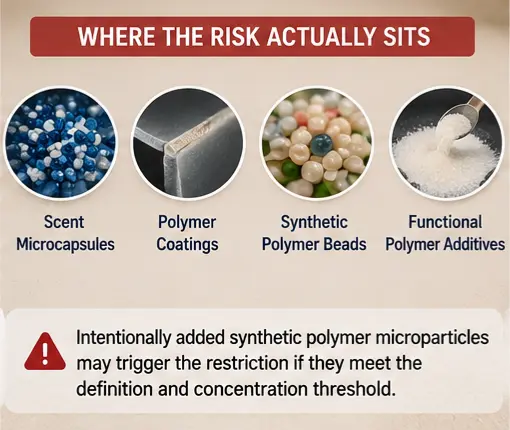
The compliance risk is usually in intentionally added synthetic polymer components used to provide a specific function, rather than in the main mineral or plant-based litter material. Importers should ask suppliers to identify and assess additives such as:
- Synthetic polymer scent microcapsules. Some fragrance encapsulation systems use polymer shells that may fall within the SPM definition.
- Polymer-based surface coatings. A synthetic polymer coating applied to litter particles may need assessment under Entry 78, particularly where it forms a continuous surface coating.
- Synthetic polymer beads or decorative particles. Added plastic-like particles, glitter or beads may fall within the restriction depending on their composition and physical characteristics.
- Other functional polymer additives. Binding, dust-control or anti-tracking additives should be assessed based on their actual polymer identity, particle characteristics, solubility and degradability rather than assumed compliant or non-compliant from their marketing description alone.
A supplier should therefore confirm the actual polymer chemistry and the applicable Entry 78 status for any synthetic additive. A claim such as “natural,” “water-soluble” or “plant-based” is not, by itself, sufficient to establish the regulatory status of an additive.
Practical Documentation for EU Importers
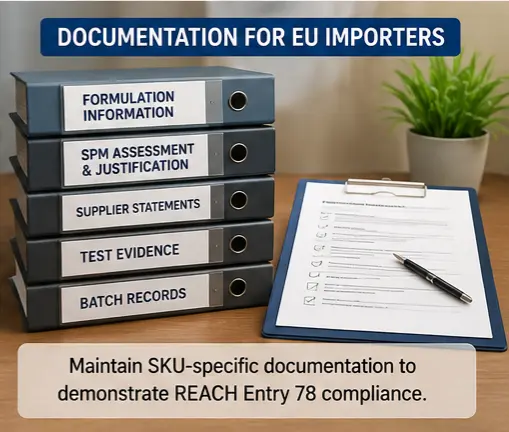
Because Entry 78 depends on the composition and characteristics of specific synthetic polymer components, EU importers and private-label brands should maintain enough supplier evidence to demonstrate how each SKU was assessed, and to respond to competent-authority requests for information. A practical compliance file can include:
- A current formulation or ingredient declaration identifying intentionally added polymers and their functions.
- Supplier specifications for fragrances, coatings, microcapsules and other polymer-containing additives.
- A written supplier statement confirming the Entry 78 status of relevant synthetic polymer components, including the basis for any claimed exclusion or derogation.
- Supporting technical documents or test evidence where polymer degradability, solubility or particle characteristics are relevant to the assessment.
- Batch and formulation records that allow the compliance assessment to be linked to the specific SKU placed on the EU market.
There is no single universal “REACH Entry 78 certificate” that automatically proves compliance for every cat litter SKU. The useful approach is to build a product-specific evidence package that matches the actual formulation and supply-chain role.
Do Cat Litter Companies Need to Report to ECHA?
The ECHA reporting deadlines should not be confused with the general placing-on-the-market restriction. The first 31 May 2026 reporting deadline applies specifically to manufacturers and industrial downstream users of SPMs in the form of pellets, flakes and powders used as feedstock in plastic manufacturing at industrial sites, covering emissions during 2025. Other reporting obligations under Entry 78 begin in 2027 for specified derogated uses and supply-chain roles. A normal cat litter product that is not within a reporting derogation does not become subject to ECHA reporting simply because the litter is sold as granules or powder. For the official scope and submission route, see ECHA’s microplastics reporting guidance.
Why Plant-Based OEM Ranges Can Simplify Entry 78 Review
Plant-based private-label ranges can simplify an Entry 78 assessment when the base materials are naturally derived and the formulation avoids qualifying synthetic polymer microparticles. The key advantage is a relatively straightforward formulation review: the importer can focus on whether fragrances, coatings, binders or other functional additives introduce polymers that meet the SPM definition. For European distributors, an OEM supplier that can provide SKU-specific formulation information and supporting REACH documentation can make this due-diligence process more efficient.
For buyers evaluating a tofu cat litter manufacturer, requesting the supplier’s Entry 78 assessment and supporting formulation documentation before placing an order is a practical due-diligence step.
Common Misconceptions
Three myths circulate in the trade and cause unnecessary rework:
- “All plastics are banned.” No. Entry 78 targets qualifying intentionally added synthetic polymer microparticles that meet the regulatory conditions and threshold; it does not ban every polymer, plastic-containing material or cat litter base material.
- “Plant-based means automatically exempt.” True for the base, but added synthetic scent or coating can still trigger the rule.
- “The restriction applies immediately to everything.” No. Entry 78 contains specific derogations, reporting requirements and deferred application dates for certain uses. For example, the first ECHA reporting deadline in 2026 applies to a specific industrial use of SPM pellets, flakes and powders as plastic-manufacturing feedstock, while other specified reporting obligations begin in 2027. These reporting timelines should not be treated as general deadlines for cat litter products.
How Entry 78 Fits Into EU Cat Litter Compliance
Microplastics is one of several EU rules affecting cat litter. Packaging (PPWR), biodegradability claims, and chemical limits all interact, and a product can be compliant on one axis and exposed on another. The cat litter export compliance hub consolidates these requirements for importers building a Europe-ready product line, so the microplastics question is answered in the context of the full regulatory stack.
Conclusion
The EU microplastics restriction does not ban cat litter, and it does not treat natural mineral or plant-based base materials as automatically restricted. The key compliance question is whether a product contains intentionally added synthetic polymer microparticles that meet the Entry 78 definition and are present to confer a sought-after characteristic at 0.01% by weight or more, unless a relevant derogation or other applicable provision applies. EU-bound brands should obtain formulation information and a supplier-specific Entry 78 assessment, while plant-based OEM ranges can offer a relatively straightforward compliance review when they contain no qualifying synthetic polymer additives.
Frequently Asked Questions
Standard bentonite clay is a natural mineral rather than a synthetic polymer microparticle, so the base material itself is generally outside REACH Entry 78. However, the complete SKU should still be reviewed for added synthetic polymer microcapsules, coatings, beads or other additives that could fall within the definition of an SPM.
Tofu and pine base materials are generally plant-derived rather than synthetic polymer microparticles, so the base material is normally outside Entry 78. However, “plant-based” does not automatically determine the status of every additive. Fragrances, coatings and other functional ingredients should be assessed separately.
The restriction can apply when a cat litter mixture contains intentionally added synthetic polymer microparticles that meet the Entry 78 definition and are present to provide a sought-after characteristic at 0.01% by weight or more, unless a specific derogation applies. The actual polymer identity, particle characteristics, solubility, degradability and function should therefore be checked rather than relying on the additive’s marketing name.
It is the EU restriction on intentionally added synthetic polymer microparticles, in force since 17 October 2023 via Regulation (EU) 2023/2055.
Regulation (EU) 2026/1168 amended REACH Entry 78 by expanding the medicinal-product derogation, adding a PPORD derogation for synthetic polymer microparticles used in product- and process-oriented research and development at quantities of up to 1 tonne per year, and clarifying the solid-matrix derogation for intended end uses lasting one year or longer. The first amendments apply from 17 October 2023, while the revised solid-matrix provision applies from 22 June 2028.
For mixtures covered by paragraph 1 of Entry 78, intentionally added synthetic polymer microparticles present to provide a sought-after characteristic at a concentration of 0.01% by weight or more cannot generally be placed on the EU market unless a relevant derogation or other applicable provision applies. The threshold applies to qualifying SPMs, not to every polymer-containing ingredient.
Not simply because the product is granular or powdered. The ECHA reporting obligation applies to specified uses and supply-chain roles covered by Entry 78. The first 31 May 2026 deadline applies to manufacturers and industrial downstream users of SPM pellets, flakes and powders used as feedstock in plastic manufacturing at industrial sites; other specified reporting obligations begin in 2027. A normal cat litter SKU should therefore be assessed against the actual Entry 78 reporting provisions rather than assumed to be reportable because of its physical form.
Potentially, yes. “Scented” and “flushable” are not themselves the legal tests under Entry 78. The importer should assess any intentionally added synthetic polymer components, including fragrance encapsulation systems or coatings, against the SPM definition, concentration threshold and applicable derogations. Flushability should be assessed separately under the requirements and claims relevant to that product.
Ask the manufacturer for SKU-specific formulation information, identification of intentionally added polymers, specifications for relevant fragrances or coatings, and written confirmation of the Entry 78 assessment. Where an exclusion depends on degradability, solubility or other technical criteria, supporting evidence should also be available. There is no single universal Entry 78 certificate that automatically proves compliance for every cat litter product.
A plant-based base material is generally not itself a synthetic polymer microparticle, so the compliance review can focus on whether the formula contains qualifying synthetic polymer additives. This can make the formulation assessment more straightforward, but plant-based sourcing alone does not guarantee Entry 78 compliance.