

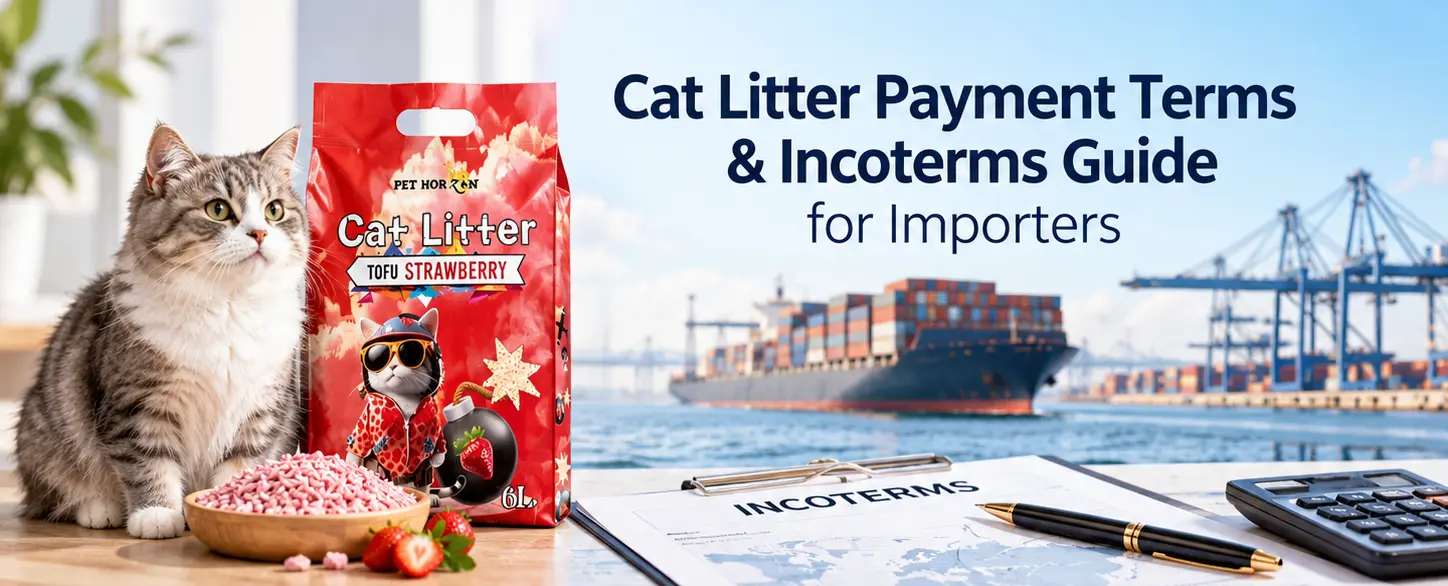
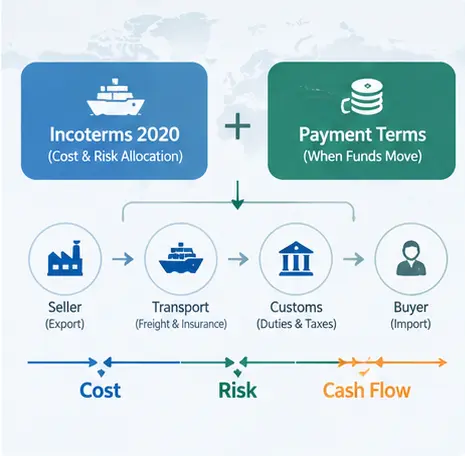
Cat litter payment terms and Incoterms decide who pays for freight, insurance, and import duty, where risk transfers, and when cash leaves the buyer’s account. For importers, distributors, and OEM buyers ordering containers of cat litter, getting these contract clauses right prevents surprise costs and protects cash flow on the first and every repeat order. This guide explains the Incoterms 2020 rules most used in cat litter trade and the payment structures that pair with them.
Quick Answer: Cat litter import contracts should define both Incoterms 2020 and payment terms. Incoterms allocate specific delivery obligations, transport costs, customs responsibilities, and risk of loss between the seller and buyer. For example, under FOB and CIF, risk generally transfers when the goods are loaded on board the vessel at the port of shipment, although the seller pays for freight and minimum insurance under CIF. Payment terms, such as a 30% T/T deposit with the balance due against agreed shipping documents, determine when funds are transferred. Compare quotations on the same delivery basis and confirm the named port or destination, inspection requirements, and payment milestones before placing an order.
Incoterms 2020: The Cost and Risk Map
Incoterms are standardized trade terms published by the International Chamber of Commerce; the current edition is Incoterms 2020. They do not cover payment or title, only the division of transportation cost and risk between seller and buyer. Always state the year (Incoterms 2020) because definitions change between editions.
| Incoterm | Main Carriage and Delivery Cost Allocation | Insurance obligation | Import clearance and duties | Risk transfer |
|---|---|---|---|---|
| EXW (Ex Works) | Buyer arranges collection and transport | Neither party is required to insure under the rule | Buyer | When goods are placed at the buyer’s disposal at the named place, not loaded |
| FOB (Free on Board) | Seller pays costs to load goods on board; buyer arranges main carriage | Neither party is required to insure under the rule | Buyer | When goods are on board the vessel at the port of shipment |
| CIF (Cost, Insurance and Freight) | Seller pays carriage to the named destination port | Seller must procure the minimum cover required by the rule, subject to the contract | Buyer | When goods are on board the vessel at the port of shipment |
| DAP (Delivered at Place) | Seller arranges transport to the named destination | Neither party is required to insure under the rule | Buyer | At the named destination, with goods placed at the buyer’s disposal on the arriving means of transport, ready for unloading |
| DDP (Delivered Duty Paid) | Seller arranges transport to the named destination | Neither party is required to insure under the rule | Seller, including import clearance and applicable duties and taxes | At the named destination, with goods placed at the buyer’s disposal on the arriving means of transport, ready for unloading |
State the precise named place or port and “Incoterms® 2020” in the contract. These rules allocate specified obligations and risk; they do not determine payment timing or transfer of ownership. FOB and CIF are intended for sea and inland waterway transport. For containerized cargo handed to a carrier before vessel loading, FCA may be more appropriate than FOB. Confirm that the chosen term matches the actual transport arrangement.
FOB, CIF, and DDP in Cat Litter Trade
FOB, CIF, and DDP differ in how they allocate transport costs, customs responsibilities, and delivery risks. Under FOB, the seller delivers the goods on board the vessel at the named port of shipment, while the buyer arranges the main carriage and handles import clearance. Under CIF, the seller pays for carriage and minimum insurance to the named destination port, but risk transfers to the buyer when the goods are loaded on board at origin. DDP places more responsibility on the seller, including import clearance and applicable duties and taxes, but the seller must be able to meet the destination country’s import requirements. For containerized cat litter, consider FCA when the seller hands the goods to a carrier before vessel loading. Compare the full delivery scope, insurance coverage, customs arrangements, and destination charges rather than choosing solely by the quoted price.
Why the Incoterm Changes Your Real Cost
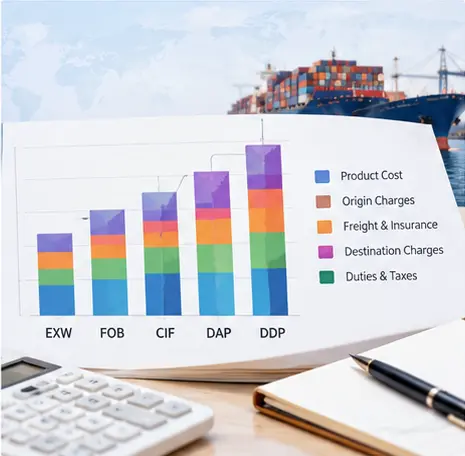
The same ex-factory price produces very different landed costs under different Incoterms. Under EXW the buyer arranges everything from the factory door; under CIF the seller prepays freight and insurance, which is baked into the quote. Comparing two quotes without noting the Incoterm is like comparing prices that include different scopes. For a product as heavy as cat litter, freight is a large share of landed cost, so the Incoterm decision is a pricing decision, not a formality. See the bulk cat litter guide for how weight and volume limits interact with freight terms.
How to Compare Cat Litter Supplier Quotes
Before choosing a supplier, compare quotations using the same delivery scope and payment assumptions. For each quote, record the following elements so the comparison is like-for-like.
- Product cost: Unit price, packaging specification, order quantity, and total goods value.
- Origin charges: Inland transport, export clearance, loading, and other charges assigned to the seller or buyer under the agreed term.
- International freight and insurance: Actual freight basis, insurance coverage, and who pays each cost.
- Destination charges: Port handling, customs clearance, import duties and taxes, inland delivery, and unloading where applicable.
- Payment and inspection: Deposit percentage, balance-payment trigger, inspection requirements, and document deadlines.
For example, an FOB quote and a CIF quote should not be compared by unit price alone. Add the buyer’s freight and insurance costs to the FOB quote, then compare the resulting cost scope with the CIF quote. Use the same destination, shipment quantity, and cost assumptions wherever possible. Keep import duties, taxes, and destination charges separate when they are not included in the quoted price.
Common Cat Litter Payment Terms
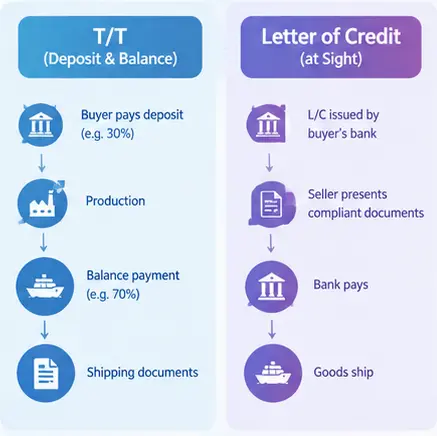
Cat litter import transactions commonly use T/T (telegraphic transfer) with a deposit and a balance payment, although the exact split and payment trigger vary by supplier, order size, and trading history. A letter of credit at sight may be suitable for transactions where the parties need a documentary payment mechanism. Established trading relationships may also use open-account or deferred-payment arrangements, subject to credit approval and negotiated terms. Buyers should evaluate each option against supplier reliability, transaction risk, bank charges, and working-capital requirements.
T/T Deposit and Balance: Cash-Flow Logic
A 30/70 T/T arrangement is one possible payment structure: the buyer pays a 30% deposit to start production and the remaining 70% at an agreed milestone, such as after a satisfactory pre-shipment inspection and before shipment, or against specified shipping documents. The exact split and payment trigger depend on the parties’ negotiating position, order size, and trading history. Buyers should define inspection scope, acceptance criteria, document requirements, and the procedure for resolving discrepancies before paying the balance. A copy of the bill of lading is not, by itself, proof that the goods meet the agreed specifications, and paying before shipment can leave the buyer with limited leverage if a dispute arises.
Letters of Credit for First Orders
A letter of credit (L/C) at sight can provide a structured payment mechanism for a first order, provided the credit is issued by an acceptable bank and its terms are workable for both parties. The issuing bank examines the documents presented under the credit and pays when the presentation complies with its requirements; it does not normally inspect the cat litter itself or guarantee that the physical goods match the contract. Buyers should agree on realistic document requirements, including the commercial invoice, packing list, transport document, certificate of origin if required, and any specifically agreed inspection certificate. The credit should also clearly state the presentation deadline and applicable rules. Although an L/C can reduce certain payment risks, it introduces bank charges and the risk of discrepancies in the documents.
Negotiating Terms With a Cat Litter Supplier
Negotiate the Incoterm and payment schedule together, and specify the exact named port or destination in the contract. For FOB, confirm the port of shipment, cargo handover arrangements, and which party pays origin charges. For CIF, clarify the destination port, insurance coverage, and which destination-side charges remain payable by the buyer. For DDP, confirm the named delivery address, unloading arrangements, import-clearance responsibilities, applicable duties and taxes, and whether the seller can legally complete the required import procedures. Agree on the product specification, inspection procedure, document list, and balance-payment trigger in the proforma invoice or sales contract. Freight economics can also differ between lighter pine cat litter and denser bentonite cat litter, so compare total delivered cost for the actual product and shipment configuration. For a related product view, see our pine cat litter range when discussing shipping and packaging options with a supplier.
Red Flags in Payment and Trade Terms
- Demand for full payment up front on a first order with no inspection lever
- Refusal to state the Incoterm year or to put terms in writing
- A DDP quote far below market that hides unknown duty or compliance risk
- Vague documents that would not satisfy a letter of credit
- Pressure to skip pre-shipment verification to “save time”
Aligning Terms With Production and Shipping Time
Payment milestones should track production reality. Confirm the supplier’s lead time, build the deposit and balance around it, and leave room for ocean transit and customs clearance. The cat litter production and shipping time reference helps you schedule the balance payment and container booking so cash and goods move in step rather than leaving you paying before the goods are truly ready.
Conclusion
Cat litter payment terms and Incoterms are the contract layers that determine your real cost, your risk, and your cash flow on every container. Choose an Incoterm that matches your logistics capability, normalize quotes to the same term before comparing, and pair the Incoterm with a payment structure you can fund and verify. Put both in writing alongside the specification, use inspection before the balance, and your first and repeat orders stay predictable instead of surprising.
Frequently Asked Questions
Incoterms 2020 define who pays freight, insurance, and duty and where risk transfers; payment terms define when money moves (for example T/T deposit and balance, or a letter of credit). They are separate layers of the same contract.
FOB is common because the buyer controls freight and can use a trusted forwarder, while CIF or DDP shift more logistics to the seller at a higher price. The best term depends on your logistics capability and whether you want to manage freight directly.
Under FOB Incoterms® 2020, the seller delivers the goods on board the vessel nominated by the buyer at the named port of shipment. The seller handles export clearance, while the buyer arranges the main carriage, any desired insurance, and import clearance and duties. Risk transfers when the goods are on board the vessel. FOB is intended for sea and inland waterway transport; FCA may be more suitable when containerized goods are handed to a carrier before vessel loading.
A common structure is T/T with about 30 percent deposit to start production and 70 percent against a bill of lading copy or before shipment. Letters of credit at sight are used for first orders where trust is not yet established.
A letter of credit at sight can reduce certain payment risks on a first order because the issuing bank examines the documents presented under the credit before payment. However, it does not guarantee the physical quality or conformity of the goods, and discrepancies in the documents may delay or prevent payment. Letters of credit also involve bank charges and administrative requirements. T/T is generally simpler, but buyers should agree on clear specifications, inspection procedures, and payment milestones before transferring funds.
Because freight is a large share of cat litter landed cost, the Incoterm decides who prepays it and whether duty is included. Two quotes at the same unit price can have very different total costs under different terms.
Paying 100% upfront is not automatically proof of fraud, but it can expose a first-time buyer to greater financial risk because most or all funds are transferred before the goods are shipped. Before accepting this arrangement, assess the supplier’s track record, verify company and banking details independently, agree on clear specifications and delivery obligations, and consider an inspection or a suitable documentary payment mechanism. A deposit with a clearly defined balance-payment milestone may provide a better balance between cash flow and risk, depending on the supplier and transaction.
Payment milestones should follow the supplier’s lead time: deposit to start production, balance around completion and pre-shipment inspection, then container booking and transit. Aligning them keeps cash and goods moving in step.